


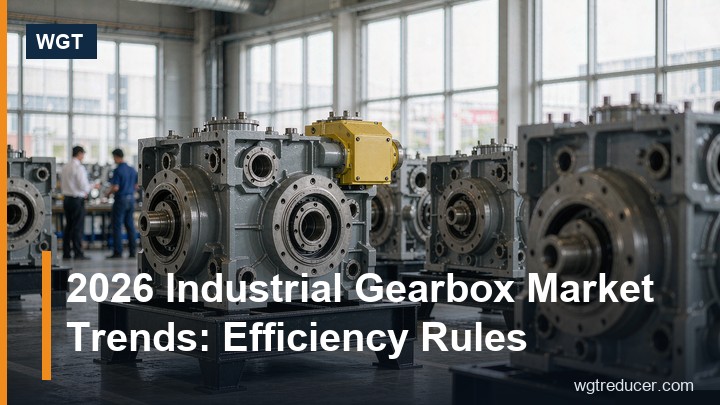
2026 Industrial Gearbox Market Trends: Efficiency Rules
The defining pressure on the industrial gearbox market in 2026 is not a new gear geometry - it is the motor attached to it. Efficiency regulation has moved from IE3 to IE4 minimums in major markets, IE5 motor platforms are commercially available, and buyers increasingly evaluate the industrial gearbox and the motor as one efficiency system rather than as two separate purchases. For plants buying gear drives in 2026, this changes what to specify, what documentation to demand, and which replacement decisions pay back fastest.
This article reviews the market shift from the buyer's side: what the efficiency classes actually are, how the rules reshape gearbox selection, what IE5 matching means in practice, and where prices and lead times stand. No forecasts pulled from thin air - just the engineering and procurement realities visible on the shop floor.
What Changed in the Industrial Gearbox Market Since 2023
Three developments have reshaped the market in the space of about three years.
First, minimum efficiency regulation stepped up. In the European Union, Regulation (EU) 2019/1781 set IE3 as the baseline for motors from 0.75 to 1,000 kW from July 2021, and raised the floor to IE4 for the 0.75 to 200 kW band (two-, four- and six-pole) from July 2023. Similar ratchets operate in other major markets. The practical consequence: a plant replacing a motor or a gear motor today often cannot simply re-buy what it had, because the old motor efficiency class may no longer be legal to place on the market.
Second, IE5 arrived commercially. Defined for converter-fed motors under IEC TS 60034-30-2, the IE5 "ultra-premium" class sets loss limits roughly 20% below IE4. Permanent-magnet and synchronous reluctance technologies make these levels reachable, and 2024-2025 brought steady price erosion as volumes grew.
Third, the gearbox side is being pulled along. When the motor wastes less energy, every remaining loss in the drive train matters more as a percentage - and the gearbox is the next largest consumer after the motor itself. Buyers now ask gearbox suppliers for efficiency figures per ratio, not just torque tables.
The Efficiency Ladder: IE1 to IE5
The International Electrotechnical Commission defines the classes; the table below summarises what each step means in practice for a buyer of gear drives.
| Class | Nickname | Defined for | Typical role in 2026 |
|---|---|---|---|
| IE1 | Standard | Line-start motors | Legacy stock only; below legal minimum in most export markets |
| IE2 | High | Line-start motors | Minimum for some special variants (e.g. Ex eb) and older markets |
| IE3 | Premium | Line-start motors | Baseline legal minimum for 0.75–1,000 kW in the EU since mid-2021 |
| IE4 | Super-premium | Line-start and converter-fed | Legal minimum for 0.75–200 kW in the EU since mid-2023; spreading elsewhere |
| IE5 | Ultra-premium | Converter-fed motors | Commercially available; roughly 20% lower losses than IE4 |
Two notes on reading this table. The classes apply to motors, not gearboxes - but gear motors are ordered as assemblies in most replacement projects, so the class travels with the order. And the step sizes shrink as the class rises: going from IE3 to IE4 saves a few percent of input power, while the same step from IE4 to IE5 saves less in absolute terms yet still compounds over 6,000 running hours a year.
Why Motor Efficiency Rules Reshape Gearbox Selection
When the legal floor was IE2, a gearbox buyer could afford to be careless about the mechanical stages: the motor's losses dwarfed everything else. With an IE4 or IE5 motor in front, the arithmetic changes. Consider a conveyor drive running continuously:
- A worm stage behind an IE5 motor can erase much of the motor's improvement, because worm meshing at high ratios loses 20–40% of the transmitted power to sliding friction.
- An all-helical train holds 94–96% efficiency per the gear stages, so the motor's gains reach the driven shaft almost intact.
- Over a year of 24-hour duty, the difference between a 90%-efficient drive train and a 96%-efficient one on a 15 kW axis is on the order of several megawatt-hours - real money, every year, for the life of the machine.
This is why the market is shifting measurably toward helical-based architectures: inline and parallel-shaft units for coaxial duties, helical-bevel for right-angle duties, and helical-worm reserved for applications that genuinely need very high ratios, self-braking tendencies or the lowest first cost. The selection logic is the same one our inline vs right-angle comparison sets out - only the economics now push harder in the same direction.
IE5 Motor and Gearbox Matching in Practice
Pairing an IE5 motor with an industrial gearbox is mostly straightforward, but three interface points deserve attention.
Flange and shaft dimensions. IE5 platforms often come from newer motor series whose frame dimensions still follow IEC standards, but weights and rotor inertias can differ from the IE3 units they replace. Check the gearbox input flange rating and the overhung load limits, particularly on smaller frames.
Converter compatibility. Most IE5 machines are designed for inverter supply. If the gearbox sits behind a variable-speed drive, confirm that the lubrication suits the operating speed range: splash-lubricated housings have a minimum speed below which the oil distribution degrades, and high-speed operation may need a synthetic grade or cooling.
Starting torque and duty. Efficient motor technologies can change the torque-speed curve a gearbox sees at start-up. A drive sized years ago around a DOL induction motor's characteristics deserves a re-check of the service factor when the motor technology changes - the gearbox rarely cares, but the margin calculation does.
For greenfield selections, the cleanest route is to size the driven machine first and let the gearbox and motor follow from the duty point. The online selection system steps through speed, torque and service factor, and returns candidate frames that pair naturally with standard IEC motors - including the higher-efficiency classes.
Prices, Lead Times and Sourcing in 2026
Gearbox prices in 2026 reflect three cost lines. Steel and cast-iron input costs have eased from their peaks but remain above the levels of the early 2020s. Energy costs feed directly into heat treatment - carburising and hardening are energy-intensive processes, so gear manufacturing cost tracks industrial electricity prices with a lag. And motor-electronics content (inverters, magnets) keeps the overall drive-train price sensitive to semiconductor and rare-earth supply conditions.
Lead times have normalised for standard frames: foot- and flange-mounted helical units in common sizes are typically quoted in weeks rather than quarters. The pinch points remain at the extremes - very large industrial frames with special mountings, and highly configured gear motors with options such as backstops, forced lubrication or ATEX variants. Buyers who survived the 2021-2022 shortages have largely kept the habits that got them through: framework agreements with reserved capacity, and spare internals held against critical drives.
On sourcing, diversification continues. European and North American buyers qualified second sources during the shortage years and have kept them. Chinese manufacturers with dimension-compatible ranges - replacements for the mainstream European series - have consolidated their position, because a frame-for-frame swap avoids the redesign cost that would otherwise offset any price advantage. Our own M-series industrial gear units exist precisely for this role on the heavy industrial side.
Digitalisation: Sensors and Predictive Maintenance
The other quiet trend in the gearbox market is instrumentation. Temperature, vibration and oil-condition sensors are increasingly fitted at the factory or retrofitted in the field, and gear drives join plant-wide condition-monitoring networks. The payoff is straightforward for continuously running assets: a bearing or gear-tooth defect announces itself weeks in advance through vibration signatures, turning an unplanned stop into a planned swap.
For buyers, the practical questions in 2026 are modest ones: does the gearbox offer space or mounting provisions for accelerometers at the bearing positions; is the breather plumbable to a remote oil line; can the oil plug take a temperature probe. None of these add meaningful cost at the order stage, and all of them make later instrumentation trivial.
What Buyers Should Do Differently in 2026
Five habits separate the plants that capture the efficiency gains from those that only pay for them:
- Specify the drive train, not the gearbox. Quote the motor class and the gearbox together; a headline IE5 motor behind an inefficient worm stage is a marketing outcome, not an engineering one.
- Ask for stage efficiencies per ratio. Serious manufacturers publish or can derive the efficiency at your actual operating ratio, not just a best-case catalogue figure.
- Re-check service factors when motor technology changes. An IE5 replacement for an IE3 unit deserves a fresh margin calculation, especially on shock-loaded duties.
- Hold framework capacity for critical frames. The shortage-era lesson remains valid: reserved production slots cost nothing to arrange and everything to lack.
- Instrument the big axes while the machine is open. A sensor fitted during a planned replacement costs a fraction of one fitted during an emergency.
Frequently Asked Questions
Does the IE5 efficiency class apply to gearboxes?
No. The IE classes defined in IEC 60034-30-1 and IEC TS 60034-30-2 apply to electric motors. Gearbox efficiency is a separate matter - it depends on the gear technology, the ratio and the operating point. When you buy a gear motor as an assembly, the motor class and the gear stages both contribute to the efficiency you actually get at the output shaft.
Is an IE5 motor compatible with my existing gearbox?
Usually yes. IE5 motor platforms follow standard IEC frame dimensions for flange and shaft interfaces, so they mount on the same input flanges as the motors they replace. Verify the flange size, the shaft diameter and the motor mass against the gearbox input rating, and re-check the service factor if the new motor's starting characteristics differ.
How much energy does upgrading from IE3 to IE4 actually save?
For a continuously running motor, the step from IE3 to IE4 typically saves a few percent of input power - the exact figure depends on frame size and pole count, and shrinks for small frames. The saving compounds over running hours, which is why the regulation targets the 0.75–200 kW band where duty hours are high. For intermittent duties the payback stretches, and the upgrade case rests on compliance rather than energy alone.
Will efficiency rules force me to replace working gearboxes?
No. The regulations govern motors placed on the market, not gearboxes in service. Your installed base can keep running. The rules bite at the moment of replacement: when a motor fails or a machine is modernised, the new motor - and any new gear motor assembly - must meet the current class. That is why replacement projects, not retrofits, are where the efficiency rules change gearbox buying decisions.
Getting the Selection Right
The efficiency ratchet will keep tightening, and the gearbox will keep growing in relative importance inside the drive-train efficiency budget. If you are reviewing a drive train in 2026 - whether a single replacement or a plant-wide programme - send the duty point through the selection system or ask for a frame-by-frame review, and the gearbox side of the efficiency equation will be quantified in writing before you commit.
