


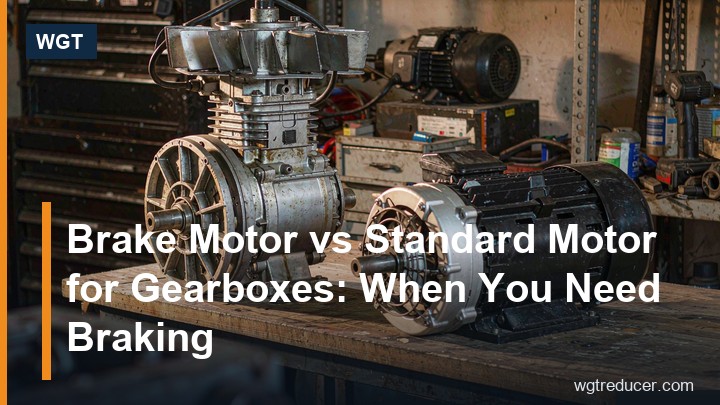
Brake Motor vs Standard Motor for Gearboxes: When You Need Braking
Most motors driving gearboxes are asked to do exactly one thing: turn. A brake motor is asked to turn and then to stop holding something that would rather keep moving. That second job changes the motor's construction, the control scheme around it, and - less obviously - the way the gearbox behind it should be selected. Choosing between a standard motor and a brake motor is therefore not a motor-department decision that the gearbox inherits; it is a drive-line decision that starts from the load's behaviour when the power stops.
This guide sets out what a brake motor adds, which duties genuinely need it, where the brake is best placed in the line, and how the braking duty feeds back into gearbox sizing and service factor.
What a Brake Motor Actually Adds
A brake motor is a standard induction motor with a spring-applied, power-released disc brake mounted on its non-drive end. With the coil energised, the magnet pulls the armature plate against the springs and the motor turns freely. Cut the power and the springs clamp the disc within fractions of a second, holding the shaft stationary without any external command. The brake is fail-safe by construction: it needs electricity to release, so every possible failure - a tripped contactor, a broken supply, a stopped control circuit - leaves the load held.
Three practical characteristics follow from that construction. The holding torque is fixed by the spring stack, usually between one and a half and three times the motor's rated torque depending on the duty. The brake is a wear item, with a friction lining and an air gap that both change over the machine's life. And every stop at speed puts a defined amount of energy into that lining, which is why braking frequency, not just braking torque, shapes the maintenance schedule.
A standard motor has none of this: no holding device, no lining, no air gap, nothing to adjust. It is cheaper, simpler and entirely correct for every duty where the machine stops safely under friction or gravity holds nothing - and quietly inadequate for every duty where it does not.
Brake Motor vs Standard Motor at a Glance
| Aspect | Standard motor | Brake motor |
|---|---|---|
| Holding the load at rest | Nothing holds it; the load is stopped by friction in the machine or rolls free | Spring-applied brake holds automatically on any power loss |
| Stopping behaviour | Coasts down under load friction | Controlled stop; brake engages as the supply drops |
| Cost and complexity | Lowest | Motor plus brake, rectifier and one more contactor |
| Maintenance | Motor only | Motor plus lining wear and air-gap checks |
| Right for | Horizontal conveyors, mixers, fans, machines with their own holding devices | Inclines, hoists, elevators, machine tools needing a defined stop |
| Wrong for | Any duty where a powered stop or held load matters | Continuous high-inertia coasting where brake drag would matter |
The table's last row is easy to miss and worth stating: a brake motor is the wrong answer on duties where the machine must coast - a flywheel press between strokes, for instance - because the default state of the brake is holding, and the coast the process expects would fight the component designed to prevent it.
Duties That Demand Braking
The clearest cases are duties where gravity has a vote. An inclined conveyor with material on it will run backwards the moment power disappears unless something holds it. A bucket elevator is a column of hung buckets and product; power off, the leg wants to reverse and reverse hard. A hoist or crane lift holds its load purely by the drive unless a brake intervenes. In all of these, a standard motor is not a value choice - it is a missing component.
The less obvious cases are duties where a defined stop matters more than holding. Machine tools and packaging lines stop in position so the next cycle starts from a known point. Process lines stop quickly to limit the material wasted between command and standstill. None of these holds a dangerous load, but both need the machine to stop when told rather than when friction decides, and a brake motor is the standard way to buy that behaviour.
Then there is the safety case. Where a rolling or falling load could injure someone - a lowered boom, a raised platform, a loaded incline above a walkway - the brake is not an efficiency feature; it is the difference between a power failure and an incident. Standards for lifting appliances are explicit that the holding function must not depend on the continued presence of power, which is precisely the fail-safe behaviour a spring-applied brake provides.
Where the Brake Should Sit in the Drive Line
Placing the brake is a real engineering choice, and the options differ more than most buyers expect.
A brake on the motor's non-drive end acts through the gearbox: it holds the input shaft, and through the gears it holds the output. That is the standard brake-motor arrangement and it works well, but the holding torque is multiplied or divided by the ratio. On a high-ratio unit the load side holds easily with a modest motor-end brake; on a low-ratio unit the brake must be large enough that the load's back-driven torque cannot overpower it. The gearbox's gears also see the full holding torque on every stop, which is one more reason the duty belongs in the gearbox enquiry.
A disc on the output-side coupling with a caliper acts at machine speed, directly on the slow shaft. The holding torque needed is at its smallest there, and the brake's action bypasses the gear teeth entirely. The cost is a coupling line long enough to carry the disc and the guard that goes with it - which is why shaft-mounted and torque-arm frames with a coupled output have become a natural home for this arrangement. A frame whose output end is designed to host a brake disc lets the plant put the brake where it works best instead of where the motor happens to be.
A backstop - a device that permits rotation one way and locks the other - is a different component doing a different job. It holds against reverse rotation automatically and needs no control circuit, but it does not stop the machine faster than its natural coast and it does nothing to position a machine. Many inclines carry both: a backstop to hold against rollback, a brake to stop and to satisfy the stopping-time requirement.
Starting, Stopping and Thermal Reality
Brake sizing lives or dies on cycles, and so does the lining. A brake that stops a loaded conveyor twice an hour lives an easy life. The same brake on a packaging machine stopping two hundred times an hour is a thermal and wear machine in its own right, and its energy per stop - the inertia it must absorb at the stopping speed - matters more than its holding torque. Manufacturers publish permissible energy and cycles per hour for exactly this reason.
Two design details earn their keep on high-cycle duties. A DC brake with controlled current lets the plant tune the stop: full braking torque for a firm stop, softened current for a gentler one. A manual release lever lets maintenance turn the machine by hand without fighting the spring load - and it belongs on the specification, because discovering its absence during the first belt change is a poor way to learn about it.
The thermal consequence reaches further than the brake. Every stop is a start again, and frequent starts are harder duty for the motor, the gearbox's input side and the coupling than continuous running at the same power. Duty cycle, not nameplate kilowatts, is what the whole drive train should be sized on.
What Braking Does to Gearbox Selection
A braking duty changes the gearbox conversation in three ways. First, the service factor should reflect the duty's true shape: frequent stops under load, reverse-torque events if rollback is possible, and the shock of restarts against a machine that has settled. A gearbox chosen on running power alone will run, but its bearings and teeth see the braking and restarting events that the nameplate never mentions.
Second, the holding path should be stated. If the brake acts at the motor end, the gears carry the holding torque on every stop, and the enquiry should say so. If a disc rides the output coupling, the gears are spared and the coupling train carries a passenger that needs balance, guarding and service access. Neither is wrong; both belong in the order.
Third, the accessories have mass and sometimes mechanisms - a disc, a backstop, a limiter - and the frame at the centre of the band is usually where they accumulate. When a plant specifies a coupled-output frame with the brake on the disc rather than the motor, the gearbox enquiry becomes simpler to write and the brake becomes easier to reach for the rest of the machine's life.
Checking the Selection Before You Order
The arithmetic a buyer needs is short. Motor speed over the required output speed gives the ratio. Running torque comes from the power and output speed; service factor comes from the duty class, and a braking or frequently stopping duty belongs one class higher than its calm appearance suggests. Holding torque, where the load must hang, is checked against the back-driven torque of the inclined load with a margin of at least one and a half - and the stopping time on hoists and public-facing machinery is a requirement, not a preference.
Our engineers run this check against the actual duty before quoting, and the online selector gives a first-pass frame and ratio in a few minutes: gearbox selection system. Bring the duty cycle and the incline, not just the kilowatts - the brake decision falls out of those two facts.
For a worked example of a frame specified around exactly this logic - a coupled output hosting the brake disc, with the service factor argued from the duty's peaks - see the MC2PLST03 torque arm gearbox, which carries accessory-laden duties of precisely this kind.
Frequently Asked Questions
Can a brake be added to an existing standard motor?
Often, yes. Add-on brakes mount on a standard motor's non-drive end where a flange and shaft end are available, and many manufacturers offer kits for common frame sizes. The checks that decide are mechanical fit, the motor's bearing arrangement at the fan end, and whether the control circuit can spare a contactor. On some sealed or specially cooled motors it is impractical, and a brake-motor unit ordered complete is the cleaner answer.
Does the brake hold the full load on an inclined conveyor?
It must, with margin. The brake's holding torque is checked against the torque the inclined load back-drives through the line, with a safety margin commonly of fifty per cent or more, and standards for some applications set their own figures. Where the brake acts on the motor side of a high-ratio gearbox, the ratio helps the holding; where it acts on a low-ratio line or the machine is a hoist, the calculation decides, and it should be written down rather than assumed.
How often does a brake need attention?
Lining wear and air gap set the interval, and both scale with braking energy per hour - cycles times speed times inertia - not with calendar time. A lightly cycled brake can go a year between inspections; a high-cycle machine needs a look every few months. Most industrial brakes mark a wear limit on the lining or an air-gap indicator, so the check is a two-minute visual task that belongs on the shift routine rather than in a breakdown call.
Is a backstop better than a brake for a conveyor that runs back?
They solve different problems. A backstop holds against reverse rotation automatically and never needs a control signal, which makes it ideal for rollback protection on inclines. A brake stops the machine in a defined time and holds it, but adds a control action and a wear item. On most inclined conveyors a backstop handles rollback and a brake handles the stopping requirement - many plants carry both, and the choice is not either-or.
Does frequent braking change the gearbox choice?
It changes the service factor conversation, and it should. Frequent stop-start duty loads the gear teeth and bearings with events that continuous running never produces, so the frame is selected against the duty cycle rather than the running power. Where the brake holds through the gears, the gears also see the holding torque on every stop, which is one more reason to state the braking arrangement in the enquiry instead of letting the gearbox inherit it as a surprise.
