


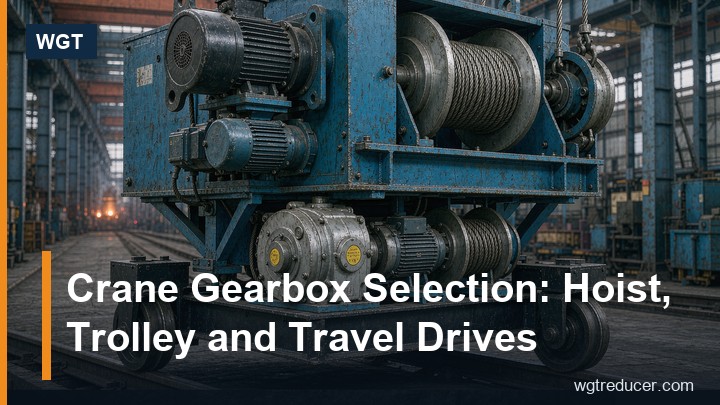
Crane Gearbox Selection: Hoist, Trolley and Travel Drives
The short answer first: a gear reducer for crane duty is selected less by its torque table than by its duty class, its shock behaviour and its braking arrangement. Hoist, trolley and travel drives see the same crane, but they live on completely different duty profiles - and the mistakes that shorten gearbox life in cranes almost always trace back to sizing all three the same way.
This page separates the three drives, explains how crane duty classes translate into service factors, and gives a practical checklist for a crane enquiry so the reply you get back is a drive you can hold the factory to.
What a Crane Asks of Its Drives
A crane is a repeating machine: pick, swing, travel, set down, return - thousands of times a year. Each cycle loads the drives differently. The hoist drive holds the load against gravity, the trolley drive moves the load along the bridge, and the travel drives move the whole crane down the runway. The torque ratings differ, but the deeper difference is the load pattern: the hoist sees gravity in one direction every cycle, the travel drives see starts and stops with the whole bridge mass, and the trolley sees both with an off-centre load.
Crane classifications exist to capture that repetition. The widely used FEM and ISO duty classes - from light handling cranes up to M8-class steel-mill and container duty - describe how often the crane runs near full load and how many cycles it makes in its life. The class matters because a crane gearbox that is perfect at rated torque can still wear out early if it was chosen for a lighter class than the plant actually runs.
Hoist Drives: Duty Class and Braking
The hoist drive is the safety-critical one, and it is specified with two questions in front of everything else. The first is the duty class, which for a workshop crane might sit in the middle bands and for a steel-mill ladle crane sits at the top of the scale. The second is braking: on most hoists the brake sits at the motor, which means the gearbox sits between the brake and the load, and every stop passes shock torque backwards through the train.
That arrangement shapes the specification. A hoist drive needs margin above the static rope torque, gears rated for the braking shock and not just the motoring case, and a housing and shaft arrangement that tolerates the load holding still - because holding a suspended load is not the same as resting. Where the hoist works in classes at the top of the scale, the gearbox family is chosen from heavy-duty industrial ranges with generous service factors; a typical example of the hardware class is a heavy-duty parallel-shaft industrial gearbox of the kind used on continuous process and lifting machinery.
Trolley and Travel Drives: Cycle Duty and Skew
Travel and trolley drives look easier and often are not. They start and stop a large moving mass many times an hour, every hour, and each start loads the gearing through the wheel-rail interface - including the surprises that interface adds: wheel slip, rail joints, and the skew forces that appear when one end of the crane is slightly ahead of the other, as every real crane sometimes is.
Three consequences follow. First, starts per hour belong in the enquiry as prominently as torque, because frequent starts raise the effective duty class even at modest loads. Second, travel drives are usually paired with the wheel through a coupling or a gear rim, and the torque share between the two ends of a double-drive travel motion is never exactly even - the specification should assume it and the hardware should tolerate it. Third, skewing is a mechanical fact, not a defect; a travel drive that was sized with no allowance for it will express the omission as early wear on gear teeth and couplings.
Duty Classes and Service Factors
The translation from crane class to gearbox service factor is where quotations differ most between suppliers. The table below shows the practical shape of that translation - the exact numbers belong to each gearbox maker's catalogue, but the proportions hold across the trade.
| Crane duty | Typical work | Gearbox service factor tendency |
|---|---|---|
| Light handling | Maintenance shops, rare lifts, short travel | Lowest band; standard industrial gearing suffices |
| Medium duty | Machine shops, warehouses, several lifts per hour | Middle band; frequent starts raise the effective class |
| Heavy duty | Steel mills, ladle and charging cranes, container cranes | Top band; shock and duty cycle dominate the selection |
| Continuous process cranes | Straddle carriers, high-cycle transfer | Specified by hours and cycles as much as by torque |
Two habits keep this table honest in a quotation. One: state the class from the crane's actual duty, measured over a normal week, not from what the crane was sold as. Two: let the service factor absorb the starts - a gear reducer for crane work that is correct at steady torque but marginal on starts will age on the tooth flanks long before its bearings do.
Sizing a Hoist Drive: The Worked Numbers
Hoist sizing reduces to three numbers and one habit. The three numbers: rope tension times drum radius gives the static torque; drum speed gives the required output speed; motor speed over output speed gives the ratio. The habit is checking the braking case - the shock torque the gearbox sees when the brake closes with the load moving - because that case, not the motoring case, decides the gear tooth rating on many cranes.
The same three-step method works for trolley and travel drives, with the load case taken from the wheel-rail side: tractive effort times wheel radius for torque, wheel speed for output speed. The ratio itself is the easy arithmetic; you can cross-check a candidate ratio and service factor for any of the three drives in the online selection system in a few minutes, which is faster than a quotation cycle and far cheaper than a mis-sized drive.
Shock, Vibration and the Crane Structure
Crane gearboxes inherit the structure's behaviour. Bridge deflection bends the travel-drive mounting feet through every cycle; girder vibration passes into trolley housings; a hoist that lands a load hard rings the whole machine. None of this appears on a nameplate, and all of it decides how long the gearing lasts.
The practical defences are simple. Mountings are specified for the real structural movements, not ideal ones. Couplings are chosen to absorb the small misalignments a deflected bridge produces. And the crane's worse habits - landing loads at speed, reversing travel before the stop completes - are declared in the enquiry, because a gearbox specified for a polite crane and hung on a rough one lives a shorter life than either the rating or the warranty suggested.
Environment: Outdoor, Coastal and Foundry Air
Where the crane works decides the second half of the gearbox specification. Outdoor cranes want breathers and seal packages suited to temperature swing and rain; coastal installations add salt to every surface and argue for protective coatings and scheduled seal renewal; foundry and steel-mill air adds abrasive dust and radiant heat, which together push the oil conversation from routine to critical.
The environment package is cheap at order time and expensive after. A filtered or expander breather, seals matched to the chemistry that actually blows past the crane, an oil grade chosen for the measured ambient rather than the catalogue default - each line costs little and each removes a common failure path. Buyers who send the installation environment with the enquiry get these answers built in; the environment, like the duty class, is part of the specification even though it never appears in the model number.
Specification Checklist for a Crane Enquiry
A crane gearbox enquiry is complete when it answers, in one page: the drive in question (hoist, trolley or travel), the duty class from measured duty, torque and speeds for both motoring and braking cases, starts per hour, the crane's structure and mounting arrangement, wheel and coupling details for travel drives, and the environment the unit will actually live in. That is enough for a supplier to return a drive, a ratio, a service factor and an oil and inspection programme - and to be held to all four.
Enquiries that stop at "gearbox for 10-ton crane" get replies priced for the average of all cranes. The checklist takes ten minutes to write and is the difference between a crane gearbox that becomes background noise and one that becomes a shutdown story.
FAQ: Crane Gearbox Selection
What duty class should I use for a workshop crane?
Use the class your measured duty supports - lifts per hour, loads near rating, running hours. Most workshop cranes sit in the middle bands; the mistake to avoid is quoting from the crane's nameplate tonne rating, which says nothing about how hard the crane actually works.
Why does braking matter so much on a hoist drive?
Because the brake usually sits at the motor and the load sits at the other end. Every stop sends shock torque through the gearbox in reverse, and gear teeth rated only for the motoring case see that shock thousands of times. The braking case belongs in the sizing calculation, not in the warranty claim.
Do trolley and travel drives need the same gearbox as the hoist?
Rarely. Their duty is start-stop cycling of large moving masses rather than holding against gravity, so the rating, service factor and mounting details differ. Specifying one gearbox for all three positions is the most common crane gearing mistake.
How do I choose the ratio for a travel drive?
Wheel speed determines it: motor speed divided by the wheel's required rpm gives the ratio, and the wheel torque - tractive effort times wheel radius - sets the frame with its service factor. Allow for skew and uneven torque share between the ends of a double-drive travel motion.
What should I send with the enquiry?
Duty class, both load cases, starts per hour, mounting and coupling details, and the environment. Suppliers turn that into a drive you can hold them to; anything less invites a quotation written for an average crane that does not exist.
If you are specifying a gear reducer for crane duty and want the ratio, frame and service factor checked against your real duty class, send the three numbers - motor speed, output speed, torque - through the online selection system or describe the crane to us directly, and we will confirm the selection in writing before you commit.
