


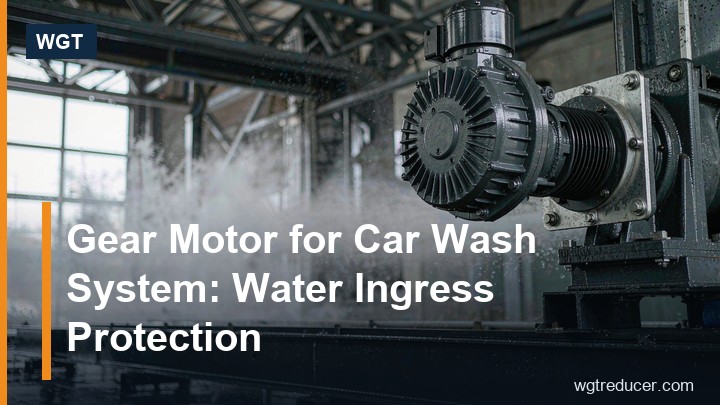
Gear Motor for Car Wash System: Water Ingress Protection
Water, not load, is what ends most car wash drives. The gearmotor on a brush or a gantry is rarely asked for more torque than its nameplate promises, but it is asked to do that work inside a permanent mist of alkaline shampoo, wax and recycled water - and the failure that follows is almost always an ingress failure rather than a mechanical one. Specifying a gear motor for a car wash system therefore starts with the enclosure, the seals and the breather, and only then moves on to kilowatts and ratios.
This article sets out what a wash bay actually does to a drive, how the IP code should be read when the "water" is a hot jet with detergent in it, which drive points need which protection, and the installation details that decide whether the unit lasts three years or fifteen.
What a Car Wash Actually Demands of a Drive
A car wash is not a wet version of a normal machine; it is a chemically aggressive environment with a duty cycle attached. Four factors act on every gearmotor on the site.
The first is water volume and pressure. A tunnel arch delivers hundreds of litres per minute, and the high-pressure pre-wash runs well over a hundred bar. A housing that merely resists rain is penetrated within a season, because pressure finds the weakest seal lip rather than the tightest one.
The second is chemistry. Traffic-film removers and wheel cleaners are often strongly alkaline, some contain acid compounds, and waxes leave a sticky film that traps grit on shaft surfaces. Aluminium housings with a thin paint film are attacked at every scratch, and the corrosion product that follows lifts the paint further.
The third is the duty cycle. Gantry machines reverse many times per vehicle, brush drives start and stop with every car, and a busy site may process forty to eighty vehicles an hour. That is hundreds of starts per shift, each one a thermal event and a moment when a brake must release cleanly and re-apply without drag.
The fourth is temperature cycling. A unit heated by its own losses and then hit by cold rinse water draws a slight vacuum as it cools. Air has to come in from somewhere, and it carries moisture. Protecting a gear motor for car wash system applications is therefore as much about what the case breathes as about the jet outside.
IP Ratings Decoded for Wet Environments
The IP code's second digit is the one that matters here, and the common mistake is to read it as a linear ladder where each step is a modest improvement over the last.
| Rating | Second digit meaning | Where it fits in a wash bay |
|---|---|---|
| IP54 | Splash from any direction | Indoor self-service bay under a roof, drive well away from jets |
| IP55 | Water projected as a jet from any direction, limited volume | Standard wash-bay drives with a guard and a dry mounting position |
| IP65 | Dust tight, plus jets from any direction | Brush rotation and gantry travel - the usual minimum for tunnel equipment |
| IP66 | Powerful jets, higher volume and pressure | Pre-wash arches, high-pressure blower zones, underbody nozzles |
| IP67 | Temporary immersion for a defined time and depth | Wash-bay pits and flood-prone conveyor troughs |
| IP69K | High-pressure, high-temperature close-range washdown | Equipment cleaned with a lance at close range between shifts |
Two practical notes sit behind that table. First, an IP rating describes a new, correctly assembled unit; every cable entry, breather and inspection cover is a separate path into the case, and an IP66 housing fitted with an unsealed gland is an IP44 assembly in practice. Second, the code says nothing about corrosion resistance or about the motor's insulation system - a unit can be perfectly sealed and still fail because its shaft has rusted under a lip seal or its windings have absorbed moisture through a cable.
For most tunnel equipment the working answer is IP65 as a baseline, IP66 on the wetter arches, and IP69K only where someone actually uses a lance on the drive. Buying IP69K for a gantry that never sees direct spray adds cost without adding life; buying IP55 for a brush sitting under an arch shortens life to the first busy winter.
Where Water Gets In
Almost every ingress failure is traceable to one of five places, and knowing them is what turns a specification into a checklist.
The output seal. A single lip seal on a painted shaft keeps splashes out and nothing more. Washdown drives need a double lip arrangement with a dust lip, a finely finished shaft, and - where the drive sits below a brush head - a slinger or labyrinth in front of the seal so the jet loses its energy first.
The breather. A gearbox must breathe as it warms and cools, but the breather is also an open hole. On wet duty it belongs on the dry side of the unit, fitted with a filter and, in humid bays, a desiccant or closed-system compensator. Many failures are breathing failures in disguise: the seal is blamed, the real fault is a breather that ingested water for a year.
Cable entries and terminal boxes. Glands sized for the cable, a terminal box seal renewed whenever it is opened, and a loop of cable below the entry so water runs off rather than in. Cheapest fix on the list, most commonly skipped.
Condensation. A motor that runs hot and cools overnight in a humid bay condenses water inside its own enclosure. Anti-condensation heaters solve it on larger frames; on small drives, drain holes at the lowest point of the endshield and a breather membrane do most of the work.
The mounting position itself. A drive bolted low on a frame in the splash zone will be wetter than the same drive mounted high and behind a guard. Layout is a protection measure, and it costs nothing.
Matching the Gearmotor to Each Drive Point
Wash systems contain four or five distinct drive duties, and each has its own combination of speed, shock and starting frequency. Choosing a gear motor for car wash system equipment is therefore a question of matching protection to exposure before matching power to load. The figures below are conventional ranges for planning, not catalogue ratings - the actual duty point should be confirmed against the machine drawing and the online selection system.
| Drive point | Typical motor power | Output speed | Duty character | Protection priority |
|---|---|---|---|---|
| Brush rotation | 0.75-2.2 kW | 120-200 rpm | Continuous, load varies with vehicle shape | Shaft seal and condensation |
| Gantry travel | 0.37-0.75 kW | 5-10 m/min | Frequent reversing, brake every cycle | Brake and IP65 enclosure |
| Tunnel conveyor | 2.2-5.5 kW | 3-8 m/min chain speed | Continuous with shock at entry | Output shaft strength and IP66 |
| Blower fan | 2.2-7.5 kW | 1,500-3,000 rpm at motor | Continuous, high ambient | Motor cooling and heat |
| Water pump | 1.5-7.5 kW | Direct or single reduction | Continuous, long hours | Motor insulation and glands |
The pattern is worth noting: the two drives that fail most often - brush rotation and gantry travel - are the two smallest. Small gearboxes have small seals, little oil to absorb moisture and little thermal mass to dry themselves out, so a specification that concentrates its protection budget on the big conveyor has the priority backwards.
For brush rotation, a helical-worm gearmotor is the usual choice because it delivers a compact right-angle layout with high ratio in one or two stages - the S67 helical worm gearbox is the kind of mid-size unit that suits a rollover brush head. For lighter self-service equipment, an aluminium-shell worm unit such as the NMRV 130 series worm gear reducer is common, though the aluminium housing makes the paint and seal specification more critical, not less.
Materials and Finishes That Survive Shampoo and Wax
Corrosion control in a wash bay is a system, not a coating. Cast iron with a multi-coat epoxy finish outlasts aluminium where the drive is hit directly; aluminium needs a properly pretreated surface plus a paint system rated for alkaline exposure, and any scratch that reaches bare metal will blister. Touch-up painting belongs in the routine, not the "someday" list.
Shafts should be stainless or hard-chrome plated in the seal zone. A painted shaft under a lip seal is a slow failure: the paint wears through, the steel rusts, the rust grinds the seal lip, and the leak starts exactly where the grit is generated. Stainless fasteners, breathers and nameplate screws cost little at the order and save a great deal at the first seal change, when a rusted cap screw rounds off at the worst possible moment.
Motor Protection, Heaters and Brakes
The motor half of the unit deserves its own specification. Windings should suit the ambient and the humidity, with a tropicalised treatment where the site is hot and wet. A brake motor is standard on gantry travel: spring-applied and electrically released, so it fails safe when power is lost, and sized so the gantry stops within the distance the control system assumes.
Brake maintenance is the forgotten item. A brake that drags adds heat and load to the gearbox all day; a worn one lets the gantry creep. Both look like gearbox faults from outside, which is why the air gap belongs in the monthly check. Where the drive is inverter-fed, confirm the motor is wound for inverter duty - high-frequency leakage currents find their way through bearings and seals, and a shaft-earthing ring is cheap insurance on larger frames.
Installation Details That Decide Service Life
Four habits separate a drive that lasts from one that becomes a quarterly maintenance item. Mount it where the spray does not reach, and where that is impossible build a stainless shield rather than trusting the enclosure. Route cables with a drip loop and point glands downward. Seal the mounting face, because water running along a bedplate will creep into the case through unsealed bolt holes. And leave access - a drive whose oil plug cannot be reached will not have its oil checked, and an unchecked drive in a wet bay is a drive running on emulsified oil.
Maintenance Routine for Wet Environments
The schedule differs from a dry plant in frequency, not in kind. Inspect oil monthly rather than annually, because a milky appearance is the earliest reliable sign of ingress and shows up long before the level moves. Check seals and breathers weekly in the wet season, and put brake air gaps, foundation bolts and guard fixings in the monthly round. Once a year, open the unit far enough to look for glitter in the oil and wear in the seal zone.
One habit pays for the others: keep a sample jar. A spoonful from the bottom of the sump, held against the light, takes a minute and turns a vague suspicion into a documented trend.
Frequently Asked Questions
What IP rating does a car wash gearmotor need?
IP65 is the practical minimum for brush rotation and gantry travel inside a tunnel. Use IP66 on drives beneath pre-wash arches and high-pressure zones, and IP69K only where equipment is cleaned with a close-range lance. The rating is meaningless unless glands, breathers and covers are sealed to the same standard.
Why do car wash gearboxes fail with milky oil?
Milky oil means water has emulsified into the lubricant, which destroys its film strength and starts corrosion on the gears and bearings. The usual causes are a breather that ingests spray on cooldown, a hardened shaft seal, an unsealed cable gland, or heavy condensation inside a motor that cools overnight without a heater.
Can a standard gearmotor be used in a wash bay with a cover?
Sometimes, in a self-service bay where the drive sits well away from jets and the cover sheds water rather than trapping it. A cover that holds spray against the housing makes matters worse. Where the drive is under an arch, specify a sealed unit with a double-lip shaft seal and stainless shaft rather than relying on a shield.
What causes gantry drives to fail early?
Three things, in order: brake drag from an unadjusted air gap, water entering through the terminal box or breather, and frequent reversing on a drive that was specified for one-direction duty. Check the brake setting first when a gantry gearmotor runs hot, and confirm the drive is rated for the starts per hour the machine actually performs.
A gear motor for a car wash system is specified once and then asked to survive a decade of chemistry, jets and starts. Get the enclosure, the seals and the breather right, confirm the duty point through the online selection tool, and the rest of the drive has a chance to wear out slowly instead of failing wet.
