


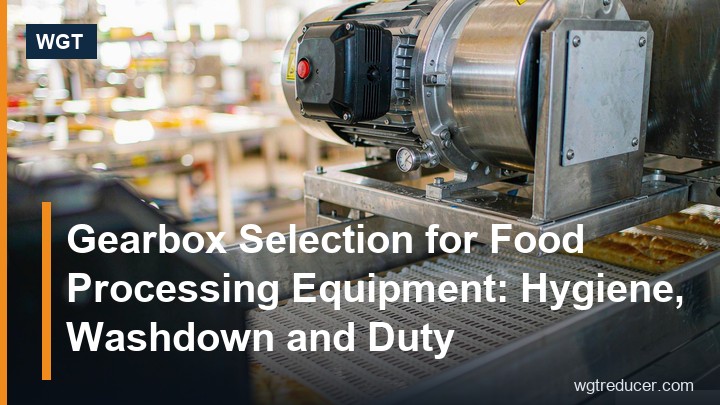
Gearbox Selection for Food Processing Equipment: Hygiene, Washdown and Duty
A gearbox in a food plant does not fail because of torque very often - it fails because of the cleaning regime. Caustic foam, hot water jets, steam, brine and flour dust attack castings, seals and fasteners that would last decades in a dry factory. So selecting a food processing gearbox is a two-track exercise: the mechanical sizing follows the same torque-and-speed method used everywhere else, but the materials, sealing and mounting decisions all start from the hygiene map of the machine. This guide sets out both tracks and the questions that catch most mistakes before the order is placed.
Start From the Hygiene Zone, Not the Torque Table
Most food machinery standards divide the machine into zones: areas that get fully washed down, areas that get wiped or rinsed, and dry areas behind guards. The gearbox belongs to one of those zones, and the zone decides nearly everything about its construction. A drive mounted under a mixing vessel that is hosed down twice a shift lives in a different world from the same gearbox driving a packaging conveyor behind a stainless guard.
Three consequences follow. First, in washdown zones the gearbox surface must tolerate the cleaning chemistry - aluminium housings anodised or coated, cast iron painted with food-grade epoxy, or stainless where the budget allows. Second, every oil seal becomes a product-contact risk if it weeps, so seal material and position matter more than on a general industrial drive. Third, mounting must let cleaning water drain away - a unit bolted into a pocket that holds puddles will corrode from the outside long before the gears wear.
Sizing Is the Usual Engineering, With One Extra Check
The torque calculation is standard:
T (N·m) = 9550 × P (kW) / n (rpm)
Take the absorbed power at the driven shaft, the required output speed, and multiply the working torque by a service factor that reflects starts, stops and shock. Food machinery adds one extra check that general industry does not: frequent washdown thermal cycling. A gearbox that runs hot during production and is then flooded with cold water every few hours sees its seals and breathing cycle stressed far more than a continuously warm drive. Choose a frame with thermal margin, not one that sits at its limit, and the seals last dramatically longer.
For most food machinery the duty lands in the light-to-medium band: agitators, dosing pumps, elevators, dough dividers and packaging lines rarely need the heavy frames that mining or cement demand. That is why compact worm and small helical families dominate this industry.
Matching the Gear Family to the Machine
| Machine type | Typical family | Why it fits |
|---|---|---|
| Mixers, agitators, kettles | Vertical helical (e.g. M3PV hollow shaft) | Shaft hangs from the vessel top, no coupling in the product zone |
| Conveyors, elevators | Inline helical or worm | Simple foot mounting, easy guarding |
| Dosing, small pumps | NMRV worm gear units | Light, compact, aluminium housing tolerates washdown |
| Dough and pastry lines | Helical bevel | High efficiency on continuous duty, quiet |
| Packing table drives | Small worm or RX helical | Low cost per axis, short spans |
The vertical hollow shaft build deserves a special mention for kettles and seed tanks: the agitator shaft passes straight through the gearbox, the drive grips it with a key or shrink disc, and the shaft can be lifted out for cleaning without touching the gear unit. In plants that strip equipment daily for hygiene, that single feature removes the coupling - the joint that most often hides product residue.
Materials and Surfaces That Survive the Chemistry
Cleaning agents in food plants are chosen to strip organic film, which means they are also hard on metal finishes. Practical guidance:
- Aluminium housings with a proper coating resist most caustic foam routines and keep the unit light - the reason the NMRV family is so common on smaller food machines.
- Cast iron painted with food-grade epoxy is the workhorse for larger frames; inspect the paint at bolt edges, where chipping starts.
- Stainless components pay for themselves only in direct splash zones or where the medium is aggressive, such as brine or acidulated products.
- Fasteners matter as much as castings - plated or stainless bolts prevent the rust streaks that auditors notice first.
Avoid surface damage wherever possible: a scratched coating on a washdown gearbox becomes a corrosion site within weeks.
Sealing, Breathing and Oil in Product-Adjacent Duty
The output seal on a food machine drive is close to product, so the failure mode is not just oil loss - it is contamination. Specify seal material against the medium: nitrile handles most detergent environments, but hot caustic or steam zones push toward fluorocarbon grades. The breather should be mounted where jets cannot hit it and where condensate cannot pool; a gearbox that inhales washwater emulsifies its oil quietly and the first symptom is usually a bearing complaint months later.
Oil choice follows the same logic as everywhere else, with one addition: use a grade and fill quantity that makes leaks obvious and keeps the drain accessible, because an oil change on a machine that runs two shifts and gets washed down daily will only happen if it is easy.
Mounting Details That Decide Cleaning Time
Washdown design lives in the details. Units foot-mounted on open frames drain and dry; units tucked into sheet-metal pockets collect product debris. A few habits that shorten cleaning and extend life:
- Stand feet off the surface on washers or pads so water runs under them.
- Route cables and conduits away from the housing so they do not trap foam.
- Keep the nameplate readable - auditors check ratio and oil spec, and a painted-over plate becomes a finding.
- Orient the drain and level plug for access without removing guards.
None of these add cost if they are decided before the machine is built; all of them cost money if they are fixed after the first audit.
Maintenance in a Wet, Short-Window Environment
Food plants rarely grant long maintenance windows, so the maintenance plan must fit short stops. A practical baseline: check oil level and colour monthly, sample oil every six months on critical drives, re-torque mounting bolts after the first washdown season, and photograph the nameplate and seal area at each inspection to build a history. On hollow-shaft vertical units, log end float - a drifting figure points at column alignment rather than the gearbox itself.
When a drive must be swapped, having the dimensional drawing and seal grade on file turns a two-day procurement into a same-week changeover, which in food production is often the difference between a minor event and a lost batch.
Frequently Asked Questions
Can a standard industrial gearbox be used in a food plant?
In dry, guarded zones, yes - the mechanics are identical. In washdown zones, a standard unpainted unit will corrode and weep quickly; specify coated or stainless construction and food-grade-appropriate seals instead.
Why are worm gearboxes so common on food machinery?
They are compact, quiet, tolerant of intermittent duty and available in light aluminium housings at low cost. Their lower efficiency matters little on small machines that run short cycles, though continuous heavy duty favours helical families.
How often should gearbox oil be changed on washdown equipment?
Follow the hours-based schedule in the manual, but inspect monthly: emulsified or milky oil means water ingress and needs immediate attention regardless of hours, because washdown cycling accelerates condensation.
What information should a gearbox enquiry for food machinery include?
The torque and speed, duty cycle, mounting posture, the hygiene zone and cleaning chemistry, ambient and wash temperatures, shaft data, and whether food-grade lubricant is required. A photo of the old nameplate plus a shaft sketch settles most dimensional questions in one exchange.
Getting a Drawing and a Quotation
Send the duty data - absorbed power or torque, output speed, hours per day, mounting posture and the hygiene zone - and the factory returns a dimensioned proposal with housing finish, seal grade and oil spec matched to the cleaning regime. The online selection system lets you shortlist frames by torque and ratio before the enquiry, and a drawing is issued within 24 hours so the machine layout can be frozen without waiting.
