


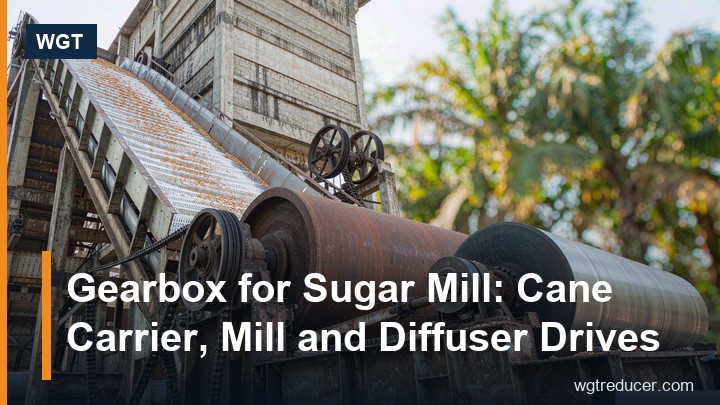
Gearbox for Sugar Mill: Cane Carrier, Mill and Diffuser Drives
A gearbox for sugar mill service is chosen by its worst hour, not its average one. Sugar processing runs as a campaign: for several continuous months the cane carriers, milling trains, diffusers and bagasse conveyors never stop, and any unit that fails mid-campaign stops the entire line, not just one machine. That is why sugar mill gearbox selection leans hard on service factor, thermal margin and simple, inspectable layouts - and why the drive points around a mill reward the parallel-shaft family, whose two- and three-stage trains cover the speed band almost every carrier and conveyor duty needs. This guide walks the main drive points, what each one asks of its reducer, and the specification details that keep a sugar mill gearbox quotation moving without a round of questions.
What a Crushing Campaign Demands of a Drive
Sugar factories are seasonal by nature. Cane arrives when cane is cut, and the plant runs around the clock for the length of the campaign, sometimes with planned stops of only a few hours between weekly cleanings. A drive unit in this environment accumulates more running hours in one season than many factory machines do in two or three years. The consequences for selection are direct: the thermal rating has to be honest about continuous duty at the drive's real ambient, the bearings have to be sized for the campaign's full hours, and the maintenance plan has to fit into short stop windows rather than long overhauls.
The second characteristic is load character. Cane is a fibrous, unpredictable material. A carrier may run evenly all morning and then meet a choke of tangled cane or tramp iron in the afternoon; a mill roller sees torque that pulses with every bite of the feed; a diffuser scraper meets a mat of fibre that varies in thickness along its length. The reducer that serves these machines is sized against the stall and jam events, and its train is expected to absorb shock rather than resent it. Two- and three-stage helical trains do this well, which is why they dominate the conveyor and carrier positions in mills worldwide.
Cane Carriers and Intermediate Carriers
The cane carrier is the first heavy conveyor in the plant, and its gearbox works in one of the least glamorous positions on the site: low, dusty, often wet from cane washing, and almost never visited until something sounds wrong. Head shaft speeds are slow - the carrier moves cane a few metres per minute - so the reduction is deep, and the torque at the head shaft is substantial because the whole weight of cane on the carrier's slats has to be dragged up the incline against friction.
Two details decide success at this position. The first is the starting case: a carrier that stops full of cane must restart under that full load, and the reducer's frame size is chosen for that restart rather than for the smooth running condition. The second is the environment. Dust from cane preparation, water from washing and the biological sweetness of juice all find their way to seals and breathers, so the specification pays attention to sealing quality and breather placement more than to headline numbers. A footed parallel-shaft unit bolted beside the head shaft keeps the whole arrangement low and serviceable, and the monthly routine - level, temperature, a listen, a sample on the annual visit - fits any short stop window.
Mill Drives: Torque, Crush and Shock
The milling train is the heart of the plant and the most demanding drive point in it. Mill rollers turn slowly and carry enormous torque; the feed between them is uneven, and every interruption in the cane blanket arrives at the rollers as a shock that travels back through the train. Reducers at this level are large-frame, deep-ratio machines, and their specification is a specialist conversation: ratio, torque, the shock class of the duty, the starting method and the arrangement of the drive train to each roller.
What a general drive buyer should take from the mill position is the principle it demonstrates: heavy duty gear reducer selection is sized by the event, not the average. The same principle scales down to every conveyor around the mill. A bagasse conveyor that jams, a cane carrier that stalls under a choke, an ash screw that stops under settled material - each of these asks its reducer for the stalled condition at least once a season, and the units that survive campaigns are the ones whose frames were chosen with those events written into the enquiry.
Diffuser, Bagasse and Downstream Conveyors
Behind the mill line, a second family of conveyors keeps the plant moving. Diffusers and their scraper and feed mechanisms move cane and fibre through the extraction stage; bagasse conveyors carry the spent fibre away to boilers; mud filters, cake conveyors and the various screws of the clarification and boiler house each take a slow, continuous, torque-heavy drive. These positions are the natural home of the parallel-shaft helical line. Speeds sit in the band two- and three-stage trains reach comfortably, layouts are horizontal and footed, and the machines run long enough that thermal margin matters more than peak efficiency percentage points.
On the bagasse position specifically, two material facts shape the drive. Bagasse is bulky and light per unit volume, so conveyors run wide and slow with large torque at the head shaft. And it is fuel: a stopped bagasse conveyor interrupts the boiler house's supply, so the drive is on the plant's critical list exactly like the mill itself. A mid-to-large parallel-shaft frame with a hollow or solid output to suit the shaft arrangement - for example a MC2PLHF05 parallel shaft helical gearbox on a head shaft that mounts the unit over the shaft - carries this class of duty with the reserve a never-stop line deserves.
Matching the Mounting to the Machine
Sugar mills use several mounting styles across their conveyor fleet, and choosing deliberately avoids retrofit pain later. The table below summarises the common drive points and what decides the unit at each:
| Drive point | Duty character | What decides the unit |
|---|---|---|
| Cane / intermediate carrier | Slow, heavy incline; restart under full load | Service factor for stall events; sealing against dust and wash water |
| Mill drive train | Very slow, extreme torque, shock pulses | Specialist large-frame selection; shock class and starting method |
| Diffuser feed and scrapers | Slow, continuous, variable fibre mat | Thermal margin for campaign hours; torque reserve for mat surges |
| Bagasse conveyors | Wide, slow, bulky low-density fibre | Head shaft torque; layout fit beside boiler house structure |
| Ash, mud and cake screws | Slow, abrasive, often wet | Sealing and breather quality; frame margin for settled-material restart |
Two general rules fall out of the table. Wherever the machine already has a shaft in place and space is tight, the hollow-bore mounting saves a coupling, a guard and an alignment job - which is why hollow-bore parallel units spread across carrier and conveyor positions once a plant standardises on them. And wherever the duty can run back under load - an inclined carrier releasing its cane, a bagasse conveyor rolling back - the backstop requirement is declared at order time, because it is an internal feature, not a bolt-on afterthought.
Ratios and Service Factors in the Sugar Context
The arithmetic of sugar mill conveyor selection is the same as anywhere else, but the duty class pushes the answers to the conservative end. Motor speed divided by target shaft speed gives the ratio; a four-pole motor turning 1,450 to 1,480 rpm driving a carrier head shaft at 20 to 40 rpm lands the ratio in the band that two- and three-stage helical trains cover without strain. The service factor, though, is where sugar differs from a tidy factory hall: frequent starts, loaded restarts, jam events and campaign-length running hours all argue for the higher end of the duty-class table rather than the minimum.
The practical check any buyer can run is to name the worst event and ask whether the proposed frame takes it. If the answer is a stall under a full carrier, size for the stall. If the answer is a jam cleared by hand followed by a loaded restart, size for the restart. Frame decisions made from running load alone are the ones that get revisited mid-campaign, and mid-campaign is the one moment in a sugar season when nobody can afford a revision.
Dust, Juice and the Campaign Maintenance Plan
Sugar mill atmospheres are specific: dry fibre dust in preparation areas, wet wash zones at the carriers, juice and mud everywhere gravity allows, and heat near the boiler house. The gearbox specification answers with sealing quality, breather selection and paint, but the campaign plan answers with routine. Level and temperature read on a fixed round; a listening check by a crew that knows the drive's baseline sound; breathers serviced on schedule because a clogged or saturated breather quietly converts the atmosphere into sump content; an annual oil sample trended year on year, where moisture names a breather path and wear metals name a mesh or bearing long before it fails.
The short stop windows between weekly cleanings are when this routine earns its keep. A drawer of seals, gaskets and a breather or two, held against the frame numbers actually running in the plant, turns most findings into a two-hour job inside a planned stop. Plants without the drawer attend the same findings as unplanned outages, and the campaign does not pause for the difference.
Specifying a Sugar Mill Gearbox
A sugar mill enquiry quotes in one pass when it carries the duty and the site together. The driven machine and its position - carrier, diffuser, bagasse conveyor, boiler house screw. The load pattern with the stall and jam events named in writing, and any runback condition that needs a backstop. Motor power, speed and starting method. Output speed and the tolerance the process accepts. True hours per day across the campaign week, and the ambient at the drive's own position - a gallery in the crush season is its own climate. Then the fitting facts: shaft diameter, keyway and usable length, or the bore the unit must accept; torque arm side and anchor structure where the layout uses one; rotation direction at first jog; and the documentation the project file expects.
With those lines filled, the quotation comes back firm, the outline drawing lets the machine shop prepare the shaft or plinth during the off-season, and the unit arrives ready for the shortest of stop windows. You can also cross-check a candidate frame against your duty in seconds with the online selection system before the enquiry goes out - it will not replace the service-factor conversation with an engineer, but it will start it with numbers instead of guesses.
Frequently Asked Questions
Why do sugar mill drives need a higher service factor than factory conveyors?
Because the events are harsher and the consequences are larger. Loaded restarts, stalls under choked material and campaign-length running hours all push the duty class up. A drive that stalls mid-campaign stops an entire line, so the frame is sized for the stall event rather than the smooth running load.
Can one gearbox model serve both the cane carrier and the bagasse conveyor?
Often yes. Both positions are slow, torque-heavy conveyor duties in the band parallel-shaft helical trains cover, and plants frequently standardise a frame family across their conveyor fleet to share spares and routines. The ratio and frame are confirmed per position from the actual speeds and torques.
Is a hollow-bore output a good idea in a wet, dusty mill?
It is a good idea at any position where a coupling would be a permanent maintenance item. The bore itself must be protected in storage and inspected at fitting, but the installed arrangement has fewer joints to seal, guard and align - which suits a washdown and fibre-dust environment well.
What should be declared for a backstop on an inclined cane carrier?
The runback condition itself: the loaded machine can reverse when power is removed. The backstop is then rated against the stalled back-running torque and built into the unit at manufacture. Retrofitting one later means opening the gearbox, so it belongs in the original enquiry.
How is maintenance fitted into a crushing campaign?
Through short, planned routines in the stop windows between weekly cleanings: level, temperature, sound and breather checks on a fixed round, an annual oil sample, and a small spares drawer against the frames in service. Findings become planned two-hour jobs instead of unplanned outages.
