


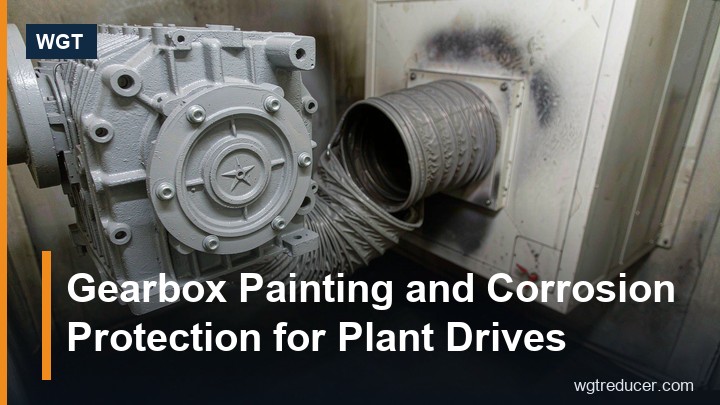
Gearbox Painting and Corrosion Protection for Plant Drives
A gear unit is rarely killed by its gears. Long before the gearset gives trouble, the case around it has been quietly negotiating with the air: humidity in a coastal plant, wash-down mist in a food line, dust that holds moisture against steel, fumes above a pickling line, or simply a paint system chosen because it was the catalogue default. Corrosion does not stop a drive in a week, but it decides what the drive costs to own in year eight - and whether the bolts, the feet, the arm bracket and the drain plug still come apart when they are needed.
The good news is that gearbox corrosion protection is one of the cheapest forms of insurance in the plant. The decisions are ordinary - how the surface is prepared, which paint system goes on, how damage gets repaired, and which details are masked and which are not - and they are all taken at order time. This page sets out what actually determines coating life on an industrial gear unit, and how to write it into an enquiry so the answer arrives built for the hall it will live in.
Why Paint on a Gearbox Is Engineering, Not Cosmetics
A gearcase is a pressure vessel for oil with a large steel surface and a complicated shape: webs, ribs, fillets, flanges, bolt bosses and drainage paths that collect water exactly where steel stays wet longest. Paint on such a shape does three jobs at once. It separates the steel from the air and moisture. It keeps the surface smooth enough that dust and product do not build a damp blanket on it. And it preserves the case's ability to shed heat, because a corroded, roughened surface holds film and grout splashes that turn a clean thermal skin into insulation.
There is also a mechanical argument. Fasteners, lifting lugs and the torque arm's pick-up points are all made of steel that must remain sound for safety reasons, not appearance. A case whose foot bolts have corroded to cosmetic ruin is a drive nobody wants to unbolt in an emergency. Coating life at those details is therefore part of the drive's structural story, and treating paint as a finish rather than a specification is how plants end up grinding bolts at 2 a.m.
What Decides Coating Life: The Environment First
Corrosion rates are set by the environment, and the industry describes that environment in families rather than adjectives. Indoors, dry and temperate is the gentlest case; the same building with process humidity moves up a step. Outdoor exposure with rain and sun is harsher. Sites near the coast, or in halls where chemicals, salts or process fumes are present, sit in the severe categories where a decorative paint job measured in months is the wrong answer and a protective system measured in years is the only one that survives.
The specification should therefore start with a truthful description of where the drive will stand: indoors or out, the ambient in the worst month, whether the air carries salt, chemicals or abrasive dust, whether the case is washed down or splashed, and whether anything radiates heat onto it. Two plants can order the same gear unit and need entirely different paint systems, and the enquiry is the one place where that difference can be stated for free.
Surface Preparation: The Step Nobody Sees Afterwards
No coating outperforms its preparation. The hierarchy is well established and worth knowing when reading a supplier's offer, because preparation is where cost is quietly saved and life is quietly lost.
| Preparation level | What it involves | Where it belongs |
|---|---|---|
| Hand or power tool cleaning | Wire brushing and sanding to remove loose scale and rust | Repair work and touch-up, not new units |
| Shot or grit blast to near-white steel | Full surface profile, anchor pattern for adhesion | The standard for new industrial gearcases |
| Blast plus shop primer and full multi-coat system | Profile, primer, intermediate and top coats to a specified thickness | Severe, coastal and chemical environments |
Blasting gives the paint an anchor pattern to grip, which is why a multi-coat system over a blasted surface lasts many times longer than the same paint brushed onto a wire-brushed one. When comparing quotations on a severe-duty site, the paint line that looks expensive is often the one that has simply been specified honestly.
Choosing the Paint System to Match the Duty
With the surface prepared, the system is chosen layer by layer. A primer bonds to the steel and carries the corrosion inhibitors. An intermediate coat builds thickness, because anti-corrosion performance is largely a function of dry film thickness applied in well-cured layers. A top coat seals the system, resists the chemicals and ultraviolet light of the specific hall or yard, and - on hot positions - is selected to tolerate the surface temperature the case actually reaches rather than room temperature.
A few practical pairings cover most plants. A clean indoor machine hall is well served by a standard primer-and-topcoat system. Outdoor yards need a thicker intermediate build and an ultraviolet-stable top coat. Coastal and chemical positions justify a full multi-coat system specified against the site's own corrosion experience - the maintenance department usually knows exactly how long paint survives on the existing plant, and that number is the most honest specification available anywhere.
Details That Decide Whether the System Works
Paint systems fail at details long before they fail on flat surfaces. The short list below is what separates a drive that keeps its coating from one that rusts from the inside out.
| Detail | Why it matters | What good looks like |
|---|---|---|
| Machined faces and bores | Paint where a coupling or cover seats destroys fit | Masked, oiled and protected, never painted |
| Breather and drain plugs | These must come apart for service | Masked threads, free of overspray |
| Bolt threads and arm pins | Corroded threads turn adjustments into destructives | Protected threads, greased pick-ups after painting |
| Welds, edges and fillets | Thin paint at edges is where rust starts | Stripe-coated edges before the main coats |
| Oil drain path and foot faces | Water traps and seating surfaces | Drain clear, feet machined and unpainted |
The pattern in that table is worth internalising: the coating protects the case, and the masking protects the function. A supplier who asks which faces must stay bare is doing the buyer's engineering for them; a buyer who answers that question in the enquiry gets a drive that arrives ready to bolt down rather than ready to clean.
Touch-Up: The Discipline That Doubles Coating Life
Every drive gets scratched. It is lifted, chocked, bolted against, splashed with grout and leaned on by the guard fitter. The difference between a case that rusts and one that does not is usually not the original system but the speed with which damage is repaired. Touch-up is simple: clean back to sound coating around the damage, feather the edges, prime bare steel promptly, and rebuild the thickness with the same family of paint rather than whatever aerosol is nearest.
Plants that run gear units well put touch-up on the maintenance list as a routine item, with the correct paint held on the spares shelf next to the oil. It costs minutes. It is also the only part of the corrosion story that happens entirely on the plant's side of the order, which makes it the plant's clearest opportunity to extend the life of something it has already paid for.
Hot, Dusty and Coastal Positions Need Their Own Answers
Three environments deserve a specific note because they defeat ordinary specifications in ordinary ways. In hot corners - beside coolers, furnaces and kilns - the case surface runs above the temperature of a standard top coat, so the paint must be specified for the measured surface temperature and the system's colour can matter, since dark surfaces in radiant heat simply run hotter. In dusty halls, the enemy is the damp blanket: dust on a rough or chalked surface holds moisture against the coating, so a smooth, hard top coat and a washing-down routine are part of the corrosion plan, not just housekeeping. On coastal sites, salt attacks fasteners and edges first, and the honest specification is the multi-coat system with edge stripe-coating and protected threads that the marine industry settled on decades ago.
A drive specified for one of these corners while carrying a catalogue default finish will look fine on arrival and start shortening its own life in the first wet season. The MC2PLST07 torque arm gearbox is a good example of a frame that is commonly ordered for exactly these positions - cooler discharge conveyors, dusty mill halls, continuous outdoor duty - and its specification conversations almost always include the paint and breather package alongside the gears.
The Enquiry Lines That Get the Right Coating
The coating part of an enquiry is five lines long. Where the drive will stand, indoors or out. The ambient in the worst month, and any salt, chemical or dust the air carries. Whether the surface is washed, splashed or hosed. Whether anything nearby radiates heat, and roughly how hot the case surface is expected to run. And which faces must remain bare for coupling, cover and foot seating. With those lines, the supplier returns a named system with film thicknesses per coat and the masked-face list, which is a document the plant can check on arrival rather than argue about afterwards.
For help matching a frame and its protection package to a duty, our engineers review the environment details before quoting, and the online gearbox selection system gives a first-pass frame and ratio in minutes. Send the environment with the tonnage - the pair together is what produces a drive that is still tidy, still bolted and still shedding heat long after the third wet season.
Frequently Asked Questions
What paint system should a gearbox have for outdoor use?
An outdoor gear unit needs more than a decorative top coat: a blast-cleaned surface, a primer, an intermediate build coat for thickness and an ultraviolet-stable top coat. Thickness is what buys the years outdoors, so the specification should state the total dry film thickness rather than naming a colour and hoping.
Do machined surfaces on a gear unit need protection too?
They need a different protection. Coupling seats, cover faces, foot pads and bores must stay bare and are protected with masking and a coating of oil for transport, because paint where metal seats on metal ruins the fit. Bare machined steel in storage should be kept oiled and inspected, not painted.
How often should paint damage on a gearcase be touched up?
As soon as it is found - ideally during routine rounds. Bare steel begins corroding immediately, and a touch-up done within days is a five-minute task with a perfect bond, while one done after a season of rust involves grinding back to sound metal and rebuilding a thicker system.
Is a standard paint finish suitable for a coastal plant?
Usually not. Salt in the air puts the site in a severe corrosion category, where fasteners, edges and thin paint films fail first. Coastal installations justify a full multi-coat system with edge stripe-coating and protected fasteners, and the plant's own experience of how long paint survives on existing steel is the best guide to how heavy the system should be.
Can a gearbox be repainted in service?
Yes, with care. The case is cleaned, loose and rusted coating is ground back to sound paint or bare steel, and the system is rebuilt locally with compatible paints - avoiding the breathers, seals and machined faces, and respecting the oil temperature at the surface. A planned repaint during an overhaul window is the ideal version; in-service touch-up of damage remains the everyday norm.
