


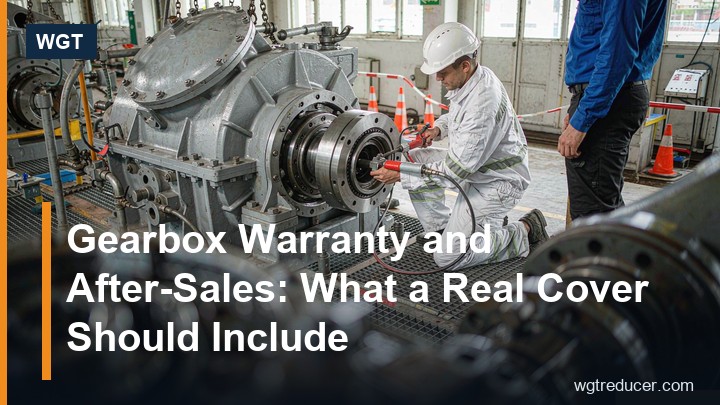
Gearbox Warranty and After-Sales: What a Real Cover Should Include
A gearbox warranty is not a marketing sentence - it is a service contract with a scope, an evidence requirement and a clock. Two suppliers can both write "two years warranty" on their quotations and deliver completely different outcomes when a unit fails at month fourteen, because what differs is not the duration but the scope of cover, the quality of the service organisation behind it, and whether the buyer has kept the records that a claim actually needs. This guide sets out what to look for in gearbox warranty and after-sales terms before the purchase order is signed, and how to run the unit so that a claim, if it ever comes, settles quickly.
Read the Scope Before the Duration
The first line of any gearbox warranty worth having states what is covered: materials and workmanship defects in gears, shafts, bearings, housings and seals. The second line - the exclusions - is the one that decides real-world outcomes. A fair exclusion list covers what the buyer controls: wrong oil or oil never changed, coupling misalignment at installation, overload beyond the rated duty, water ingress through an opened breather, and unauthorised disassembly. An unfavourable one hides operational realities there: some suppliers exclude any seal weep, any noise claim, or any failure where the site cannot produce oil-change records.
The practical test is to ask the supplier to walk through two concrete scenarios in writing: a bearing that fails at normal load with correct oil, and a seal that weeps after a washdown. What the supplier answers - and how fast - tells you more than the warranty page of their catalogue. Suppliers who answer with a claim procedure, not a defence, are the ones who will actually stand behind the unit.
What a Sensible Warranty Table Looks Like
When comparing quotations, put the warranty terms side by side in the same structure. The differences become obvious immediately:
| Term | Typical offer | What to check |
|---|---|---|
| Duration | 12–24 months from commissioning, capped at 18–30 months from delivery | Which date starts the clock, and the cap for slow projects |
| Coverage | Gears, shafts, bearings, housing, seals against material and workmanship defects | Whether seals and bearings are included or excluded |
| Remedy | Free parts, or parts plus labour, or unit exchange | Who pays freight, and whether labour on site is covered |
| Claim evidence | Nameplate photo, oil records, operating hours, failure photos | Whether the list is reasonable or requires full telemetry |
| Response | Reply within 24–48 h, solution proposal within a week | A named contact, not a shared mailbox |
A duration alone means little. A 12-month cover with fast parts logistics and a clear remedy often beats a 24-month cover with a claims process measured in weeks. Industrial buyers usually care less about the anniversary date and more about how long the line stands still while a claim is being processed.
After-Sales Is Mostly Logistics, Not Goodwill
When a gearbox fails in service, the outcome is decided by three logistics questions long before any engineering judgement is made. First, spares availability: are shaft seals, breathers, oil and bearings for the purchased frame held in stock by the supplier, and can they be shipped in days? Second, interchange information: does the supplier publish the oil quantities, bearing designations and seal dimensions for the frame, so a local workshop can service the unit without sending it back? Third, repair-or-exchange policy: for a mid-size industrial gear unit, a factory exchange unit often returns the line to service faster than a repair, and the supplier's willingness to offer one is a fair measure of their after-sales organisation.
Suppliers of standardised industrial ranges - helical, bevel-helical, parallel-shaft and worm families built on fixed frame dimensions - have a structural advantage here. Because every unit of a frame shares the same seals and bearings, one spare kit serves the whole fleet. That is why, when we build offers around our M series industrial gear units and similar ranges, the after-sales conversation starts with the frame number, not the serial number.
The Records That Make a Claim Settle Fast
Almost every slow or disputed claim fails on evidence, not on merit. The set of records that settles a claim in one exchange is short and cheap to keep:
- The commissioning record: oil fill quantity and grade, measured alignment values, rotation check, first-run temperature and noise baseline.
- Oil service log: dates, hours, grade and quantity for every change, plus any sample results.
- Operating context: typical absorbed power, start frequency per day, ambient conditions, and any known overload events.
- Failure documentation: photos of the failed parts before cleaning, the nameplate, the breather and the coupling area.
A site that keeps these four items can usually close a legitimate claim in one or two exchanges. A site that keeps none will spend months in a loop where every engineering question - oil grade? alignment record? hours? - restarts the discussion. The commissioning baseline deserves special mention: a gearbox that has been quiet and cool for a year and then develops a noise is a very different claim from one that ran noisy from day one, and only the baseline proves which is which.
Installation Handover: Where Warranty Disputes Are Born
Most warranty disputes do not originate in the gearbox - they originate in the installation week. Coupling alignment done by eye, bolts torqued unevenly on a foot-mounted frame, a guard pressing on the input shaft, oil filled to an unmarked level, or a motor wired to run the output backwards on a worm unit: any of these can produce a failure months later that looks, from the outside, like a defect. The countermeasure is a written handover at commissioning: alignment readings, torque wrench values on the base bolts, oil level photographs, rotation direction check and the first unloaded run notes. Ten minutes of documentation at installation removes the most common arguments before they exist.
For buyers installing hollow-shaft or torque-arm units, add the insertion depth and end-float measurements to the same record. These are the two numbers a factory will ask for first when a bearing claim arrives on a bored-output build.
Spares Strategy: Buy the Consumables With the Unit
A gearbox warranty covers defects; it does not cover consumables, and consumables decide most of the after-sales experience. Shafts seals, breathers and oil are wear items by definition. Ordering the first seal kit, one spare breather and the initial oil supply together with the unit costs little and removes the classic failure mode of after-sales: a healthy gearbox immobilised for three weeks waiting for a lip seal that a local store does not carry. Ask the supplier to quote the consumable kit for the frame at order stage - a supplier who can price it immediately has the spares organisation their warranty letter implies.
For fleets, go one step further: keep a frame-level consumables list per plant, and review it annually against the units actually installed. Frames that are used across many machines deserve a stocked kit; one-off frames can be ordered against the maintenance plan.
Evaluating a Supplier's After-Sales Before You Order
Before the purchase order, three low-cost checks reveal most of what you need to know. Send a technical question about an existing unit - an oil quantity, a seal dimension - and time the reply. Ask for a sample claim procedure in writing. And ask which spares for the quoted frame are held in stock and at what lead time. A supplier who answers these three quickly, with specifics rather than brochure language, will almost certainly run their warranty the same way.
It is also fair to ask about documentation: dimensional drawings, maintenance manuals and exploded views for the frame. Suppliers who publish these treat after-sales as part of the product; suppliers who treat them as confidential add a support tax to every future service event.
Common Questions from Buyers
Does the warranty clock start at delivery or at commissioning?
It varies, and it matters on slow projects. Ask for "from commissioning, capped at N months from delivery" - that wording protects both sides: the buyer is not penalised for a delayed project, and the supplier is not exposed indefinitely on units that were delivered but never installed.
Can we service the gearbox locally without voiding the cover?
Routine service - oil changes, seal renewal, breather replacement - should never void a warranty if done to the manual. What voids cover is unauthorised opening of the gear chamber or modification of the housing. Confirm in writing that routine maintenance by the site or a local workshop is permitted with records kept.
What happens if the failure cause is disputed?
A fair contract names the evidence that decides it: the oil records and the failed-part photos usually settle cause quickly. If a dispute remains, many industrial suppliers offer a neutral teardown at the factory with the buyer invited or the parts returned. Agreeing on this path before any failure is far easier than negotiating it during one.
Are spare parts covered after the warranty ends?
Parts supplied later usually carry their own shorter warranty - commonly the same duration as the original cover or a fixed shorter period. Ask for it in the parts quotation, not after the part has failed.
How We Run Warranty and Support
Our industrial gear units ship with a written warranty, a commissioning checklist and the consumable list for the frame, and our team answers technical questions with the drawing and the frame number in hand. If you are comparing suppliers, send us the duty point - torque or absorbed power, speed, mounting posture and daily hours - and we will come back with the model, the ratio and the after-sales terms in one reply. You can also size the frame yourself in our online selection system, then send us the result for a quotation with the warranty and spares terms stated in writing.
Frequently Asked Questions
How long should a gearbox warranty last?
Twelve months is the industrial floor; eighteen to twenty-four months from commissioning is a fair standard for quality-built units. Duration matters less than scope and remedy, so compare the whole clause, not just the number.
What voids a gearbox warranty most often?
Missing oil records and installation faults - misalignment, wrong oil level, reversed rotation - are the two most common causes of disputed claims. Both are prevented by a written commissioning record.
Should we buy spare seals with the unit?
Yes. One seal kit and a breather per frame is cheap insurance and usually ships with the unit. Wear parts are consumables and sit outside any warranty, so having them on site is the only way to keep a seal change a one-hour job.
Do you support units supplied years ago?
Standardised frames share dimensions and consumables across the whole production run, so a unit supplied years ago can still be supported with drawings, seals and bearings matched to its frame number.
