


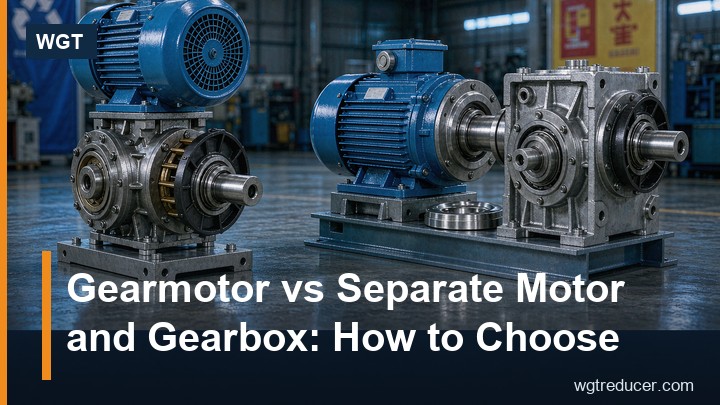
Gearmotor vs Separate Motor and Gearbox: How to Choose
The short answer is that a gearmotor wins when the machine needs a compact, pre-aligned drive that ships as one unit and starts earning the day it is bolted down, while a separate motor and gearbox wins when the motor and the reduction have different lives, different suppliers, or different reasons to be replaced. The gearmotor vs motor gearbox question is really a question about where you want your risk to sit: in a factory-matched assembly, or in the interfaces between components you chose yourself.
This guide walks through the comparison the way it lands on a real project: what each layout physically is, what the torque arithmetic allows, how space and shaft orientation decide the geometry, what alignment and installation actually cost, and how the two options differ on efficiency, spares and total installed cost.
What a Gearmotor Is - and What It Is Not
A gearmotor is a motor and a gear reduction engineered and assembled as one unit. The motor flange bolts directly to the gearbox input housing - on IEC machines through a B5 or B14 flange, on NEMA machines through a C-face - so the motor pinion or input shaft engages the first gear stage inside the same housing, sharing the same oil or grease. There is no coupling, no intermediate shaft, no guard, and no alignment procedure between motor and reducer.
A separate drive is exactly what the name says: a standard motor, coupled to a standalone gearbox through a flexible coupling, each with its own feet, its own foundation, and its own nameplate. This is the layout most maintenance teams grew up with, and it survives for good reasons - a 75 kW motor is a stock item in every plant, while the gearbox behind it may be a special ratio that only one supplier builds.
One boundary matters in practice. When a motor bolts to a gearbox through a flange but each keeps its own oil system and its own shaft seal at the interface, the industry still usually calls it an integrated gear motor only if the first gear stage is inside the motor endshield or the gearbox is designed as the motor's rear housing. Catalogue practice varies, so check the drawing, not the brochure.
Torque, Ratio and Duty: The Arithmetic
Mechanically, both layouts deliver the same thing - input speed reduced, output torque multiplied - and the governing numbers are identical. Output torque in Nm equals 9550 times power in kW divided by output speed in rpm, adjusted for gear efficiency. What differs is where each layout is comfortable.
A gearmotor is built around the motor: the first stage is sized to the motor's torque and starting behaviour, and the catalogue limits the ratio range that keeps the pinion healthy. Typical integrated units cover roughly 3:1 to 200:1 in one to three stages. Beyond that, pinion torque rises until the motor-mounted first stage stops making sense, and the catalogue pushes you toward a separate reducer.
A separate motor and reducer has no such coupling to the motor rating. The same 1450 rpm motor can drive a 5:1 helical unit this month and a 120:1 bevel-helical unit next month, and the gearbox service factor can be raised independently for shock loads without touching the motor.
| Criterion | Integrated gearmotor | Separate motor + gearbox |
|---|---|---|
| Typical ratio range | 3:1 to about 200:1 | 3:1 to 300:1 and beyond, stage by stage |
| First-stage sizing | Fixed to the motor rating | Chosen per application |
| Service factor adjustment | Limited by the paired motor frame | Independent, per gearbox |
| Starting behaviour | Factory matched, motor and pinion sized together | Depends on coupling and flywheel choices |
| High-frequency starts | Thermal behaviour engineered as a unit | Motor and gearbox rated separately |
| Overload path | Shared housing; one rating governs | Coupling is the fuse; gearbox can be oversized |
The last row is the quiet advantage of the separate layout: the coupling can be deliberately sized as the weak link that protects both machines. In an integrated unit there is no coupling to sacrifice, so the service factor has to absorb what the coupling would have shed.
Space, Layout and Shaft Orientation
A gearmotor is short. Removing the coupling and the intermediate shaft typically saves 150 to 400 mm of axial length on a mid-size drive, and because the motor hangs on the gearbox flange, the whole assembly often hangs off the driven machine - on a screw conveyor trough, on an agitator nozzle, on a belt conveyor drive pulley shaft - with no separate foundation at all. That is why shaft-mounted and flange-mounted gearmotors dominate conveyors, mixers and packaging lines where floor space is not negotiable.
A separate drive is longer but more flexible. The motor can sit beside the machine, behind a wall, or in a cleaner environment than the gearbox; a belt or chain stage between them can bridge a distance neither shaft could span directly. Right-angle gearmotors exist and solve orientation elegantly, but a separate right-angle reducer plus a standard inline motor still offers more mounting permutations than any integrated catalogue.
Two layout questions settle most cases. First, can the drive hang on the machine, or does it need its own plinth? Second, is there anything near the motor - heat, dust, washdown, operators - that argues for moving it away from the gearbox? A gearmotor answers the first question brilliantly and the second one poorly; a separate drive is the reverse.
Alignment, Couplings and Installation Labour
This is where the gearmotor takes its clearest win. A separate motor and gearbox must be aligned at the coupling - typically within 0.05 to 0.10 mm of parallel offset and a fraction of a degree of angular error for couplings in this class - and it must stay aligned, because soft foot, thermal growth and foundation settlement all pull the shafts out of true. Every realignment is a shutdown, a dial indicator session and a second shutdown to verify.
An integrated gearmotor has no field alignment at all. The faces are machined together, the pilot diameter controls concentricity, and the assembly bolted up on the workshop floor is aligned. Installation reduces to levelling the feet or tightening the torque arm, wiring the motor, and filling the oil. Plants that keep poor alignment records - which is most plants - effectively buy back their own history when they choose the integrated layout.
The trade appears later. A gearmotor that fails is removed as a unit: an 11 kW right angle gearmotor might weigh 80 to 150 kg, and if the spare is not on the shelf, the whole machine waits for one shipment. In a separate drive, a failed motor can be swapped in hours from general stores, and the gearbox keeps running only if the failure was on the motor side - which, thanks to windings and bearings being the more common failure, it often is.
Efficiency and Heat: Where the Losses Sit
Per stage, the gears do not know which housing they live in. A helical stage runs 98 to 99 percent efficient either way, and a worm stage 70 to 90 percent depending on ratio and lead angle. The layout-level differences are smaller and come from three places.
First, the integrated unit deletes the coupling and any belt or chain stage, and those each cost one to three percent when they exist. Second, a gearmotor's compact housing holds less oil, so surface area per watt of loss is lower - in continuous hot duty this can push winding and oil temperatures up, and the motor's cooling fan is now blowing across a warmer gearbox. Third, a separate motor can be specified at a higher efficiency class and a separate gearbox at a higher gear quality independently, which matters on drives that run 6000 hours a year and pay for every point of efficiency.
For most machines under about 30 kW with moderate duty, the differences net out to less than the cost of one alignment session per year. For large continuous drives, run the numbers per point of efficiency against annual energy spend before deciding.
Maintenance and Spares: Two Philosophies
Separate drives support a spares philosophy that built most plant storerooms: stock motors by frame size, stock gearbox parts or whole gearboxes by ratio, and mix freely. One 132M frame motor serves a dozen different drives. Gearbox seals, breathers and oil can be serviced without touching the motor, and the motor can be sent away for rewinding while the gearbox stays in place.
Integrated gearmotors push you toward unit exchange. You either hold a complete spare gearmotor per critical drive, or you accept that a failure means a factory lead time. Oil and breather service is the same as any gearbox, and the motor's own maintenance is nearly nil until it fails - at which point the unit philosophy applies whether you like it or not. Suppliers now mitigate this with modular platforms that share gear stages and accept several motor sizes, so a wise buyer checks how many catalogue units share the spare stages before committing a plant to one family.
The hybrid worth naming: use an integrated gearmotor, but specify it with a motor that matches your existing frame stock. Several platforms accept standard IEC motors on the gearbox flange, so the gearbox ships pre-aligned and the motor in the spare pool remains usable. That single specification decision recovers most of the spares argument for the separate layout.
Cost: Nameplate Price vs Installed Cost
At nameplate level, a separate motor and gearbox is almost always cheaper: a stock motor plus a stock reducer plus a coupling undercuts an integrated unit of the same duty, sometimes by 10 to 20 percent. The gap closes - and often reverses - once installation is priced honestly.
A separate drive needs a longer baseplate or plinth, a flexible coupling and its guard, alignment labour, and grouting; on small and mid-size drives that package routinely adds 15 to 30 percent to the component cost before the first startup. A gearmotor needs a bracket, four bolts and a cable gland. On a conveyor drive hanging off the pulley shaft, the separate layout also needs bearing blocks and take-up frames that the shaft-mounted gearmotor simply deletes.
| Cost element | Integrated gearmotor | Separate motor + gearbox |
|---|---|---|
| Component price | Higher | Lower |
| Baseplate and guard | Minimal or none | Required |
| Alignment labour and tools | None in the field | Recurring over the drive's life |
| Spares held | Complete unit or modular stages | Motors by frame, gearboxes by ratio |
| Failure recovery | Whole unit out of service | Failed component swapped |
| Typical installed cost, small/mid drives | Often lowest | 15 to 30 percent above component price |
Frequently Asked Questions
Can I bolt a standard motor onto a gearbox to make a gearmotor?
Yes, if the gearbox is designed for motor mounting - an IEC B5/B14 or NEMA C-face input with a pilot diameter and a motorized input stage. Bolting a foot motor to a flange it was not drawn for, with a coupling in between, gives you a separate drive in a shorter space, with all the alignment work that implies. Match the flange size, the pilot fit and the input speed the gearbox catalogue states.
Which layout handles high starting torque better?
A separate drive has more tools: fluid couplings, couplings with deliberate torque limits, and a gearbox service factor raised independently of the motor. An integrated gearmotor handles starts well within its catalogue duty - the motor and first stage were sized together - but repeated heavy starts on a unit near its limit have nowhere to shed the load. For crushers, shredders and similar shock duty, the separate layout usually specifies more comfortably.
Is a gearmotor less repairable than a separate drive?
At component level, yes - the motor of an integrated unit is not rebuilt while it hangs on the gearbox, and the gearbox cannot be serviced without handling the motor. At plant level it depends on what you stock: plants that hold complete spare gearmotors recover faster than plants that realign couplings at midnight. The honest comparison is downtime, not repairability.
Do gearmotors restrict my choice of motor?
They used to. Modular platforms now accept a range of standard IEC motors on one gear case, and many suppliers will fit brake motors, increased-efficiency windings or inverter-duty motors to a gearbox you have already validated. Check the platform's motor matrix before assuming the integration locks you to one motor family.
Which should I choose for a conveyor?
For most belt and screw conveyors, an integrated gearmotor - especially a shaft-mounted or right-angle shaft-mounted unit hanging on the drive pulley or trough end - wins on space, installation and alignment for the life of the machine. Choose the separate layout when the conveyor is part of a plant that already stocks motors by frame size, when duty is severe enough to justify an oversized gearbox, or when the motor must live away from dust and product spillage.
The Decision in One Paragraph
If the drive is small to mid-size, lives close to the machine, and will be maintained by people who do not want to align couplings, an integrated gearmotor is usually the better machine and the cheaper installation - and you can size one directly in the online selection system at https://weigao.comp.yunqi3d.com/#/selection/params. If the motor and the reduction have different duties, different lifetimes, or a storeroom already built around frame-size motor stock, the separate layout turns those differences into uptime. For machines where the gearmotor route fits, our H226 series gear motor reducer at https://www.wgtreducer.com/products/h226-series-gear-motor-reduce shows the layout in its most common industrial form - motor, helical-bevel stages and output options on one flange - and the same selection system will price the separate equivalent if the arithmetic points that way.
