


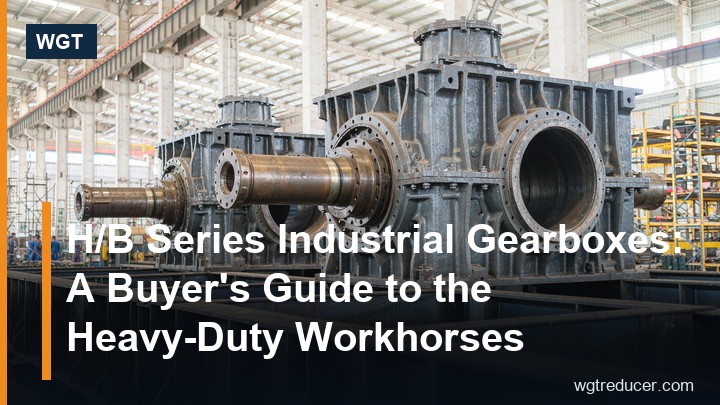
H/B Series Industrial Gearboxes: A Buyer's Guide to the Heavy-Duty Workhorses
Walk through a cement plant, a mine concentrator or a steel mill and you will pass dozens of large foot-mounted gearboxes without giving them a second glance. They sit on concrete plinths beside mills, kilns, conveyors, crushers and fans, turning slowly and steadily for years. A large share of those drives belong to one engineering family: the H and B series industrial gearboxes - H for the horizontal helical builds, B for the bevel-helical builds that turn the drive through a right angle.
They are not glamorous products, and that is exactly their value. Everything about them is designed around one objective: delivering high torque at low speed, continuously, in dirty air, for decades, with maintenance that a normal plant crew can perform. This guide explains how the family is organised, what the letters mean, where each build earns its place, and what a well-prepared enquiry looks like.
What the H and B Letters Mean
The two letters divide the family by the shape of the power path rather than by size or power. Both builds use helical gearing for the main torque stages; the difference is what happens at the input end.
| Aspect | H series (helical) | B series (bevel-helical) |
|---|---|---|
| Power path | Input shaft in line with the output shafts | Bevel stage turns the drive 90 degrees, helical stages follow |
| Input direction | Horizontal, parallel to output | Horizontal, at a right angle to output |
| First-stage mesh | Helical | Spiral bevel, then helical stages |
| Footprint | Long and relatively narrow | Shorter and deeper, motor sits across the unit |
| Natural fit | Conveyors in a line, mills, hoists, generators | Belt conveyors, crushers, fans, pumps where the motor must sit crosswise |
| Maintenance focus | Gear mesh condition, bearing wear | Bevel pair pattern, axial adjustment of the bevel wheel |
The H build keeps everything in one straight line, which simplifies alignment and suits installations where the motor can sit end-on. The B build trades one extra mesh for a right-angle turn, which shortens the drive bay and lets the motor sit where the plant layout wants it - usually across the conveyor axis instead of along it.
Where This Family Sits Among Industrial Gearboxes
Industrial gearing is a spectrum. At the small end sit compact worm and helical-worm units for light duty; in the middle, modular bevel-helical series cover general plant work; at the heavy end live the large industrial units that carry mill and mine loads. The H/B family occupies the heavy end of that spectrum and overlaps the middle where duties become continuous and severe.
Three characteristics mark the territory. First, torque: these are frames built to transmit torques that smaller modular series only read about in their catalogue's "beyond this line, ask us" section. Second, duty: they are rated for continuous operation with high daily usage, not intermittent cycles. Third, environment: dust, moisture, temperature swings and washdown-adjacent locations are part of the design brief, not exceptions to it.
That positioning has a practical consequence for buyers. The selection conversation for an H/B unit is less about "which model is cheapest" and more about "which frame carries my worst hour with an honest service factor" - because at this scale, an undersized gearbox is not replaced, it is lived with until the next plant shutdown.
The Bevel-Helical Train and Why It Works
The B build's signature is its first stage: a spiral bevel pair that turns the drive through ninety degrees with quiet, graduated tooth engagement. After that turn, one or more helical stages do the torque multiplication in the familiar way.
Why not simply use helical stages all the way through and mount the motor along the axis? Sometimes plants do - that is the H build. But the right-angle input buys three real advantages in heavy installations. The motor sits across the unit, which shortens the drive station along the conveyor or mill axis and often saves a full metre of plant length. The bevel stage allows the motor to be placed where access is best, which matters when the alternative is coupling work from a cage over a live conveyor. And the first reduction happens in a stage that handles modest torque, so the bevel pair stays compact even on very large frames.
The engineering attention in a B unit concentrates on that bevel mesh. Its tooth contact pattern is set at the works and verified again after any bearing work; a pattern that drifts is the earliest warning the train can give. Well-run plants photograph the pattern at commissioning and keep the photo with the machine file - a thirty-second habit that makes every later inspection a comparison instead of a mystery.
The Helical Builds for In-Line Heavy Duty
The H series answers a different layout problem: the motor and the driven machine want to sit in a line. Long belt conveyors, rod and ball mills, hoists, winches and generator sets all prefer an in-line train because their foundations, guards and access ways are already arranged along one axis.
Inside the case, two or three helical stages multiply torque with the efficiency the tooth form is known for. The output shaft is typically a solid shaft for a coupling connection, though flange and hollow-shaft outputs exist within the family for special installations. Because the whole train is in line, alignment is a two-plane discipline at the coupling, and the feet - not a torque arm - carry the reaction. That makes the foundation drawing part of the gearbox purchase: the supplier supplies reaction torque and bolt pattern, and the plant builds the plinth to match.
Duty Classes and Service Factors
The single most misunderstood number in industrial gearing is the service factor. It is not a safety polish added at the end; it is the multiplier that converts the duty's real behaviour - starts, shocks, stops per hour, daily running hours - into a rating the machine can live with.
| Duty character | Typical example | What the service factor must absorb |
|---|---|---|
| Uniform, few starts | Yard conveyor with controlled start | Starting inertia and minor surges |
| Moderate shock | Crusher fed at uneven rate | Peak breakaway and recurring shock passes |
| Heavy shock, frequent starts | Mill drive with direct-on-line starts | Start torque trace, torsional excitation |
| Torsional pulsation | Reciprocating machinery on the shaft | Torque ripple that fatigues the train |
The practical rule that has kept plants out of trouble for decades: size the unit for the worst observed start, not the average running load. A supplier who asks for the motor's starting method, the driven machine's inertia and the duty cycle is not being difficult - that information is what separates a gearbox that runs quietly for twenty years from one that develops tooth surface distress in its third.
Housings, Bearings and the Details That Decide Life
At this scale the gearing rarely fails first. What decides the machine's working life is everything around it: the housing's rigidity, the bearing arrangement, the sealing, the breather and the cooling.
A rigid cast housing keeps the gear meshes in alignment under load; flexible structures transmit deflection into tooth contact. Bearings at heavily loaded positions are selected for the duty's life in hours - a legitimate question to ask at quotation is the calculated bearing life at your actual duty, not a generic catalogue figure. Sealing faces outward against dust and water ingress, and the breather - that small fitting everyone forgets - is what stops the daily temperature cycle from breathing contaminated air into the oil.
Oil care completes the picture. Large industrial gearboxes hold enough oil for analysis programmes to be meaningful, and a quarterly sample trend tells you more about the machine's future than any single inspection. Plants that run a disciplined oil programme schedule their bearing work years ahead; plants that do not meet their bearings by noise.
Typical Applications
The family shows up wherever torque is large and continuity matters. Common homes include: mine hoists and shaft conveyors, where availability is measured in shifts and a stopped drive stops the whole pit; cement kilns, mills and clinker transport, with dust loads that punish sealing and breathing; steel mill tables, run-out conveyors and rolling line auxiliaries, where shock passes are routine; port cranes and ship loaders, where salt air and duty cycles combine; and large fans, pumps and drum drives across general heavy industry.
What these applications share is not a product type but a purchasing attitude: the drive is bought once, specified carefully, and expected to run through more hours a year than almost any other machine on site. The H/B series exists precisely for that attitude.
Specifying an H/B Unit: What to Send
An enquiry that closes in one round carries a short, specific set of facts. Driven machine type and its characteristics - conveyor, mill, crusher, fan. Required output speed and torque, or motor power and speed from which they derive. Starting method, because it decides the shock the unit must absorb. Duty hours per day and expected starts. Mounting arrangement - foot or flange, output shaft form, direction of rotation. Environment - ambient temperature range, dust, moisture, altitude. And any interface constraints: shaft dimensions, spacing, the space the drive bay offers.
With those facts, a competent supplier returns a frame selection with its service factor shown, an outline drawing, and a quotation that holds. Without them, the reply is a guess wearing a part number. If you want to see how the arithmetic works before writing to anyone, the online selection tool walks through the ratio and frame logic in a few minutes, and a heavy-duty bevel helical unit product page shows what a large right-angle industrial drive looks like as a delivered article.
Frequently Asked Questions
What is the difference between the H and B series in one sentence?
The H series keeps input and output shafts in line using only helical stages; the B series adds a spiral bevel stage that turns the input through ninety degrees, trading one mesh for a shorter drive bay and a crosswise motor position.
Which one should a long belt conveyor use?
Most long conveyors suit the B build, because the motor can sit across the belt axis where access is easiest and the drive bay stays short. Where the layout already reserves an in-line drive station, the H build does the same work without the bevel stage.
How important is the service factor, really?
It is the number that decides whether the unit survives its worst hour. Two quotations at the same torque can differ hugely in real fitness once the duty's starts and shocks are multiplied in - always compare service factors at your duty, never catalogue torque alone.
What maintenance does a large industrial gearbox actually need?
Routine oil level and temperature checks on a fixed schedule, breathers kept clear, seal areas observed, and an oil analysis programme on a quarterly cadence. The bearings and teeth are then serviced on evidence from the trend, years before failure announces itself.
Can these units be paired with a variable frequency drive?
Yes, and it is common on modern installations. Confirm the input speed range and any low-speed lubrication considerations with the supplier at order time - a brief note in the enquiry is all it takes to have the ventilation and oil routing checked for the intended speed band.
The Bottom Line
The H/B series is the family plants reach for when the duty is continuous, the torque is real and the installation must outlast the people who ordered it. The choice between H and B is a layout decision, the choice of frame is a duty-cycle decision, and the difference between a good purchase and an expensive one is almost always the completeness of the enquiry.
Send the driven machine's story, the start method and the environment, and expect back a selection with its service factor in writing. That exchange - boring, specific, complete - is what has kept these workhorses turning in the world's heavy industries for generations.
