


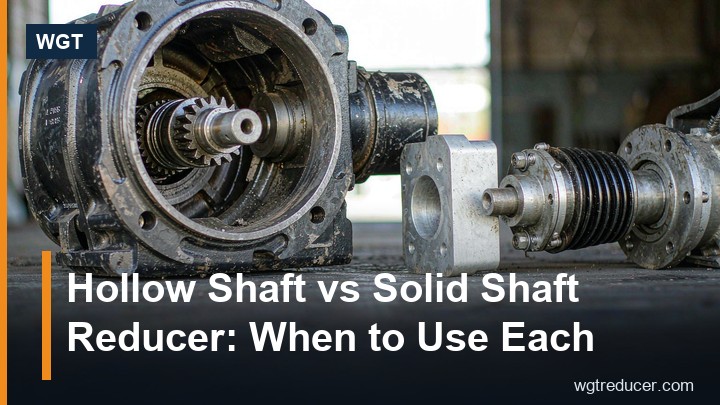
Hollow Shaft vs Solid Shaft Reducer: When to Use Each
Two reducers can have identical gearing, identical ratios and identical nameplate power, and still be completely different products, because of one decision made at the output stage: does the reducer present a hollow bore or a solid shaft? That single choice decides who carries the overhung load, who owns the shaft, how the unit is held against torque reaction, how it comes off at maintenance time, and - more often than buyers expect - which vendor's drawing governs the interface.
This guide compares the two constructions on the points that actually decide installations: load paths, mounting, alignment, thrust, service, and the specific duties where each one is the obvious answer. It is written from the perspective of someone who has to make the machine run for twenty years, not from a catalogue page.
The Two Constructions in Plain Terms
A hollow shaft reducer - also called a hollow bore, hollow output or shaft-mounted unit - has a through-bore in its output. The driven machine's own shaft passes through or into that bore, and torque is transmitted either by a keyed bore or, more commonly now, by a shrink disc that clamps the hub onto the shaft with a controlled interference fit. Because the reducer hangs on the machine shaft, it needs a separate anti-rotation device: a torque arm anchored to the structure.
A solid shaft reducer ends in a projecting shaft. It bolted to a foundation or a flange, and a coupling connects its shaft to the driven shaft. Torque reaction goes into the feet or the flange, not a torque arm, and the two shafts are joined rather than one sleeved inside the other.
The table below is the summary most enquiry conversations come back to.
| Decision point | Hollow shaft reducer | Solid shaft reducer |
|---|---|---|
| Mounting method | Hangs on the driven shaft, restrained by a torque arm | Bolted to feet or flange, shafts joined by coupling |
| Overhung load path | Machine shaft carries the reducer's weight and reaction | Reducer bearings carry coupling-induced loads |
| Alignment ownership | Set by the bore and the shrink disc | Set at installation with a dial indicator |
| Thrust capacity | None - driven machine must take axial load | Can be built to carry thrust if specified |
| Removal time | Typically 1-3 hours with a shrink disc, faster with a keyed bore | Coupling split, then lift |
| Best fit | Conveyor head and tail drums, screw conveyors, small mixers | Agitators, crushers, mill drives, vertical applications |
| Weak point when misapplied | Bore fretting, shaft wear, torque arm fatigue | Coupling misalignment, soft foot, plate flexibility |
Who Carries the Overhung Load
Every drive arrangement has one component that has to absorb the bending that comes with transmitting torque through a shaft, and the hollow shaft design deliberately puts that burden on the driven machine. The reducer's output hub is supported by the machine shaft, so any deflection of that shaft - under belt tension, under impeller bending, under the weight of a screw flight - is fed straight into the bore and the shrink disc.
This is the single most misunderstood point in the comparison. Buyers sometimes assume the hollow bore is a lighter-duty option. It is not; it is an option that redistributes duty. On a conveyor head drum with a well-supported shaft in a pair of heavy pillow blocks, the arrangement is efficient and compact. On an agitator with a long unsupported overhung shaft, the same arrangement asks the vessel shaft to carry a load it was never sized for, and the failure shows up as bore fretting long before it shows up as a gear problem.
Solid shaft units invert that logic. Their output bearings are chosen to take whatever radial load the coupling introduces, and the driven shaft can be supported independently at both ends. If the driven shaft is long, flexible or heavily loaded in bending, a solid shaft with a flexible or spacer coupling keeps the two machines' structural problems separate, which is usually what you want.
Mounting and Torque Reaction
A hollow shaft unit hangs. It follows whatever the machine shaft does, which means it also needs a device to stop it rotating with the shaft: the torque arm. Torque arms are simple and effective, and they are also the most neglected component on any shaft-mounted installation. A torque arm anchored with a single bolt through an oversized slot will work loose, then hammer, then crack. Anchoring it with a proper bracket and a resilient bush, and checking it at every service, is the difference between a decade of quiet running and a fatigue failure in year three.
A solid shaft unit is bolted down, and its torque reaction goes into the feet. That is more forgiving in service but less forgiving at installation: the foundation or flange has to be flat, clean and stiff, and the soft-foot check has to be done before the first start, not after the first complaint. A solid shaft unit bolted to a plate that flexes will run with internal misalignment that no amount of careful coupling work can correct.
There is also a geometric rule worth remembering. Hollow bore units need space along the shaft axis for the bore, the shrink disc and the removal allowance. Plants that specify a shaft-mounted unit late in a project frequently discover there is no room to withdraw it - the pillow block is too close, or a chute sits directly behind. Solid shaft units need space instead for the coupling and its guard, which is easier to negotiate at design stage because it is a known quantity.
Shrink Discs, Keys and the Bore Interface
The bore interface is where hollow shaft installations succeed or fail, and modern practice has largely moved to shrink discs for good reasons. A shrink disc clamps the hub onto the shaft with a defined interference, transmits torque by friction and needs no keyway, so there is no key to fret and no keyway to act as a stress raiser on a shaft that is often already working hard. It also allows a controlled, even release, which matters when the unit has to come off in a plant where nobody can get a three-legged puller behind it.
Keyed bores still exist and still make sense in smaller sizes, in low-torque duties, and where the maintenance culture is comfortable with keys. Their honest weakness is backlash: a keyed connection has clearance, so every reversal or load step is accompanied by a small impact inside the bore. On a duty that reverses often - a shuttle conveyor, a reversing mixer - that impact becomes a fretting pattern that eventually requires a new shaft.
Whichever system is used, the shaft must be prepared for it: correct diameter tolerance, correct surface finish, correct hardness in the bore contact zone. A shrink disc fitted to a shaft with a scored journal will slip, and a slipped shrink disc is not a gearbox failure - it is a shaft preparation failure that gets reported as one.
Thrust: The Question That Settles Vertical Applications
Axial load is the argument that usually decides between the two constructions for vertical machinery. A hollow shaft reducer cannot carry thrust, because the shaft it hangs on has to be free to slide through the bore. Anything with a downward axial load - an agitator paddle pushing down on slurry, a screw conveyor with a thrust-bearing tail, a vertical pump - therefore needs the driven machine to provide its own thrust bearing.
Solid shaft reducers can be built with output bearings that carry thrust, and in vertical builds that capacity is a design feature rather than an accident. This is why vertical agitator drives almost always present a solid shaft: the gearbox can be specified to take the impeller's axial load, the coupling becomes a pure torque path, and the wet end needs no separate thrust bearing that would sit inside the product.
For the person writing the enquiry, the practical rule is blunt: state the axial load and say who is carrying it. A supplier who has to guess will assume the cheaper arrangement and quote accordingly, and the difference appears later as a change order or a seal failure.
Service Access and the Cost of a Shutdown
Removal time is where these two constructions diverge most in day-to-day plant life, and the difference is measured in shutdown hours rather than purchase cost.
A hollow shaft unit comes off along the machine shaft. On a conveyor that means releasing the shrink disc, sliding the reducer off the drum shaft and lifting it clear - typically one shift with proper lifting gear and room to move. On a vertical vessel with a fixed shaft, the same operation can require the shaft to be dropped first, which means the tank has to be emptied.
A solid shaft unit comes off upward after the coupling is split. On a vertical installation with a spacer coupling, the gearbox lifts clear while the driven shaft stays in place, which means the seal can be serviced or the unit swapped without touching the vessel contents. This is often the deciding argument for process drives even when the hollow bore would have been cheaper.
There is a second, quieter service difference. A hollow bore installation hides its output bearing condition inside the hub, where it is hard to inspect. A solid shaft unit presents its bearing housing where a vibration probe can reach it. Plants running condition monitoring tend to prefer the solid version for exactly that reason.
Cost, Delivery and the Hidden Line Items
At equal rating, a hollow shaft reducer is usually cheaper than a solid shaft unit with a comparable thrust capability, because it omits output bearings and a housing designed to take bending and thrust. That saving is real, and it can also be misleading, because the hollow version shifts cost to other line items: a torque arm and its bracket, shaft preparation for the shrink disc, and in some cases a heavier machine shaft to carry the hanging load.
The solid shaft version shifts cost the other way: a coupling, a guard, a foundation or flange with a flat machined surface, and alignment labour at commissioning. Comparing quotations without those surrounding items is the classic way to buy the wrong drive and believe you saved money.
Delivery is worth a line too. Hollow bore units are often held in stock in standard sizes because they serve so many conveyor applications. Solid shaft units with specified thrust capacity and a particular mounting arrangement are more often built to order. A project that needs a drive in three weeks may find the technical answer is solid but the schedule answer is hollow - and the honest move is to say so early rather than discover it at the drawing stage.
Where Each Construction Belongs
Rather than a rule of thumb, it helps to group duties by what they demand of the output stage.
Hollow shaft reducers suit duties where the driven shaft is short, well supported at both ends, carries no axial load, and is accessible for removal. Belt conveyor head and tail drums, screw conveyors with a supported end, small paddle mixers with a bottom bearing, and line-shaft drives in a machine frame all fit this description. In these duties the compact axial length and the absence of a coupling are genuine gains, and the torque arm has a solid structure to anchor to.
Solid shaft reducers suit duties where the driven shaft is long or flexible, where axial load exists, where thrust has to be carried by the drive, or where removal without disturbing the machine matters. Vertical agitators, thickener rakes, crushers, mill pinion drives, kiln and dryer drives, and anything that has to be serviced above a live process all fall here.
A useful test for the doubtful middle ground: ask what happens if the driven shaft deflects by half a millimetre. If the answer is "the coupling absorbs it", the solid arrangement is doing its job. If the answer is "the bore takes it", confirm that the shaft, the shrink disc and the reducer bearings were all specified with that in mind - because on a hollow bore installation, nobody else will have checked.
Specification Checklist
Whichever construction is chosen, the enquiry that produces a correct answer the first time carries the same core information. The list below is the one used for both types in practice.
| Item to state | Why it decides the construction |
|---|---|
| Driven shaft diameter, length and support arrangement | Sets bore size, or coupling size and shaft projection |
| Radial load at the output, plus its direction | Decides whether a hollow bore can be used at all |
| Axial load and who carries it | Eliminates hollow bore where thrust is present |
| Starting method and load steps | Sets service factor and bore interface type |
| Removal requirement and available space | Chooses spacer coupling, shrink disc type, withdrawal clearance |
| Mounting structure description | Decides torque arm anchoring or foundation flatness |
| Environment: dust, washdown, temperature | Drives sealing and surface protection choices |
| Duty hours and expected life | Sets bearing selection and service interval |
Sending that list takes ten minutes. Leaving any line blank usually costs a week, because the supplier quotes the assumption they consider most likely and the plant discovers the mismatch when the drawing arrives.
Frequently Asked Questions
Can a hollow shaft reducer be used on a vertical agitator?
Only where the agitator shaft is supported in its own thrust bearing and the axial load never reaches the reducer, and where the shaft can be prepared for the bore. In practice most vertical process drives use a solid output shaft with the thrust capacity specified, because that removes a bearing from inside the vessel and makes seal service possible without emptying the tank.
How much overhung load can a hollow bore take?
The bore and shrink disc transmit torque; they are not bearings. The radial load has to be carried by the driven machine's shaft and its supports. Ask the reducer supplier for the maximum permitted radial load at the bore, and compare it with the actual figure at your duty - do not assume that a large bore implies a large radial capacity.
Is a shrink disc better than a keyed bore?
For most modern installations, yes: no keyway stress raiser, no backlash, even clamping and a controlled release. Keyed bores remain sensible in small sizes, low-torque duties and where maintenance practice favours keys. Either way, the shaft's diameter tolerance and surface finish must match the bore system's requirement.
Why does my shaft-mounted reducer keep loosening its torque arm?
Almost always because the arm is anchored to something flexible, slotted or single-bolted. The arm must resist the full reaction torque without clearance, and the anchor bracket should be stiff enough not to flex under load. Re-torque at the first service and inspect the bush for wear.
Can a solid shaft reducer replace a hollow bore unit without other changes?
Rarely without rework. The solid version needs axial space for a coupling, a foundation with a machined flat surface or a flange, and alignment work at commissioning. The gearing may be identical, but the installation around it is not.
Getting the Output Stage Right First Time
The choice between a hollow bore and a solid shaft is not a preference; it is a consequence of four facts about the driven machine: how its shaft is supported, what radial and axial loads it imposes, how it will be removed, and who will carry the load path. Answer those and the construction chooses itself.
If the duty involves a long shaft, a vertical arrangement, thrust, or service access above a live process, a solid output shaft with the thrust capacity written into the specification is the safer starting point - and it can be checked quickly against your duty figures. Our engineers will review a shaft drawing, a load statement and a duty description against the frame range and confirm the arrangement in writing before any drawing is issued. The online selection tool covers the ratio and frame side in a few minutes, and a vertical parallel shaft gearbox page shows what a thrust-carrying vertical build looks like in practice. Send the four facts and you will get a construction recommendation rather than a guess.
