


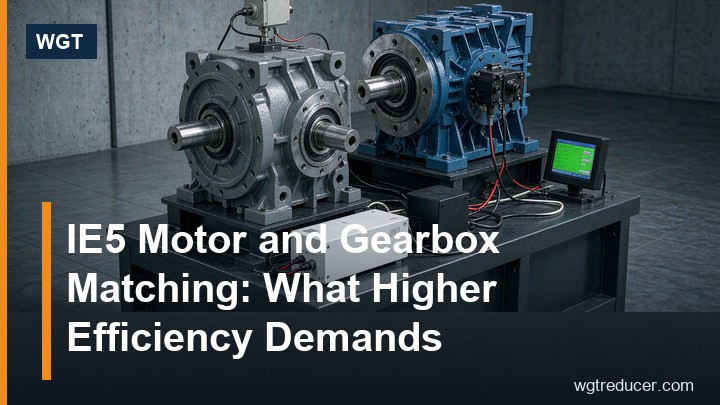
IE5 Motor and Gearbox Matching: What Higher Efficiency Demands
The short answer first: an IE5 motor changes the electrical side of a drive package far more than the mechanical side. The gearbox still sees torque, speed and duty cycle exactly as before, so the matching work shifts to three places - the motor's flatter torque curve at low speed, the inverter that an IE5 machine almost always arrives with, and the thermal conversation about how hard the pair runs and for how long. Buyers who treat IE5 as "the same motor, a better sticker" tend to miss all three.
This page walks through what the efficiency classes actually change, what stays the same, and how to specify a motor-gearbox pair so the efficiency gain survives contact with a real plant. It applies equally to a new gearmotor and to an upgrade where an older motor is being re-paired with a gearbox that is staying put.
Why the Efficiency Classes Changed the Conversation
The IEC efficiency ladder - IE1 through IE5 - sets maximum losses, not minimum output. Each step down the ladder removes losses that used to leave the plant as heat in the motor's frame, and the last two steps get there mainly by leaving conventional construction behind: permanent magnets, line-start permanent magnet designs, or synchronous reluctance rotors instead of the classic induction squirrel cage.
That construction change is why matching matters. An IE5 induction-style unit behaves much like the motor it sits next to on the shelf. A magnet-based IE5 unit does not: it needs a drive to run at variable speed, it can deliver rated torque differently across the speed band, and its efficiency profile holds up better at part load than an induction machine's does. None of that is a problem - it is just specification work that used to be optional and is now part of the pairing.
| Class | Construction typically behind it | Inverter needed? | Loss level in the trade |
|---|---|---|---|
| IE3 | Standard induction | No, line start | The old baseline most plants still run |
| IE4 | Premium induction or PM-assisted | Usually, for full benefit | Roughly 15-20% below IE3 |
| IE5 | Permanent magnet or synchronous reluctance | Yes, effectively always | A further step below IE4 |
The table's last column is the honest way to think about the classes: as loss reductions, which compound with running hours, rather than as a single efficiency number stamped on a plate.
What Stays Exactly the Same
The gearbox cannot tell what rotor the motor has. It sees input speed, input torque, the duty cycle and the shocks the driven machine stages - all mechanical facts that the efficiency class never touches. Ratio selection, service factor, overhung load and the output-side details all follow the same rules they always did.
That cuts both ways. An efficiency upgrade does not excuse an undersized gearbox, and it does not rescue a misapplied ratio. If the existing pair runs hot because the unit was one frame too small, an IE5 motor will run cooler while the gearbox continues to cook. The matching exercise therefore starts by confirming the mechanical selection independently - ratio from speeds, frame from torque with the service factor - and only then layers the electrical upgrade on top.
A useful discipline: write the two selections on separate lines. Line one, the gearbox, is chosen from the driven machine. Line two, the motor, is chosen from the driven machine plus the energy argument. When the two lines get mixed, buyers pay for efficiency with one hand and lose it to a bad ratio with the other.
Torque Behavior Across the Speed Band
Here is the difference a magnet rotor makes that shows up in gearbox conversations. An induction motor's torque capability sags at low speed unless the drive and motor are sized for it; a PM-based IE5 machine typically holds its torque to lower speeds more comfortably, and holds it there efficiently. For a gearbox application, that changes the shape of the usable speed band on the input side.
The practical consequences:
- Deep-ratio duties get friendlier. A pair that turns a slow output through a deep ratio spends its life at low input-side loading and long running hours - exactly where a PM machine's flat efficiency curve earns its premium back first.
- Part-load hours stop being the enemy. Plants with batches, varying levels or two-speed style duty see induction machines drift away from their best efficiency at part load. Magnet machines hold closer to their plateau, which flatters any duty cycle that never sits at 100% for long.
- The thermal margin at low speed improves. Slow, heavily loaded running is where self-cooled induction motors struggle for air. An IE5 machine loses less to heat at those points, which eases - but does not delete - the cooling conversation for enclosed spaces.
None of this changes which gearbox frame is correct. It changes how confidently the pair can run near the edges of its map, which is worth saying out loud in the specification rather than assuming.
The Inverter Is Part of the Matching
An IE5 selection effectively includes a variable frequency drive, and the drive changes three interface details that belong in the same order as the gearbox:
- Insulation and dv/dt. A drive-fed motor sees voltage spikes at its terminals. The motor's insulation class and, where the cable run is long, a filter belong in the specification. This is an electrical detail, but it shortens motor life quietly when skipped, and a short motor life undoes every efficiency argument.
- Speed range on the gearbox side. Inverter-fed pairs get run slower and faster than the old fixed-speed point. Running slower reduces the gearbox's input-side cooling and oil throw at the extremes; running faster raises the input speed the unit was quoted against. Both ends of the intended speed band should be stated so the gearbox is specified for the range, not the old single point.
- Constant-torque versus variable-torque loads. The drive's control profile matters less on a conveyor and more on a fan or pump. But the gearbox cares about torque regardless of how neatly the drive delivers it, so the service factor conversation proceeds exactly as before.
Plants upgrading an existing pair should also plan the emotional half of the change: operators who have run a machine at 50 Hz for twenty years will find the new one behaves differently at the panel. A short commissioning note about minimum and maximum speeds prevents a week of well-meant fiddling.
Thermal Duty and the S1 Reality
Efficiency gains shrink the motor's heat, which is why IE5 pairings often let a plant run the same frame in a warmer room or a tighter enclosure than before. The gearbox, however, still makes its heat the old way - gear mesh and bearings churning oil - and its thermal rating is set by case surface, oil volume and ambient, none of which the motor's class touches.
The honest checklist for a hot or enclosed duty:
- State the true ambient at the machine, not the plant's annual average.
- State the duty cycle - continuous, batch, starts per hour - on both halves of the pair.
- Ask for the gearbox's thermal verdict at that ambient and duty in writing.
- Where the verdict is marginal, the fixes are known and cheap relative to a failure: the right oil grade, a clean heat-shedding surface, a unit sited where air actually moves.
A pair specified this way spends its life with both temperature curves in the comfortable band. A pair specified from nameplates alone often discovers that the motor's new efficiency was spent paying for the gearbox's old thermal sins.
A Worked Matching Walkthrough
Take a mixer that must turn at 37 rpm, driven today by a 15 kW four-pole induction motor through a two-stage industrial gear unit. The mechanical selection never moves: 1465 rpm divided by 37 rpm gives a ratio near i=40, and the frame follows from the torque with the duty's service factor applied. Our MC2 vertical hollow-shaft gear unit family is specified through exactly that arithmetic, and the same numbers hold whether the input motor is IE3 or IE5.
Now layer the efficiency upgrade. The IE5 candidate is likely a PM machine, so it arrives with a drive; the drive's speed band gets stated; the motor's terminal insulation gets matched to the cable run; and the pair's thermal case is re-checked at the mixer's real duty cycle. If the mixer runs continuously at steady load, the efficiency premium is recovered on running hours. If it runs short batches with long idle gaps, the recovery stretches out - and a drive with a good standby behaviour matters as much as the rotor's class. Either way, you can cross-check the ratio and duty factor for your own numbers in seconds with our online selection tool.
The order of operations is the takeaway: mechanical selection first, electrical upgrade second, inverter interfaces third. Skipping to the last step first is how plants end up with an elegant motor bolted to the wrong ratio.
Frequently Asked Questions
Can I put an IE5 motor on my existing gearbox?
Usually yes, provided the mechanical selection was right in the first place. Check three things: the input speed stays within what the gearbox was quoted for, the motor's torque at the operating point matches or exceeds the old motor's, and the mounting - flange, foot, or hollow-bore - is available in the new motor's frame. If the old pair was already marginal on torque or thermal, fix the mechanical side first.
Does an IE5 motor always need an inverter?
For magnet-based and synchronous reluctance designs, yes in practice - they are not practical line-start machines in most industrial sizes. IE5-class induction-style units exist and can start across the line, but they are the minority. Assume a drive is part of the package and specify accordingly; if a supplier offers an IE5 machine without one, ask how it starts.
Where does the efficiency payback come from?
Running hours. The loss difference between classes is a fixed wattage figure per unit of rating, so a machine that runs 6,000 hours a year recovers the premium far faster than one that runs 600. Batch plants with long idle periods should compare the drive's standby behaviour as carefully as the full-load figures.
Is the gearbox selection method different for an IE5 pair?
No. Ratio comes from speeds, frame from torque with service factor, and the output-side details from the driven machine - identical arithmetic for any motor class. The only additions sit on the input side: state the intended speed band from the drive, and re-confirm the gearbox's thermal rating at the true ambient and duty.
Specifying a full drive package? Send the driven machine's speed, torque and duty cycle - we confirm the ratio, frame and service factor in writing, and the efficiency conversation layers on top of a selection that is already right.
