


Keyway or Shrink Disc: Choosing the Torque Connection on a Gearbox Output Shaft
Every gearbox catalogue tells you how much torque the unit makes. Almost none of them tell you, loudly enough, that the torque still has to cross one joint before it does any work: the connection between the output shaft and the hub of the pulley, coupling or impeller that rides on it. Get that joint right and the drive fades into the background for twenty years. Get it wrong and the finest gearing in the world is merely an expensive way to ruin a shaft. The two connections that dominate industrial practice are the ordinary key and the shrink disc, and choosing between them is less about fashion than about torque, diameter and the kind of maintenance the plant actually does.
Why the Output Connection Decides the Drive
The output joint is asked to do something no bearing and no gear has to do: transfer the full torque of the train through a few square centimetres of steel-to-steel contact, resist fretting while it does so, and come apart on demand years later. Everything the plant feels at the driven machine - backlash, wobble, a pulley that has crept along the shaft - traces back to how well this one interface was chosen and fitted.
There is a cost angle too. The connection is specified at order time and lived with for decades, because changing it later means a new shaft, a new hub or both. A buyer who sends the driven machine's hub drawing with the enquiry gets the right connection quoted first time; a buyer who leaves it blank gets the supplier's default, which may not match the hub that arrives from a third machine builder.
How a Keyed Connection Carries Torque
A keyed joint is a partnership of three parts: the keyseat cut into the shaft, the keyway broached into the hub, and the key sitting between them. Contrary to everyday intuition, a well-fitted key does not carry the torque alone - the hub is clamped to the shaft by the fitting, and the key's real job is to carry the residual torque and to act as a shear fuse during the worst starts. The clamp comes from the fit: on a standard keyed drive the hub bore and the shaft are made to a defined interference or transition fit, and assembly means warming the hub or pressing the shaft until the two grips.
That division of labour is why keyed drives are everywhere. The parts are cheap, every machine shop can cut the seat, and replacement keys live in every stores cupboard in the world. The joint is also honest about overload: when a truly violent jam arrives, something yields visibly - the key shears or the hub creeps - and the crew knows to look, rather than discovering the event months later.
The weaknesses are the flip side of the strengths. The keyseat cuts a notch across the shaft, and notches concentrate stress; on a shaft that also carries heavy bending - long pulley overhangs, agitator loads - that concentration matters. Under reversing loads a loose key can work back and forth in its seat, hammering the seat walls into an egg-shaped slot that no new key will ever tighten.
How a Shrink Disc Carries Torque
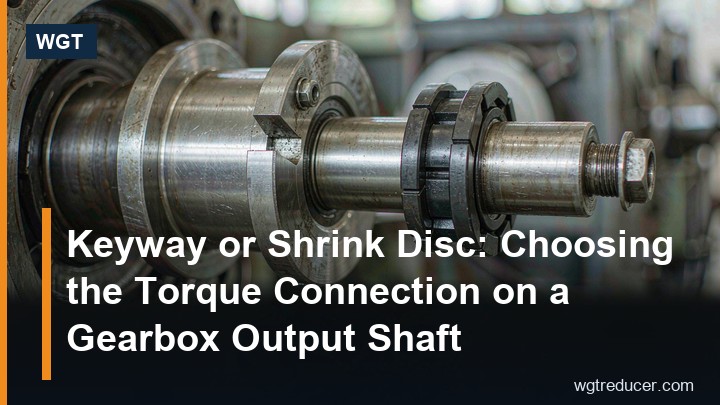
A shrink disc takes the opposite approach: no keyseat at all. The hub extends into a forged sleeve, and a tapered ring outside that sleeve is drawn inward by its clamping screws. The taper converts screw tension into uniform radial pressure, the pressure grips shaft and hub in one continuous band, and the full torque travels through friction alone. There is no notch in the shaft, no backlash in the joint, and the connection can be positioned anywhere along the shaft, not just where a seat happens to be.
The engineering benefits follow directly. A plain shaft keeps its full fatigue strength, because nothing has been cut into it. The joint is concentric by construction - pressure all round means no clearance for the hub to rock into - so runout at the driven end is smaller than any keyed assembly can promise. And because the grip is friction, the joint tolerates torque reversals and shock starts without the hammering that ruins keyseats.
The costs are equally real. A shrink disc costs more than a key, the sleeve adds diameter to the assembly, and disassembly demands a method: the screws are released in sequence, and on stubborn joints the disc's own jacking threads do the work. Fitting also asks for cleanliness and even screw torque, because an oiled taper or an uneven bolt pattern shows up as grip that is not quite what the rating table assumed.
Where Each Connection Wins
| Situation | Keyed connection | Shrink disc |
|---|---|---|
| Small to mid torques on a straight run | Natural choice - cheap, familiar, everywhere | Usually more than the duty needs |
| Shock, reversing or frequent starts | Key hammers; seat wear to watch | Friction grip absorbs reversals cleanly |
| Long pulley overhang with bending | Keyseat notch reduces shaft fatigue margin | Plain shaft keeps full strength |
| Positioning along the shaft | Must land on the cut seat | Anywhere the sleeve fits |
| Runout-critical driven machine | Clearance-dependent | Concentric by construction |
| Field service by general crews | Keys and seats are universal | Needs sequence and clean faces |
| Spare shaft in stores | Any shop can cut the seat | Must keep the plain diameter drawing |
The table, like all tables, flattens one nuance: the two are not rivals so much as different answers to "where does the torque cross, and how do we want it to fail". Many medium drives use both in one train - a shrink disc at the gearbox output and a keyed coupling at the motor - without any contradiction at all.
The Failure Modes Worth Knowing
Keyed joints fail in three predictable ways. Creep is the quiet one: a hub under torque reversals inches along the shaft until the alignment drifts and the key starts carrying work it was never sized for. Seat wear is the loud one's early warning - a knocking that grows with every start as the clearance widens. And key shear is the honest one: a jam arrives, the key gives its life, and the train is spared. Each has the same root cause more often than not - a fit that was assembled loose or a key that was undersized - and the same fix: restore the fit, not just the key.
Shrink discs fail differently, which is to say slowly. Fretting at the friction faces shows first as a fine rust dust at the joint edge and a faint knock that grows by the month; it means the clamping pressure has fallen below what the duty demands. Screw relaxation follows any poor fitting job, which is why the first re-torque after commissioning - a standard step in the fitting instructions - must actually happen. Neither failure is exotic; both are found by a wrench and a torch during a routine round.
Mounting and Removal in the Real Works
A keyed assembly mounts with heat, a press or patience, and comes apart the same way. Every millwright in the world owns the skills, which is the joint's great strength in plants where maintenance is general rather than specialised. The risk is not skill but shortcuts: a hub drifted on with a hammer and hope, a key filed to fit a worn seat, a set screw leaned on to stop what the fit should have stopped.
A shrink disc mounts cold with a torque wrench and comes apart by reversing the process - no presses, no heat, no fight. On large or awkward installations that difference is worth real money: a vertical agitator hub can be fitted and removed on the bridge without craning the gearbox clear. The discipline it asks for is different in kind: sequence, cleanliness and even screw torque, checked with the wrench rather than estimated with the wrist.
Choosing for Vertical and Agitator Drives
Vertical trains sharpen the comparison. A vertical output carries bending from the impeller as well as torque, and the shaft points down into the process, where a leaking joint or a creeping hub is not a cosmetic problem. This is a large part of why so many agitator and mixer drives are specified with a solid output shaft and a shrink disc or a splitted flanged coupling: the plain shaft keeps its fatigue margin under the bending load, the concentric grip keeps the impeller track true, and the whole connection can be opened for seal service without dismantling the machine below. Our vertical parallel-shaft units - for example the MC2PVSF03 vertical gear unit for agitator drives - are built around exactly that connection logic, and the same reasoning carries to any drive where the joint lives above a live process.
Where the connection is a keyed one on a vertical line, the two habits that matter are fit discipline and the anti-creep hardware: a shaft nut or a clamp collar taking the axial position, and a fit assembled to the drawing rather than to feel.
Sizing Checklist Before You Order
The connection is chosen with four numbers and one story. The four numbers: the torque the joint must carry, including the peak; the shaft diameter and the hub's capacity to accept the sleeve or the seat; the bending load the shaft sees, if any; and the runout the driven machine will tolerate. The story is the duty: starts per day, reversals, shocks, and who will service the joint in five years. Send those lines with the gearbox enquiry and the connection is settled in the same pass as the frame size.
The frame itself follows the same arithmetic from the other end. Work the motor speed, target output speed and required torque through the rating table - the online selection system walks the same steps - and confirm the service factor against the duty class before committing. A connection oversized by one step costs a little; a joint undersized by one step costs a shutdown.
Questions We Hear Most Often
Can I add a key as a back-up to a shrink disc? Occasionally, on heavy shock duties, a light key is fitted to take overload - but only where the supplier's drawing shows it, because a keyseat in a shaft that was meant to stay plain undoes the fatigue benefit the disc was bought for.
Which connection suits frequent removal? A shrink disc, comfortably. It comes apart cold, on schedule, with hand tools - while a large interference-fit keyed hub may want heat and a press every time.
Does a shrink disc need special storage? Only ordinary care: faces clean and oiled lightly, screws free, the taper protected from rust. A disc that has sweated in a damp container for a season is the most common cause of a difficult first fitting.
How tight should the clamping screws be, really? To the figure in the fitting instruction, in sequence, with a calibrated wrench, and re-checked after the first running period. There is no wrist-calibrated alternative that survives contact with a real duty.
