


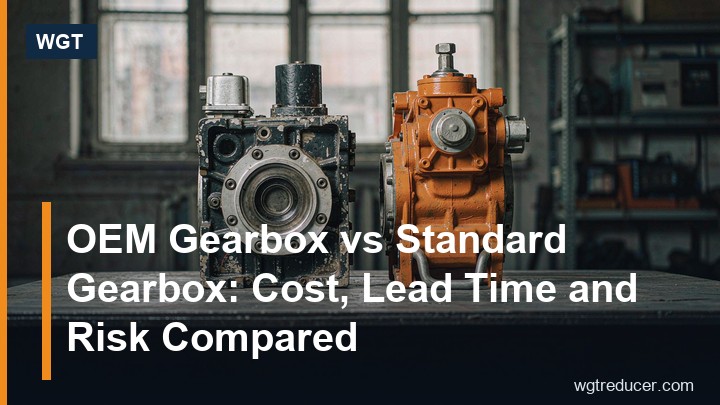
OEM Gearbox vs Standard Gearbox: Cost, Lead Time and Risk Compared
Every gearbox buyer eventually stands at the same fork. One road leads to a standard catalogue unit: a frame the factory has made hundreds of times, with published ratings, known dimensions and a price everyone can check. The other leads to a made-to-drawing machine - what the trade shorthand calls an OEM build - engineered around one application, one shaft arrangement, one set of interfaces. Both roads end at a working drive. What separates them is how much of the engineering the buyer does before the order and how much risk arrives with the crate.
The honest answer is that neither option is universally right. Machines built by the thousand are standard-gearbox country; machines built by the ten, or rebuilt once at midnight, are where made-to-drawing work earns its keep. This page sets out where the money, the calendar and the risk actually sit on each road, so the choice is made on the purchase order rather than discovered at commissioning.
What Each Option Actually Means
A standard gearbox is a catalogue frame: a defined series, a defined set of ratios, published thermal and mechanical ratings, and mounting dimensions the manufacturer holds stable for years. Selection is a matching exercise - torque, speed, mounting, environment - against a table that already exists. The factory is not really making a gearbox for the buyer; it is shipping the buyer the next one off the line.
A made-to-drawing unit starts from the driven machine instead of the catalogue. The shaft may be longer, the flange may match an old housing, the ratio may sit between two catalogue steps, and the lubrication may answer a specific angle of installation. The factory designs, checks and builds one configuration that exists for this buyer. The engineering is not free and the schedule is not instant, but the result fits a machine that no catalogue was written for.
How the Cost Really Compares
The list price of a made-to-drawing unit is higher - that part is simple. What complicates the comparison is everything around the price: the engineering hours the buyer spends adapting a standard unit to the machine, the coupling or bracket that bridges the mismatch, and the cost of the stop while a modification is machined. A fair comparison counts the whole installed system, not the gearbox line alone.
| Cost element | Standard catalogue unit | Made-to-drawing unit |
|---|---|---|
| Unit price | Catalogue level, quote in days | Higher - engineering is priced in |
| Adaptation work | Buyer side: brackets, couplings, shims | Mostly designed out at the drawing stage |
| Spares pattern | Shared across many frames | One configuration - spares held per machine |
| Cost of a late mismatch | Appears at installation, paid in downtime | Caught at drawing review, paid in emails |
On long production runs the standard unit almost always wins the arithmetic: the adaptation is amortised over years and the catalogue price keeps paying dividends. On a one-off machine, or a retrofit where the interfaces are unusual, a single drawing review can remove weeks of adaptation work, and the higher unit price buys back the difference before the drive is even running.
Lead Time: Which Road Is Faster
The intuitive answer - standard is fast, custom is slow - is usually correct and occasionally wrong in an instructive way. A standard frame ships from stock or short production, so for a common configuration nothing beats it. But a made-to-drawing unit is a plan, not a gamble: the drawing review locks dimensions before metal is cut, and what arrives is right the first time.
A standard unit that turns out not to fit is not fast at all. It is fast twice - once when ordered and once when the adaptor plate, the special coupling and the second shipment have each taken their turn in the queue. Plants that have lived through that sequence stop asking only "how long until it ships" and start asking "how long until it turns". The two numbers can differ by more than the entire lead time of a made-to-drawing build.
The Risk Ledger on Each Side
Risk is where the comparison gets interesting, because the two options fail differently.
- Standard unit risks: a rating read optimistically from the table; a mounting adaptation that introduces its own misalignment; a thermal margin that assumed winter; obsolescence when the series is revised years later.
- Made-to-drawing risks: a specification that captured the duty incorrectly at the start; a single-source dependency on one factory's drawing; a spares plan that lives in one machine's file instead of the industry's catalogue.
Note the shape of the two lists. Standard-unit risks concentrate at installation and in the first months of running; made-to-drawing risks concentrate at specification time and at the end of life. Neither list is longer in general - but each is longer for a particular kind of buyer. A plant with strong drawing discipline and a stable machine population manages specification risk well and should lean toward made-to-drawing where the application demands it. A plant buying many drives of common types is better served by staying on the catalogue and letting volume carry the risk.
Where Made-to-Drawing Work Pays for Itself
Certain situations push the decision almost by themselves.
| Situation | Why the standard catalogue struggles |
|---|---|
| Retrofit into an existing machine | Interfaces are legacy dimensions no catalogue carries |
| Unusual installation angle or environment | Ratings and lubrication assume catalogue conditions |
| Ratio between catalogue steps | A non-standard ratio can save a whole transmission stage |
| Space envelope with hard limits | The case must fit the machine, not the other way round |
| Combined functions on one shaft | Integrating two drives removes couplings and misalignment sources |
Retrofits deserve a particular word, because they are the most common of the five. An existing machine has shafts, bolt circles and centre heights that were decided decades ago by someone who is no longer reachable. Making a new drive fit that reality by adapting a standard unit is possible, and often wise; but when the adaptation list grows past a page, a made-to-drawing unit designed around the legacy dimensions is usually the cheaper and shorter route.
How to Buy a Made-to-Drawing Unit Well
The quality of a made-to-drawing gearbox is decided almost entirely before production starts. The buyer's job is to hand over a complete duty statement: the driven machine and its duty cycle, the motor data and starting method, the output torque and speed with their tolerances, the installation geometry and angles, the environment - heat, dust, wash-down, altitude - and the maintenance expectations. A selection engineer who receives all of that returns a design, not a guess; one who receives half of it returns a question.
The review step is the second discipline. Drawings come back for approval, and the buyer who checks shaft ends against hub drawings, bolt circles against the machine, and sealing arrangements against the environment at this stage has bought every problem early, while it is still a redline. The same check missed here reappears at installation, wearing steel toes and a crane ticket.
For buyers working through the sizing themselves before the conversation, the online selection system at the WGT 3D selection platform takes power, speed and mounting inputs and returns candidate frames - a useful reality check on whether the duty actually needs made-to-drawing work or whether a standard frame closes the case.
How to Buy a Standard Unit Well
Buying standard has its own disciplines, and they are mostly about reading the catalogue honestly. The mechanical rating must be checked against the service factor the duty class demands, not against the smooth running point; the thermal rating must be checked against the real ambient, not the laboratory's; and the mounting arrangement must be confirmed to the driven machine's actual interfaces. None of this is difficult, and all of it is skipped somewhere in the world every day, which is why the standard gearbox has such a rich folklore of "it failed in three months" stories that are really specification stories.
The second discipline is continuity. Standard series get revised, and a drive specified today should be ordered with the knowledge of what its spares path looks like in a decade. Frames with a long, stable production history - like the units in the M series industrial gearboxes - make that continuity part of the purchase, because the seal sizes, oil grades and mounting dimensions stay put while the catalogue around them moves.
A Decision Framework Buyers Can Actually Use
Strip the question down and three numbers decide it: how many machines, how unusual the duty, and how long the fleet must live. Many machines with ordinary duty and long life point to standard frames bought on a considered specification. Few machines with unusual interfaces point to made-to-drawing work entered with a complete duty statement and a disciplined drawing review. The middle ground - a handful of drives, mildly special duty - is where most buyers live, and the practical rule there is to price the adaptation honestly before pricing the alternative.
Buyers who want a second opinion on which road a particular duty belongs to can send the driven-machine details and duty statement through the contact page and get the arithmetic back with the quotation - including the option of a standard frame where one genuinely fits, which is the mark of a supplier selling drives rather than drawings.
Frequently Asked Questions
Is a made-to-drawing gearbox always more expensive over its life?
No. It is more expensive on the purchase order. Over the life of a machine with unusual interfaces, the avoided adaptation work, avoided second shipments and avoided downtime can put the total cost below a standard unit that was bent into place. The comparison that matters is installed cost plus ten years of spares and stops, not the invoice.
How long does a made-to-drawing unit take compared with a standard frame?
A standard frame ships in days to weeks. A made-to-drawing build typically adds drawing review and design time before production - realistic total lead times are a matter to agree up front, and a good supplier states them with the quotation rather than after it. What the custom route removes is the risk of a second, unplanned delivery cycle caused by a mismatch.
Who owns the drawings of a made-to-drawing gearbox?
It depends on the contract, and the answer should be in it. Buyers who intend to source spares against the drawings for the machine's life should say so at order time; manufacturers who intend to keep design ownership should price the unit accordingly. Either position is workable - an unclear one is not.
Can a standard gearbox be modified instead of buying made-to-drawing?
Often, within limits: shaft ends, flanges, sealing and lubrication arrangements are common modification points, and a factory modification keeps the series' ratings and spares pattern intact. The discipline is the same as for a full custom build - get the modified dimensions onto an approved drawing before production, so the change is engineered rather than improvised.
