


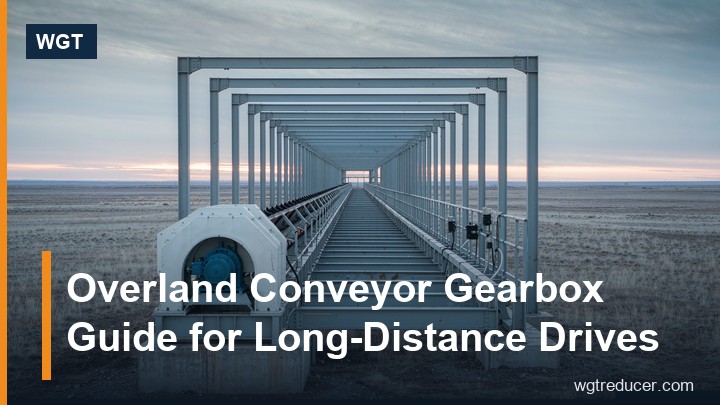
Overland Conveyor Gearbox Guide for Long-Distance Drives
An overland conveyor gearbox has one job the catalogue never shows: it turns a landscape into a production line. The belt may run for a kilometre or more between a mine and its plant, and every kilogram on that belt reaches the drive as tension, then as torque. Size the gearbox for a power figure alone and the route will correct the mistake - usually on a wet night, months from anywhere.
This guide covers overland conveyor gearbox selection the way the route actually imposes it: what belt tension means at the drive shaft, how decline sections return power, why a loaded restart is the duty's real design case, and what a remote site must plan around the gearbox so its worst day stays short.
What an Overland Conveyor Asks of Its Drive
Short conveyors are sized mostly by motor power. Overland conveyors are sized by tension. A belt a kilometre long carries its own weight along every metre, plus the material, and the drive station is where all of that resolves into shaft torque. The gearbox therefore works against two numbers at once: the steady pull of a fully loaded run, and the surge that travels down the belt every time the drive starts, stops or sheds load.
Three consequences follow for the gearbox. First, the torque is slow and wide: overland drives run at low shaft speeds, so gear teeth and bearings spend their life at high load per revolution. Second, the load is directional and well understood - which is good news, because a drive specified against a real tension curve behaves predictably for decades. Third, the drive station is usually far from help, so every component inside the case was chosen for a life without daily attention.
Reading the Route Before Choosing the Frame
The route writes the specification. Length, profile, tonnage and climate all arrive at the gearbox as numbers, and the enquiry that collects them honestly is worth more than any brochure comparison.
| Route fact | What it changes in the drive | What goes wrong if ignored |
|---|---|---|
| Belt length and lift/fall profile | Tension at the drive shaft, brake and holdback decisions | Gearbox sized for average load fails at the loaded restart |
| Steady and peak tonnage | Service factor and bearing life | Early pitting on teeth that looked adequately sized on paper |
| Decline fraction of the route | Power return, braking scheme, reverse-flank loading | A flat-run specification on a falling route runs hot and surprises everyone |
| Climate and altitude along the line | Oil grade, heaters, seals, paint, motor derating | Cold-season starts grind thick oil; UV and dust age seals early |
| Who services the drive, how often | Spares plan, monitoring package, access design | Minor seal weeps become major outages because nobody was there to see them |
A useful habit is to treat the route description and the gearbox enquiry as the same document. When the belt engineer's profile drawing and the drive order say the same things, the frame that arrives is the one the landscape needs.
Tension, Torque and the Drive Station
Between the belt and the gearbox stands the drive station: pulley, couplings, steelwork and the reaction path. The gearbox sees the belt's tension as torque at its output shaft, and it sees the same tension as load through its feet or torque arm into the structure. Both paths matter.
The output torque follows from belt tension and pulley radius - a relationship worth checking by hand rather than trusting to a single line in a quotation. The reaction path follows from geometry: a shaft-mounted unit pushes its torque into a bracket, and that bracket works against real steel. On overland drives the loads are large enough that "attach it to something solid" becomes an engineering item with drawings, not a fitter's judgement on the day.
Drive station layout also decides the next twenty years of maintenance. Room to pull the coupling, access to oil drains and level plugs, lifting points above the gearbox, and a floor that can hold an oil drum are all cheap at design time and expensive to improvise later.
Decline Sections and Power That Comes Back
Where the route falls, the material drives the belt. A loaded decline returns energy through the drive train, the motor slips into generator duty, and the gearbox runs in a state no flat conveyor ever sees: torque reversed, teeth loaded on their opposite flanks, and the whole train held between the load above and the braking scheme below.
This is not an abnormal condition - on many overland routes it is the majority duty. The specification must therefore say it plainly: which part of the route falls, at what tonnage the return becomes continuous, and how the electrical system absorbs the returned power. Mechanical details follow from that truth - holdback or backstop choices, brake sizing against the worst believable stop, and a gearbox whose reverse-flank loading was part of the rating rather than a surprise.
Sites that hide the decline from the drive order always meet it again later, as hot brakes, loose base bolts and a gearbox that wears in ways its datasheet cannot explain. The decline is not the problem; the unspoken decline is.
The Loaded Restart: The Real Design Case
The hardest minute in an overland drive's week is the restart of a fully loaded belt. Every metre of belting is stretched and sagging, the material sits where the trip left it, and the motor is asked to bring the whole moving mass to speed without sending a tension wave down the route. The gearbox experiences that start as a long, deep torque pulse - different from a shock spike, and harder on press-fits, keys and bolted joints.
Good installations make the loaded start boring. Soft starting or variable-speed ramps let the tension wave settle as the belt accelerates. Acceleration curves are agreed between the electrical and mechanical sides rather than defaulted. And the gearbox service factor is argued from this event - the one that happens every trip - rather than from the gentle average of a full-speed run.
The test is simple to state. If restarts are boring, the specification was right. If every restart is a small drama of smell, sound and reset buttons, the drive is living on margins it was never given.
Braking, Holding and Where the Energy Goes
Stopping a loaded kilometre means parking its kinetic energy somewhere. Controlled stops spread the absorption across time; emergency stops concentrate it into seconds; and holds on inclined or declined routes must keep the load still indefinitely. The gearbox sits in the middle of every one of those events, so the braking plan is a gearbox specification whether or not anyone says so.
The practical checklist is short. Brakes sized for the worst credible stop, not the average one. Heat sinks - discs, drums or the grid itself - chosen for the energy the route actually produces. Backstops or holdbacks selected against the heaviest reversed load the decline can deliver. And a rule that repeated trips are investigated rather than reset, because each unexamined emergency stop is a full-price wear event the gearbox pays for.
Remote Service: Planning Around the Box
A plant gearbox breaks down into a walk down the corridor. An overland conveyor gearbox breaks down into a logistics plan. The difference is not the gearbox - it is the distance between the failure and the people, tools and parts that fix it.
Remote service autonomy is built before the drive ships. The drive station gets room to work, lighting, lifting points and access to every plug and bolt. Consumables get a shelf on site: seal sets, breathers, fasteners in the correct grade, and oil in enough volume for a full change, held clean and sealed. Special tools listed in the gearbox documentation are bought once and stored where the drive lives, not where the office is. And the site writes down who attends the drive, how often, and what they check - because a maintenance plan that lives only in someone's head does not survive staff changes.
Sites that run this discipline measure gearbox downtime in shifts. Sites that improvise measure it in weeks, and the gearbox itself is rarely the reason.
Monitoring a Drive Nobody Passes Daily
On a plant floor, someone walks past the gearbox every shift and hears trouble before instruments do. On an overland run, nobody passes - so the drive must report through instruments. Sump temperature, vibration at bearing positions, oil condition and motor current all feed the same log, and the log is reviewed against a baseline captured when the drive was new.
The value is in trends, not alarms. A sump temperature that climbs a degree a month says more than an alarm on the day of failure. A vibration signature that shifts after a storm says the route took a hit worth investigating. Even a simple weekly read of temperature and level, recorded rather than glanced, turns a silent drive into a documented one.
When an overland conveyor gearbox is specified, the monitoring package belongs in the same order as the frame - instruments fitted at the factory cost a fraction of retrofits at altitude.
Writing the Enquiry for an Overland Drive
The enquiry that gets the right frame reads like a route description with numbers attached. Head shaft diameter, keyway and seat length. Belt length, lift and decline profile. Steady and peak tonnage. The start and stop plan, with its electrical scheme named. Climate and altitude along the route. The service reality: who attends, how often, with what. And the steel available at the drive station for reaction loads.
The reply should answer each line rather than summarize around them: bore and keyway against the drawing, ratio and speed at the pulley, service factor defended against the loaded restart, braking and regeneration addressed by name, oil and seals graded for the worst month on the route, and the monitoring package listed instrument by instrument. That exchange takes a page and prevents the most expensive kind of discovery - the kind made at the far end of a loaded belt, in the rain, with the plant waiting.
If you are sizing a drive for a long run now, our online selection system cross-checks ratio, torque and service factor in minutes - and for a worked example of a hollow-bore frame on a remote overland duty, see the MC2RLHF07 right-angle hollow shaft gear unit page, where the bore, bracket and service-factor logic for long runs is laid out.
Frequently Asked Questions
What size gearbox does an overland conveyor need?
Size from the route, not the motor nameplate. Belt tension at the drive pulley, converted to torque through the pulley radius, sets the duty; the steady figure sets bearing and gear life, and the loaded restart sets the service factor. A drive chosen on power alone will usually be undersized in exactly the events that matter - starts, stops and decline running.
How does a decline overland conveyor affect the gearbox?
On falling sections the material drives the belt, so power flows back through the drive train: the motor generates, and the gearbox runs with torque reversed, loading the opposite gear flanks. The braking scheme, holdback and monitoring must all be specified for this duty. A gearbox sold as a flat-run unit on a real decline will wear in ways its datasheet cannot explain.
Why is the loaded start harder than continuous running?
During a restart the whole moving mass of belt and material must be accelerated from rest, and the tension wave from the drive travels the belt's length. The gearbox sees a long, deep torque pulse rather than steady load - hard on press-fits, keys and bolted joints. Soft-start ramps that let the wave settle are part of the mechanical design, not an electrical nicety.
How often should an overland conveyor gearbox be serviced?
Interval follows duty and remoteness, not the calendar alone. As a baseline: oil level and temperature read and recorded weekly, oil sampled at intervals the duty earns (typically every few months on continuous heavy duty), seals and breathers inspected at each visit, and a full internal check at the plant's planned stop. Remote sites service to plan rather than to symptom, because symptoms are easy to miss when nobody passes daily.
Can one gearbox design suit both plant and overland conveyors?
The gear technology is similar, but the specification is not. Overland duty adds route profile, power return, large loaded restarts and remote service to the same basic helical-bevel torque problem - which is why the enquiry, the braking scheme, the spares shelf and the monitoring package all look different even when the frame looks familiar. Specify the route, and the right frame follows.
