


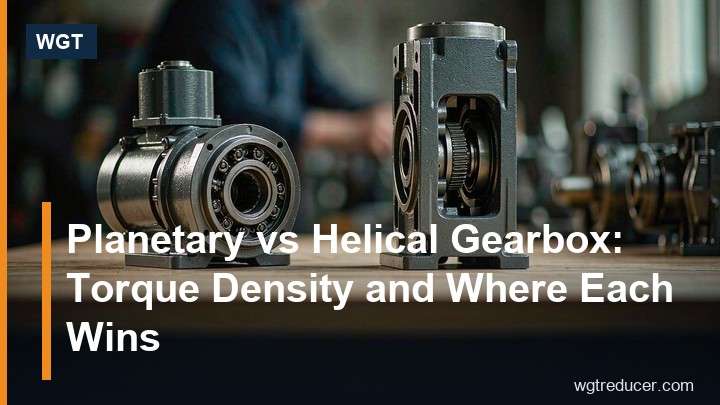
Planetary vs Helical Gearbox: Torque Density and Where Each Wins
A planetary gearbox wins on torque density and coaxial alignment; a helical gearbox wins on simplicity, ratio span in a single train and cost at moderate torque. The decision is rarely about which technology is better - it is about whether the space around the driven shaft is the binding constraint, and whether the duty punishes a load path that shares torque across several planets.
This comparison works through the four things that actually decide a selection: torque density, ratio range, efficiency and behaviour under shock. It closes with a table you can take to an enquiry.
How the Two Layouts Carry the Load
A planetary unit places a sun gear at the centre, a ring gear on the inside of the housing, and three or more planet gears between them, carried in a rotating carrier. Motor torque enters the sun and leaves through the carrier, and because every planet shares the tangential load, the tooth forces on any one mesh are a fraction of the total. That is the whole source of the layout's torque density: the same housing volume can transmit far more torque when the load is divided across several meshes rather than carried by one.
A helical unit is a train of parallel shafts, each pair of gears carrying the full torque of that stage. Two or three stages sit side by side in a cast case, and the shaft centrelines are offset from one another. Load per tooth is higher, the case is longer, and the input and output shafts are not coaxial unless the layout is designed that way.
Neither arrangement is an accident of manufacturing. Each is a different answer to the same question: how do you reduce speed while keeping tooth stress, bearing load and heat inside limits the materials can survive.
Torque Density: Where the Numbers Come From
Torque density is output torque per unit of gearbox volume or mass. Planetary units generally lead here, and the margin grows with size, because the number of planets and the width of the planet gears can be increased without making the housing longer.
| Characteristic | Planetary gearbox | Helical gearbox |
|---|---|---|
| Load path per tooth | Shared across 3 or more planets | Full stage torque on each mesh |
| Shaft arrangement | Coaxial in and out | Offset; parallel shafts |
| Typical torque density | Highest per unit volume | Moderate; rises with frame size |
| Ratio per stage | Roughly 3:1 to 10:1 | Roughly 3:1 to 6:1 |
| Efficiency per stage | About 97 percent, slightly lower at high ratio | About 97 to 98 percent |
| Backlash | Can be built very low with preloaded planets | Moderate; depends on gear quality |
| Overhung load capacity | Poor at the output; needs a bearing support | Good; output shaft designed for it |
| Service access | Bearings and planets need a trained fitter | Simple; gears visible under the cover |
| Relative cost at equal torque | Higher below about 5 kNm | Lower across the common range |
The last row is where most projects actually decide. Planetary advantages in density translate into cost only when the alternative would need a much larger helical frame, and that crossover sits at different torques depending on how the driven machine is mounted.
Ratio Range and Stage Count
A single planetary stage covers roughly 3:1 to 10:1, and stacking stages multiplies the ratios. Two stages reach the low hundreds, three stages reach well beyond that, and the whole train stays coaxial, which is why planetary units appear in wheel drives, winches and travel gears where the motor must sit in line with the driven shaft.
A helical train covers a similar ratio per stage but reaches the same total with a longer case. Where the ratio requirement is modest - say 10:1 to 40:1 - a two-stage helical unit is usually the cheaper and cooler answer. Where the ratio pushes past 100:1, a three-stage helical unit works but grows long, and that is the point where a planetary or a combined layout starts to make sense on space grounds.
The practical rule: compare the two layouts on the outline drawing before comparing them on price. A ratio that forces a helical case 400 mm longer than the available space is not a cheaper option, whatever the quotation says.
Efficiency, Heat and Backlash
Both layouts are efficient by the standards of mechanical drives, and the differences are small enough that they matter mainly in continuous duty.
A helical mesh typically loses one to two percent per stage to sliding and churning. A planetary mesh is comparable, but the planet bearings add a small allowance and the losses rise at high ratios where the relative speed between sun and planets climbs. In a three-stage unit of either type, expect a few percent overall, and expect the losses to appear as heat in the oil.
Backlash is a different story. A planetary set can be built with preloaded or split planets to remove almost all free play, which is why it dominates in positioning duties - indexing tables, tool changers, antenna drives. A helical unit can also be built to tight backlash, but the cost rises steeply and the result is still limited by the number of meshes in the train.
If the machine needs accurate positioning after a stop, that difference decides the layout. If the machine needs to move material from one place to another, it does not.
Shock, Overhung Load and Shaft Stiffness
Here the helical layout often takes the lead, for a reason that has nothing to do with gear strength.
A planetary output is a rotating carrier with the load split among several pins. It handles pure torque well and overhung load poorly: a chain sprocket or a large pulley mounted far out on a planetary output puts a bending moment into a bearing arrangement that was never designed for it. Most planetary installations solve this with a separate bearing pedestal, which adds a component and an alignment step on site.
A helical unit's output shaft runs in bearings sized for a defined overhung load at a stated distance. That is exactly what a conveyor head pulley, a screw conveyor or a mixer shaft imposes. The result is a drive that can be coupled without extra support, which shortens installation and removes a failure point.
Shock is more even. Both layouts cope with starting torque above running torque, provided the service factor reflects the starting condition. What differs is where the shock lands: in a planetary unit it distributes across planets and their pins, which is benign until the pins and the carrier bores take the wear; in a helical unit it lands on one mesh and one pair of bearings, which is easier to inspect and easier to rebuild.
Where Each Layout Wins in Practice
Planetary units tend to win where the drive must be compact and coaxial: mobile equipment, winches, travel drives on cranes and stackers, screw jacks, and any machine where the motor has to sit inside the machine envelope. They also win in high-ratio, low-speed duties where a helical train would be unreasonably long.
Helical units tend to win on fixed plant: belt conveyors, screw conveyors, mixers, agitators, pumps and fans, where the drive sits on a bedplate, the shaft imposes an overhung load, and a maintenance team needs to inspect and rebuild with ordinary tools. A foot-mounted three-stage helical unit such as the MC3PLSF03 parallel shaft gear unit is the typical answer for a slow conveyor or an agitator at moderate torque, and a two-stage inline unit such as the R87 helical gearbox covers the moderate-ratio band at lower cost.
A Selection Sequence That Settles the Question
Work through these four checks in order; most projects stop at the first or second.
- Outline space. If the drive must be coaxial with the driven shaft, or must fit inside a machine envelope, the planetary layout is the default.
- Overhung load. If a pulley, sprocket or screw connects directly to the output, a helical unit with a rated overhung capacity removes the need for a support bearing.
- Ratio. Above roughly 100:1, compare case length and mass before comparing price; the shorter unit often wins on installed cost.
- Duty and maintenance. Fixed plant with an in-house maintenance team favours the layout that can be opened, inspected and rebuilt on site.
Once those four are answered, the remaining choice is frame size, which follows from torque and service factor rather than from layout. Running the numbers takes a few minutes in the online selection system, and sending the result with the enquiry removes most of the back-and-forth that precedes a firm offer.
Frequently Asked Questions
Is a planetary gearbox always more efficient than a helical gearbox?
No. Per stage the two are close, with helical units usually a fraction of a percent ahead at moderate ratios. Planetary efficiency falls slightly at high ratios because the relative speed at the planet bearings increases. In a multi-stage unit the difference is small compared with the effect of oil viscosity, fill level and cooling.
Why is a planetary gearbox more expensive at low torque?
Because the housing, carrier and planet pins carry cost that does not shrink in proportion to the torque rating. At low torque a simple two-stage helical unit does the same job with fewer parts and a simpler casting. The planetary layout becomes competitive when its density advantage lets a project use a much smaller frame than the helical alternative would require.
Can a planetary gearbox take a belt pulley directly on its output?
It can be done, but the output bearing arrangement is usually not designed for it. A pulley mounted outboard imposes a bending moment that most planetary outputs handle poorly, and the usual fix is a separate bearing pedestal supporting the pulley, with a coupling to the gearbox. A helical unit with a rated overhung load capacity avoids that extra component.
Which layout is better for frequent starts and reversing?
Both handle it if the service factor accounts for the starting torque and the number of starts per hour. Frequent reversing puts more demand on bearings and on lubrication than on the gear teeth. State the starts per hour and whether the machine starts loaded; that information changes the frame more than the layout does.
How do I compare two quotes for the same duty?
Put both on the same basis: output speed and torque, service factor, mounting build, overhung load allowance, oil and seal specification, and trade term. A quotation that does not state the service factor behind its rating is not yet comparable, whichever layout it describes.
Send the duty point, the available space and the driven machine details, and the two layouts can be compared on the same drawing rather than on a price column. Our engineers will confirm the frame, ratio and service factor in writing before anything is ordered.
