


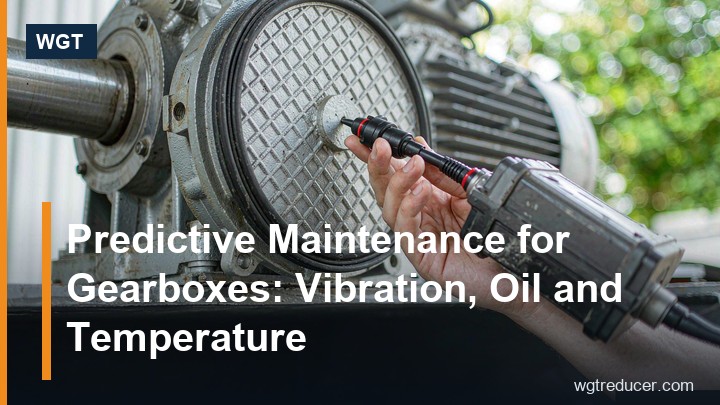
Predictive Maintenance for Gearboxes: Vibration, Oil and Temperature
Predictive Maintenance for Gearboxes: Vibration, Oil and Temperature
A gearbox rarely fails without warning. Long before a tooth breaks or a bearing seizes, the unit tells you what is coming through three channels: the vibration it emits, the condition of its oil, and the way its temperature drifts under a constant load. Predictive maintenance is the practice of reading those channels on a schedule and acting on the trend rather than the alarm. For an industrial gear unit that runs three shifts, it is usually the difference between a planned two-hour oil change and an unplanned week of lost production.
Why Gearboxes Suit Condition Monitoring
Gear units are mechanically simple but load-critical. They sit at the heart of a drive train, so when they stop, everything downstream stops with them. That combination - simple enough to instrument, critical enough to matter - is exactly what condition monitoring is built for.
The failure modes of an industrial gearbox are also well understood and each one leaves a signature. Pitting and scuffing on gear teeth raise vibration at the gear mesh frequency and its sidebands. A spalling bearing adds a distinct high-frequency burst at its own defect frequency. A slowly degrading seal raises oil contamination long before it shows up as a leak. Because these signatures develop over weeks, there is normally time to plan the intervention - provided someone is looking at the data.
Vibration: The Primary Diagnostic Channel
Vibration analysis is the most informative single technique available on a gear drive. The measurement is not complicated: a transducer on the housing, a known shaft speed, and a spectrum that separates the contributions of each rotating element.
The reading that carries the most weight is the gear mesh frequency - the shaft speed multiplied by the number of teeth. Energy growing at that frequency, or at the sidebands spaced around it, points to tooth wear or a developing crack. A rising overall vibration level alone is useful but blunt; the spectrum is what tells you which component is moving.
| Measurement point | What it detects | Typical early sign |
|---|---|---|
| Overall vibration (RMS) | General condition change | Slow upward trend across weeks |
| Gear mesh frequency | Tooth pitting, wear, misalignment | Growing sidebands around mesh frequency |
| Bearing defect frequencies | Outer/inner race, rolling element damage | Discrete high-frequency peaks |
| Time waveform | Impact events, tooth cracks | Repetitive shocks once per revolution |
| Envelope / demodulation | Early bearing faults buried in noise | Extractable defect pattern before it dominates |
The practical discipline is to take readings at the same points, at the same load and speed, and compare against a baseline taken when the unit was new. A number in isolation means very little; a trend over months means a great deal.
Oil Analysis: Chemistry and Wear Debris
Oil does two jobs at once - it lubricates the gears and it carries away the evidence of what is happening to them. Sampling that oil on a fixed interval turns the sump into a continuous health record.
Three families of result matter. First, physical properties: viscosity and water content, which tell you whether the oil is still doing its job or has been contaminated. Second, chemistry: oxidation and additive depletion, which flag when the oil itself is finished regardless of the gearing. Third, wear metals: iron, copper and chromium counts, which indicate which internal component is shedding material.
A rising iron count with a stable vibration reading typically points to a wear process that has not yet become mechanical; the oil is warning you earlier than the accelerometer can. Used together, the two channels cover each other's blind spots.
Temperature Trend: The Slowest but Steadiest Signal
Sump or bearing temperature is the easiest measurement to instrument and the easiest to ignore, which is a mistake. Under a constant load and ambient, oil temperature should sit flat. A gradual rise with no change in duty means the unit is losing the ability to dissipate heat - fouled cooling surfaces, degraded oil, or a bearing generating friction that did not exist before.
The most useful form of this measurement is a trend, not a limit. A gearbox that has run at 62 degrees Celsius for two years and now sits at 71 degrees at the same duty is telling you something, even though neither number breaches any alarm threshold. Forced cooling, where fitted, should be checked at the same time: a fouled radiator produces the same temperature rise as an internal fault, and it is far cheaper to rule out first.
Setting Up a Practical Programme
A condition monitoring programme does not have to be expensive to be effective, but it does have to be consistent. The five decisions that define it are the measurement points, the technique at each point, the interval, the baseline, and the action rule.
| Decision | Simple starter approach |
|---|---|
| Measurement points | Driver bearing, input bearing, output bearing on each critical unit |
| Techniques | Vibration spectrum + oil sample; temperature logged continuously where practical |
| Interval | Vibration monthly, oil analysis quarterly, adjusted by criticality |
| Baseline | Capture on commissioning, at known load and speed |
| Action rule | Written thresholds that trigger, at minimum, a closer look and an oil sample |
The units that earn a place in the programme first are the ones whose failure would cost the most: the primary drives on a continuous production line, the units running closest to their thermal limit, and any gearbox supporting more than one machine. A foot-mounted industrial gear unit on a busy conveyor head typically sits at the top of that list.
From Data to a Maintenance Decision
Data only pays for itself when it changes a decision. The useful output of a monitoring programme is not a chart but a work order: this unit needs an oil change this shutdown, that unit needs the coupling re-aligned, this other unit needs a replacement scheduled before the next campaign.
Three levels of response keep the programme proportionate. Normal readings mean continue on the standard interval. Readings trending toward a threshold mean increase the sampling frequency and put eyes on the machine. Readings that cross a threshold mean schedule the intervention at the next realistic opportunity rather than waiting for the failure. The gap between the second and third level is where most of the value sits - it is the window in which a planned stop replaces an unplanned one.
Frequently Asked Questions
How often should a gearbox be vibration-monitored?
Monthly vibration readings at fixed points are a reasonable starting interval for most industrial gear drives. Units that are process-critical, or that are already showing a rising trend, may justify weekly or even continuous monitoring through permanently mounted sensors.
Is oil analysis or vibration analysis more important?
Neither replaces the other. Vibration reads mechanical damage developing in gears and bearings; oil analysis reads chemical degradation and wear debris that has not yet become mechanical. Running both on different intervals gives early warning from two independent directions.
What is a normal operating temperature for an industrial gearbox?
It depends on the unit, the oil and the ambient, which is why a trend is more useful than an absolute limit. Confirm the expected running temperature with the manufacturer for your duty and ambient, then watch for any sustained rise at constant load.
Can I start condition monitoring without expensive equipment?
Yes. A handheld vibration meter, a written log of readings at marked points, and a quarterly oil sample sent to a laboratory will catch the majority of developing faults on a small population of critical drives. The consistency of the measurements matters more than the sophistication of the instruments.
What information do I need to select a gearbox that is easy to monitor?
State the driven machine, the motor power and speed, the required output speed and the running profile. Also confirm the mounting and shaft arrangement, because bearing access and sensor placement differ between foot-mounted and shaft-mounted builds - the selection tools on our online parameter selector start from motor speed, output speed and torque and produce a frame candidate you can then discuss against the outline drawing.
Putting It to Work
Condition monitoring is not a product you buy once; it is a habit of looking at three numbers on a schedule and acting on what they say. Start with the gearboxes that hurt most to lose, capture a baseline while the unit is new, and let the trend do the diagnosis. If you are specifying a new drive and want the mounting and bearing layout to support easy monitoring from day one, send us the duty data and we will confirm the frame, ratio and arrangement in writing. Every industrial gear unit we supply ships factory-tested with a one-year warranty, and our engineers are glad to walk through the monitoring points before commissioning.
