


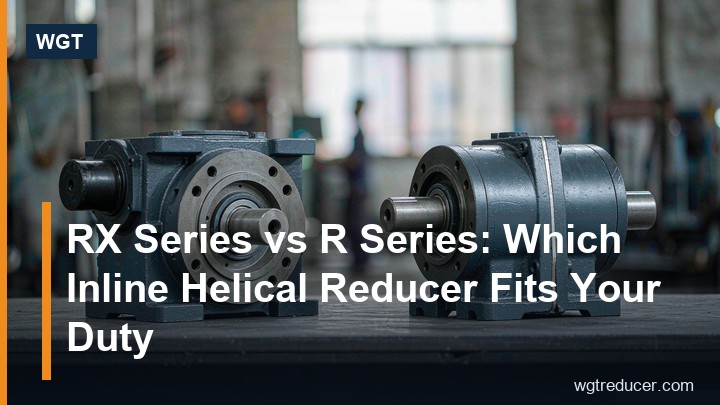
RX Series vs R Series: Which Inline Helical Reducer Fits Your Duty
Buyers comparing the RX series against the R series are usually looking at two inline helical gear units that look almost identical on a dimension sheet: same coaxial layout, same foot or flange mounting language, same solid or hollow output choices. The differences sit in the frame sizes, the torque bands and the way each family is positioned in the market. Picking the wrong one rarely fails immediately - it just costs more than it should, or leaves no room to grow. This guide walks through both families side by side and gives a decision path that ends in one frame number.
Where the Two Families Sit
The R series is the standard inline helical range, built from frame 17 up to frame 167 in two- and three-stage versions. It is the workhorse of the industry: conveyors, mixers, agitators, pumps, hoists - any duty where the motor can sit in line with the driven shaft. The RX series covers the smaller end of the same coaxial geometry, typically frames 57 through 157, and is positioned as the economical inline choice for moderate torque and continuous light-to-medium duty.
That positioning has practical consequences. An RX unit at a given centre distance usually carries less peak torque than its R counterpart, and the housing details are simpler. For a duty inside its band, the RX delivers the same speed reduction at a better price; for a duty near or above the band, no amount of price advantage saves an undersized housing.
Comparing the Two at a Glance
| Aspect | R series | RX series |
|---|---|---|
| Layout | Coaxial helical, 2-3 stages | Coaxial helical, 2-3 stages |
| Frame span | 17 - 167 | 57 - 157 |
| Torque band | Widest of the inline families | Mid band, lighter duty |
| Mounting | Foot, flange, shaft-mounted | Foot, flange |
| Typical duties | Conveyors, mixers, hoists, process drives | Light conveyors, stirrers, fans, small pumps |
| Price position | Standard industrial | Economical inline |
Both families share the fundamental advantage of the coaxial layout: every stage is a parallel-axis helical mesh, so efficiency stays high, noise stays low, and the motor bolts straight onto the input flange without a coupling or a foundation for a separate motor base.
How the Frame Codes Read
Both designations work the same way: letters name the family and the geometry, the two-digit number names the housing. An R37 and an RX37 do not share a foot pattern - the RX frame is its own casting with its own dimensions - so a drawing for one will not fit the other. The suffix logic matches across families: F for foot-and-flange builds, H for hollow output, and combinations in between.
The practical rule is that the frame number selects the casting, and the ratio is chosen separately within that casting's span. Two units of the same frame with different ratios share the same mounting interface, which is why standardising on one frame per duty class pays off across a plant.
Sizing: Same Method, Different Ceiling
The sizing method is identical for both families. Start from the duty, not from the motor nameplate:
T (N·m) = 9550 × P (kW) / n (rpm)
Take the power the machine absorbs at the driven shaft, the output speed you need, and the service factor the application demands. Multiply the working torque by that service factor and compare it against the family's rating table. The R series table runs further to the right - larger frames, higher peak torque, heavier bearing sets - so a duty that falls off the bottom of an R chart at frame 17 may fit comfortably on an RX chart at 57.
Three checks decide the family:
- Peak torque including service factor. If the figure sits inside the RX band, the RX wins on price. If it sits above, move to the R series; do not overspeed an RX unit to chase torque.
- Thermal rating. Continuous high-torque running heats the housing. The R series carries more oil and more housing mass, so it holds thermal balance on harder duty cycles.
- Overhung load at the output. Chain sprockets and belt pulleys load the output shaft sideways. The heavier R frames accept more of it, and the shaft-mounted builds spread it into the driven shaft itself.
When the RX Series Is the Right Answer
Choose the RX series when the duty is continuous but moderate, the driven machine is light, and the drive runs a predictable cycle. Packaging lines, small belt conveyors, agitators on thin liquids, fans and rotary screens are the classic fits. On these duties the RX gives the same life expectancy at a noticeably lower first cost, and its simpler housing keeps spares cheap.
It is also the natural choice where footprint matters more than peak capacity: the RX frames keep the coaxial length short without giving up the bolt-on motor flange. A machine builder who standardises on one or two RX frames across a product line simplifies both procurement and field service.
When the R Series Takes Over
Step up to the R series when any of these appears: shock or reversing loads, frequent starts, high ambient temperature, an overhung load near the family limit, or a duty that may grow. The R series' wider frame span means growth stays inside the family - a plant that begins at frame 47 and later needs more torque moves to 57, 67 and upward on the same mounting language, rather than switching families mid-project.
For heavy process duty the R series is also the better spares story. Its larger frames share seals, oil quantities and fitting tools with the bigger industrial builds, so maintenance teams that already run large gear units need no new procedures. A typical plant example: a 5.5 kW mixer drive at 40 rpm continuous with soft starts fits an RX frame with margin; the same mixer on a viscous batch product with frequent starts belongs on an R frame, where the service factor headroom is real capacity rather than paper.
Mounting and Options Compared
Both families offer foot mounts, torque-arm-free flange builds and keyed solid shafts; the R series adds shaft-mounted builds with a torque arm for conveyors where a bore over the head pulley shaft removes the base frame entirely. Hollow-shaft options appear in both, and both accept standard IEC or NEMA motor flanges.
On options that cost money later, the honest comparison is short: neither family hides surprises. Oil grades, breathers and backstops are catalogued in the same way, and the same installation discipline applies - plinth flatness, bolt torque in sequence, correct oil line at rest, breather upright. An inline unit installed on a dished plinth misloads its bearings exactly like any other gear unit.
A Short Decision Path
Work the choice in this order:
- Compute working torque and multiply by the service factor.
- Check it against the RX rating table first - if it fits with margin and the duty is smooth, price the RX.
- If the figure fails or sits near the limit, price the same duty on the R series; the frame will usually be one or two sizes up.
- Confirm thermal rating for continuous duty and overhung load for sprocket or pulley drives.
- Choose mounting from the machine interface: foot, flange, or shaft-mounted over the driven shaft.
If you would rather not run the arithmetic alone, the online selection system takes duty data directly and proposes a frame, and the product pages for representative builds - the R37 inline helical gear unit, the RX57 inline helical gear reducer and the R167 heavy duty helical gearbox - show where each family lands in practice.
Frequently Asked Questions
Can an RX unit and an R unit with the same number be swapped?
No. Same number, different casting. The foot patterns and shaft dimensions differ, so a swap needs a new adapter plate or a re-look at the machine interface. Treat the frame code as family-specific.
Is the RX series less efficient than the R series?
No. Both are all-helical trains with similar per-stage efficiency. The RX gives up torque capacity and housing mass, not gearing quality.
Which family suits a shaft-mounted conveyor drive?
The R series, in its shaft-mounted build. The RX range sticks to foot and flange mounting, so a drive that clamps directly over the conveyor head shaft belongs on the R side.
How much service factor should I apply?
Uniform loads with gentle starts typically take 1.25; moderate shock 1.5; heavy shock or frequent reversing 1.75 and upward. Apply the factor to torque, then check the frame - never select on raw motor power alone.
Do both families accept the same motors?
Yes. Both take standard IEC and NEMA flanges across their frame span. Confirm the flange size for the exact frame rather than assuming the next size up carries the same motor interface.
