


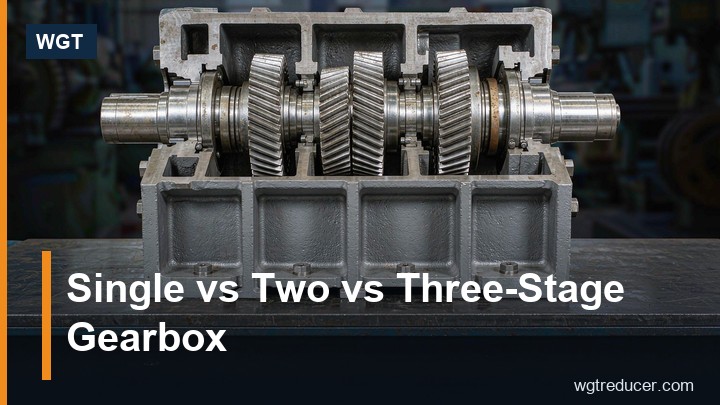
Single vs Two vs Three-Stage Gearbox: Stage Count | WGT
Pick the stage count from the ratio you actually need, then check efficiency, torque and envelope against it. If the required ratio is under about 6, a single stage is almost always the cheapest and most efficient answer. Between roughly 6 and 45, two stages. Above 45, three stages - and above about 200 the question stops being "how many stages" and becomes "parallel shaft or planetary". Everything else in the selection is a consequence of that number.
This guide explains what each stage buys you, what it costs in efficiency and money, and how to sanity-check a quoted unit before you accept the frame.
What a Gear Stage Actually Does
A stage is one meshing pair: a small pinion driving a larger wheel. Each pair multiplies torque by its ratio and divides speed by the same amount. In a parallel-shaft train the ratios multiply:
i_total = i1 × i2 × i3
Two consequences follow immediately. First, stage count and ratio are not independent - to reach a given total ratio you need enough stages. Second, torque at the output is set by the load, not by the stage count: a 15 kW motor at 1475 rpm turning a 30 rpm shaft delivers about 4775 N·m whether it gets there through two stages or three. What changes is how large and how lossy the housing has to be to carry that torque.
The design rule that governs real units is that each stage should not exceed roughly 6:1 for a helical pair in continuous industrial duty, and should not fall below about 2.5:1 or the wheel becomes unnecessarily large for the pinion. That band is what produces the practical ratio ranges everybody quotes.
Ratio Ranges You Can Realistically Reach
| Configuration | Practical total ratio | Typical efficiency | Notes on size and cost |
|---|---|---|---|
| Single-stage helical | 1.5 - 6 (stretch to 8) | 98 - 98.5 % | Smallest frame for a given torque, cheapest, fewest parts |
| Two-stage helical | 6 - 45 | 96.5 - 97 % | The workhorse range for conveyors, mixers, pumps |
| Three-stage helical | 45 - 200 (stretch to 300) | 95 - 96 % | Long housing, more oil, forced lubrication above mid-size |
| Two-stage bevel-helical | 8 - 40 | 95.5 - 96.5 % | Right-angle output, one bevel plus one helical stage |
| Three-stage bevel-helical | 40 - 160 | 94 - 95.5 % | Right-angle high-ratio duty, large oil volume |
| Worm gear unit (single) | 5 - 100 | 50 - 90 % depending on ratio | High ratio in one stage, but efficiency falls steeply with ratio |
| Planetary (two or three stages) | 25 - 1000+ | 94 - 97 % | Highest torque density per kilogram, highest cost per unit |
The pattern is clear: ratio comes from stages, and every stage you add buys ratio at the price of efficiency, length and money. A worm unit appears to break the rule, and it does - it reaches 60:1 in one mesh - but the sliding contact that makes that possible is also why its efficiency drops to 60 % or below at high ratio. That is the trade, and it is why worm units dominate low-power, low-duty applications and disappear from anything above a few tens of kilowatts running continuously.
Efficiency: Where the Losses Come From
Helical gearing loses roughly 1.5 to 2 % per mesh in a well-made industrial unit. That sounds trivial per stage and is not trivial in aggregate, because the loss compounds and it shows up twice: once in the electricity bill and once as heat that has to leave the housing.
Take a 90 kW drive running 8000 hours a year. A two-stage unit at 96.75 % overall loses about 2.9 kW continuously. A three-stage unit at 95.5 % loses about 4.05 kW. The difference is roughly 1.1 kW, or around 9000 kWh a year, plus the extra cooling surface the three-stage unit needs to reject it. On a single machine that is a modest number. Across a plant with forty drives it is the reason efficiency arguments get made at all.
The loss is not only in the mesh. Bearing losses, oil churning and seal drag all rise with stage count. Churning matters more than people expect on splash-lubricated three-stage units, because the gears run in a deeper oil bath and the last stage wheel is large and slow. Above roughly 100 kW and ratios beyond 100:1, forced lubrication with a shaft-driven or motor-driven pump becomes the normal specification rather than an option - not for the gears' sake but to get oil to the upper bearings and to keep the sump temperature in range.
Torque, Size and the Cost of an Extra Stage
A three-stage gearbox is not simply a two-stage gearbox with one more pair inside the same box. To hold the same output torque with an extra mesh, centre distances and shaft diameters have to be redistributed, the housing gets longer, and the oil volume increases. In most manufacturers' ranges, moving up one stage at constant output torque adds roughly 15 to 30 % to the unit weight and a similar amount to the price.
That is the correct comparison to make when a project asks for "a bit more ratio". If the duty needs 55:1 and the two-stage limit is 45:1, the honest options are a three-stage helical unit, a two-stage bevel-helical unit if the layout allows a right-angle turn, or a change of motor speed - a 6-pole motor at 985 rpm instead of a 4-pole at 1475 rpm reduces the required ratio by a third and may keep the drive inside two stages.
Changing the input speed is the cheapest lever available and the most often forgotten. It costs a motor, not a gearbox.
Backlash, Torsional Stiffness and Inertia
Every mesh adds backlash, and every mesh adds compliance. For a reversing duty - a positioning axis, a slew drive, a winder - the total backlash of a three-stage train can be three times that of a single-stage unit, and the torsional stiffness at the output falls accordingly. If the machine's accuracy depends on the gearbox, stage count is a precision decision, not just a ratio decision.
Inertia behaves the other way, in your favour. Reflected load inertia falls with the square of the ratio:
J_reflected = J_load / i²
A fan with 400 kg·m² of inertia behind a 25:1 reduction presents about 0.64 kg·m² to the motor - which is why high-ratio drives start easily even with a heavy driven mass, and why the same fan on a 4:1 belt drive does not. High ratio through more stages is a legitimate way to make a high-inertia load startable, provided the gear unit's own thermal capacity can absorb the acceleration.
When Two Stages Beat Three, and Vice Versa
Two stages win when: the ratio sits inside 6 to 45, the duty is continuous and energy matters, the envelope is tight, or the application reverses and needs modest backlash. Conveyors, agitators, screw feeders, centrifugal pumps, most general machinery - this is the two-stage range and it is where the majority of industrial gear units are sold.
Three stages win when: the ratio genuinely exceeds what two stages can carry, the driven machine is slow and heavily loaded (kiln drives, thickener rakes, slow belt feeders, sugar mill tandems), or the layout demands a compact coaxial or right-angle package that only a third stage can reach. They also win when a single large ratio step would produce an unacceptably large wheel - a 3 × 3 × 3 split of 27:1 gives a far smaller housing than one 27:1 pair.
Single stage wins when: the ratio is low, the speed is high, efficiency is at a premium, or the unit is a high-speed input stage feeding something else. Single-stage helical units are also the standard choice for gearmotor input stages and for pump drives where 2:1 to 4:1 is all that is required.
Reading the Stage Count from the Nameplate or Drawing
You can usually count stages without opening the unit. In a parallel-shaft reducer, count the shaft centrelines visible on the end cover: three shafts means two meshes, four shafts means three. On a bevel-helical unit, one shaft is horizontal at the input, one vertical at the bevel, and the remainder are parallel - subtract one mesh for the bevel pair.
Two checks are worth doing whenever you are replacing an existing unit. First, confirm the ratio from measured speeds rather than the plate, since plates get repainted and units get rebuilt. Second, measure the shaft centrelines and overall length, because a three-stage substitute for a two-stage original will not fit the same footprint no matter what the ratio says.
Choosing the Stage Count in Practice
Work in this order. Establish output torque and speed from the driven machine. Compute the required ratio at the motor speed you intend to use. Check which configuration band that ratio falls into using the table above. Then verify three things against the candidate: the service factor at the real duty (1.25 to 1.5 for smooth continuous load, 1.5 to 2.0 where shock or frequent starting is present), the thermal rating at the actual ambient, and the mechanical envelope against the foundation.
Do that and the stage count decides itself. Skip it and you end up arguing about price on two units that were never equivalent in the first place.
If you want to see how frame data is presented for a three-stage parallel-shaft build, the MC3PLHT three-stage parallel shaft gearbox page shows ratio, torque and thermal ratings together. To run your own numbers, the online selection system takes power, output speed and duty and returns the frame candidates - including whether the ratio lands in two stages or three.
Frequently Asked Questions
Is a three-stage gearbox less efficient than a two-stage gearbox?
Yes, by roughly 1 to 1.5 percentage points overall, because each helical mesh loses about 1.5 to 2 %. Whether that matters depends on power and running hours: below about 15 kW it is usually irrelevant, above 75 kW in continuous duty it is worth calculating before you accept the extra stage.
Can I get 100:1 from a two-stage gearbox?
Not with helical stages in a standard industrial unit - two stages top out near 45:1. You can reach 100:1 in two stages with a worm unit or a planetary, but the worm will be inefficient at that ratio and the planetary will cost more than a three-stage helical unit of the same torque.
Does more stages mean more backlash?
Generally yes. Backlash accumulates across meshes, so a three-stage train typically shows two to three times the total backlash of a single-stage unit of comparable quality. For reversing or positioning duty, specify the permissible backlash at the output shaft and let the supplier confirm it rather than assuming a catalogue value.
Can I replace a two-stage unit with a three-stage unit of the same ratio?
Only if the ratio was below the two-stage limit and you accept a longer housing. The three-stage unit will have a different footprint, shaft height and often a different oil volume. Check the envelope and the foundation bolt pattern before ordering, and confirm the thermal rating at your ambient.
Does stage count affect starting a high-inertia load?
It affects it indirectly. Higher total ratio reduces reflected load inertia with the square of the ratio, which helps, but the gear unit must also survive the acceleration thermally. For fans and centrifuges, state the driven inertia and the expected start time so the thermal capacity can be checked, not just the mechanical torque rating.
