


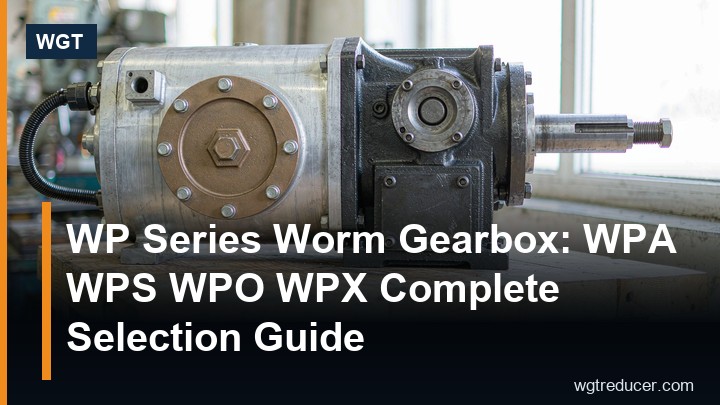
WP Series Worm Gearbox: WPA WPS WPO WPX Complete Selection Guide
Few gear families have travelled as far as the WP worm gearbox. It descends from a European design that has been copied, refined and localised for decades, which is why the same letters - WPA, WPS, WPO, WPX - appear in factories on every continent. The family is loved for a simple reason: a single worm stage gives large ratios in one compact pass, at low noise, for a modest price. It is also misunderstood for a simple reason: the letters describe mounting geometry, not performance, so two units with identical codes can still be very different machines. This guide decodes the family, shows how the frames are sized, and lists the data a serious enquiry should carry.
What the Designation Actually Says
In the WP family, the first two letters fix the family identity, and the letters after them describe the shape of the housing and the position of the output. Reading the code is the fastest way to tell whether a unit will bolt onto your machine:
| Code | Arrangement |
|---|---|
| WPA | Shaft at 90 degrees, output shaft horizontal, foot mounted |
| WPS | Shaft at 90 degrees, output vertical (upward), flange style |
| WPO | Shaft at 90 degrees, output horizontal on the opposite side, foot mounted |
| WPX | Shaft at 90 degrees, output shaft positioned for flange mounting |
| WPV / WPVT | Vertical build variants for upward or downward shaft positions |
The frame number that follows - 40, 50, 60, 70, 80, 100, 120, 135, 155 and beyond - fixes the centre distance between worm and wheel, and with it the torque capacity. A WPA60 and a WPA120 may share every letter; the larger centre distance is what moves them into a different duty class entirely.
Why a Single Worm Stage Is Still Relevant
Modern catalogues lead with helical and bevel-helical units, yet the worm stage survives because it solves three problems at once. First, ratio: one pass reaches 10:1 to 60:1 routinely, and double-reduction builds go far beyond, without the length of a multi-stage in-line train. Second, right angles: input and output at 90 degrees let a motor sit alongside a conveyor instead of behind it. Third, quietness: the sliding contact of a worm mesh is inherently smooth, which matters on packaging lines, door drives and indoor conveyors. A S series helical worm gear reducer carries the same idea into a hardened-gear build - the WP family remains its classic, cast-iron ancestor.
There are honest trade-offs. Sliding contact means efficiency drops as ratio rises, and self-locking behaviour at high ratios is a design feature that can become a service hazard. Worm drives also generate more heat per transmitted kilowatt than crossed helical trains, which is why thermal rating - not just mechanical torque - decides many worm selections.
Sizing the Frame: Three Numbers First
Frame selection starts with three figures, in this order:
- Output torque. The continuous torque at the wheel shaft, taken from the duty, with the service factor of the driven machine applied. Belt conveyors, mixers and crushers each carry their own factor.
- Ratio. Input speed divided by output speed. The WP family offers standard ratios from 10:1 upward; the closest catalogue ratio is chosen, then verified against the tolerance of the process.
- Thermal capacity. The power the unit can dissipate at the ambient temperature and duty cycle of the installation. A gearbox that is mechanically strong but thermally undersized will not fail today - it will fail in the fourth hour of a hot afternoon.
Only after these three figures agree do output shaft options, mounting style and accessories come into play. Ordering the letters before the numbers is the most common way a WP purchase goes wrong. You can cross-check candidates against the online selection system before committing to a frame.
Mounting Forms and Where Each One Fits
The housing variants are not cosmetic. A WPA foot mount suits a conveyor head drive where the unit sits on a frame; a WPX flange form suits a machine where the gearbox hangs on a machined face; the vertical builds in the WPV family handle stirred vessels and agitators where the output must point down into the process. Because the housings are cast, the mounting surfaces, breather position and oil routing are all fixed by the variant - a WPA cannot casually become a WPS by rotating it, and treating the variants as interchangeable is a recurring cause of seal leaks and dry bearings.
When a duty needs the worm's quietness and ratio but a stronger, more efficient gear set, buyers often step to a hollow shaft worm gear unit in the modern S series, which keeps the 90-degree layout while adding ground helical stages before the worm. The WP family, meanwhile, remains the reference for cost-driven, proven, widely understood right-angle drives.
What a Complete Enquiry Contains
A WP enquiry that can be answered in one pass carries:
| Item | Example |
|---|---|
| Full designation | WPA 100, ratio 30:1 |
| Motor data | 4 kW, 1440 rpm, 4-pole, IE3 |
| Duty | 16 h/day, uniform load, service factor 1.25 |
| Output shaft | 45 mm solid, keyed |
| Mounting | Foot mounted, output horizontal |
| Ambient | 35 °C max, indoor, dust |
Sending only "WPA100, 30:1" leaves the motor coupling, thermal check and shaft detail unresolved, and each of those can move the delivery date. The five-minute version of the table above is what separates a quotation from a guess.
Commissioning and Care
WP units leave the works filled and sealed for the declared mounting position; on site, the level is checked at standstill in that same attitude. The breather replaces the solid plug only after transport. Alignment is forgiving by worm standards - the 90-degree input tolerates modest motor misalignment better than a pure helical train - but soft foot and loose base bolts still show up as housing resonance within weeks. Oil changes follow the hours, not the calendar: first change inside the first year, then per the lubricant's service interval, with the level inspected whenever the housing is wiped down. A WP worm gearbox that is correctly sized thermally and lubricated on schedule is one of the least dramatic machines in the plant - which is precisely the compliment this family has spent seventy years earning.
Frequently Asked Questions
Is a WP worm gearbox self-locking?
At high ratios the worm can drive the wheel but not the reverse, which stops back-driving from the load. This is useful on inclines and vertical gates, but it is not a certified brake: holding torque depends on friction and wear, so any safety-relevant application still needs a separate mechanical brake.
Which is better, WPA or WPX?
Neither is better in general - they answer different mounting questions. WPA is the classic foot-mounted horizontal build; WPX is intended for flange attachment. Choose by where the unit has to stand on your machine, not by price alone.
Can a WP unit take a higher ratio by double reduction?
Yes. Double-reduction builds pair a first worm stage with a second, reaching ratios of several hundred to one in one housing. Efficiency is lower than a single stage, so thermal sizing becomes even more important.
Why does my WP gearbox run hot?
Worm drives convert part of the input power into heat through sliding contact. If the surface temperature exceeds the oil's stable range, the frame is undersized thermally, the ambient is hotter than declared, or the oil level is wrong. Re-check the thermal rating before assuming a defect.
What oil should be used?
Mineral or synthetic worm gear oil with appropriate EP additives, filled to the level for the declared mounting position - not to the top of the plug. Overfilling churns oil and raises the temperature, a mistake as common as underfilling.
