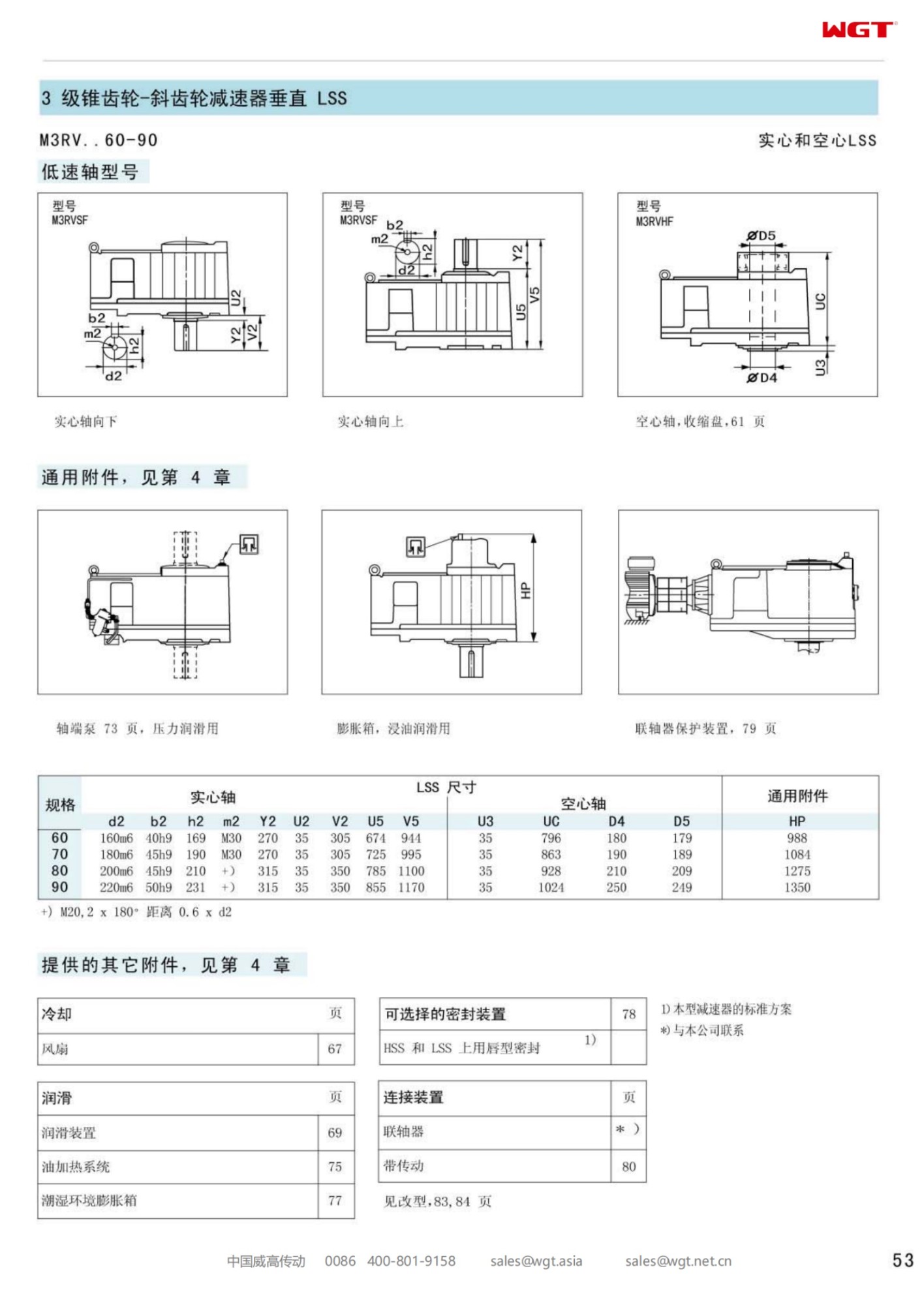
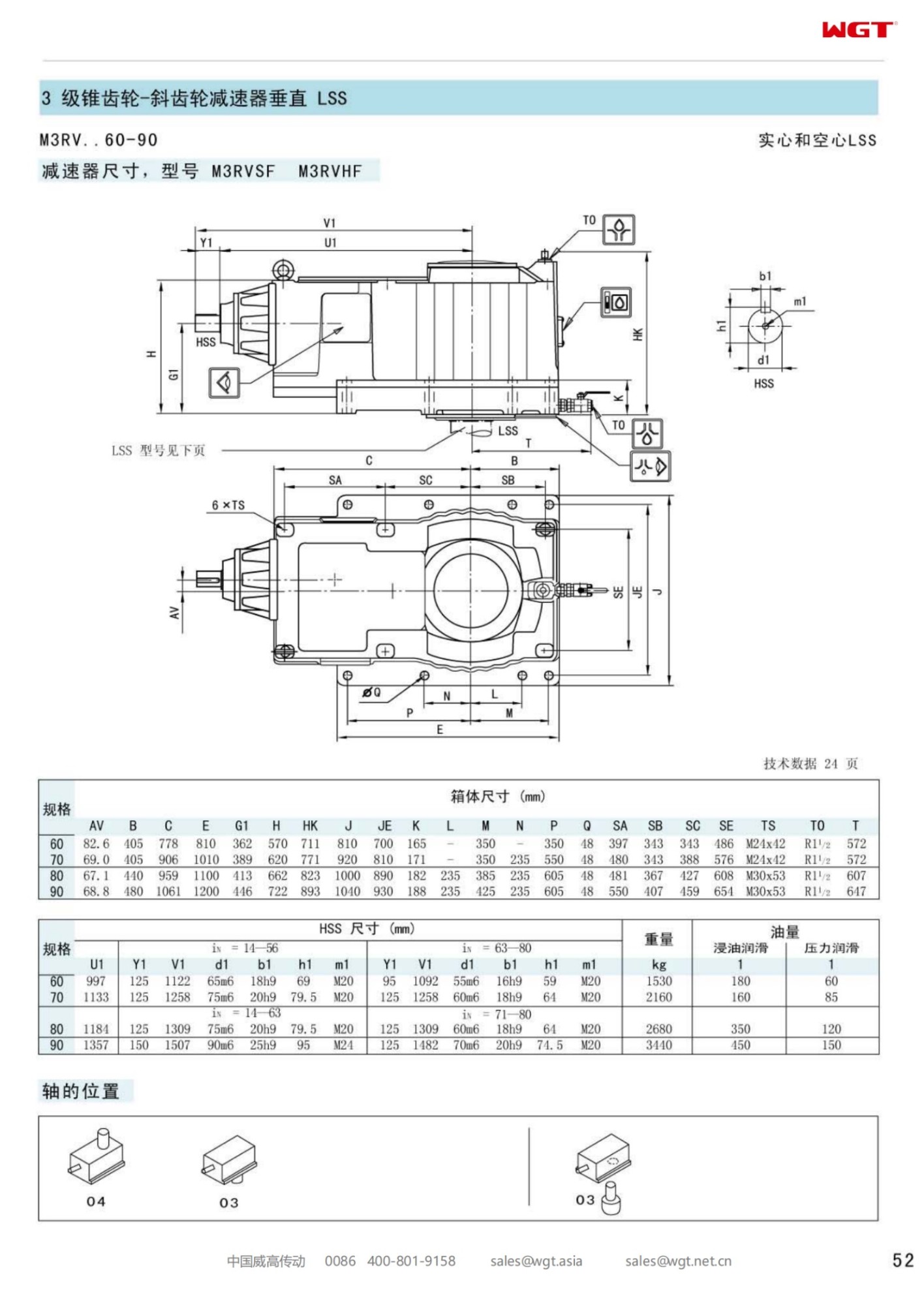
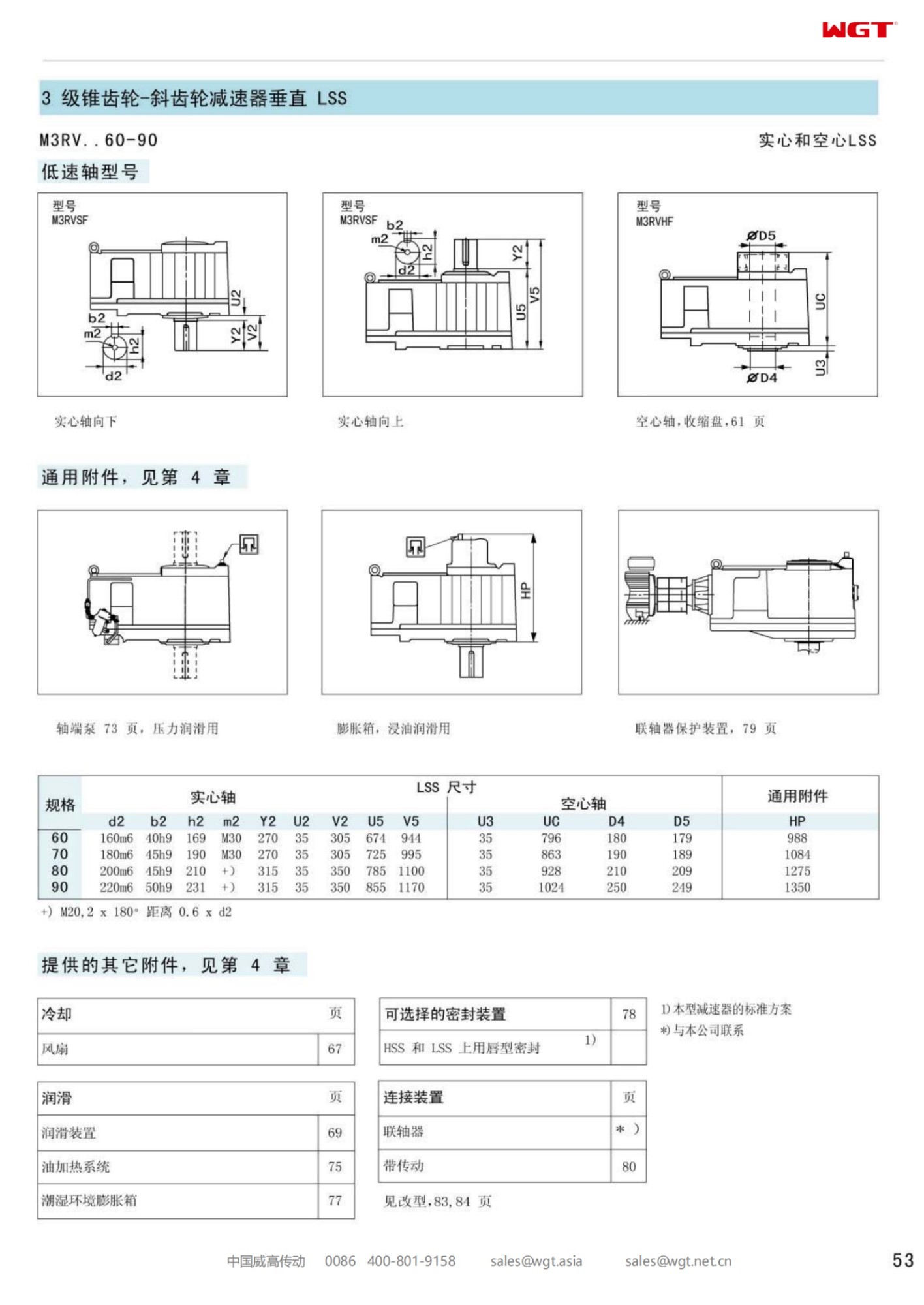
The M3RVHF80 vertical hollow shaft gearbox passes the process shaft directly up through a bored output, so the drive hangs on the shaft rather than the shaft hanging from the drive. A spiral bevel input takes the motor out to the side at deck level, and two helical stages set the speed before the torque reaches the bore. The result is a tank or sump drive with one machined interface, no coupling to align, and no motor tower blocking the walkway.
Why the Bored Output Changes the Load Path
In a solid-shaft arrangement the gearbox carries the process shaft on top of a coupling, and every bending moment has to pass through that joint. A bored output removes the joint: the shaft sits in the bore, keyed or gripped by a shrink disc, and the unit bearings take the moment directly. That shortens the stack and removes a routine alignment task from the maintenance calendar.
At the 80 frame the bore is large enough to accept the process shafts found on industrial scale equipment - thickener rakes, stock chest agitators, large circulation pumps - without a sleeve. It is also the frame where the lower bearing set grows enough to carry those shafts at the insertion depths used in practice. Choosing the frame on bore diameter alone, without the moment curve, is how a correctly sized bore ends up on an undersized bearing.
What the Designation Commits You To
| M | Industrial multi-stage gear unit range |
| R | Right-angle entry via a lapped bevel pair |
| V | Vertical axis, output at the lower face |
| H | Hollow output shaft, machined bore through the housing |
| F | Foot pads and flange face, headplate or steel frame |
| 80 | Frame size, third step in the upright family |
Each of those letters resolves to a dimension that must be quoted: bore and tolerance, keyway or shrink-disc specification, seal grade, flange bolt circle, breather position. A unit shipped to the right ratio but the wrong bore is scrap for that vessel, which is why the enquiry should always carry the mating shaft drawing rather than a nominal size.
Seals and the Medium Above Them
A bored vertical unit has a seal directly under whatever the vessel holds, and that seal is the component the plant will swap out most often. Clean water at ambient temperature is the easy case; brine, slurry fines, solvent vapour, hot oil and vacuum service all demand a different grade. Stating the medium is not paperwork - it decides whether the unit runs a year between seal changes or a fortnight.
The lower bearing is the second wear item, and its life is set by shaft moment and by how well the process shaft is supported at the far end. Where a column is guided by a steady bearing at the bottom of the tank, load sharing between that bearing and the gearbox changes completely; the factory needs to know about it.
Machine groups this unit is specified into: Rake arms on primary clarifiers at large municipal works Propeller pumps in storm water retention basins Impellers in pulp stock chests at paper mills Bore pumps on cooling tower circulation loops Agitators in yeast propagation vessels Vertical shaft drives on cement slurry blending tanks Submersible column pumps in quay dewatering pits Mixers on polymer ageing tanks in water plants
Fitting to an Existing Headplate
Measure the headplate before ordering, not after: bolt circle, hole size, face flatness and the height of any existing pedestal all matter. On site, clean the face, verify flatness with a straight edge across the bolt circle, and set the unit down without forcing it onto high spots. Raise the process shaft through the bore with the agreed fit, set end float to the drawing so thrust is shared as designed, then make up the key or shrink disc to the recorded torque.
Fit the breather upright, fill to the marked quantity, and read the level at rest. Turn the drive by hand - binding at one point means the column is not straight - then run unloaded briefly before applying process load. Record oil temperature and any seal weeping at the end of the first shift; both are the baseline against which later readings will be judged.
Ordering, Drawing and Repeat Supply
Every unit is supplied with a dimensional drawing that fixes bore, shaft and flange for the file, and a nameplate that repeats frame, ratio and arrangement. That combination is what makes a repeat order straightforward years later, when the original buyer has moved on and the only evidence is a photograph of a plate. Keeping the drawing with the vessel record, rather than in a project folder, is the habit that saves a site the next time it needs a seal kit.
How Customers Use This Unit
Asphalt plant aggregate feeder
An asphalt plant powers its aggregate feeders with reducers in outdoor, dusty conditions. The cast-iron housing and standard paint finish have come through several winters without refurbishment.
Fertiliser granulator drum
A fertiliser producer drives granulator drums with gear units. The slow, high-torque rotation needed to tumble the granules is a natural fit, and the torque-arm option avoids a heavy base frame.
What Engineers Ask Us
Can you supply vertical-shaft versions?
Yes. Vertical builds of the same industrial family cover the smaller size band and are common on vertical mixers, agitators and clarifier drives. State the orientation when ordering so oil levels and breathers are set correctly.
What documentation comes with an industrial gear unit?
Every shipment carries an installation manual, a dimension drawing, the nameplate data and a bench test record covering noise, temperature rise and backlash. Material certificates for shafts and gearing are available on request.
Model Table: Frames, Shafts and Duty
| Model | Centre distance | Output | Typical duty |
|---|
| M3PSF50 | size 50 | solid shaft, foot | conveyors, feeders |
| M3PSF60 | size 60 | solid shaft, foot | crushers, mixers |
| M3PSF70 | size 70 | solid shaft, foot | ball mills, shredders |
| M3PSF80 | size 80 | solid shaft, foot | kilns, heavy conveyors |
| M3PSF90 | size 90 | solid shaft, foot | mill and kiln drives |
| M3RSF50 | size 50 | solid shaft, foot, right-angle | inclined conveyors, elevators |
| M3RSF60 | size 60 | solid shaft, foot, right-angle | screw classifiers, feeders |
| M3RHF70 | size 70 | hollow shaft, foot, right-angle | agitators, drum drives |
| M3PHT80 | size 80 | hollow shaft, torque arm, parallel | shaft-mounted conveyors |
| M3RHT90 | size 90 | hollow shaft, torque arm, right-angle | heavy shaft-mounted drives |
Larger size numbers mean higher torque capacity and larger shafts. Because interfaces follow the common industrial dimensions, a size-for-size change is the normal upgrade route for these industrial units.
Selection Example: Typical duty point
Follow the same three steps with this frame: Motor speed divided by the target output speed gives the ratio, rounded to the nearest available step, and the required torque with the service factor then fixes the frame size. Note that the ratio comes from speeds alone, while the frame size depends on torque and service factor - never size a unit on ratio only.
![industrial helical gearbox selection chart]()
A quick visual of the selection sequence for a industrial helical unit.
![M3 series gear reducer installation examples]()
Application coverage of the the M3 series.
Talk to the Factory, Not a Catalogue
Questions before ordering? Prefer to check the figures yourself? The WGT Motor & Gearbox Online Selection System gives you the model, torque margin and ratio before you ask us.
Our technical team works beside the assembly line. Describe the application in your own words and you get a straight answer - including when a different frame or series would serve you better. Looking for a gear reducer for food processing machine? Tell us the duty point and we will confirm the model in writing.