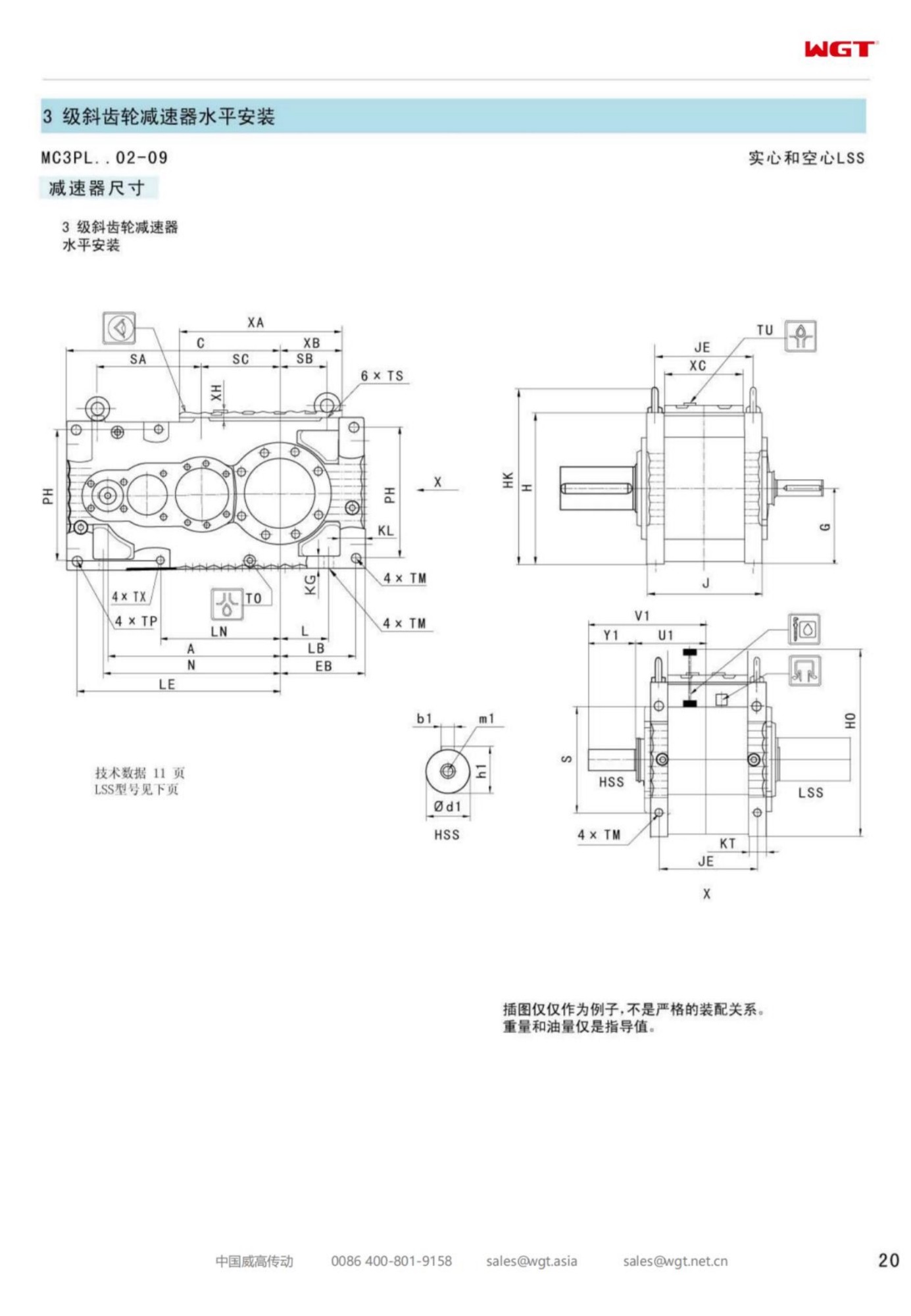
A granulator drum is a long tube on trunnions, turning slowly while steam, ammoniating liquor and recycled fines are sprayed into a rolling bed. It floats axially as it heats, it gains weight as build-up forms on the shell, and it never stops for the shift. The MC3PLST04 three-stage parallel shaft gearbox drives that tube from a keyed shaft beside the trunnion, with a torque arm holding the reaction on the drum's own support steel.
The sections below work through the code, the reason the arm suits a floating drum, the build-up and vapour it has to live with, and the figures a fertiliser plant needs on the table before a frame can be fixed.
A Granulator Drum Moves and the Drive Must Not Care
A drum grows perhaps twenty millimetres in length between a cold stop and a hot run, and it walks a little on its trunnions in between. Any drive pinned rigidly to both the drum and a foundation becomes a strut in that movement. The design that survives it is the one where the shaft defines the position and a single arm absorbs rotation: no axial restraint, no baseplate to crack, no coupling asked to swallow two movements at once.
What the MC3PLST04 Designation Commits To
The letters are not decoration; each one closes a layout question.
| MC | Industrial gear unit family for continuous plant duty |
| 3 | Three stages of reduction in one housing |
| P | Parallel-shaft helical gearing, coaxial input and output |
| L | Level output axis into the driven shaft |
| S | Solid output shaft, keyed to the driven shaft |
| T | Torque-arm reaction, no baseplate required |
| 04 | Fourth frame of the three-stage band |
Read as a sentence: a three-stage industrial unit, parallel shafts, level output axis, solid shaft keyed to the drum's drive shaft, reaction taken by a torque arm, in the fourth frame of the band.
The Arm Takes the Torque, the Drum Keeps Its Freedom
The arm is a stay, not a mount. It resists the reaction couple about the output axis and does nothing else, which is exactly what a floating drum needs. The bracket it lands on must be stiff in the direction of the reaction and clear in every other direction, so the drum can extend and walk without pushing its drive sideways. A bracket designed as a cradle will fight the drum; a bracket designed as a stop will not.
A Keyed Output Beside the Drum Trunnion
The drive shaft on a granulator is short and ends close to the trunnion bearing, so a solid output with a keyed coupling is the honest connection. There is no room to pass a bore over it without disturbing the bearing arrangement, and no benefit in doing so: the coupling can be shimmed and checked in place, and the arm carries the reaction that a bore would otherwise hand to the shaft.
Build-Up on the Shell and the Torque It Adds
Material sticks to the inside of every granulator, and a patch that stays through a shift adds mass at a radius where mass costs torque. The drum also carries a rolling bed whose angle of repose changes with moisture. Both effects push running torque up over a campaign, so the frame is chosen on the condition at the end of a campaign, not on the first week after a clean-out.
Steam, Ammonia Vapour and Plant Air
The atmosphere above a granulator is warm, damp and faintly alkaline, and it condenses on anything cooler than itself. Painted steel that was never specified for it will chalk and then rust; a breather that draws that air will carry moisture into the oil. A finish chosen for a chemical plant, a breather piped to a clean spot, and a drain that can be opened without dismantling the guard are the practical answers.
Why Three Reductions Suit a Rotating Drum
Drum speeds sit in the single digits to low teens of revolutions per minute, and four-pole motors do not. The ratio therefore lands deep in the three-stage band, where three meshes share the reduction and the case stays short enough to sit beside a trunnion instead of above it. A two-stage train at that ratio would need a much larger pair of wheels and a case that no granulator deck has room for.
Setting the Arm Stop Before First Product
The stop is set with the drive at rest: the arm should sit at its designed angle and the stop should show a visible gap, so the next fitter can see what correct looks like. Then run the drum loaded and check again, because a warm drum moves and the gap changes. A stop that is set once and never re-checked is how drives end up hanging on their coupling bolts.
Bearings, Grease and the Drum's Axial Float
Because the arm allows axial freedom, the drive's own bearings are not asked to resist the drum's growth. That is the point of the arrangement, and it only holds if the coupling is the type that permits a little end float. A rigidly clamped coupling turns the arm's freedom into a bearing preload, and a bearing run with preload in a hot hall is a bearing with a short life.
Sizing From Drum Diameter and Retention Time
Retention time and drum slope give the revolutions per minute the process needs; the motor speed divided by that figure gives the ratio. The torque comes from the rolling bed at its heaviest and from the build-up at the end of a campaign, multiplied by the service factor the plant's own history justifies. Two process numbers in, one frame out.
What the Granulator Supplier Should Send Us
The useful first message carries the drive shaft diameter and keyway, the drum speed, the drum diameter and loaded mass, the motor frame and speed, the spray and steam conditions, and the steelwork available for the arm bracket. A photograph of the drive end and a note of the plant's build-up routine complete it, and the quotation comes back with one frame rather than three.
Frame Four in a Compound Fertiliser Line
Frame four is the size most granulator drives land on: enough case for a loaded drum at campaign-end torque, compact enough to hang beside a trunnion without fouling the walkway, and stiff enough that the arm bracket can be a simple fabrication rather than a casting. It is not the largest frame in the band, and it does not need to be.
A drum that grows, walks and collects build-up - three stages hold it steady:
- Rotary drum granulator on a compound fertiliser line
- Coating drum at the back end of a prilling tower
- Dryer drum discharge conveyor at a blending plant
- Recycle fines return conveyor on a granulation circuit
- Rotary cooler drum drive at a fertiliser works
- Drum mixer feeding a bulk blending station
Selection Example: Rotary drum granulator at a compound fertiliser plant
Take a 30 kW motor at 1480 rpm turning the drum at 9.5 rpm. The ratio follows directly: 1480 / 9.5 = 156, so a ratio near i=155 is taken from the three-stage parallel band, and the frame is confirmed against the torque of a bed with build-up at the end of a campaign rather than against a freshly cleaned shell. In this case frame four turns the drum from a case held by a torque arm on the trunnion steelwork, keys a solid output to the drive shaft, and keeps axial growth out of its bearings. That is the whole calculation. If your duty involves heavy starting, frequent reversing or many stops per hour, tell us and we raise the service factor.
Which Frame Size Do You Need?
| Model | Centre distance | Output | Typical duty |
|---|
| M3PSF50 | size 50 | solid shaft, foot | conveyors, feeders |
| M3PSF60 | size 60 | solid shaft, foot | crushers, mixers |
| M3PSF70 | size 70 | solid shaft, foot | ball mills, shredders |
| M3PSF80 | size 80 | solid shaft, foot | kilns, heavy conveyors |
| M3PSF90 | size 90 | solid shaft, foot | mill and kiln drives |
| M3RSF50 | size 50 | solid shaft, foot, right-angle | inclined conveyors, elevators |
| M3RSF60 | size 60 | solid shaft, foot, right-angle | screw classifiers, feeders |
| M3RHF70 | size 70 | hollow shaft, foot, right-angle | agitators, drum drives |
| M3PHT80 | size 80 | hollow shaft, torque arm, parallel | shaft-mounted conveyors |
| M3RHT90 | size 90 | hollow shaft, torque arm, right-angle | heavy shaft-mounted drives |
Foot-mounted frames are listed below; torque-arm (T), hollow-shaft (H) and vertical (V) variants are available across the size range. Ask for the outline drawing to check the interface before ordering.
Answers to Common Questions
What is the recommended oil change interval?
The housing is lubricated for life under normal duty and normal ambient. In hot, humid or continuous service, change the oil after the first 400 running hours and then every 4000 hours, or once a year, whichever comes first.
What paint finish and corrosion protection is applied?
Housings are shot-blasted and finished with a two-component industrial paint in RAL colours, giving good protection for indoor and sheltered outdoor duty. For aggressive or coastal sites, ask for the heavy-duty coating option.
Do you supply spare parts such as seals and bearings?
Seal kits, bearings, output shafts and covers are available from stock or on short lead time. We keep the drawings for every unit we ship, so a replacement part ten years from now is still traceable to your original order.
![gearbox sizing steps for engineers]()
Four steps from your application data to a firm model number.
Case Notes from the Field
Wood chipper line
A board mill drives its drum chipper with a heavy-duty gear unit. Knife engagement shocks arrive several times a second, and the case-hardened gearing with generous bearing spans has shown no measurable wear.
Fertiliser plant drag chain
A fertiliser complex runs drag-chain conveyors on industrial gear units in a corrosive atmosphere. The heavy-duty epoxy coating and FKM seals have kept the units presentable and leak-free through several campaign cycles.
![industrial gear unit application overview]()
A cross-section of the installations we supply every month.
Drive Down? Ask About Priority Builds
A drive is down right now? Try the WGT Motor & Gearbox Online Selection System, then send the result sheet - we return a complete datasheet, drawing and price the same day.
Priority builds slot into the next production run, and urgent units can be air-freighted within days of payment. Describe the failure and the machine - we tell you honestly what is possible. Looking for a gearbox for belt conveyor? Tell us the duty point and we will confirm the model in writing.