Most gear units arrive on site and are then married to their driven shaft by a coupling - two halves, a spacer, an alignment job and a guard to build around. The MC2PLHF02 parallel shaft gear unit skips that ceremony. Its output is a hollow bore, so the unit slides over the driven shaft itself: the machine's own shaft becomes the gearbox's output shaft, the case lands on its feet, and a torque arm absorbs the reaction. On the compact end of the two-stage parallel line, that arrangement turns a half-day coupling alignment into a bolting job.
Inside, the layout is the family's own: two helical stages in one horizontal plane, a footed cast case, the motor bolted alongside. The 02 frame is the small end of the hollow-bore band - light enough for two fitters to handle, sized for the screw conveyors, feeders and small mixers where a low, short drive between the machine's own supports matters more than headline torque.
A Bore Instead of a Boss
The practical difference between this unit and its solid-shaft sibling is measured at installation. A solid output shaft must meet a coupling, and a coupling demands concentricity within tenths of a millimetre - checked, re-checked and re-checked again after the first thermal cycle. A hollow bore removes that whole conversation: the driven shaft is machined to the bore's specification, the unit is offered up, the key is fitted, the end plate closes the assembly, and the drive is made. There is no coupling to buy, no spacer to store, no guard to stretch over a spinning joint.
The trade is a different kind of precision. The driven shaft's diameter, its runout and its keyway must all be right, because the bore and the shaft now share a fit that carries the full torque. Plants that treat the shaft drawing with the same seriousness they would give a coupling alignment get an installation that runs true for years - and one that can be pulled and refitted in an afternoon if the unit ever needs bench attention.
Two Stages and What They Cover
Two helical stages give the frame a ratio band that maps a standard four-pole motor onto the speeds where most small conveying and stirring lives. Fewer meshes also mean fewer bearings, fewer seals and a shorter list of spares, which is why maintenance crews tend to like the two-stage line on the machines they visit most often.
The honest limit is at both ends of the band. Very slow, very high-torque duties fall below what two stages reach practically, and belong on the three-stage frames of the wider family; very fast, light duties waste the frame's torque capability. Between those poles - the 20 to 90 rpm conveyor and mixer territory - the 02 sits comfortably, and its small sump warms quickly enough to shed condensation on intermittent duty.
Reading the Designation on the Plate
The type string compresses the whole arrangement into a few characters, and every character answers a question the stores or the fitting crew will eventually ask.
| MC | Industrial multi-stage gear unit family |
| C2 | Compact two-stage parallel-shaft series |
| P | Parallel stages - input and output shafts in one horizontal plane |
| L | Horizontal build with feet flat on the plinth |
| H | Hollow output bore that mounts over the driven shaft |
| F | Foot mounting with holding-down hardware to the frame drawing |
| 02 | Second frame - the small end of the hollow-bore band |
Two of those characters change the site work directly. The hollow bore means the driven shaft arrives as part of the machine builder's scope, machined to the bore drawing and protected until fitting day. And the parallel geometry keeps the unit's height down, which is why these units end up under troughs and between stringers where a right-angle build would not fit.
Where a Hollow Bore Beats a Coupling
There are three situations where the bore wins clearly. The first is space: no coupling length means the drive occupies less of the machine's axial envelope, which matters inside a conveyor trough or against a wall. The second is alignment skill: a crew that can bolt and shim can fit this unit, where a coupling job wants dial indicators and patience. The third is service: the unit can be withdrawn from the shaft and swapped without touching the driven machine's bearings.
Against that, the bore asks for a clean, undamaged shaft and the correct shoulder-to-bore relationship at fitting time. A shaft scored by a previous clamp collar, a keyway cut oversize, a shoulder that lets the unit creep axially - each of these turns the bore's simplicity into a vibration complaint a year later. The fitting sheet that comes with the unit exists to prevent exactly those outcomes, and it repays ten minutes of reading.
Duties That Fit a Small Hollow-Bore Unit
Drives that drop straight over the shaft, sized for the small end of the line:
- Screw conveyor drives mounted over the tail shaft at a blending plant
- Paddle mixer drives on a small effluent treatment line
- Bucket elevator head shafts at grain depots and feed mills
- Rotary vane feeder drives under lime and gypsum silos
- Agitator drives on chemical dosing and make-up tanks
- Sand cooling drum drives at a foundry reclamation plant
What those duties share is a shaft that is already there and a drive position that is cramped, dusty or wet enough to make a coupling an ongoing liability rather than a connection. The 02 frame carries them at a speed where two stages do the work and the case's small oil volume reaches its running temperature quickly.
Preparing the Driven Shaft
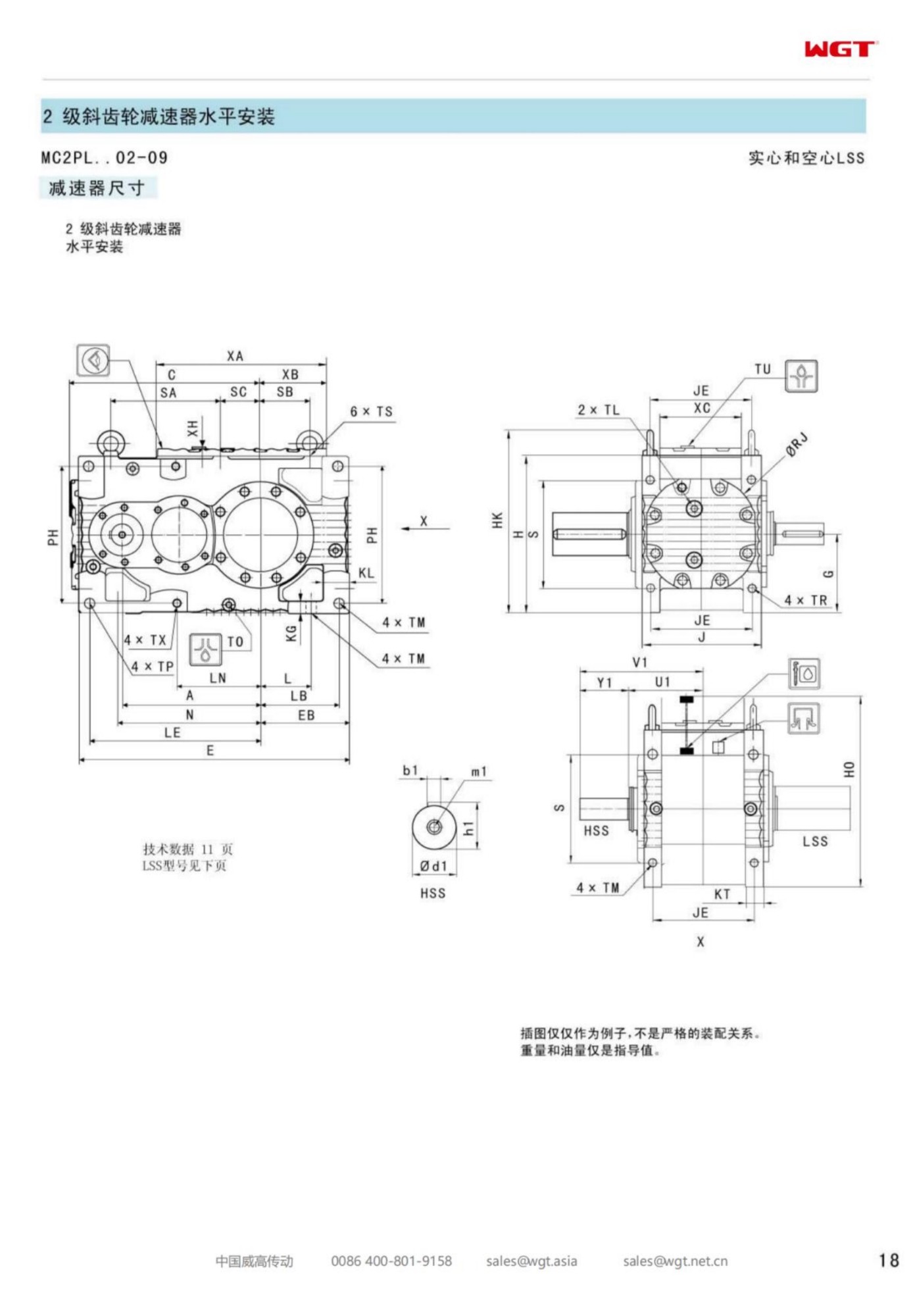
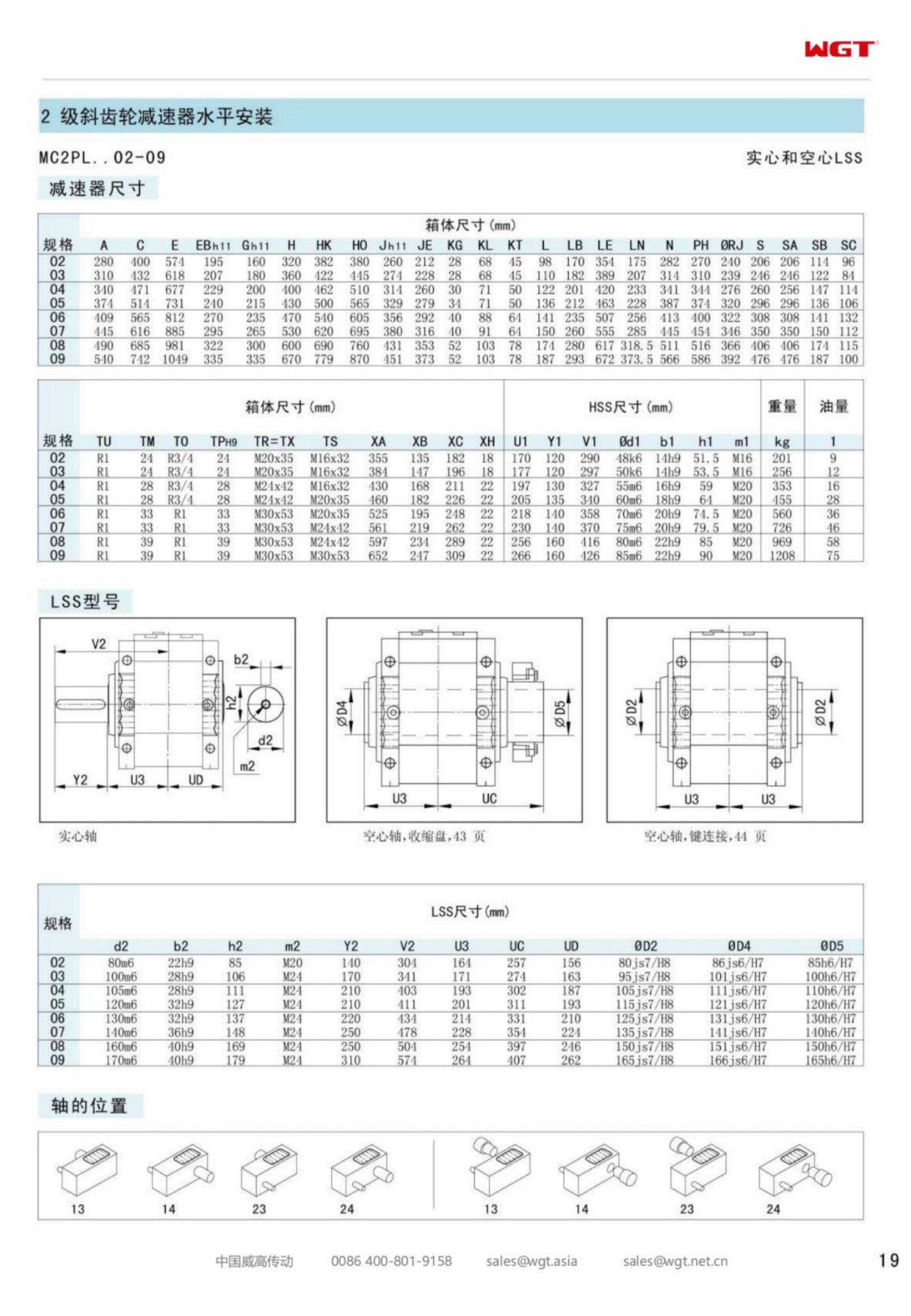
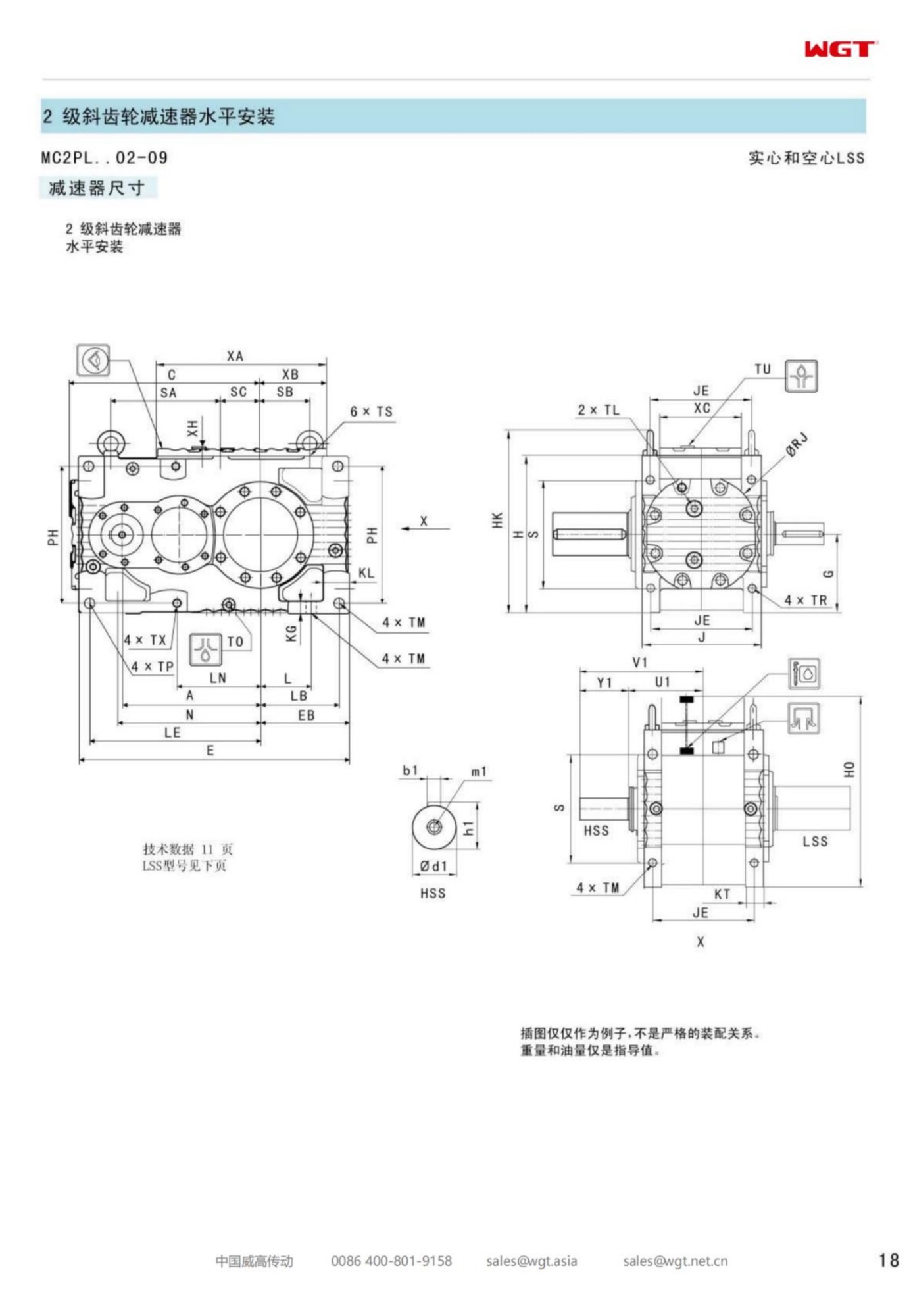
The shaft specification arrives with the outline drawing: diameter and tolerance, usable length, keyway width and depth, and the shoulder dimension that positions the unit axially. The shop that machines the shaft should treat those figures as inspection items, not suggestions - measure the finished diameter with a micrometer at two points along the fit, check the runout near the shoulder, and deburr the keyway edges so the key sits square.
Protection before fitting matters as much as the machining. A shaft section left bright and unpainted will grow rust film in an outside store within weeks, and rust on the fit is bore damage waiting to happen. Grease, wrap and cap the shaft end until fitting day, and keep the key with the shaft rather than in a drawer.
Fitting the Unit and Taking the Reaction
On fitting day the sequence is short. Offer the unit up to the shaft with the bore's keyway and the shaft's key aligned, slide it home against the shoulder, and close the assembly with the end plate or retaining hardware the drawing specifies. The feet then come down onto shims - levelled, not forced - and the holding-down bolts are pulled evenly.
The step crews most often rush is the torque arm. With a hollow-bore mount, the case is free to rotate about the shaft axis, and the torque arm is what turns that freedom into a fixed reaction path. It must be set at or near the angle the drawing shows, pinned or bolted at both ends without preload, and given room to flex through its rubber bushing if it has one. A torque arm jammed against a structural member, or tensioned like a tie rod, transmits vibration into the frame and shows up later as a seal that weeps on one side.
Oil Volume on a Small Case
A small sump is quick to warm and quick to check, and that is its virtue and its discipline. Level is read cold, on the monthly round, through the sight glass; the first change comes early in the unit's life to clear running-in debris; an annual sample follows. On a case this size the change is a few litres, so there is no economic argument for stretching an interval - the labour dominates the cost, and the protection is worth more than the oil.
Because the unit breathes with every thermal cycle and often sits in dust or washdown, the breather deserves the same attention as the oil. A breather sited out of the spray path, or a desiccant type on a wet position, keeps the inside of the case as dry as the day it left the works. The milky oil sample that ends a breather's career is entirely preventable for the price of a monthly look.
First Service and the Storage Question
Units sometimes wait - spares on a shelf, machines delivered ahead of their process. Storage is a routine, not an accident: the transport plug stays in until mounting, the shaft is turned by hand a turn every month so the bearings never rest in one position, and the crate stays indoors and off a wet floor. The hollow bore should be protected with its original wrap or a light coat of grease, because a rusted bore is the one fault storage can inflict that fitting day cannot fix.
Before a stored unit is energised, three checks take minutes: oil level and condition, free rotation by hand without scraping or dead spots, and the breather refitted after the transport plug comes out. A unit that passes those three begins its service life as if it had never waited at all.
The Enquiry That Quotes Without Queries
A hollow-bore enquiry is quoted in one pass when it carries the fitting information alongside the duty information. Driven machine and load pattern, with any jam or stall condition named. Motor power, speed and starting method. Output speed and the tolerance the process accepts. Hours per day across a real week. Ambient conditions - dust, moisture, washdown - stated plainly. Then the fitting half: driven shaft diameter and keyway, usable length, the shoulder dimension, torque arm side and mounting position, and the rotation direction the first jog must produce.
With both halves present, the quotation returns with an outline drawing the machine builder can cut the shaft from immediately. Without them, the order waits on a dimension that was knowable on day one - and on a cramped drive position, the delay always lands at the worst possible point in the project.
Available Frames and Their Typical Duty
| Model | Centre distance | Output | Typical duty |
|---|
| M3PSF50 | size 50 | solid shaft, foot | conveyors, feeders |
| M3PSF60 | size 60 | solid shaft, foot | crushers, mixers |
| M3PSF70 | size 70 | solid shaft, foot | ball mills, shredders |
| M3PSF80 | size 80 | solid shaft, foot | kilns, heavy conveyors |
| M3PSF90 | size 90 | solid shaft, foot | mill and kiln drives |
| M3RSF50 | size 50 | solid shaft, foot, right-angle | inclined conveyors, elevators |
| M3RSF60 | size 60 | solid shaft, foot, right-angle | screw classifiers, feeders |
| M3RHF70 | size 70 | hollow shaft, foot, right-angle | agitators, drum drives |
| M3PHT80 | size 80 | hollow shaft, torque arm, parallel | shaft-mounted conveyors |
| M3RHT90 | size 90 | hollow shaft, torque arm, right-angle | heavy shaft-mounted drives |
Note that PSF and RSF frames of the same size share the mounting footprint; the R build simply inserts a bevel stage, so switching layout rarely forces a foundation change.
Questions and Answers
Can I get a CAD drawing or 3D model for my design review?
Yes. Send us the model and ratio and we provide a 2D dimension drawing and a 3D STEP model for your review, usually the same working day. Drawings follow the layout of the original series so they drop into your existing assembly.
What is the recommended oil change interval?
The housing is lubricated for life under normal duty and normal ambient. In hot, humid or continuous service, change the oil after the first 400 running hours and then every 4000 hours, or once a year, whichever comes first.
What paint finish and corrosion protection is applied?
Housings are shot-blasted and finished with a two-component industrial paint in RAL colours, giving good protection for indoor and sheltered outdoor duty. For aggressive or coastal sites, ask for the heavy-duty coating option.
Installation Examples
Cold-store conveyor
A cold-store operator uses reducers on freezer-room conveyors. Low-temperature synthetic oil and moisture-resistant seals keep the units running below -20 deg C ambient.
Bakery spiral cooler
A bakery equipment builder fits units to spiral cooler drives. The compact right-angle layout fits under the spiral cage, and food-grade lubrication was specified for the hygienic area.
![gear box application map for industry]()
From quarries to food plants - one right-angle drive concept.
Selection Example: Screw conveyor drive at a small blending plant
Take a 3 kW motor at 1420 rpm turning the conveyor screw at 47 rpm. The ratio follows directly: 1420 / 47 = 30.2, so a ratio near i=30 is drawn from the two-stage band, and the frame is checked against the stall that follows a start with the trough half full of settled material. In this case the compact footed case sits between the trough stringers, and the hollow bore drops straight over the screw tail shaft, so no coupling has to be aligned inside the trough. The ratio is the easy part. The service factor for the shock level is what makes the selection safe, and we check that for you at no charge.
![how to choose a speed reducer model]()
Ratio first, then torque, then frame size: the standard selection route.
Duty Data In, Firm Model Out
Three numbers decide it. The WGT Motor & Gearbox Online Selection System covers motor power, ratio and mounting on one screen - enter your numbers and see the model immediately.
Motor power and speed, required output speed and the driven-machine description fix the selection. Send them and the confirmed model, service factor and price come back in writing the same day. Looking for a gearbox for mixer and agitator? Tell us the duty point and we will confirm the model in writing.