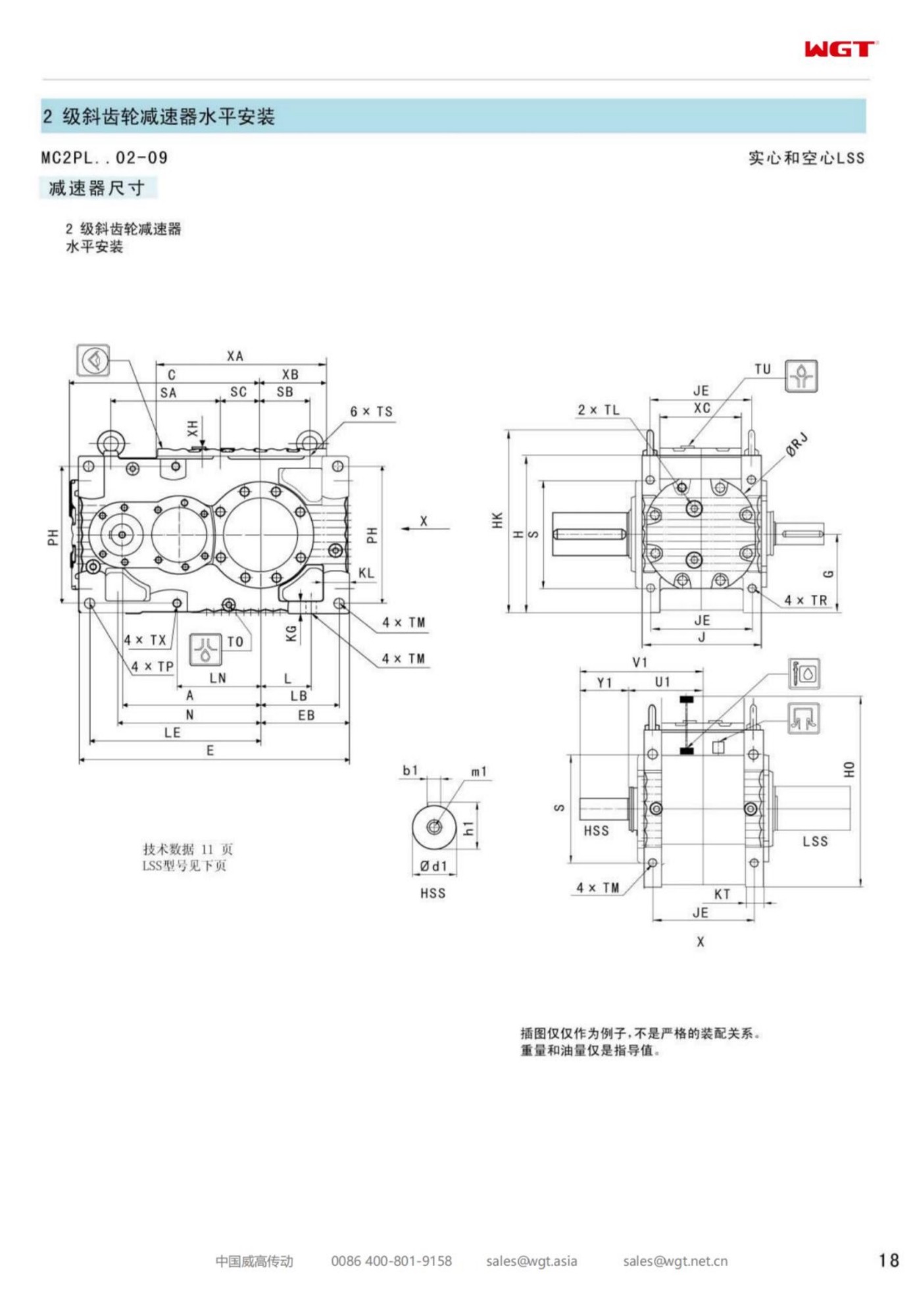
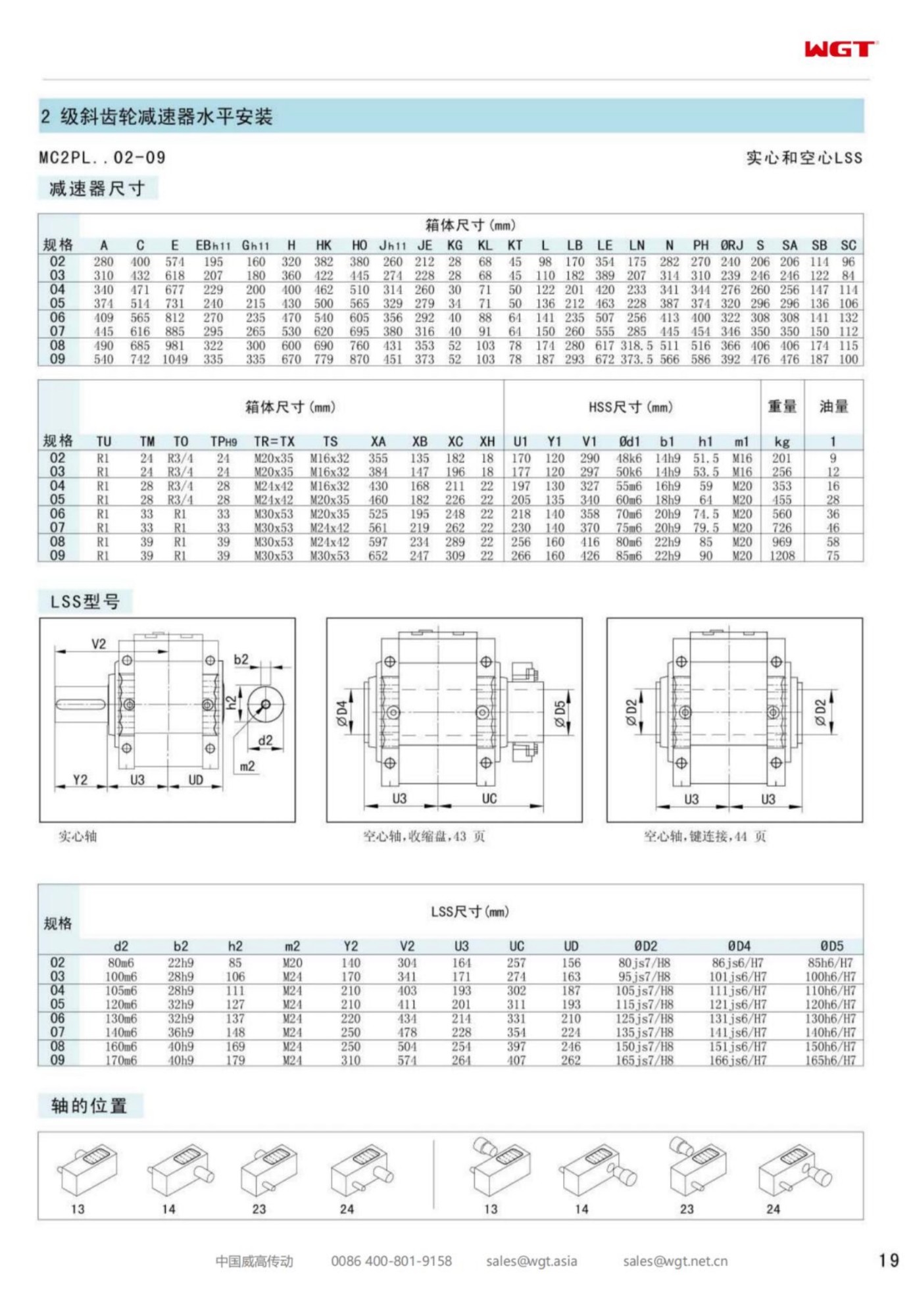
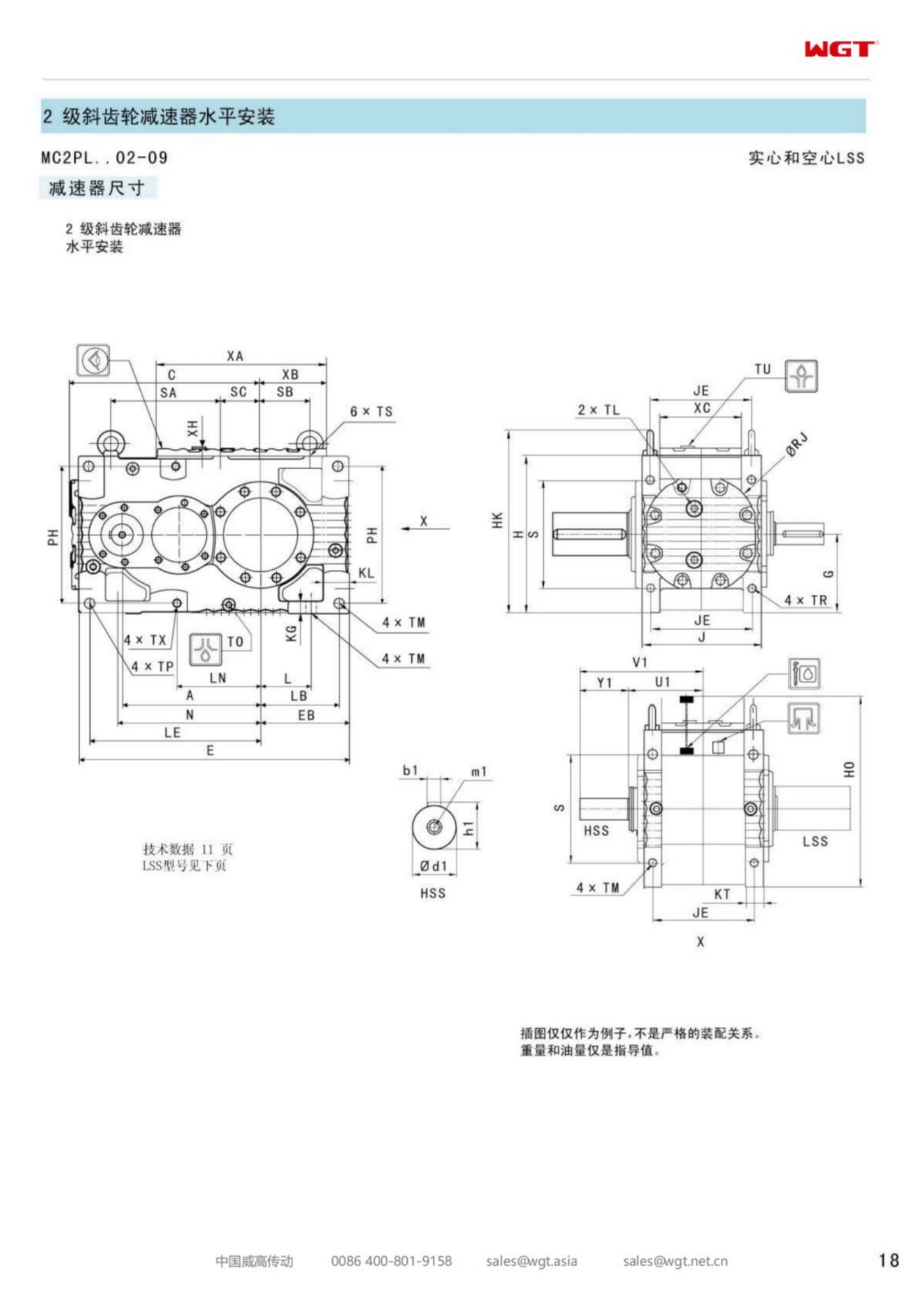
At the last frame of a family, the selection conversation changes character. The MC2PLHF07 parallel shaft gear unit is the top of the two-stage hollow-bore line, and the machines it drives are the ones a plant is built around: the overland conveyor that starts the shift loaded, the drag chain that cannot spill, the apron feeder under the crusher that takes whatever the pit sends down. Nothing about the arrangement is new - two helical stages, feet on the plinth, motor alongside, a hollow bore over the driven shaft. What is new is the scale at which those familiar features now work.
For the crew, the seventh frame is a familiar machine grown heavy. The mounting is still a slide over the shaft and a set of holding-down bolts. The knowledge, the tools and most of the spares carry over from the frames below. What the purchase adds is a lifting plan, a shaft machining order and a service factor chosen with real respect for the worst hour of the duty.
Where the Two-Stage Line Finishes
The top frame exists because plenty of heavy duties still suit two stages. A train with only two meshes loses less to friction, has fewer bearings to watch and fewer parts to fail, and at the moderate output speeds of conveyor and feeder work it holds good contact without needing the third stage. The line finishes where the wheel sizes a two-stage build would need stop being practical - and that boundary is drawn by torque, ratio and hours together, not by habit.
Buyers sometimes climb a family out of caution, taking the frame above the calculation because the calculation was never quite trusted. On this line that instinct is affordable. The cost step between adjacent frames is small next to the cost of a stopped conveyor, and a unit running with thermal and mechanical room in hand will outlive the process it serves.
Reading the Characters Before the Order
The plate reads like every unit in the line, but the last character now carries the heaviest meaning in the family.
| MC | Industrial multi-stage gear unit family |
| C2 | Compact two-stage parallel-shaft series |
| P | Parallel stages - shafts in one horizontal plane |
| L | Horizontal build on feet |
| H | Hollow output bore, unit mounts over the shaft |
| F | Foot mounting, holding-down hardware |
| 07 | Seventh frame - the top of the two-stage line |
The H is the character that sets the project calendar. The driven shaft is machined to the bore drawing - diameter, tolerance, finish, keyway, shoulder - while the unit is in transit, so the drawing must be requested in the enquiry and the machining slot reserved on the shutdown plan. The F sets the civil calendar: pockets cast, pad levelled, grout cured before the crate reaches the gate. Neither task is difficult. Both are expensive when they are discovered late.
Breakaway, Jam and the Duty Class
The running load rarely sizes a frame like this one; the starting load does. A long belt gallery started cold, a drag chain buried under a spill, a feeder breaking loose from settled material - each asks the train for a torque that has no equivalent in the steady-state table. The duty class exists to turn those events into arithmetic: starts per hour, jam frequency, reversals, stops under load. Declared honestly, the class selects the frame. Guessed, it sells the next one a year early.
Starting method is part of the same arithmetic. A soft starter or a variable drive stretches the breakaway and lets a standard frame carry a duty that would punish a across-the-line start. The specification only has to say what the site intends; the wrong guess between those methods is worth a frame size in either direction, and both directions cost money.
Duties at the Top of the Line
Top-of-the-line torques, and the machines that need them:
- Run-of-mine belt conveyor drives at a concentrator pit head
- Bagasse and coal drag conveyors in a boiler house
- Heavy apron feeder drives under a primary crushing station
- Overland conveyor drives between a quarry and a railhead
- Sludge and grit conveyor drives at a coastal treatment works
- Reclaimer cross-travel drives on a coal stockpile
These are drives with consequence - machines whose stoppage is measured in tonnes and shifts rather than minutes. The top frame suits them precisely because it combines serious torque with the hollow-bore installation that keeps their shafts, their guarding and their alignment simple.
The Driven Shaft and Its Tolerances
At this torque the bore-to-shaft fit stops being a fitting detail and becomes an engineering item with numbers on it. The bore's finish, the shaft's diameter within its band, the keyway's width, depth and squareness, the shoulder's square to the axis - each is an inspection line with a tolerance, and the fit is made once, cold, clean and to the drawing. A careless fit at this level does not usually break anything at once; it frets, and fretting shows itself as rust dust at the bore mouth and a knock that grows by the month.
The first planned withdrawal is the fit's first examination. Even, polished contact is the target; bright scoring at one edge says the shoulder let the unit tilt, and dust in the keyseat says the key is working. Both findings are cheap to correct at the first withdrawal and costly at the third, which is the whole argument for scheduling that first look instead of waiting for a sound.
Holdbacks, Brakes and Stopped Loads
An inclined machine with a lifted load has a second life the moment the power drops: it becomes a runaway. Elevators and loaded belts store enough energy in the raised material to back-run the train, and a coasting gallery belt can reach speeds the unit was never rated for. The countermeasure is a backstop or a holdback, built into the unit or carried on the motor extension, and it is an order-time choice because fitting one afterwards means opening a case that was supposed to need nothing but oil.
Brakes are a separate question and both are sometimes needed: the holdback stops the load, the brake stops the machine within its stopping distance. Which of the two the duty needs, and whether both, is written down in the enquiry in one line - and that line has saved more drives than any bearing upgrade ever has.
Cold Starts and Hot Afternoons
The thermal band this frame lives in is wider than any office chart suggests. A winter morning start with thick oil is normal for a few minutes; a unit that moans through half an hour of every cold start is asking for the viscosity grade matched to the climate, not for sympathy. A summer afternoon in a confined gallery can put the sump twenty degrees above the general works reading, and the rating table only knows the temperature at the drive.
The routine that keeps the frame honest is short: temperature read at the same point each round and trended against the commissioning baseline, an annual sample trended the same way, and any change investigated while it is still a number in a log. Machines this size reward dullness and punish improvisation, without exception.
Moving and Storing a Unit This Size
A seventh-frame unit travels by crane from the moment it leaves the works, and the crane plan is written before the unit leaves the store. It lifts from the eyes or lugs provided, never from the bore, the shaft or the cooling pipework, and it never travels balanced on a forklift tine because the right forks were on another truck. Most damage to units this big happens in the last fifty metres of the journey, and none of it is visible in the crate.
Storage has its own rules. If the unit waits on site through a season, it waits filled or preserved exactly as the instruction book states, shafts and bores greased and capped, breather plugged, and turned by hand every month so the bearings do not learn a home. A unit stored carelessly for a year hands its new owner a bearing story on commissioning day.
Training the Crew Who Will Run It
The frame is familiar to anyone who has run the smaller hollow-bore units, and that familiarity is worth an hour of formal handover. The rounds are the same: oil level and temperature, the listening check, the sight glass, the breather. What changes is consequence - a fault that develops here stops more than one machine, and the crew should know which parts of the trend matter and where the sample bottle lives.
Handover works best when it is written: one page of rounds, one page of what-to-escalate, and the baseline numbers taped inside the guard. The next crew, a shift pattern later, inherits a system rather than a story.
The Quotation and What Completes It
A top-frame enquiry closes in one pass when it carries the duty and the fitting in full: driven machine and load pattern with stall, jam and runback named; motor power, speed and starting method; output speed and tolerance; true hours per day across a real week and the summer ambient at the drive's position; bore, keyway, usable length and shoulder; torque arm side and anchor structure; rotation direction; backstop and brake answers in writing; and the documentation the project file expects.
Complete, the enquiry returns a firm quotation, an outline drawing the machine shop can cut from, and a delivery date the shutdown can be built around. The unit itself is straightforward heavy machinery - the only thing that has ever made a project like this difficult is an enquiry that stopped halfway.
The M3 Series at a Glance
| Model | Centre distance | Output | Typical duty |
|---|
| M3PSF50 | size 50 | solid shaft, foot | conveyors, feeders |
| M3PSF60 | size 60 | solid shaft, foot | crushers, mixers |
| M3PSF70 | size 70 | solid shaft, foot | ball mills, shredders |
| M3PSF80 | size 80 | solid shaft, foot | kilns, heavy conveyors |
| M3PSF90 | size 90 | solid shaft, foot | mill and kiln drives |
| M3RSF50 | size 50 | solid shaft, foot, right-angle | inclined conveyors, elevators |
| M3RSF60 | size 60 | solid shaft, foot, right-angle | screw classifiers, feeders |
| M3RHF70 | size 70 | hollow shaft, foot, right-angle | agitators, drum drives |
| M3PHT80 | size 80 | hollow shaft, torque arm, parallel | shaft-mounted conveyors |
| M3RHT90 | size 90 | hollow shaft, torque arm, right-angle | heavy shaft-mounted drives |
All frames in the table belong to one industrial family. P = helical parallel-shaft, R = bevel-helical right-angle; the low-speed shaft is solid (S) or hollow (H), mounted on feet (F) or a torque arm (T).
Selection Example: Run-of-mine belt conveyor drive at a concentrator pit head
Take a 75 kW motor at 1480 rpm driving the head pulley at 29 rpm. The ratio follows directly: 1480 / 29 = 51, so a ratio near i=51 is drawn from the top of the two-stage band, and the frame is sized by the breakaway of a gallery started full rather than by the steady running load. In this case the top frame carries that breakaway with the service factor the duty class asks for, and the hollow bore mounts over the head shaft so the drive line stays a bolting job instead of an alignment project. That single division gives the catalogue ratio; the service factor for your duty class is then applied to the torque, and the frame size follows.
![how to size a industrial helical gearbox in four steps]()
Sizing flow: motor speed, target output speed, torque, service factor.
Where This Series Works in Practice
Coal handling conveyor
A power station coal-handling plant standardized on one industrial gear family for thirty drives. A single spare-part pool now covers the whole conveyor network, from transfer points to the bunker feed.
Dredger pump drive
A dredging contractor powers its slurry pump skid with an industrial gear unit built for shock loads. The dense abrasive mixture demands a rigid drive train, and ground gearing has kept backlash unchanged over multiple seasons.
Technical Questions, Answered
How is the unit protected against dust and water ingress?
Housings are sealed to IP55 as standard with NAK oil seals and gasketed covers. Heavy dust, washdown chemicals or steam cleaning call for the higher protection option, which we specify together with the correct lubricant.
Do you support commissioning and after-sales service?
Every shipment includes an installation manual and a test record. Our engineers answer commissioning questions by e-mail or video call, and spare seals, bearings and shafts remain traceable to your original order for years afterwards.
![industrial helical gear reducer application fields]()
Common application areas for right-angle industrial helical drives.
From RFQ to Dispatch - One Account Manager
Tired of chasing suppliers? Skip the back-and-forth: configure your drive in the WGT Motor & Gearbox Online Selection System and send us the result for a same-day quotation.
One account manager follows your enquiry from selection to dispatch, with lead times and test dates confirmed in writing. Urgent unit needs and project volumes are handled on the same route. Looking for a reducer for woodworking machine? Tell us the duty point and we will confirm the model in writing.