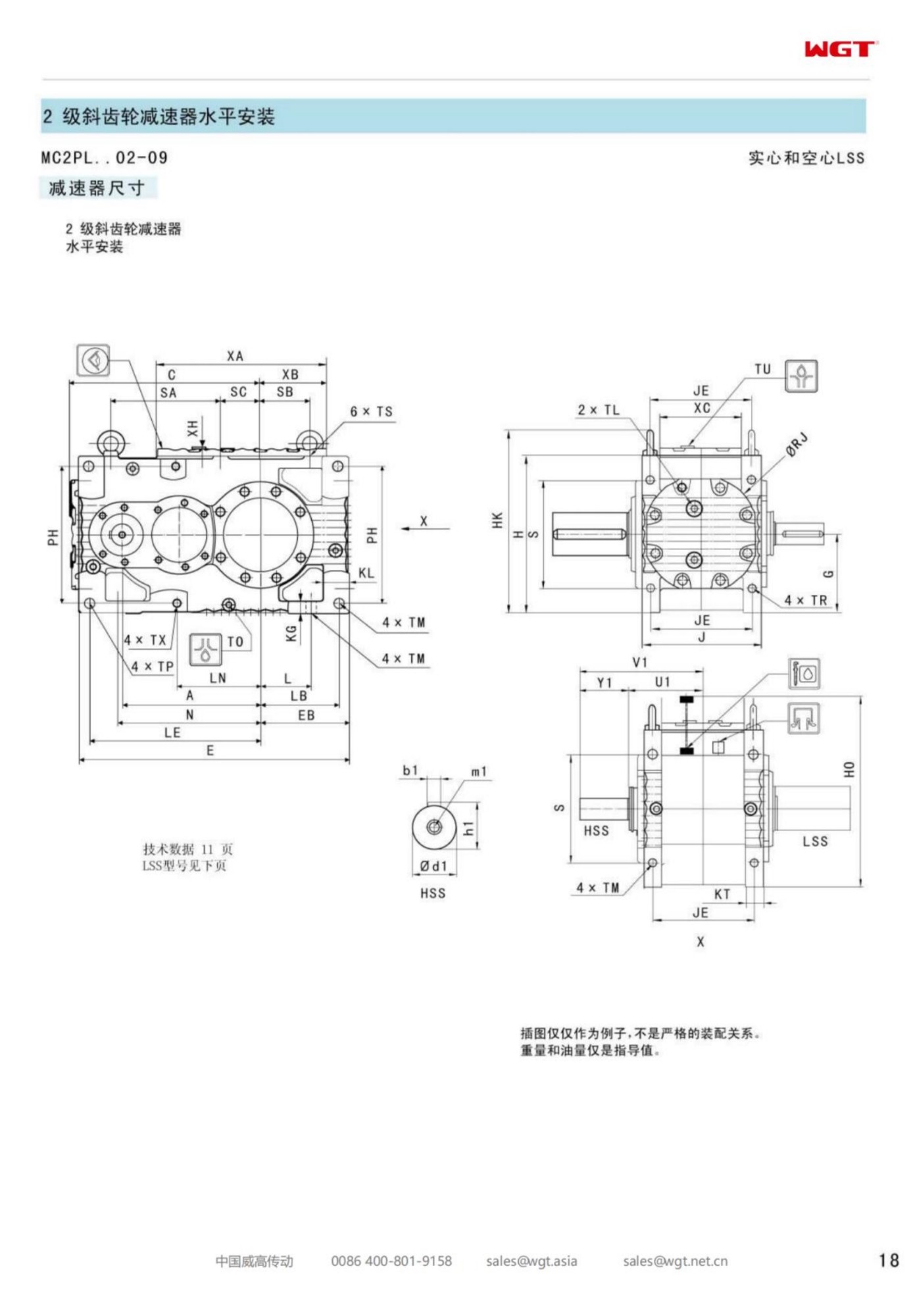
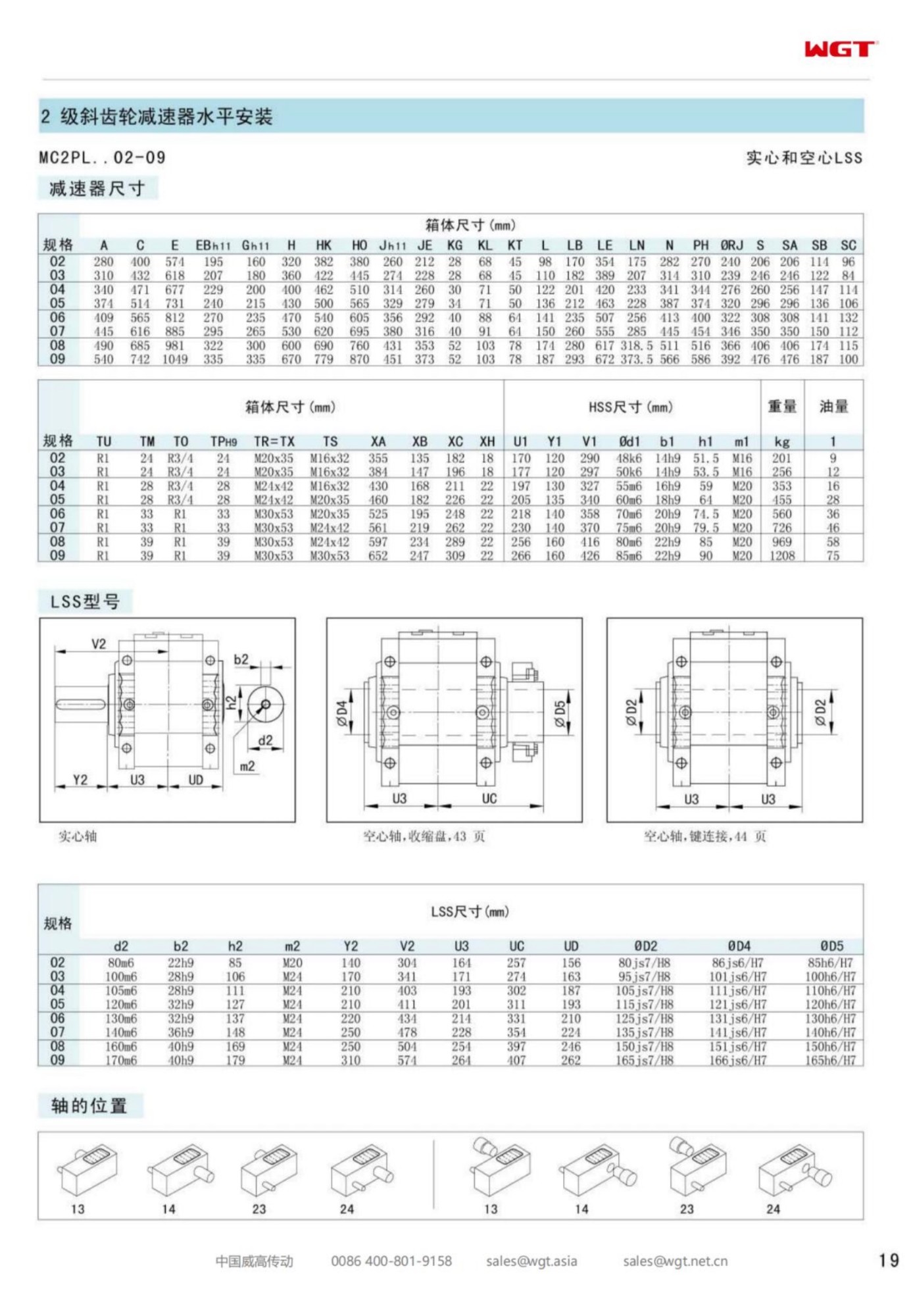
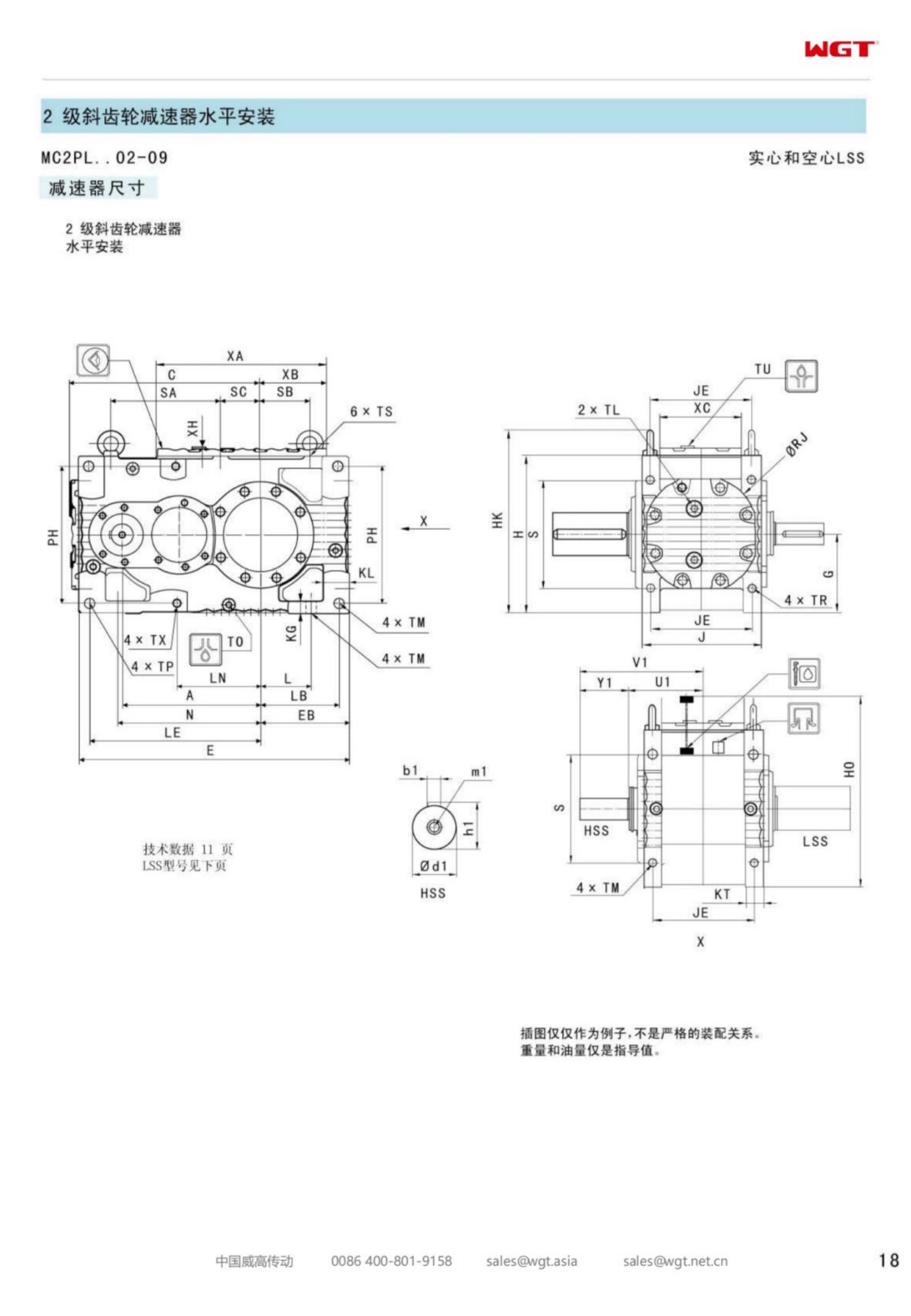
There is a point in every gear family where the drawings stop shrinking with each frame and start simply getting heavier. The MC2PLHF08 parallel shaft helical gearbox is that point on the two-stage hollow-bore line: the same honest layout - two helical stages in one horizontal plane, a footed case, a hollow bore that drops over the driven shaft - now built at a scale where the frame itself becomes part of the plant's structure rather than an accessory to it.
What makes frame eight interesting is not novelty but consequence. Every decision that was routine on the small frames - the shaft drawing, the grout, the oil grade, the guard layout - now carries a price tag with an extra zero on it if it gets done twice. The crews who run these units well are not the ones with cleverer instruments; they are the ones who treat the basics with the respect that size demands.
Two Stages, Carried to Full Size
The argument for staying with two helical stages at this size is efficiency written in fuel bills. Every mesh in a train costs a few per cent to friction, so a two-stage drive gives back what a three-stage build of the same ratio quietly spends. At the moderate output speeds of conveyor, feeder and thickener work, the tooth contact stays healthy and the wheel sizes stay buildable, so the two-stage case holds its mechanical case for duty after duty.
The boundary is real, though. Push the ratio too far on two stages and the wheels grow past what a sensible case can carry; that is the third stage's territory. Frame eight sits close to that border by design, which is why the enquiry's ratio and torque deserve exact figures rather than round guesses - the difference between a comfortable two-stage duty and a strained one is sometimes only a few points of service factor.
Why Big Machines Still Buy Two Meshes
Plant engineers who standardise on a family like this learn the second-order benefits of the short train. Fewer meshes mean fewer bearings to trend, less oil churn and slightly cooler running at the same torque. Fewer parts in the load path mean a shorter fault tree when something does go wrong: the vibration analyst has two mesh frequencies to know instead of three, and the alignment task is a pair of couplings rather than a chain of them.
There is also a spare-parts economy. Across a line of frames sharing bore sizes and seal dimensions, one well-kept shelf covers most first-line work. The bigger the frames, the more that economy matters - a bearing for frame eight is not a counter purchase, and every commonality the family offers is money the stores never have to spend twice.
The Type String at Frame Eight
The designation still decodes with the same table the family has used since the small frames, and a purchaser who reads it once reads it everywhere.
| MC | Industrial multi-stage gear unit family |
| C2 | Compact two-stage parallel-shaft series |
| P | Parallel stages in a single horizontal plane |
| L | Horizontal build, feet flat on the plinth |
| H | Hollow output bore over the driven shaft |
| F | Foot mounting with holding-down bolts |
| 08 | Eighth frame - two stages carried to full size |
At this frame the H character carries the heaviest calendar weight. The driven shaft is machined to the bore drawing while the unit crosses the ocean, so the drawing request belongs in the first enquiry letter and the machining slot belongs on the shutdown plan weeks before delivery. The F character sets the civil programme: pockets formed, pads levelled, grout scheduled and cured. Neither task is technically hard. Both are the classic reason a heavy drive sits crated for a fortnight.
Handling Weight With Ordinary Works Equipment
A frame-eight case leaves the lifting-sling category and enters the mobile-crane category, and the works that receive it should plan the lift with the same seriousness as the lift itself. The lifting points provided are the only points. Shafts, bores and cooling surfaces are not lifting points, however convenient the geometry looks on the day, and a bent shaft discovered at commissioning is an argument nobody enjoys having.
Inside the plant the last metres matter most. Doorways, floor loadings and the route from laydown to foundation deserve a walk-through before the truck arrives, not during it. Plants that rehearse the move with a tape measure and a loaded pallet of similar weight report that the real lift then feels dull - which is exactly what a heavy gearbox delivery should feel like.
Duties That Fill the Eighth Frame
The frames where two meshes still carry full plant torque:
- Conveyor head-shaft drives in a cement plant's clinker hall
- Scraper chain drives in a paper mill's wood room
- Thickener rake drives at a mineral processing plant
- Mixing drum drives at a refractory products works
- Runout table drives at a bar and section mill
- Lower pulley drives of a grain terminal bucket elevator
The common thread is torque at the centre of the plant's flow - drives whose stoppage stops the works, and whose shafts were never meant to carry a bolted coupling in the first place. For those machines the eighth frame offers full-size power with the hollow-bore installation that keeps their guarding and alignment simple.
Foundations for a Heavier Case
The foundation under a frame-eight unit is doing real structural work, and it deserves drawings rather than folklore. Anchor pockets sized to the holding-down hardware, a plinth mass that damps the mesh pulse instead of amplifying it, and a grout bed finished level within the tolerance the outline drawing states - these are the quiet decisions that keep the vibration signature boring for twenty years.
Two details repay attention every time. The first is levelling before grouting, taken at the feet with the unit resting on its own weight, because shimming after grout is a repair in disguise. The second is the torque-arm anchor: on a hollow-bore drive the reaction arm works against the machine structure, and an anchor into a flexible mezzanine turns the arm into a resonance story. Neither is expensive to get right at construction time.
Thermal Headroom and the Long Shift
A sump this size is a heat bank as much as a lubricant store. Short surges that would cook a small case barely register here, and the temperature trace across a long shift is flatter than any small-frame crew expects. The corollary is that when the trace does climb, it climbs for a reason worth finding: a blocked breather breathing against a filter, a fan cover choked with dust, or a duty that has quietly outgrown the original selection.
The ambient that matters is the one at the drive, in the hottest week, at full load - the number the rating table actually asks for. A gallery in summer or a mill building without airflow can run twenty degrees above the works weather station, and the margin between standard cooling and an order-time cooling option lives exactly inside that difference.
Alignment Habits for Large Parallel Trains
Parallel-shaft geometry is forgiving of small errors in a way that few other layouts are, and that forgiveness is a trap. A frame-eight unit aligned by eye will run; it will also spend its bearings unevenly and hand the plant a vibration trend that explains itself two years later. Laser alignment of both couplings, taken cold with the foundation at ambient, is an hour of work that buys back years of even bearing wear.
Recheck after the first thermal cycle. Large cases grow with heat and the alignment moves a little; the honest practice is a hot verification on the first running week and a note of the figures in the commissioning file. From then on the annual route check compares against numbers, not memories.
Spares and the Shared Bore Sizes
The family's shared dimensions are worth exploiting deliberately. Seal sizes and end-plate gaskets that repeat across frames let one stores position serve a whole line of units, and the annual shelf audit should list which frames each spare fits. What stays out of the shelf is bearings: at this size a bearing carries a maker's designation tied to the unit's serial, and a planned order beats a hopeful guess every time a shutdown is on the clock.
Oil deserves the same discipline as parts. One grade, labelled at the fill point, with the top-up quantity written on the guard - the number of large drives ruined by a helpful contractor and the wrong viscosity is small but entirely preventable.
What an Eighth-Frame Enquiry Needs
The enquiry that closes in one pass at this level carries the plant's worst hour and the shaft's true dimensions side by side: driven machine and load pattern with jam and stall conditions named; motor power, speed and starting method; output speed and the tolerance the process accepts; hours per day across a real week; summer ambient at the drive's own position. Then the fitting facts: bore and keyway with tolerances, usable shaft length, shoulder, torque-arm side and its anchor structure, rotation direction, and the backstop or brake answers in writing.
With those lines complete the reply is a firm quotation and an outline drawing the site can build from, and the project runs on schedule for the dull reason that nothing was discovered late. Frame eight rewards the same habit every large purchase rewards: the whole truth, written down on day one.
Field Applications
Wood chipper line
A board mill drives its drum chipper with a heavy-duty gear unit. Knife engagement shocks arrive several times a second, and the case-hardened gearing with generous bearing spans has shown no measurable wear.
Fertiliser plant drag chain
A fertiliser complex runs drag-chain conveyors on industrial gear units in a corrosive atmosphere. The heavy-duty epoxy coating and FKM seals have kept the units presentable and leak-free through several campaign cycles.
![where gear reducers are used in industry]()
Where these units are installed across industry.
Selection Example: Clinker hall conveyor head-shaft drive at a cement plant
Take a 45 kW motor at 1475 rpm turning the head pulley at 33 rpm. The ratio follows directly: 1475 / 33 = 44.7, so a ratio near i=45 is drawn from the upper two-stage band, and the frame is checked against the dust load - breathing, sealing and the annual oil sample all carry the clinker hall duty. In this case the eighth frame runs that duty with margin in hand near the border of the two-stage band, and the hollow bore drops over the head shaft from a footed case whose foundation is drawn, not improvised. Once the ratio is fixed, check the required output torque against the rating table with the service factor applied - that is what decides the frame, not the ratio alone.
![gearbox selection guide: speed, torque, service factor]()
How a ratio and a frame size are determined, step by step.
Frame Sizes and Typical Duties
| Model | Centre distance | Output | Typical duty |
|---|
| M3PSF50 | size 50 | solid shaft, foot | conveyors, feeders |
| M3PSF60 | size 60 | solid shaft, foot | crushers, mixers |
| M3PSF70 | size 70 | solid shaft, foot | ball mills, shredders |
| M3PSF80 | size 80 | solid shaft, foot | kilns, heavy conveyors |
| M3PSF90 | size 90 | solid shaft, foot | mill and kiln drives |
| M3RSF50 | size 50 | solid shaft, foot, right-angle | inclined conveyors, elevators |
| M3RSF60 | size 60 | solid shaft, foot, right-angle | screw classifiers, feeders |
| M3RHF70 | size 70 | hollow shaft, foot, right-angle | agitators, drum drives |
| M3PHT80 | size 80 | hollow shaft, torque arm, parallel | shaft-mounted conveyors |
| M3RHT90 | size 90 | hollow shaft, torque arm, right-angle | heavy shaft-mounted drives |
The size number is the key dimension that steps up torque capacity through the range: 50 to 90 in horizontal builds, 10 to 90 in vertical builds. Gearing philosophy is shared across the family.
Custom Shafts and Ratios for OEM Builds
Non-standard interface? Engineers can size the unit themselves in the WGT Motor & Gearbox Online Selection System - input speed, torque and duty, get the model instantly.
Splined, extended or flanged output shafts and special ratios are quotable for OEM volumes. Tooling cost is amortised across the order, and the drawing approval cycle starts the day you ask. Looking for a gearbox for packaging machine? Tell us the duty point and we will confirm the model in writing.
Common Questions from Buyers
Can the gear unit hold a load on an inclined conveyor?
For inclined belts a backstop prevents the loaded belt from driving the unit backwards when power is cut. Specify the incline angle when ordering so the backstop and the oil level are matched to the actual mounting position.
What is the difference between foot and torque-arm mounting?
Foot mounting bolts the housing to a foundation and suits most fixed installations. A torque-arm lets the housing swing on the driven shaft, so no base frame is needed - common on shaft-mounted conveyors where the reaction rod absorbs the torque.
Should I choose a solid or hollow output shaft?
A solid shaft with a keyed coupling is the flexible, conventional choice. A hollow shaft takes the driven shaft directly with a key or shrink disc, removing one coupling and one alignment step; it is preferred where space or alignment access is limited.