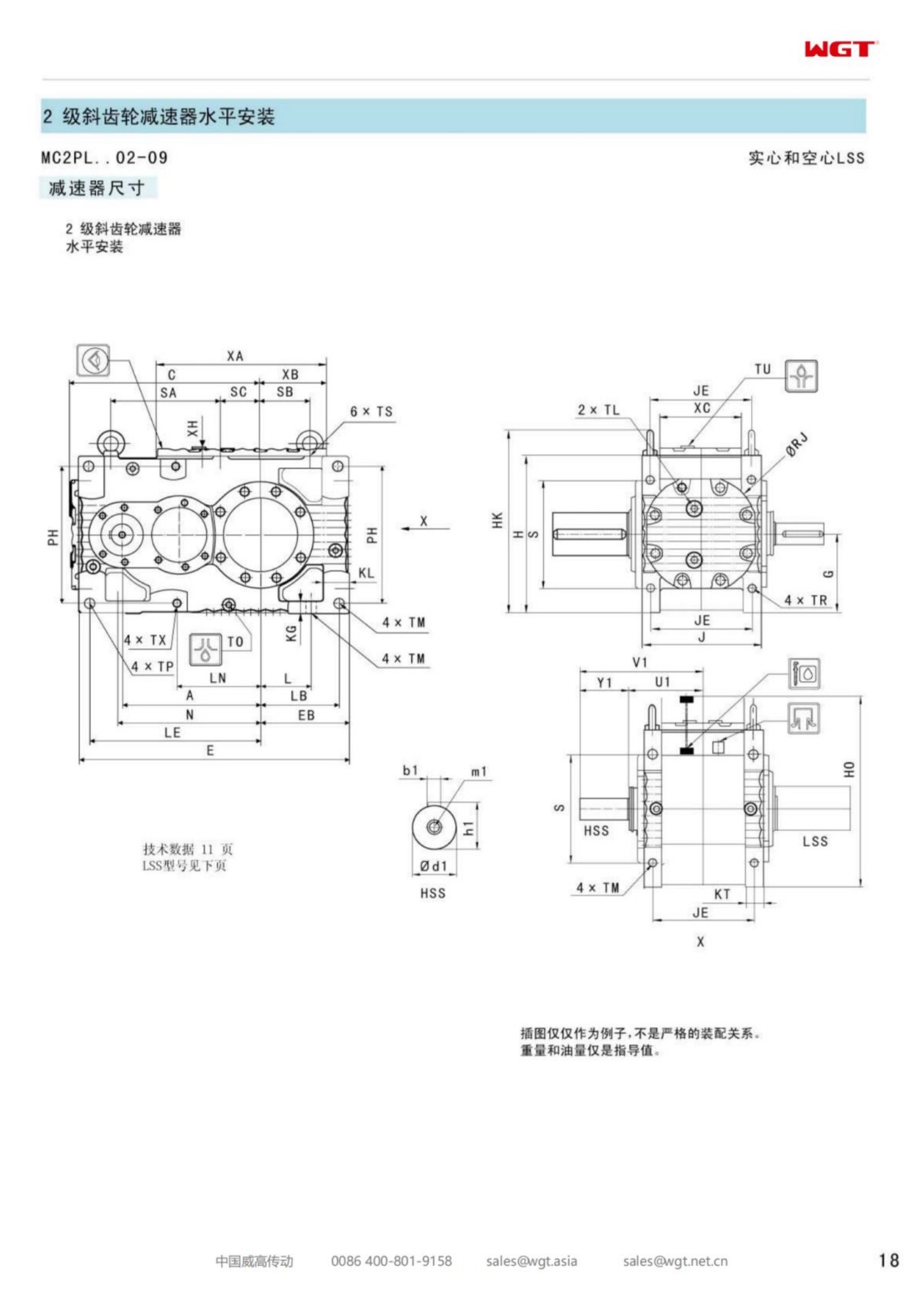
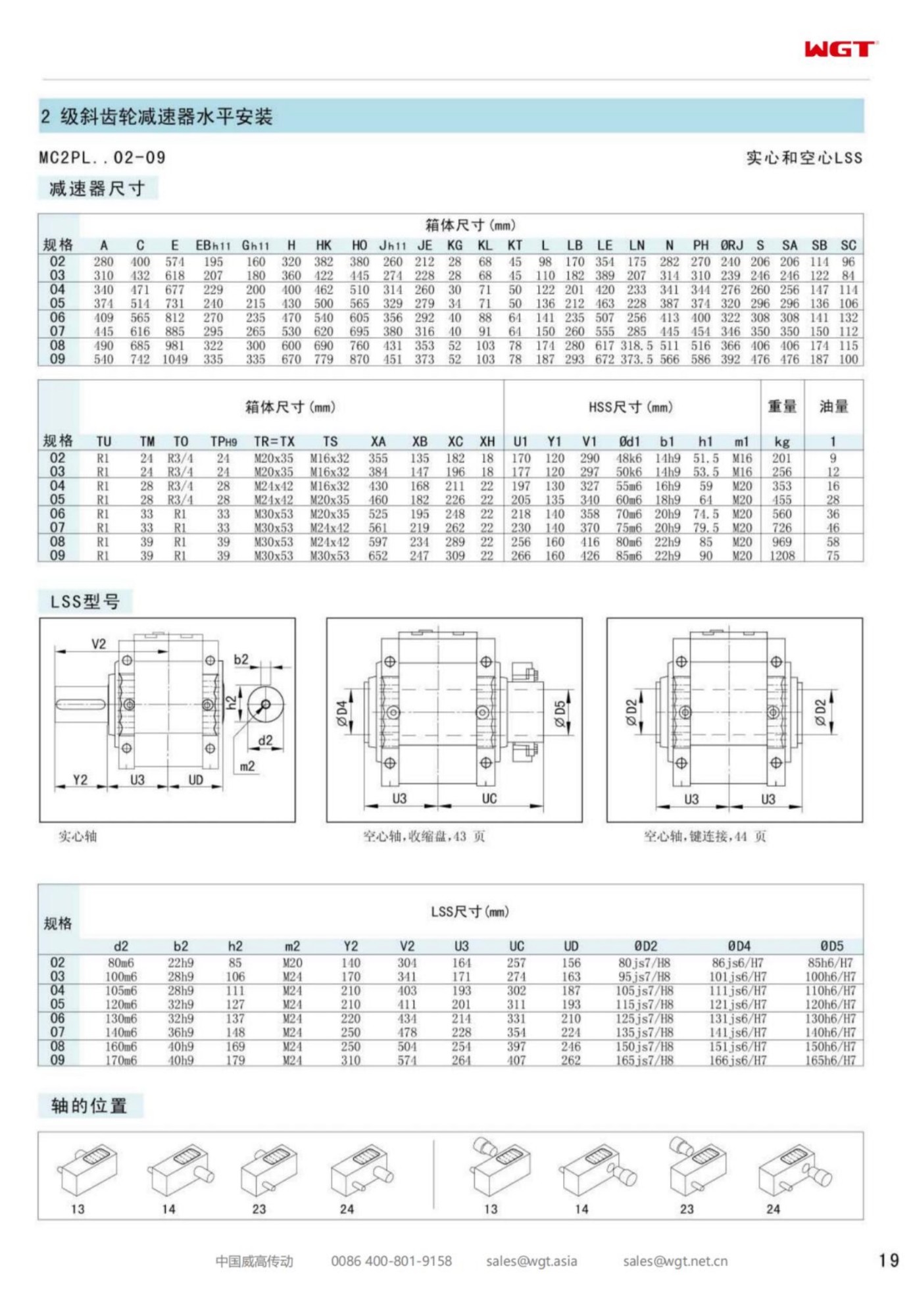
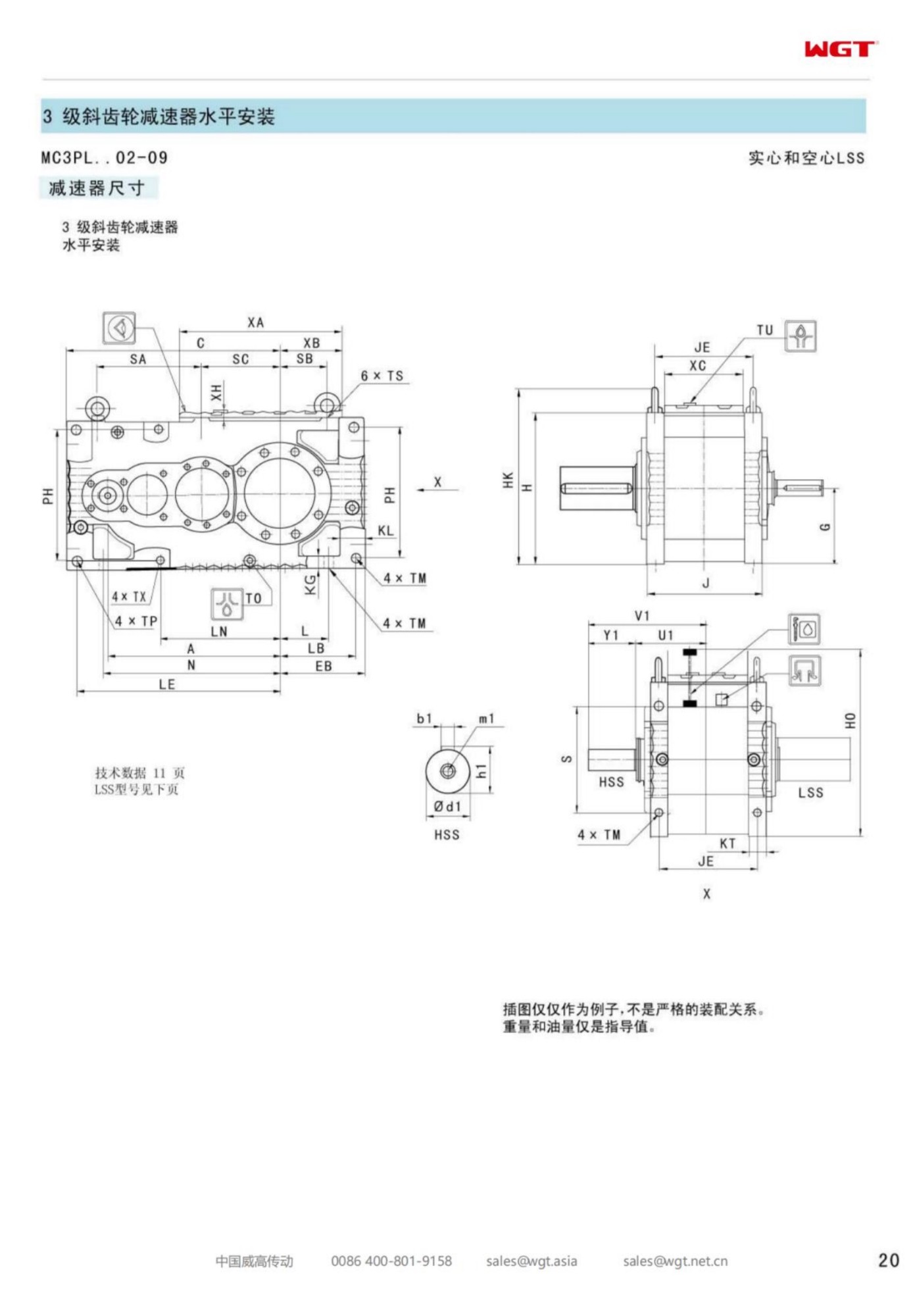
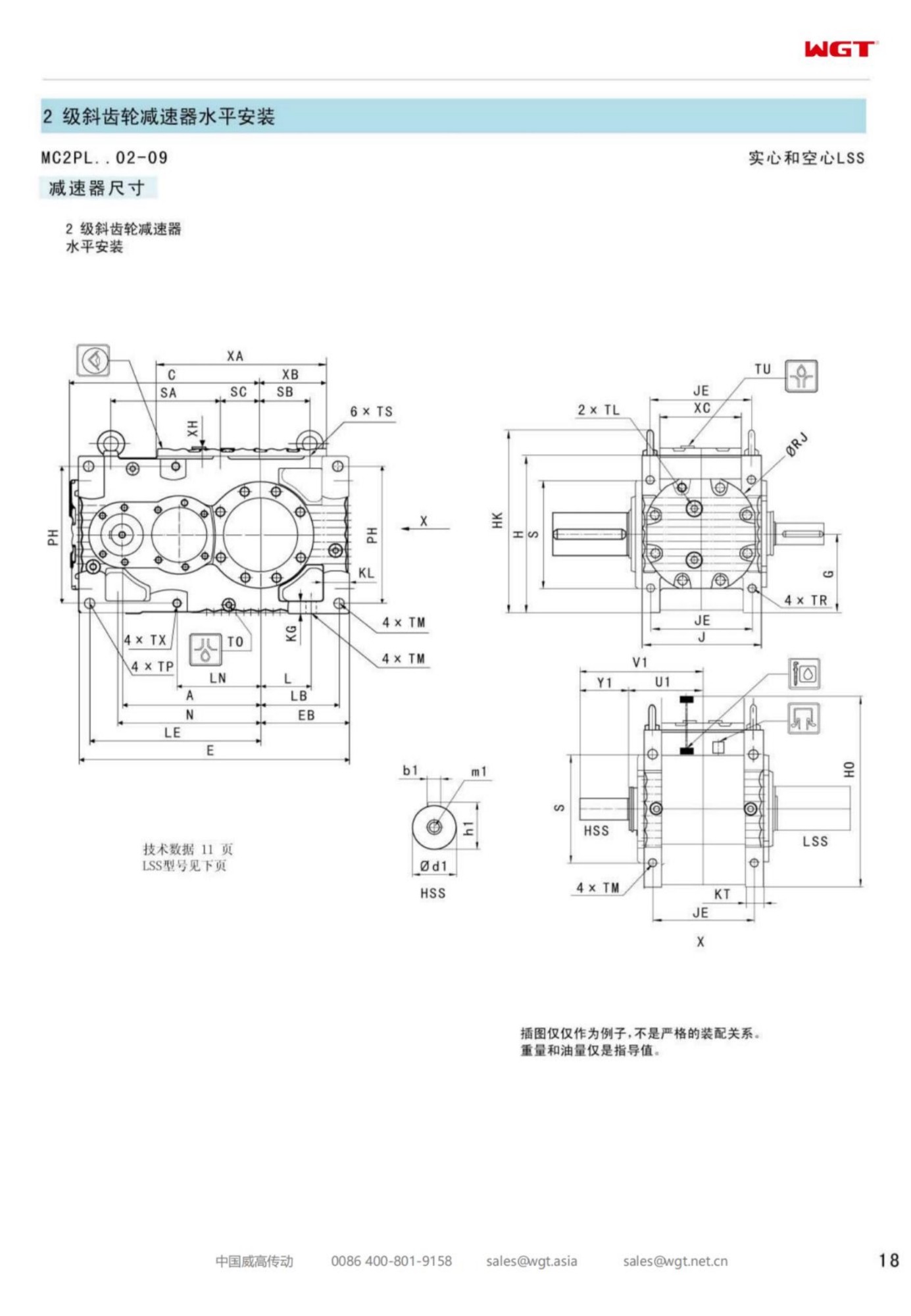
Most conveyors forgive a slow decision. Feeders under crushers do not. The material arrives already broken or about to be, the machine in front of the drive hits rather than pulls, and the gearbox hanging on the head shaft spends its life absorbing events the catalogue never draws. The MC2PLHT06 shaft-mounted gearbox is the frame in this band that ends up on those duties: apron feeders under primary crushers, reclaim feeders under coarse stockpiles, and the chain conveyors that carry what crushers leave behind.
The arrangement is the family's usual one - two helical stages, a level case, a hollow bore over the driven shaft and a torque arm handing the reaction to the machine frame. What distinguishes the duty is not the geometry but the character of the load: peaks that arrive without warning, stalls that stop the shaft dead, and restarts against a chamber still full of the material that caused the stall. A frame chosen for the average of such a duty will be chosen wrongly.
Where Shock Load Duty Begins to Decide the Frame
Below this frame, buyers can size by the running torque and add a modest factor for starts. From here upward, the running torque is often the smaller of the two numbers that matter. A feeder under a crusher sees a load that varies with the feed itself: a clean moment, then a slab arriving edge-on, then a bridged chamber that drops its whole column at once. Each of those moments passes through the shaft, into the bore, through the teeth and out along the arm in a fraction of a second.
This is why enquiries for crushing and reclaim duties ask for the machine's worst moment as well as its average. The motor rating says what the drive can deliver; it says nothing about what the driven side can hand back. A supplier who knows the material, the crusher type and the feed pattern can size against those events. A supplier who knows only kilowatts will return a frame that runs quietly for a year and then explains itself at the bearings.
Decoding MC2PLHT06
The designation reads field by field in the same way as the rest of the band, and the final frame digit locates the duty within it.
| MC | Industrial gear unit family built for continuous plant service |
| 2 | Two helical reductions carried in a single gear plane |
| P | Parallel-shaft arrangement, input and output shafts parallel |
| L | Level build with both shafts horizontal in one case |
| H | Hollow output bore that slips over the driven shaft |
| T | Torque arm anchoring, no feet and no foundation required |
| 06 | Sixth frame of the band: the step where shock load and stall events size the order |
The string, as ever, is silent on the things a hard duty is actually bought for: the service factor against shock, the bearing arrangement's appetite for reversing events, the sealing where crushed dust is airborne, the holdback if the incline can run back. Those lines belong in the enquiry text, and the sixth frame is where leaving them out starts to cost real money.
Shock Loads and What They Do to a Service Factor
A service factor is a multiplier against the running load, and on smooth duties it is generous enough to be almost decorative. Under shock load it becomes the whole selection. Each peak loads the tooth mesh beyond its steady figure for an instant; each stall holds the driven side still while the motor keeps trying; each restart against a full chamber asks for several times the running torque before the material begins to move again.
The honest way to size such a duty is to name the events. How often does the crusher pass unbreakable material? What does the feeder see when a bridge collapses? Is the restart loaded or is the chamber cleared first? A selection made against those answers may land on a larger frame than the kilowatts alone suggested, and that larger frame is the cheap option. The expensive version of the same decision is a marginal frame that survives the peaks until one day it does not, at a time of the supplier's choosing rather than the plant's.
What an Impact Does Along the Load Path
It is worth following a tramp event through the drive. The peak arrives at the driven shaft, through the bore and the key, into the low-speed gear, across the mesh, along the shafts and bearings, and finally into the case and the torque arm. Every joint on that path sees a version of the event. A slack key hammers its keyway into an hourglass. A worn arm bushing lets the case rotate a few degrees before the arm catches, and the catch is itself a second impact. Loose bracket bolts multiply everything that follows.
This is why the inspection routine on a shock duty is tighter than on a steady one. Key and keyway examined at every strip-down. Arm bushings checked for play at every planned stop. Bracket bolts re-torqued on a schedule rather than when something sounds wrong. None of these checks is difficult, and each one reads the duty's true severity directly off the hardware - which is more honest than any instrument bolted to a smooth-running neighbour.
Starts, Jams and the Worst Moment of the Day
On crushing and reclaim duties the electrical side usually gets the attention: soft start, VSD, current limits. The mechanical side lives with the same moments. A jam holds the output still while the drive applies whatever the starter permits, and the gear mesh holds that torque as a static load until something moves or something yields. The design question is not whether the frame can survive the average jam - it is whether it survives the jam that happens on a cold morning at full chamber.
The enquiry should carry this in plain words: what clears a jam costs, how often jams arrive, whether the machine restarts loaded and what the electrical scheme applies during the start. With those lines, the selection can be made against the stall as deliberately as against the run. Without them, the frame is sized for a life of clean moments that the duty will not provide.
Noise as a Diagnostic on a Shock Duty
Every gearbox speaks, but a shock-duty frame speaks in a dialect worth learning. A steady tone at the usual load is the sound of a healthy mesh. A knock that arrives with the material is the duty itself, passing through. A growl that persists after the load has gone is a bearing asking to be heard, and a click at each revolution of the low-speed shaft is something local - a key beginning to move, or a guard beginning to touch. None of these sounds names itself on a datasheet; all of them are legible to the crew that walks the machine daily.
The discipline is to compare, not to diagnose in isolation. The same drive yesterday, the twin drive on the neighbouring feeder, the same position after the last oil change - one of those comparisons will date the change precisely, and a dated change is a decision waiting to be made cheaply. Sounds that arrive and stay go in the logbook with a date and a load condition, and the logbook does the rest.
Bore, Key and Shaft Under Cyclic Load
A hollow-bore case hanging on the machine's own shaft lives on the fit. Under cyclic and shock loading, the bore edge works against the shaft surface, and the first sign of trouble is a rust-coloured dust at the bore mouth - fretting, the Quiet kind that does its work for years before it shows as movement. The defences are specified at order time: correct fit class, key steel of the right grade, a keyway fit that holds rather than rocks, and retaining hardware that keeps the case from walking.
The driven shaft deserves the same respect. On shock duties the shaft has usually seen events of its own before this frame arrives: previous units, previous jams, perhaps a weld repair somewhere in its history. Measure it honestly, look at the keyway corners, and say in the enquiry what the measurements show. A shaft with history is not a rejection; it is a condition the selection should know about before the frame is hung, not after.
Duties That Land on Frame Six
Positions where the load arrives with a hammer behind it:
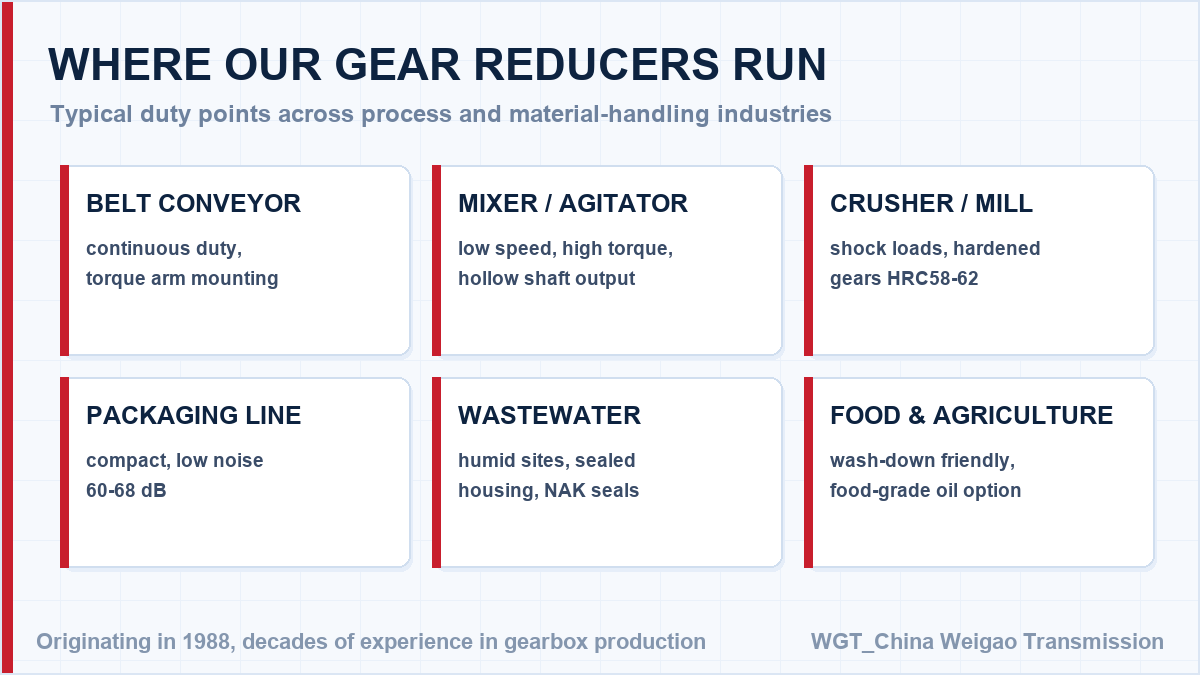
- Apron feeder under a primary jaw crusher at a limestone quarry
- Belt feeder drawing reclaim from a coarse ore stockpile
- Slag conveyor at an electric arc furnace shop
- Breaker feeder at a recycling yard processing demolition concrete
- Chip screen drive at a sawmill taking unsorted roundwood
- Drag chain at a power station boiler ash hopper
What the list shares is that every machine in it feeds or clears something harder than a tonnage figure suggests. The duty's personality - how it hits, how often it stalls, how it is restarted - is known to the people who run it, and that knowledge is worth more in the enquiry than any single catalogue column.
Sealing and Hardware Where Crushed Dust Is Airborne
Crushing and reclaim areas make dust of a particular kind: sharp, abrasive and persistent. It finds the seals first and the breathers second, and it works on both slowly enough that the damage reads as normal ageing until someone compares a drive of the same age in cleaner air. On this class of duty the sealing arrangement is part of the engineering: lip material suited to the temperature, a labyrinth or protective sleeve where the dust is worst, and a breather positioned where the air is cleaner than the machine's immediate neighbourhood.
The hardware follows the same logic. Plugs and fasteners that will still come out after two years of dust and washdown. Drain points that can be reached without stripping guarding. A paint system chosen for the atmosphere rather than the catalogue photograph. Each item is one line on an order and a small cost; each omission is a maintenance story that repeats until someone finally writes the line.
Ordering an Enquiry That Names the Worst Case
A shock-duty enquiry is built around events rather than averages. The machine and its material. Running power and speed, and the ratio the duty needs. The events: what causes them, how often, what the restart looks like, what the electrical scheme applies. Hours per day and starts per hour. The driven shaft's measured diameter, key and plain length, the bracket drawing, whether the incline can run back, and the ambient and dust description at the drive position.
Sent complete, that enquiry returns a frame with a factor that means something and fittings chosen for the events the duty actually delivers. Sent as kilowatts, it returns questions, and every round of questions costs a week while the shutdown window holds still. On this frame the difference between those two outcomes is wider than on any smaller one, because the events are bigger than the average everywhere in the arithmetic.
Oil and Inspection on a Beaten Duty
Shock load shortens oil life the same way it shortens everything else: peaks shear the film, heat thins it, and dust that finds its way past a tired seal thickens it. On this class of duty the first oil change comes early and every sample after that is read closely - wear metal from the teeth and bearings, water from washdown or condensation, viscosity drift that says the sump has been running warmer than intended. The sample record, kept from the first change, turns the drive's condition into a trend instead of an argument.
The walk-round belongs on the same route as the crusher's own checks: oil at the plug or glass, temperature at a marked patch, arm bushings free of play, bore mouth clean of fretting dust, seal area dry, noise steady at the usual load. Five minutes, written down, every week. On a duty that hits its drive for a living, that notebook is the difference between a planned swap and an unplanned one.
The First Month on a Hard Duty
A new frame on a shock duty proves itself quickly or says so early. Temperature after the first loaded shift, again at a day and at a week. Oil level with any top-up noted. The bore mouth inspected for dust of the rust-coloured kind after the first hundred hours. Arm bushings checked for play at the first planned stop, bracket bolts re-torqued to figure, noise described in words at the usual load.
A month of that record either settles the installation or names the loose end while it is still cheap - a bushing at the wrong travel, a bracket that flexes where it should not, a seal weeping in the dust. Every one of those is an afternoon at month one and a shutdown at year three. The frame is built for the duty; the first month is when the installation is asked to be worthy of it.
Available Frames and Their Typical Duty
| Model | Centre distance | Output | Typical duty |
|---|
| M3PSF50 | size 50 | solid shaft, foot | conveyors, feeders |
| M3PSF60 | size 60 | solid shaft, foot | crushers, mixers |
| M3PSF70 | size 70 | solid shaft, foot | ball mills, shredders |
| M3PSF80 | size 80 | solid shaft, foot | kilns, heavy conveyors |
| M3PSF90 | size 90 | solid shaft, foot | mill and kiln drives |
| M3RSF50 | size 50 | solid shaft, foot, right-angle | inclined conveyors, elevators |
| M3RSF60 | size 60 | solid shaft, foot, right-angle | screw classifiers, feeders |
| M3RHF70 | size 70 | hollow shaft, foot, right-angle | agitators, drum drives |
| M3PHT80 | size 80 | hollow shaft, torque arm, parallel | shaft-mounted conveyors |
| M3RHT90 | size 90 | hollow shaft, torque arm, right-angle | heavy shaft-mounted drives |
Note that PSF and RSF frames of the same size share the mounting footprint; the R build simply inserts a bevel stage, so switching layout rarely forces a foundation change.
Questions and Answers
Which mounting positions can be used?
The unit can be installed in M1 to M6 positions - floor, wall or ceiling. The oil level plug is repositioned for the position you order, so state it up front and the unit is filled and labelled correctly at the works.
Can I reuse my existing couplings and foundations?
Yes. Centre distances, shaft dimensions and flange bolt patterns follow the common industry standards, so couplings, guards and foundations do not have to be redesigned. Send the nameplate details and we confirm the equivalent frame in writing.
Can the reducer be used outdoors or in a washdown area?
Standard paint and NAK seals suit sheltered outdoor duty. For washdown or coastal sites specify the heavy-duty coating, FKM seals and stainless fasteners; for humid rooms we recommend the breather and oil-check routine in the manual.
Installation Examples
Airport baggage conveyor
An airport baggage-handling integrator uses reducers on check-in conveyors. Thousands of start-stop cycles a day are absorbed without overheating, and the low noise level matters in a public terminal.
Quarry primary crusher
A quarry operator fits industrial gear units on its primary jaw crusher feeders. The shock of rock dumped straight from the haul truck is covered by the service factor, and the cast-iron housing shrugs off years of dust and vibration.
![gear box application map for industry]()
From quarries to food plants - one right-angle drive concept.
Selection Example: Apron feeder under a primary jaw crusher at a limestone quarry
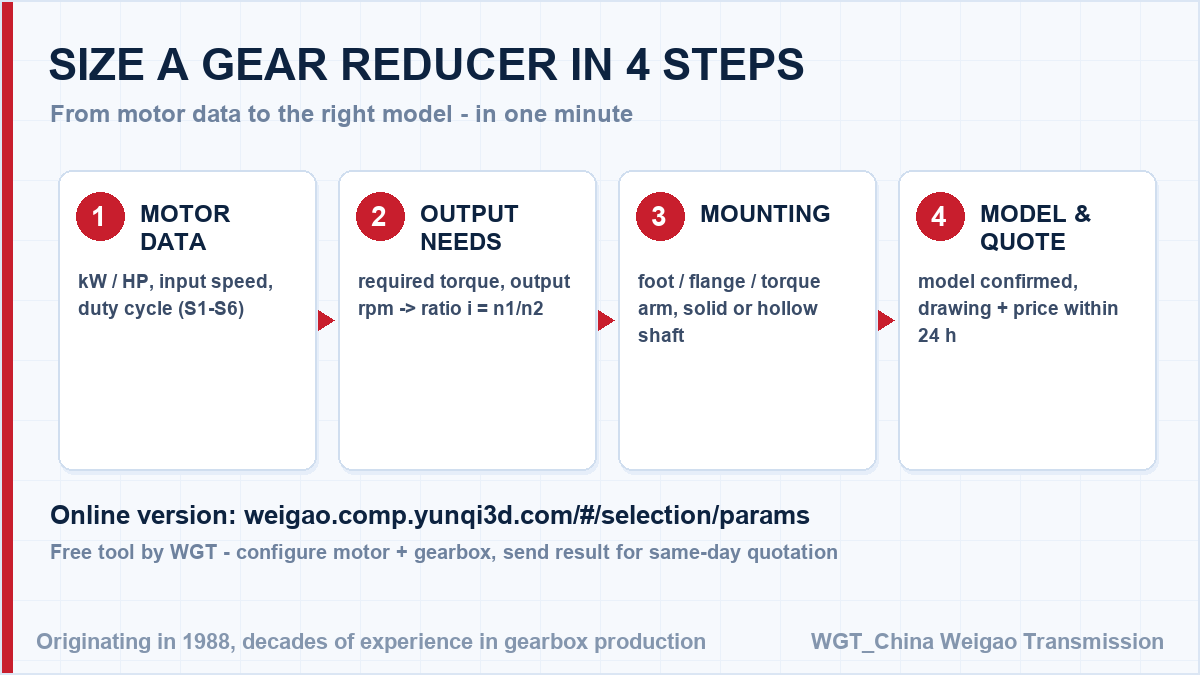
Take a 45 kW motor at 1480 rpm turning the feeder at 31 rpm. The ratio follows directly: 1480 / 31 = 47.7, so a ratio near i=48 is drawn from the two-stage band, and the frame is checked against the shock peaks a jammed or tramp-loaded feeder delivers, not just the running torque. In this case frame six carries the impact with margin to spare, and the torque arm takes the reaction without passing it into the crusher structure. The ratio is the easy part. The service factor for the shock level is what makes the selection safe, and we check that for you at no charge.
![how to choose a speed reducer model]()
Ratio first, then torque, then frame size: the standard selection route.
Design Review, Datasheet and Price - Same Day
Planning a new machine? The WGT Motor & Gearbox Online Selection System covers motor power, ratio and mounting on one screen - enter your numbers and see the model immediately.
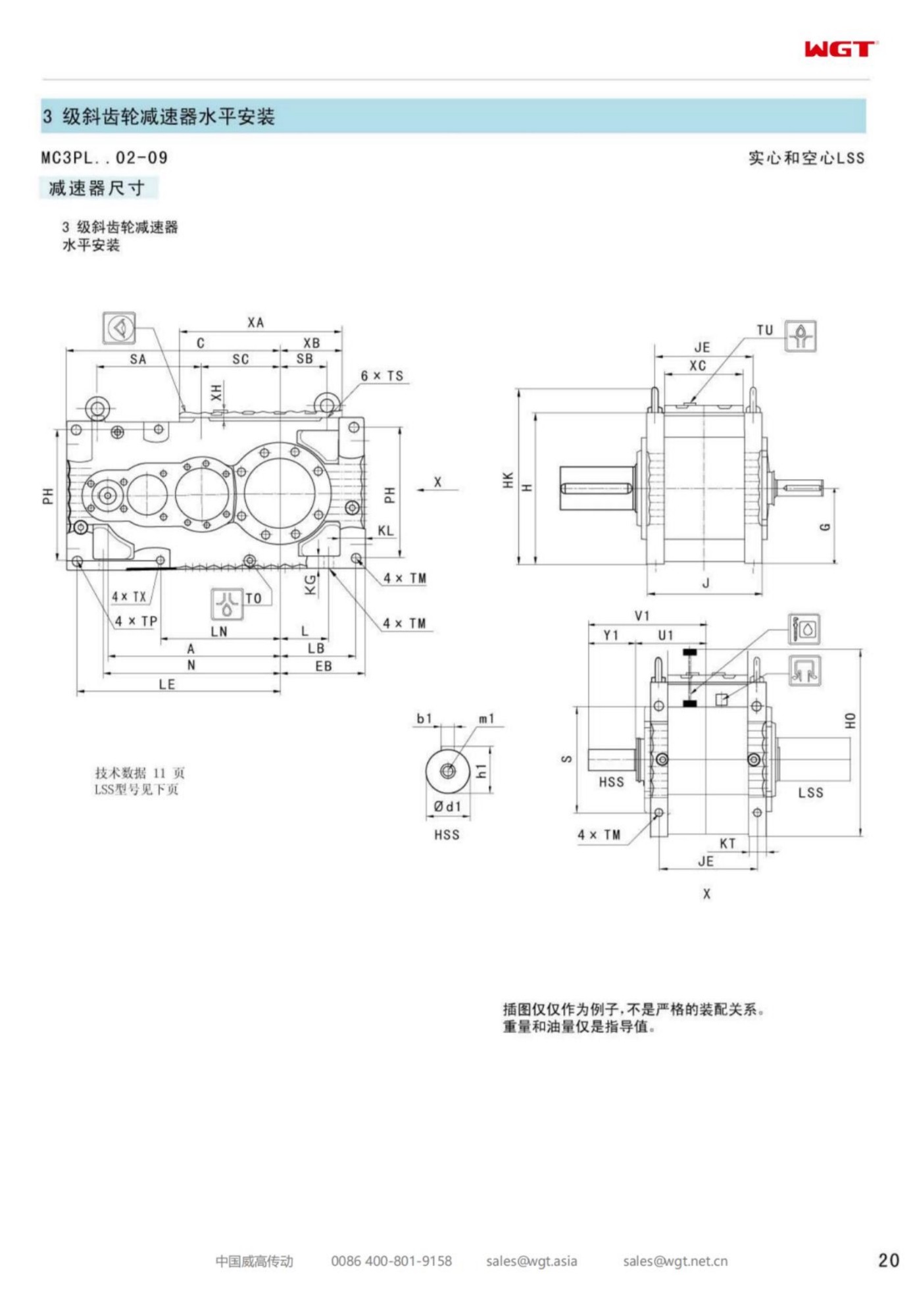
Send the interface drawing or the frame dimensions you need to match, and we return a 2D drawing and 3D STEP model with the quotation, so your design review is not held up waiting on the supplier. Looking for a gearbox for packaging machine? Tell us the duty point and we will confirm the model in writing.