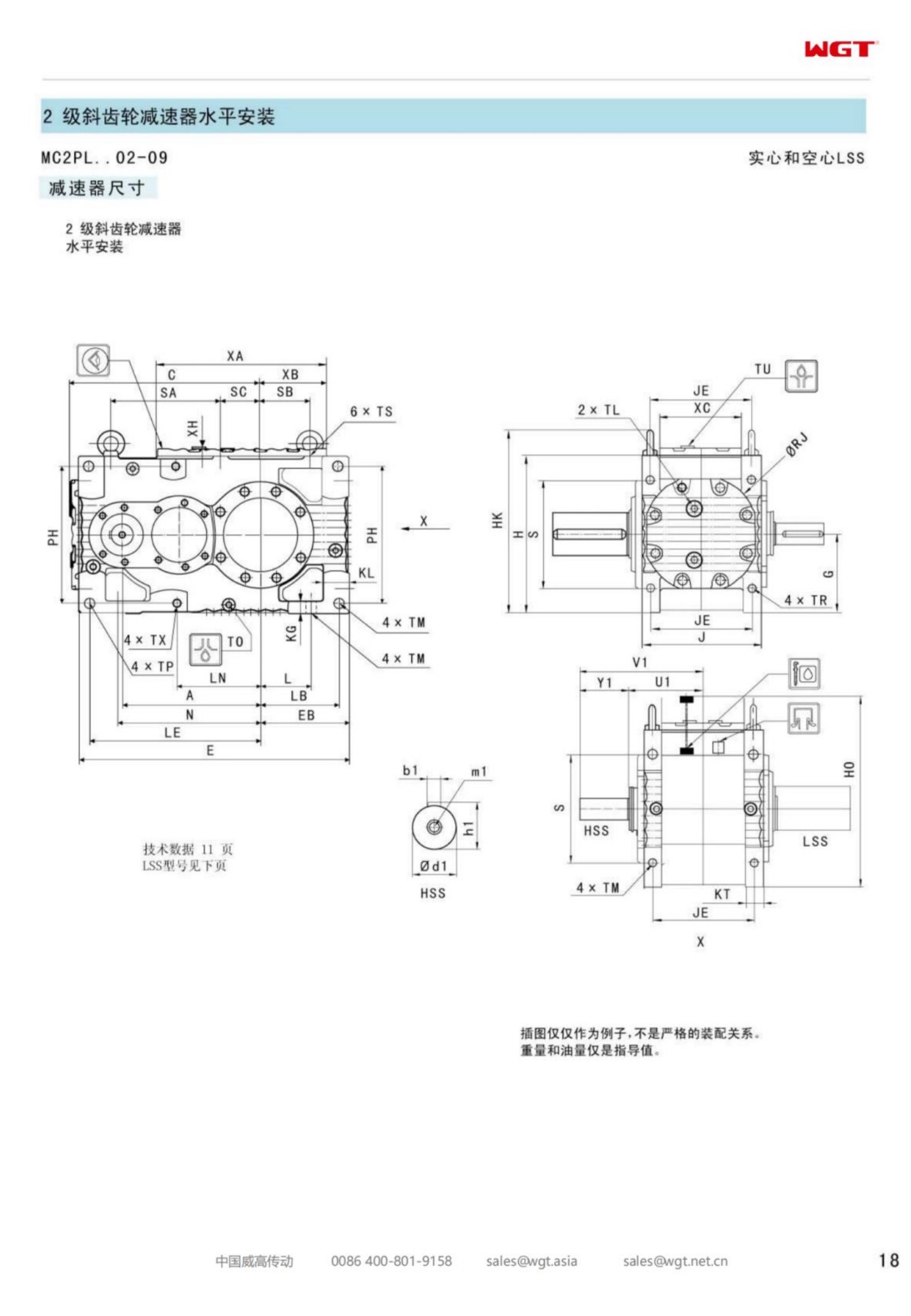
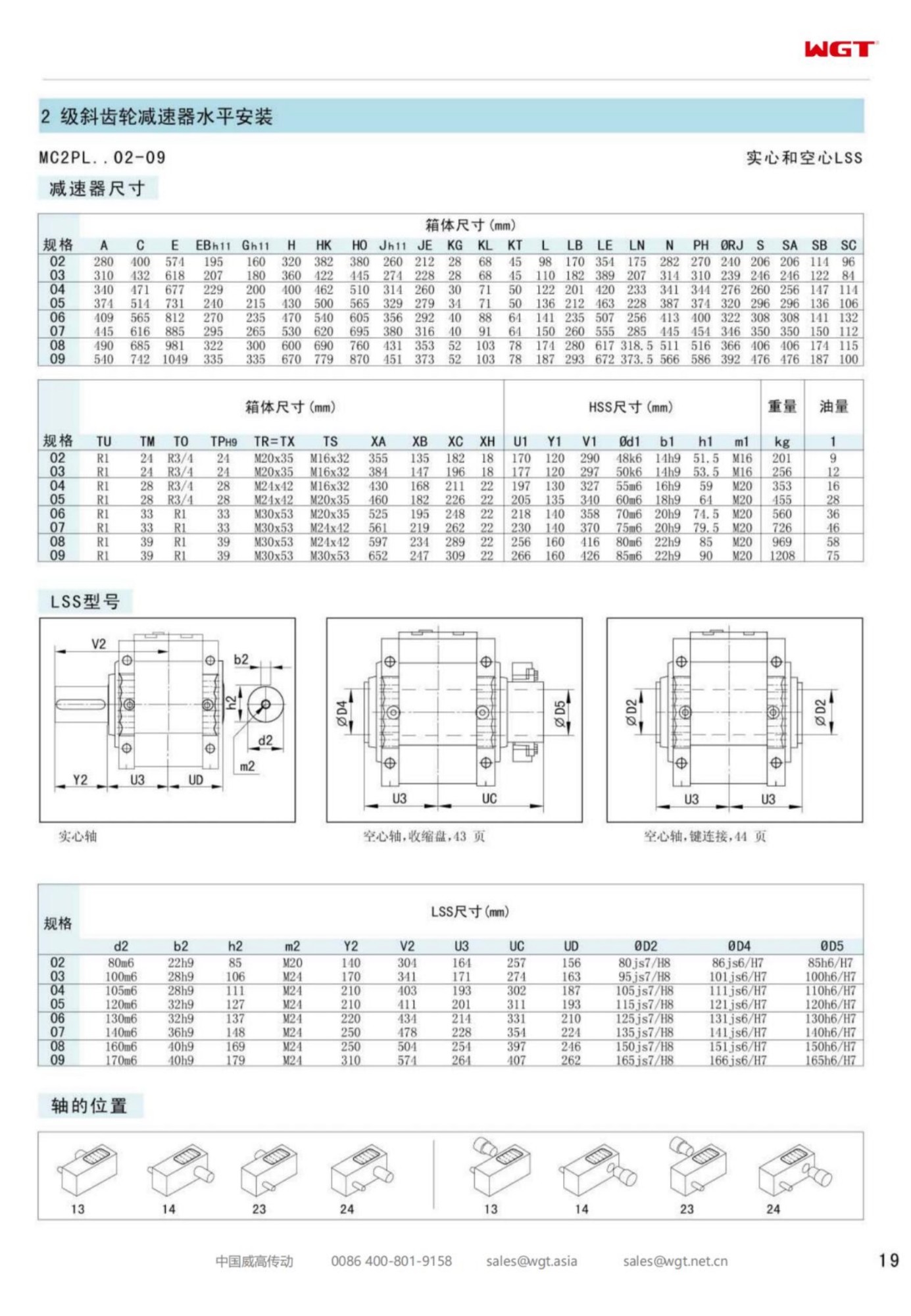
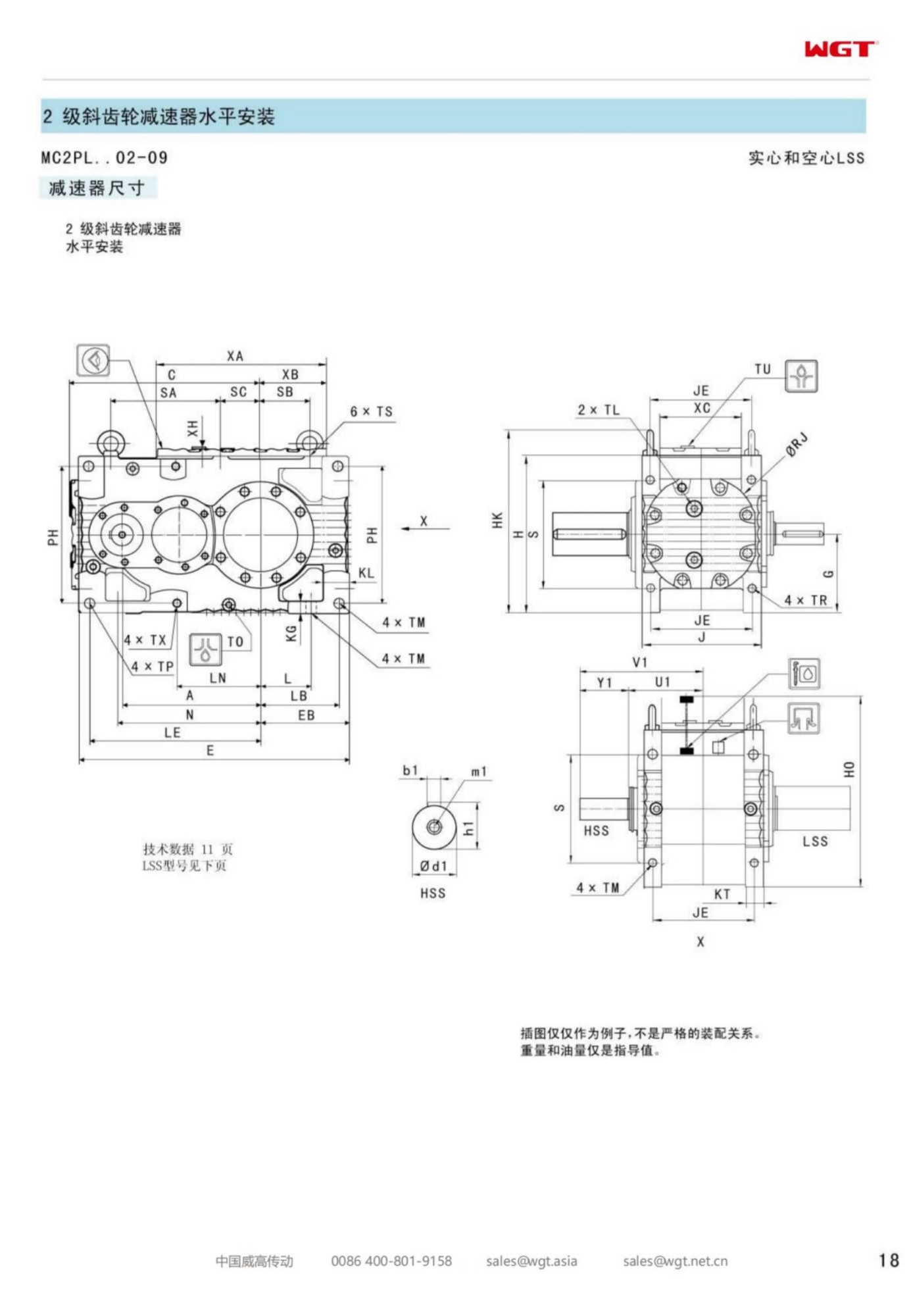
The MC2PLSF04 parallel shaft helical gearbox carries the same low, footed, two-stage layout as the frames below it in the series, but the 04 casting gives that layout real headroom: a wider output shaft, a taller gear case for deeper teeth, and a sump sized so a continuous shift does not keep the oil on the warm side of its band. On plants that standardised on the 02 and 03 for lighter lines, the 04 is usually where the heavier transfer conveyors and feeders end up.
What the 04 Frame Adds Over the 03
The step from the 03 to the 04 is mostly about margin under continuous load. A 03 running a twelve-hour duty near the top of its band will do the work, but it sits closer to its thermal and bearing limits than a 04 doing the same job at a relaxed fraction of its rating. Plants that plan for throughput growth often fit the 04 from the start for exactly that reason: the gearbox never notices the extra tonnes that get added to the line later.
The physical changes are modest and practical. The footed base spreads load over a longer footprint, the output end accepts a larger keyed shaft for bigger couplings, and the internal bearing arrangement leaves room for a service visit without pulling the whole unit off the plinth.
Reading the Code Before the Drawing
| M | Industrial multi-stage gear unit family |
| C2 | Compact two-stage parallel-shaft series |
| P | Parallel stages - shafts in one horizontal plane |
| L | Long-centre build with the motor mounted alongside |
| S | Solid output shaft with parallel key drive |
| F | Footed housing for plinth bolting |
| 04 | Frame size, with headroom over the 03 |
One line of code, and most of the mounting conversation is settled: a horizontal, footed, low-profile box with a keyed solid output and space reserved for a side-mounted motor. The ratio itself is ordered per job, so two 04 frames on the same plant can run at completely different speeds off the same drawing.
Matching Motor, Ratio and Duty Cycle
The ratio on a two-stage frame is best chosen from the driven machine outward. Take the conveyor or feeder speed the process actually needs, allow for the drive-end losses, and pick the reduction that lets a standard four-pole motor sit near its efficient middle rather than at either edge of its curve. Intermittent duty widens the choices; continuous duty narrows them, because the frame also has to hold its temperature over an eight or sixteen-hour shift, not just carry the peak torque for a minute.
A useful habit is to size the frame one step up from the calculated minimum whenever the duty is expected to grow. The casting is not the expensive part of the install; the shutdown that follows an undersized unit is.
The heavy drives this frame is regularly chosen to carry: Overland and shuttle conveyor drives in quarry and aggregate plants Rotary airlock and vane feeder duties at power and boiler houses Sludge cake and belt filter press drives at treatment plants Cooler and drum discharge feeds on clinker and lime lines Inclined apron feeder drives handling ore and mill scale Screw reclaimers and transfer conveyors at port terminals
Foundation, Shimming and First Alignment
The 04 rewards a careful install. Machined feet sit on cleaned pads, the plinth is checked with a straight edge in both directions, and thin shims are used under individual feet until the case sits level before any bolt reaches full torque. Pulling a foot down over a void twists the housing, and the symptom appears weeks later as a bearing that runs warm on one side for no obvious reason.
Alignment follows the same patience. The coupling is set with a dial gauge, the gap taken from the drawing, and the whole check is repeated after the first warm run, because housings move slightly as they reach operating temperature. A side-mounted motor on slide rails makes this easy: alignment is done by moving the motor, never by stressing the feet.
Oil Care on a Small Sump
Two-stage frames of this size carry a modest oil volume, so the grade and level matter more than they do on larger gear cases. Fill to the level plug with the grade named on the plate, run unloaded briefly, then stop and re-check, since air worked out of the housing during the first minutes drops the level visibly. The first change comes early, at a few hundred running hours, to clear the running-in particles every new gear set sheds. After that the calendar rules: dusty or hot sites sit at the short end of the interval, and a choked breather is checked before the oil is blamed.
Enquiry Checklist for the 04 Frame
Five lines make the enquiry complete: absorbed power or torque at the output, required output speed, the daily running pattern, mounting orientation including output direction, and the shaft diameters to be coupled on both sides. A nameplate photograph from the old unit, if one exists, settles the rest in seconds. With that packet the factory can confirm frame, ratio and build in a single reply, and the unit that ships matches the plinth that was poured for it.
Available Frames and Their Typical Duty
Frame numbers rise with torque capacity, and each frame is available with several mounting styles. If you are matching an existing installation, send the interface drawing and we will identify the equivalent frame for you.
Questions and Answers
Which lubricating oil should be used?
GB L-CKC220~460 or Shell Omala 220~460 as supplied. Under normal duty the housing is lubricated for life; in hot or continuous-duty environments an oil change after the first 400 hours and then every 4000 hours is recommended.
What warranty and documentation come with the gearbox?
A one-year warranty covers material and workmanship. Each unit ships with a test record (noise, temperature rise, backlash), a dimension drawing and an installation manual.
How do I calculate the ratio I need?
Divide motor speed by the target output speed (i = n1/n2), then check the required torque against the rating table with your service factor. The online selector below does this automatically.
Installation Examples
Glass batch charger
A float-glass line drives its batch charger with units. Abrasive raw material demands a robust drive, and the case-hardened gears show minimal wear after years of continuous operation.
Battery slurry mixer
A battery materials plant uses reducers on slurry mixers. High shear loads are absorbed by the 42CrMo shafts, and the 94-96% efficiency keeps motor sizing and running cost down.
![gear box application map for industry]()
From quarries to food plants - one right-angle drive concept.
Selection Example: Quarry transfer conveyor head drive
Take a 1470 rpm four-pole motor turning the head pulley at 28 rpm. The ratio follows directly: 1470 / 28 = 52.5, so a ratio near i=52 is ordered and the absorbed power is checked against the 04 frame rating with the service factor the site requires. In this case two helical stages land the reduction without the height a bevel set would add, which suits a drive mounted between conveyor stringers. The ratio is the easy part. The service factor for the shock level is what makes the selection safe, and we check that for you at no charge.
![how to choose a speed reducer model]()
Ratio first, then torque, then frame size: the standard selection route.
Design Review, Datasheet and Price - Same Day
Planning a new machine? The WGT Motor & Gearbox Online Selection System covers motor power, ratio and mounting on one screen - enter your numbers and see the model immediately.
Send the interface drawing or the frame dimensions you need to match, and we return a 2D drawing and 3D STEP model with the quotation, so your design review is not held up waiting on the supplier. Looking for a gearbox for belt conveyor? Tell us the duty point and we will confirm the model in writing.