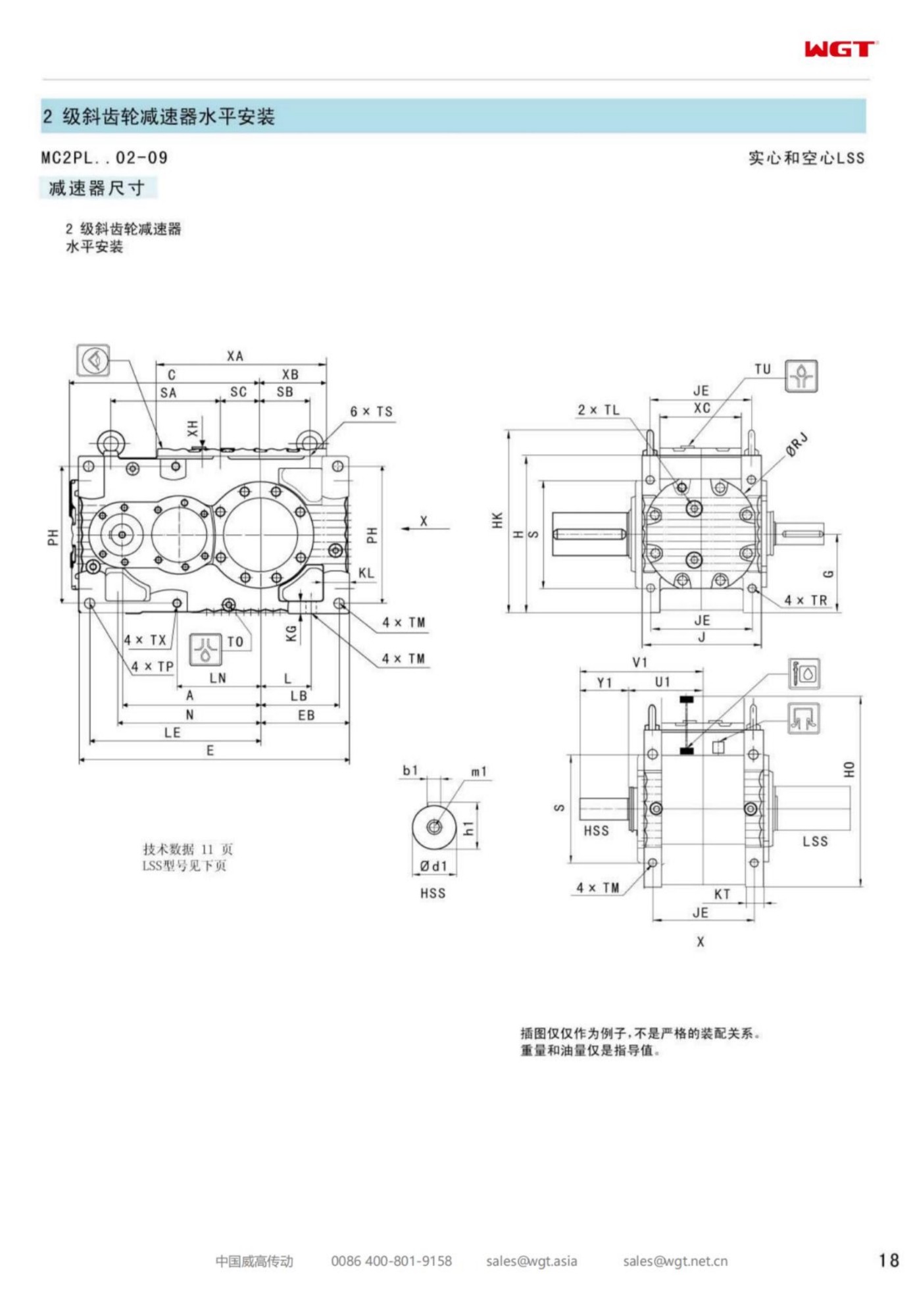
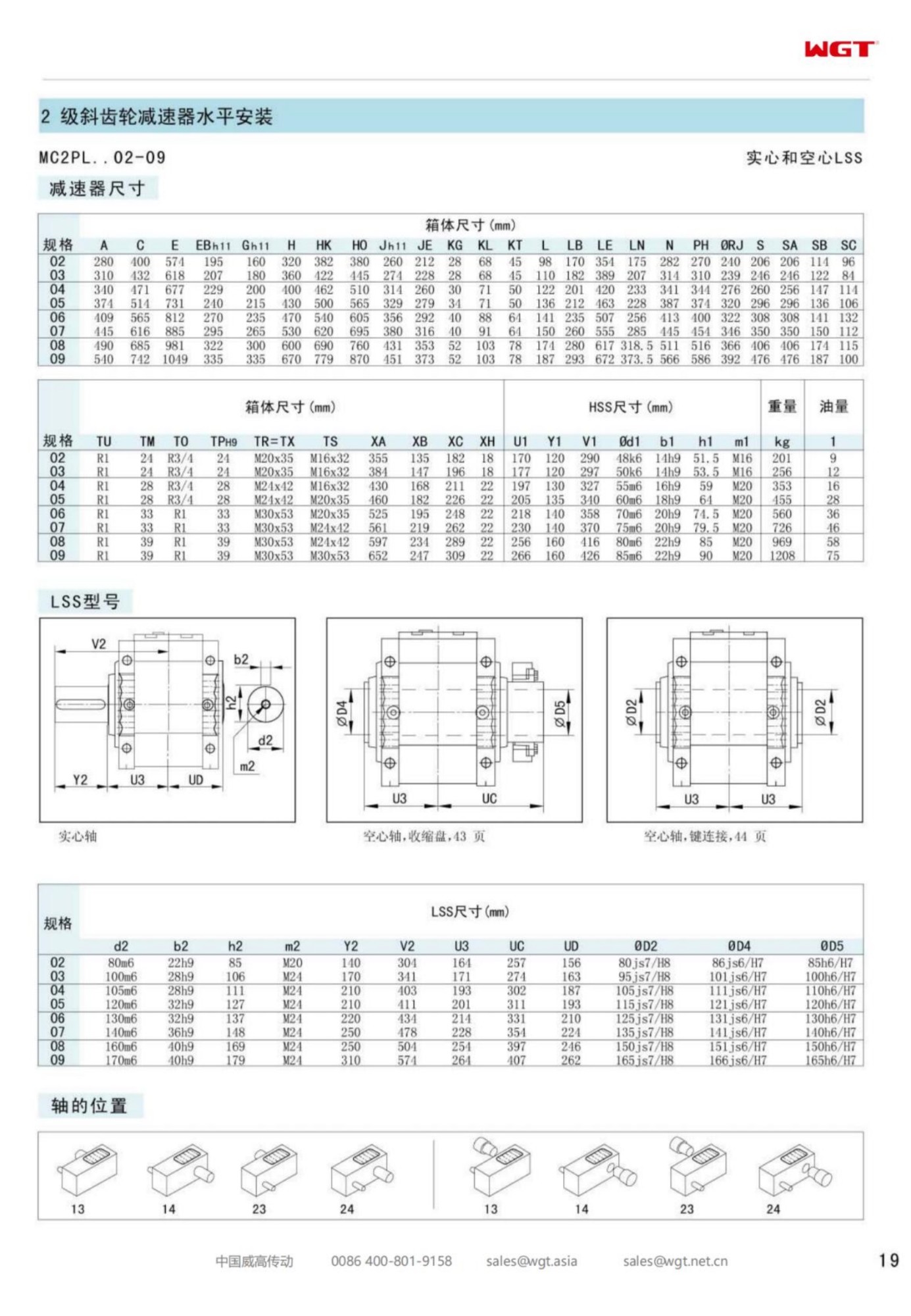
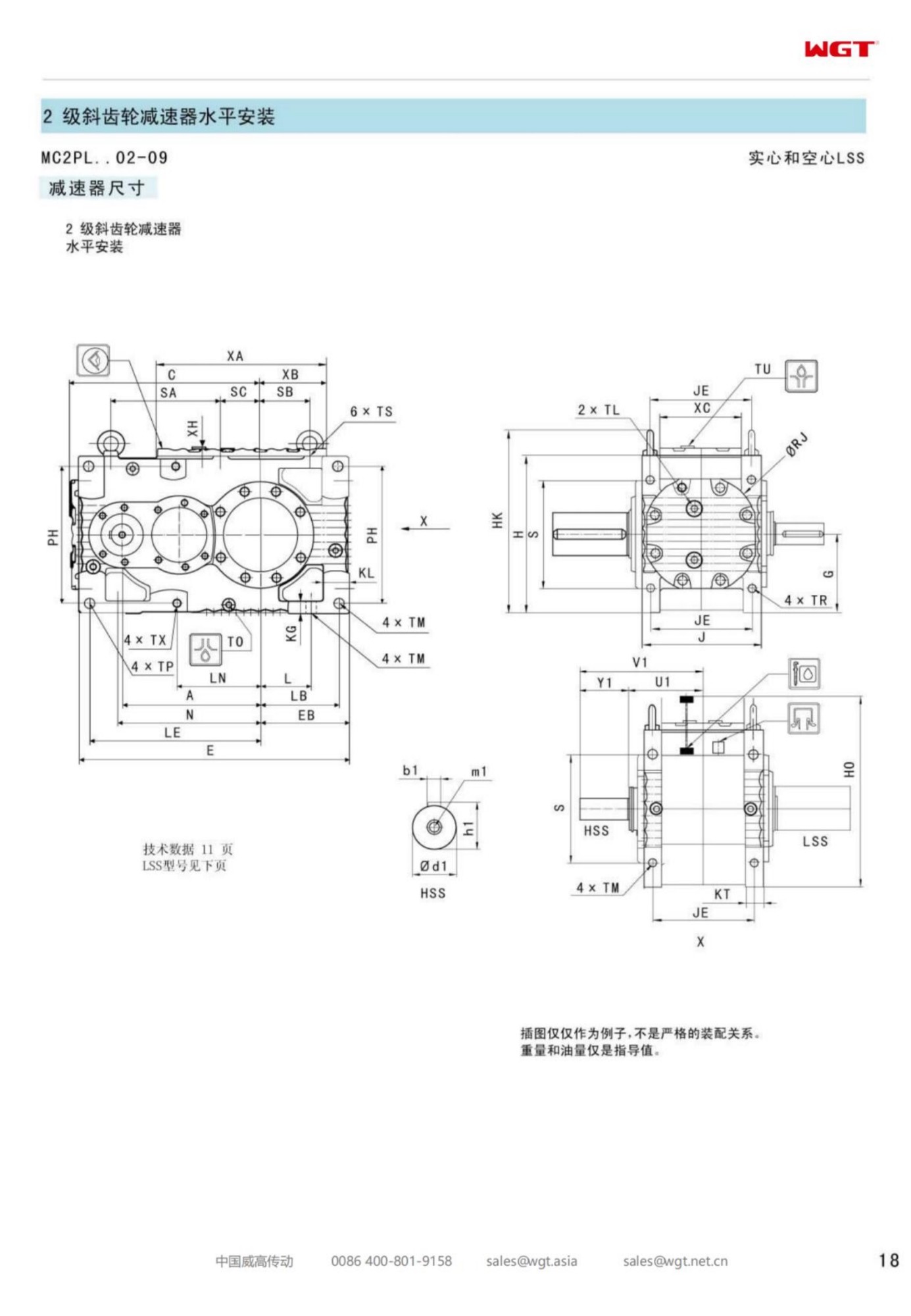
The MC2PLSF06 parallel shaft helical gear unit sits in the middle of the compact two-stage range: a footed casting with both shafts in one horizontal plane, a solid keyed output, and a case large enough that a plant can run it through three shifts without keeping an eye on oil temperature. Most sites arrive at the 06 after a 05 has served well and the line behind it grew - a longer conveyor, a wider screw, an extra shift - while the mounting pattern and the maintenance routine stayed exactly as they were.
Why the 06 Frame Is the Usual Step Up from the 05
The step is not dramatic on paper: the feet sit a little further apart, the output shaft takes a larger coupling, and the sump holds more oil. What changes on site is how relaxed the unit feels. A 05 running near the top of its band will carry a continuous duty, but it spends the shift close to its thermal limit, and every degree of ambient summer heat is felt. The 06 doing the same work sits comfortably below that line, which is why plants that expect tonnage to creep upward tend to order the larger casting from the beginning rather than after a warm bearing complaint.
The second reason is spares discipline. Where a site already runs 03 and 04 frames on lighter lines, the 06 shares seal and oil families with them, so the store room does not grow a new shelf for every size. That practical detail often decides which frame gets written into a project specification long before the torque calculation is finished.
Code Breakdown on the Nameplate
Each letter in the model string carries a decision that was already made at the enquiry stage. Reading the plate in the right order saves a great deal of correspondence later.
| MC | Industrial gear unit family with a compact multi-stage layout |
| 2 | Two reduction stages, so a shorter axial length than a three-stage build |
| P | Parallel shaft arrangement, input and output on the same side of the case |
| L | Case profile of this series, with the foot pads cast into the body |
| S | Solid keyed output shaft for a coupling or a pulley hub |
| F | Foot mounting, horizontal installation on a bedplate or steel frame |
| 06 | Frame size, which fixes the centre distance, shaft diameters and torque band |
The last two characters matter most to a buyer: change the S to an H and the unit becomes a hollow-shaft build for a shaft-mounted duty; keep the F and the same internals bolt to a floor frame instead of hanging on the machine shaft.
Torque, Speed and Service Factor in Practice
Selection starts with two speeds and one torque. Motor speed divided by the required output speed gives the ratio; the ratio then points to the stage combination. The torque, multiplied by the service factor for the duty class, has to land inside the frame rating. A belt conveyor running evenly for a single shift needs a modest factor; the same conveyor starting against a loaded belt after a stoppage needs a larger one, because the breakaway torque can be well above running torque.
In practice the 06 is chosen when the figure that matters is not the running torque but the restart. Plants that report frequent jam clears, or conveyors that sit loaded overnight, are the cases where the bigger casting pays for itself in the first year. It is worth stating on the enquiry whether the machine can be emptied before starting, because that single answer often moves the selection one frame.
Where These Units Sit on Site
Duties this hollow-bore torque-arm build is regularly specified for:
- Clinker and gypsum transfer belts inside cement grinding halls
- Raw meal screw conveyors and air-slide feeder drives
- Biomass chip and pellet conveyors at energy plants
- Fertiliser granulator and coating drum drives
- Board-plant chip washers and refiner feed screws
- Sludge thickener and dewatering centrifuge drives
The common thread is steady, unglamorous duty: a drive that nobody talks about because it simply runs. That is exactly the duty this frame is comfortable with.
Preparing the Bedplate and Aligning the Coupling
Machined feet want clean, flat pads. Before the unit is lowered, check the frame with a straight edge in both directions and shim in full packs rather than stacks of thin leaves, which creep under vibration. Bring the unit down gently, fit the foundation bolts finger tight, and only then begin alignment.
Coupling alignment is the step that decides how long the seals last. A dial gauge on both sides of the coupling, or a laser set if the site has one, should show the shafts within the tolerance the coupling maker publishes. Check hot as well as cold where the driven machine warms up in service; a train that is perfect at ambient can sit half a millimetre out once the conveyor pulley is warm. Re-check the bolts after the first week of running, then again after the first month.
Oil Routines That Actually Get Done
Most lubrication failures are not the wrong oil - they are the right oil, four months late. A simple schedule that the crew will actually keep beats a perfect one that gets postponed: inspect the sight glass every shift, top up weekly, change the charge at the interval in the manual, and record it on the machine, not in an office file. Where the drive sits in a dusty hall, wipe the breather at the same time; a blocked breather pushes oil past the seals.
Oil temperature is worth watching on any continuous duty. A slow upward drift over weeks usually means the oil is due, the cooling surface is fouled, or the load has quietly grown. Any of those is cheaper to deal with than a failed bearing.
What We Need to Quote an 06
Send motor power and speed, the required output speed or the ratio, the driven machine and its duty pattern, the mounting position, and the shaft or bore detail if the unit has to fit an existing coupling. A photo of the nameplate on the drive already on the machine, plus the centre height and bolt spacing, removes most of the back-and-forth. With those details we confirm the frame, the ratio and the service factor in writing before anything is built.
Selection Example: Clinker transfer belt in a grinding hall
Take a 1475 rpm four-pole motor turning a clinker belt head pulley at 19 rpm. The ratio follows directly: 1475 / 19 = 77.6, so a ratio near i=78 is drawn from the two-stage band and the absorbed power is compared with the 06 rating at the ambient of the hall. In this case the larger sump and wider gear face hold their temperature through three shifts, which is what a grinding hall asks of a drive that is never allowed to stop. That is the whole calculation. If your duty involves heavy starting, frequent reversing or many stops per hour, tell us and we raise the service factor.
Which Frame Size Do You Need?
| Model | Centre distance | Output | Typical duty |
|---|
| M3PSF50 | size 50 | solid shaft, foot | conveyors, feeders |
| M3PSF60 | size 60 | solid shaft, foot | crushers, mixers |
| M3PSF70 | size 70 | solid shaft, foot | ball mills, shredders |
| M3PSF80 | size 80 | solid shaft, foot | kilns, heavy conveyors |
| M3PSF90 | size 90 | solid shaft, foot | mill and kiln drives |
| M3RSF50 | size 50 | solid shaft, foot, right-angle | inclined conveyors, elevators |
| M3RSF60 | size 60 | solid shaft, foot, right-angle | screw classifiers, feeders |
| M3RHF70 | size 70 | hollow shaft, foot, right-angle | agitators, drum drives |
| M3PHT80 | size 80 | hollow shaft, torque arm, parallel | shaft-mounted conveyors |
| M3RHT90 | size 90 | hollow shaft, torque arm, right-angle | heavy shaft-mounted drives |
Foot-mounted frames are listed below; torque-arm (T), hollow-shaft (H) and vertical (V) variants are available across the size range. Ask for the outline drawing to check the interface before ordering.
Answers to Common Questions
What if the ratio I need falls between two catalogue steps?
Choose the next available step and adjust the driven speed, or ask us for a special pair of gears. Trimming the driven machine is normally cheaper than ordering a special ratio, and a slightly higher ratio never hurts the drive.
How is the unit protected against dust and water ingress?
Housings are sealed to IP55 as standard with NAK oil seals and gasketed covers. Heavy dust, washdown chemicals or steam cleaning call for the higher protection option, which we specify together with the correct lubricant.
Do you support commissioning and after-sales service?
Every shipment includes an installation manual and a test record. Our engineers answer commissioning questions by e-mail or video call, and spare seals, bearings and shafts remain traceable to your original order for years afterwards.
![gearbox sizing steps for engineers]()
Four steps from your application data to a firm model number.
Case Notes from the Field
Automatic car-wash line
A car-wash equipment builder fits hollow-shaft reducers to its conveyor chains. The compact frame hides inside the wash tunnel, and FKM seal options handle the constant moisture.
Textile dyeing drums
A dyeing machine maker uses speed reducers on its fabric-turning drums. Low vibration (under 20 microns) prevents streaks in the fabric, and the 94-96% efficiency keeps the heat load down in a warm workshop.
![industrial gear unit application overview]()
A cross-section of the installations we supply every month.
Request the Datasheet and Dimension Drawing
Need documentation for approval? Try the WGT Motor & Gearbox Online Selection System, then send the result sheet - we return a complete datasheet, drawing and price the same day.
We issue complete technical files on request: dimension drawing, rating table, test record format and material certificates, in English and ready for your engineering or purchasing approval package. Looking for a gearbox for mixer and agitator? Tell us the duty point and we will confirm the model in writing.