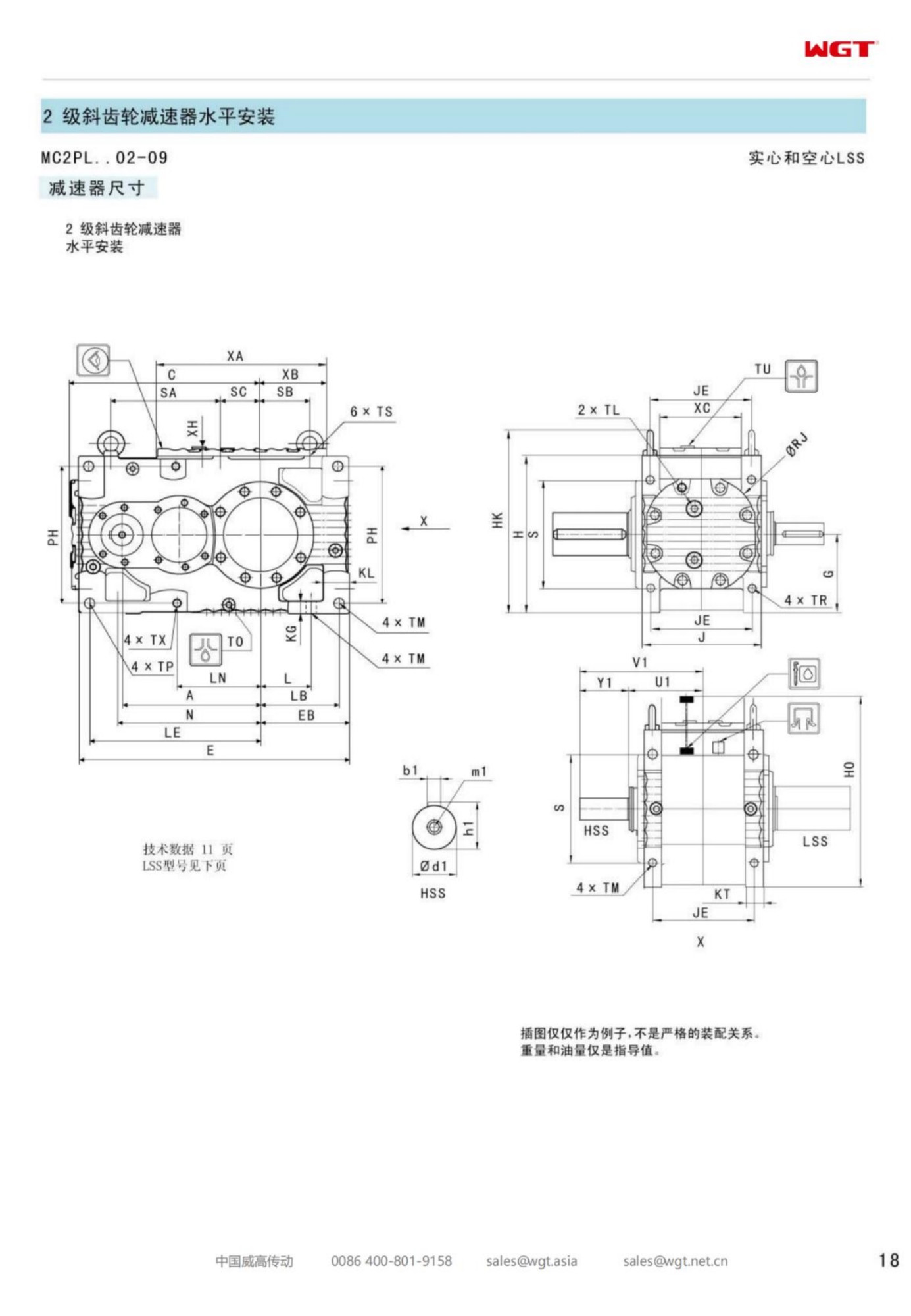
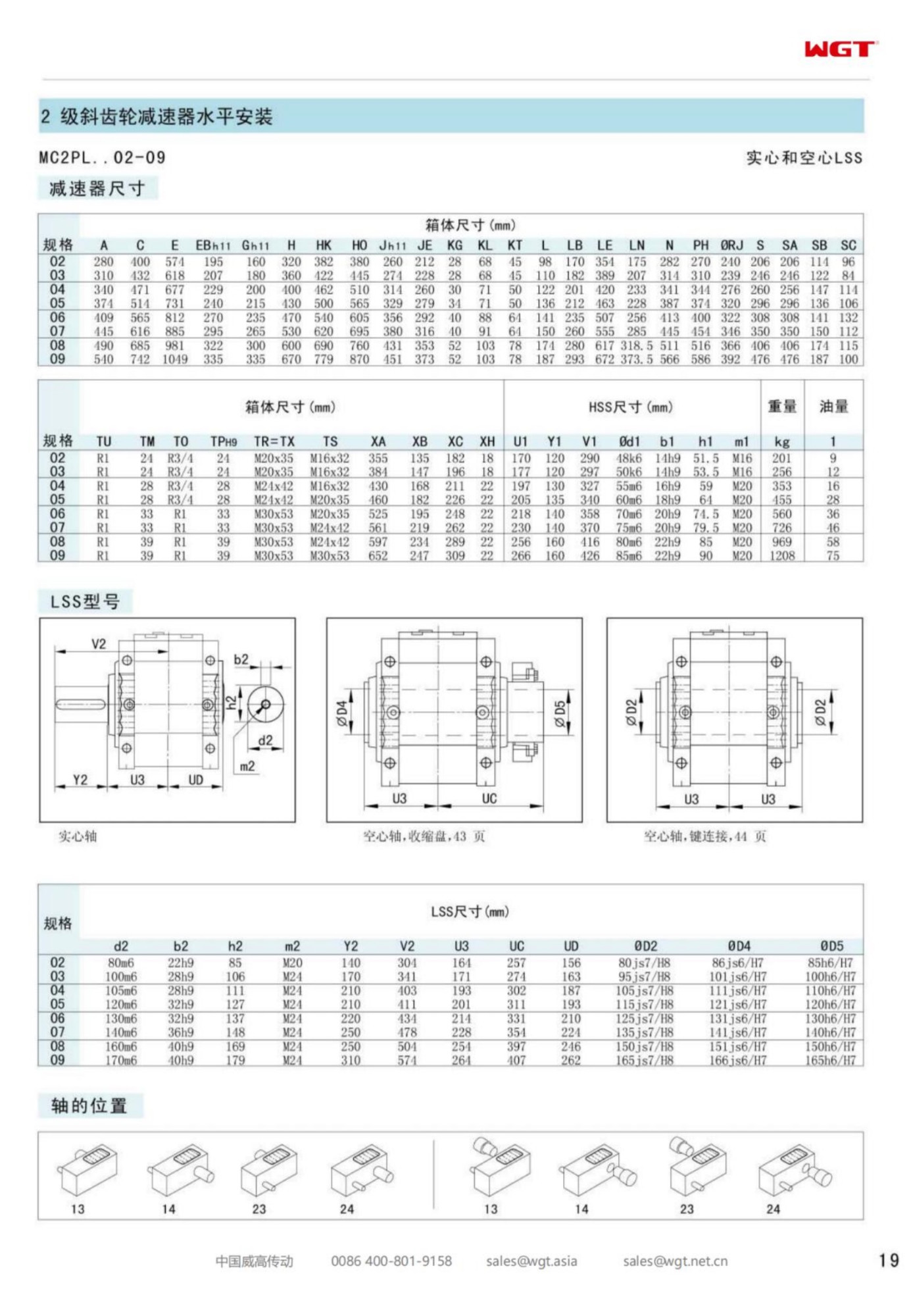
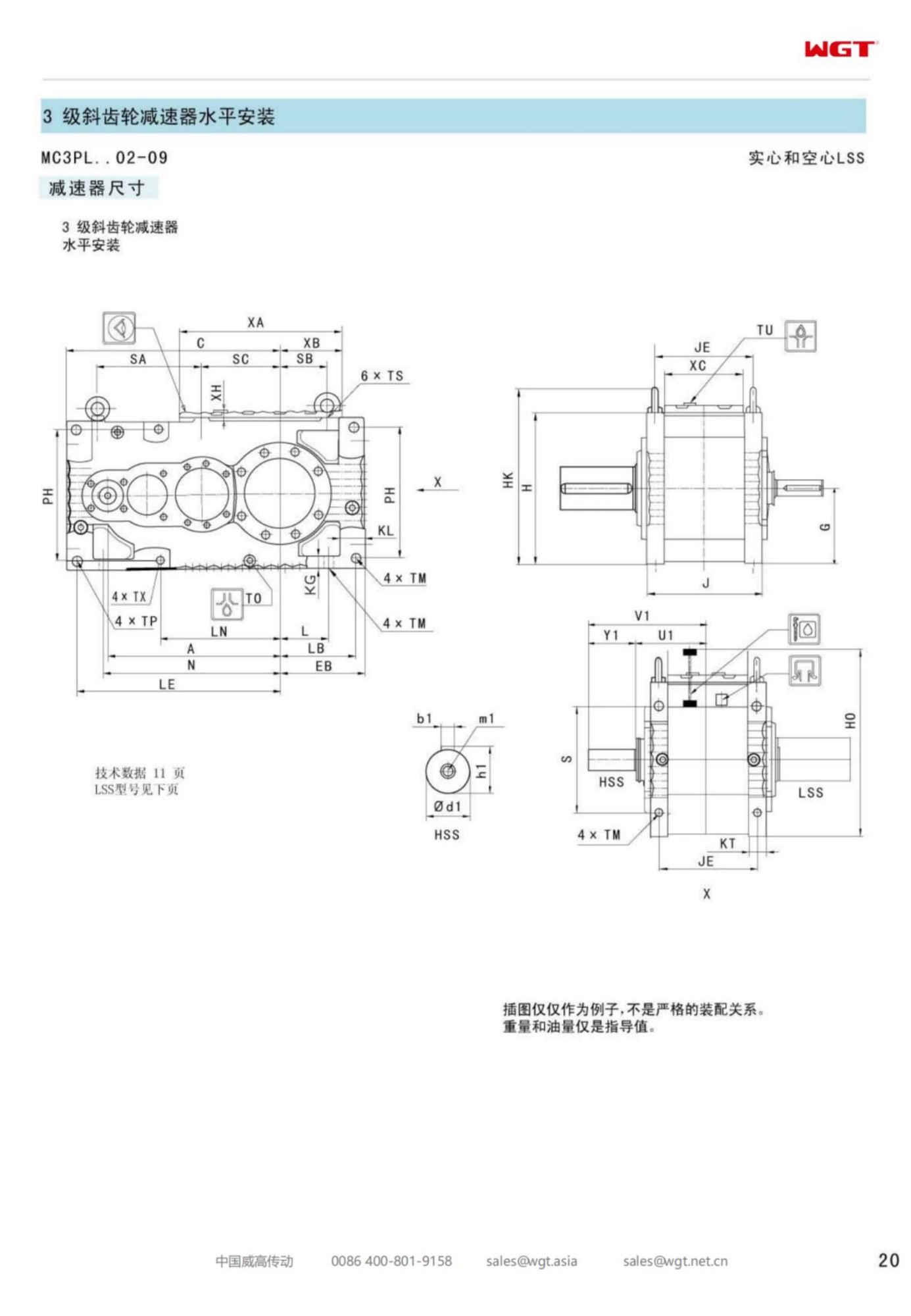
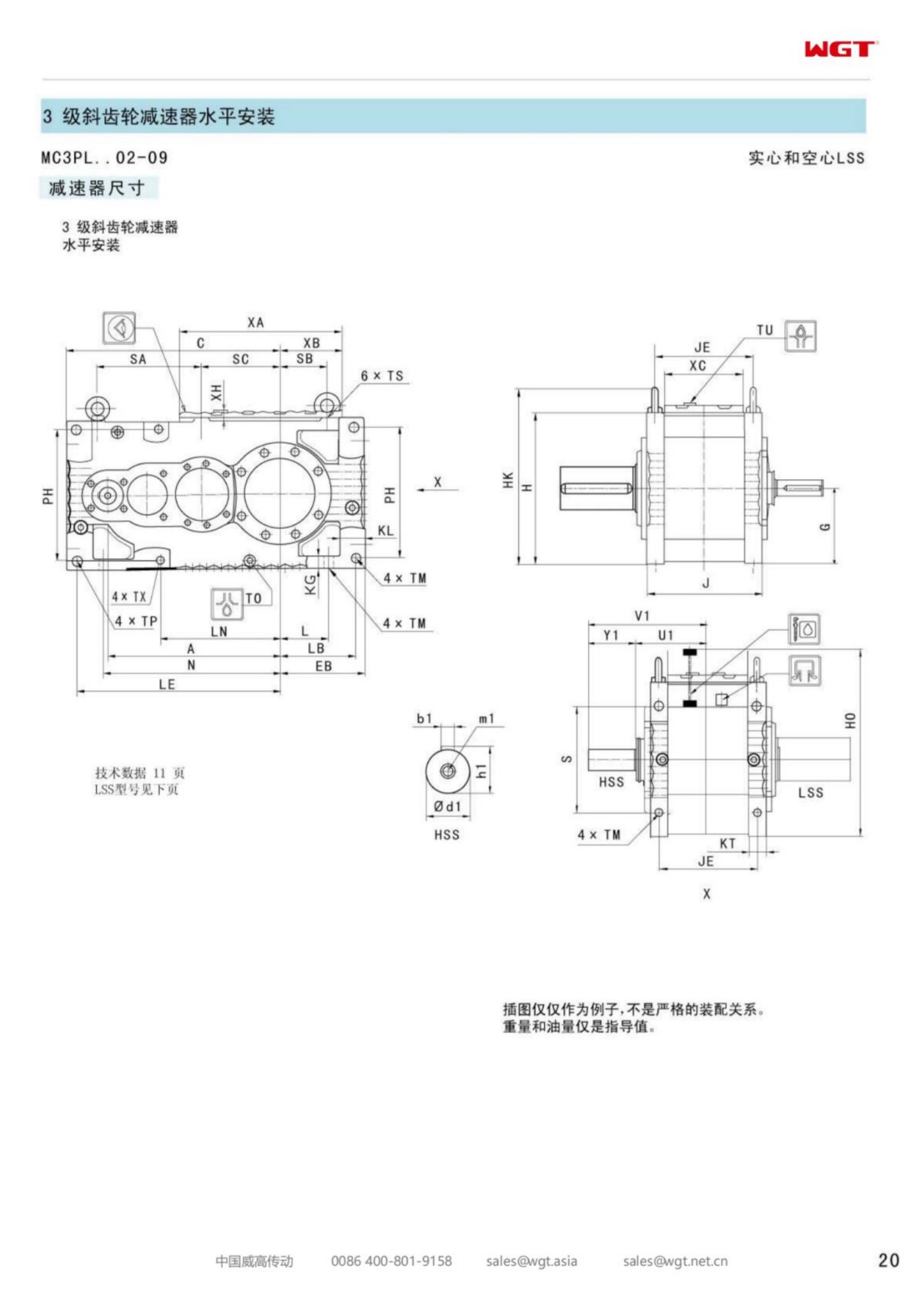
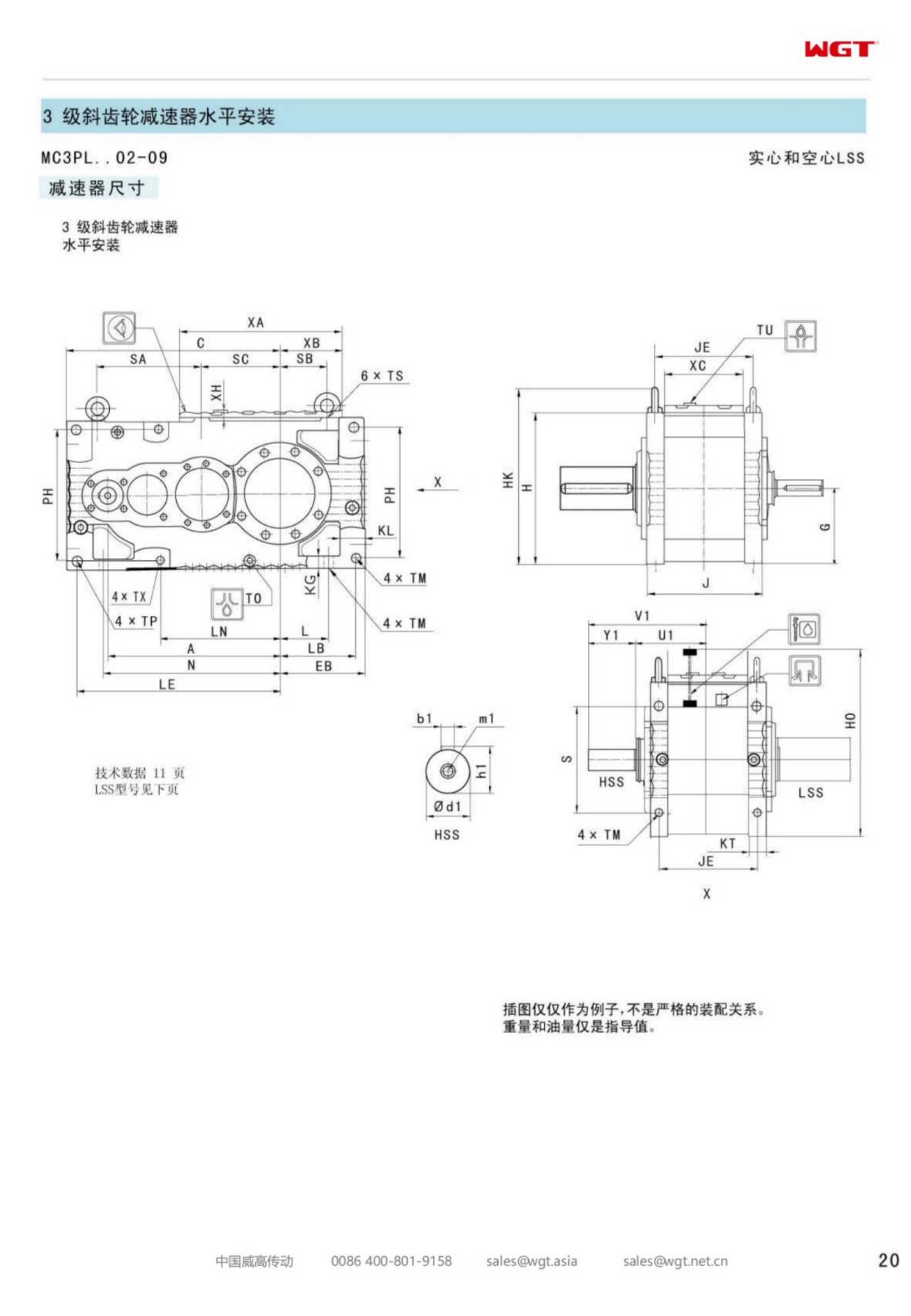
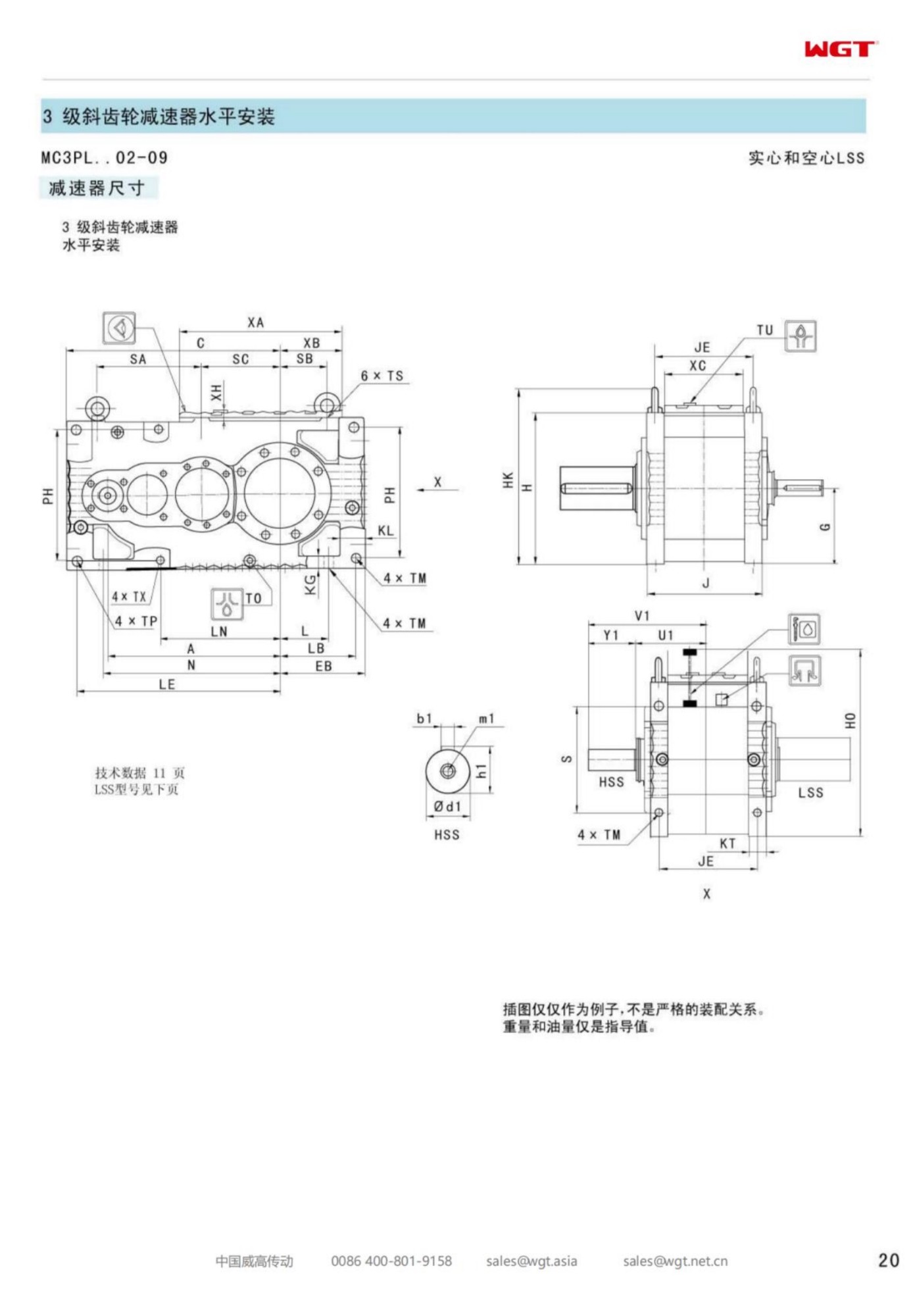
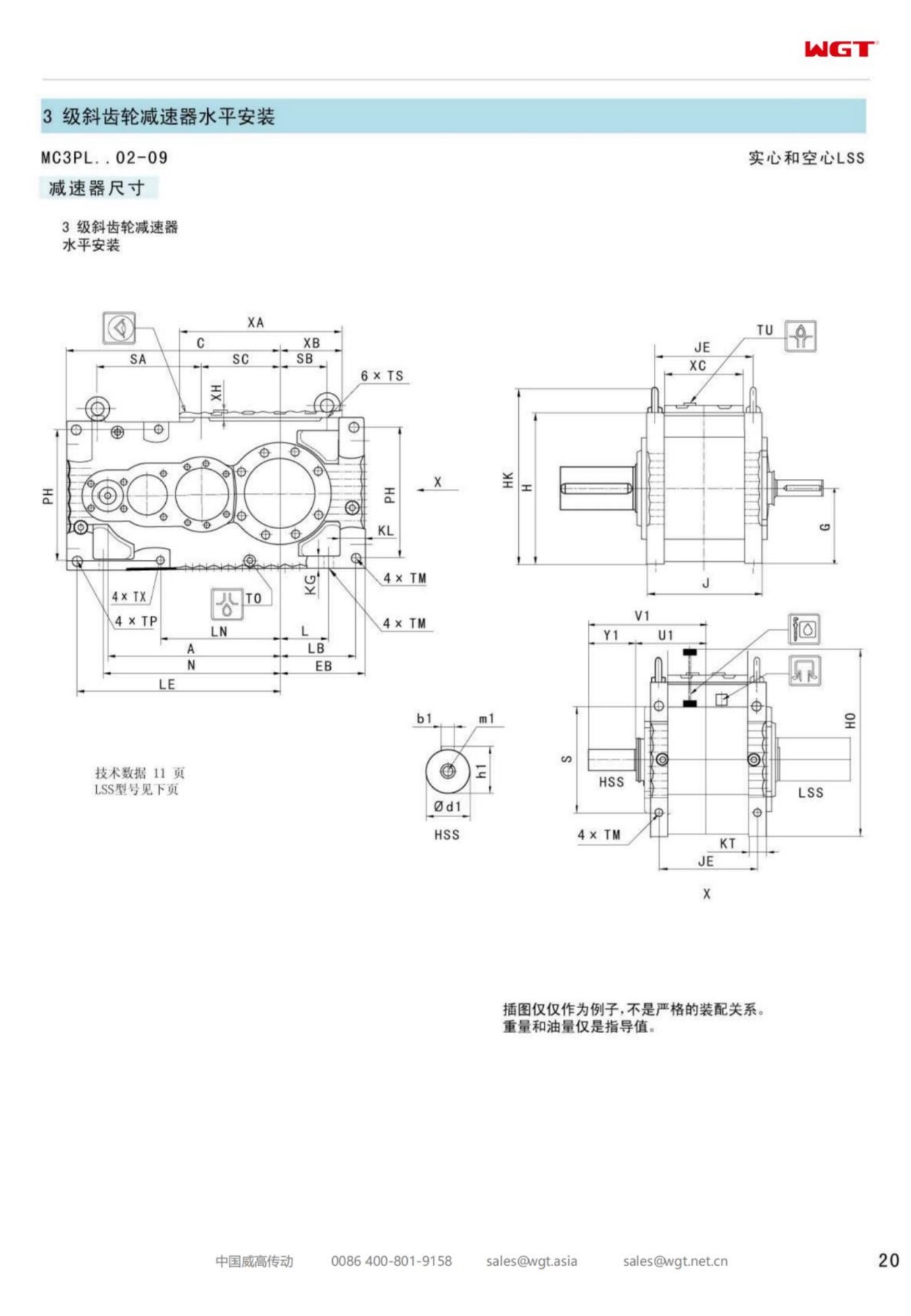
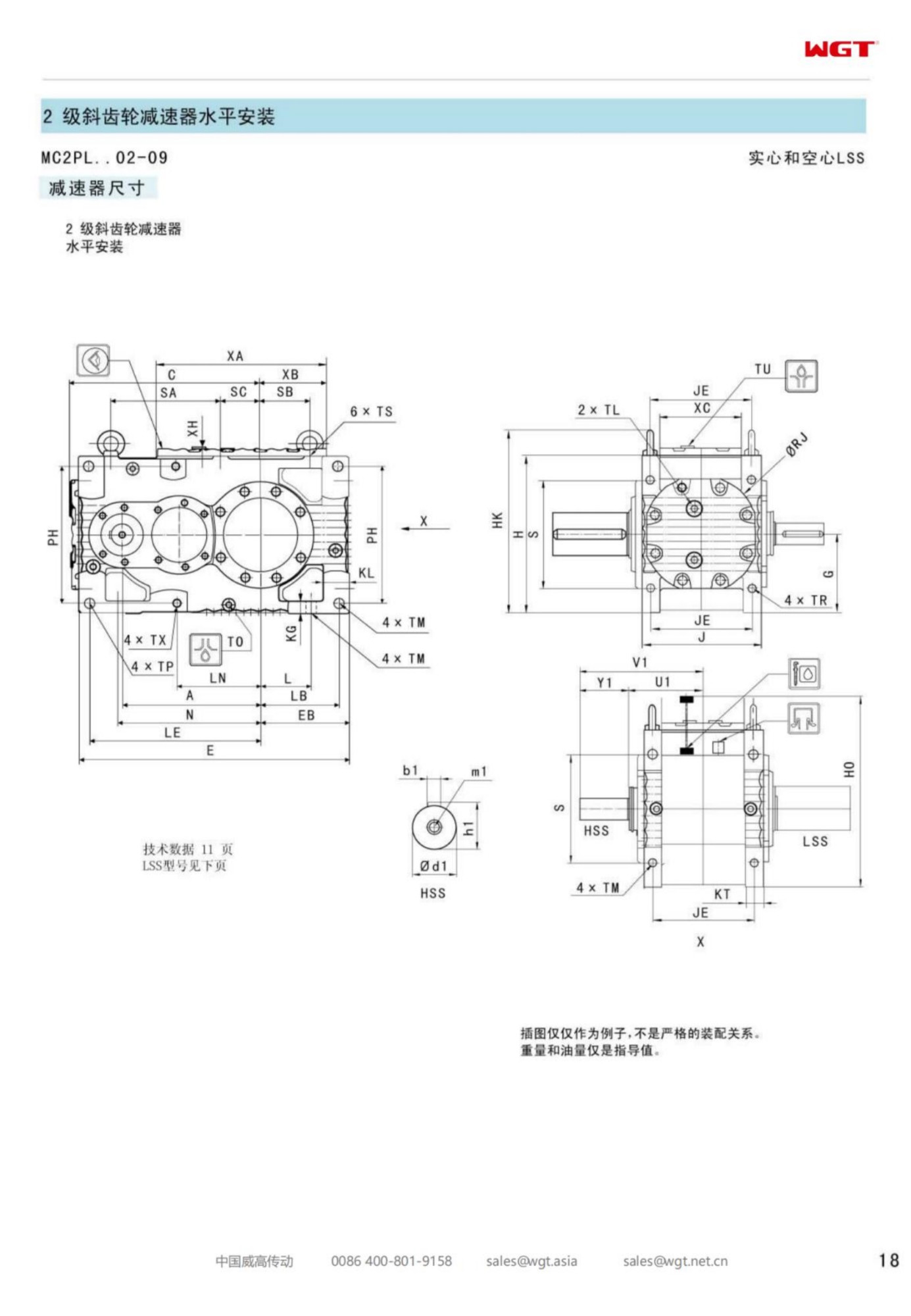
There is a moment in every large conveyor project when the top frame of the drive band is chosen, and the choice is argued twice: first on paper, between quotation and order, and later on site, between the people who must install and run what the paper produced. The MC2PLST09 torque arm gearbox is the frame that most often sits at the top of that band, and this page is about winning both arguments - the enquiry that gets a complete answer, the acceptance that proves it, and the first year that confirms it.
Top-frame purchases amplify everything. The tonnage is large, the stoppages are expensive, the drawings cross more desks, and the difference between a good specification and an average one is measured in years of quiet running or weeks of avoided argument. The frame itself is straightforward; the discipline around buying it is what this page documents.
Frame Nine and the Paper Trail
Frame nine carries the largest duties this solid-shaft, torque-arm construction serves, and duties that large rarely arrive alone. They arrive inside projects - a new line, a plant expansion, a tender - where the gearbox is one deliverable among many and its paperwork has to survive interfaces with structures, electrical scopes and commissioning schedules. A frame nine bought casually inside a formal project inherits every gap the casualness leaves.
The remedy is unglamorous: treat the drive's own document set as seriously as the concrete schedule. The enquiry, the selection reply, the acceptance test, the installation drawings and the first-year records form one continuous trail, and each stage inherits its value from the one before it. Projects that keep the trail unbroken commission faster and argue less; projects that break it rediscover the missing links at the worst possible moments.
Decoding MC2PLST09
The type string is the band's grammar at its largest expression.
| MC | Industrial gear unit family built for continuous plant duty |
| 2 | Two helical reductions in one level case |
| P | Parallel-shaft layout, input and output on parallel axes |
| L | Level build, both shafts horizontal |
| S | Solid output shaft, torque leaves through a coupling |
| T | Torque arm reaction, no feet, no foundation, no grout |
| 09 | Ninth frame: the band's top, where projects and tenders usually land |
As an order document the string settles geometry and frame size; the project around it supplies the rest. In a tender context the string also becomes the reference everyone quotes against, which is why spelling out the full duty - load cases, ambient, stopping behaviour, service factor basis - in the enquiry matters more here than anywhere lower in the band. A top frame selected from a single kilowatt figure is a decision the whole project will live with.
What a Complete Enquiry Contains
The enquiry that gets a frame nine right is short but whole. It states the driven machine and its duty cycle, motor power and speed, required output speed and torque, the service factor class the duty demands, ambient conditions in the worst month, and the mounting survey - available steel for the bracket, the direction the arm can reach, drain and inspection access. It adds the position's special clauses: any holdback or brake in the train, the coupling arrangement, the paint and environment package, and the documentation the project requires.
The most useful line in the enquiry is the one most often omitted: what the buyer will judge the answer by. Whether the selection reply must show both load cases, whether the frame carries an acceptance test, which drawings count as deliverables - writing the judgement criteria into the enquiry converts the quotation from a price into a promise that can be checked. Suppliers bid better against stated criteria than against silence.
Reading the Selection Reply
A selection reply for a top frame should be readable as a small argument: the duty as the supplier understood it, the ratios considered, the frame chosen, the service factor achieved, and the margins over the rating table - thermal, mechanical and for the starts. Reading it is a skill worth having on the buyer's side. A reply that quotes service factor without stating its basis, or that silently drops a load case the enquiry declared, is telling the buyer something before the first shipment.
The comparison between replies deserves the same discipline. Two quotations for the same string can differ in oil specification, sealing package, breather type, coupling scope and documentation depth - differences invisible in a spreadsheet of prices and visible in year two. Projects that tabulate replies line by line, against the enquiry's own criteria, buy the drive they actually asked for rather than the one that quoted cheapest.
The Acceptance Test Before Shipment
For a frame of this size, a witnessed or documented acceptance test is inexpensive insurance. The usual scope is short: a no-load run at both recommended speeds with temperature and vibration readings taken, an oil tightness check, verification of ratio by rotation count or certified figures, and confirmation of the accessories actually fitted - breather type, seal set, arm hardware, paint system. The test record, signed, becomes the first page of the drive's baseline file.
The test's real value is what it prevents: a drive that arrives with the wrong breather, a missing grease path, or a mislabelled ratio is a small disaster at a project's busiest week. Buyers who waive acceptance to save a day usually spend the day later, plus the freight, plus the schedule. The test also disciplines the factory floor in the quiet way that paperwork always does - a drive that knows it will be read before it runs is a drive that leaves the works correct.
Installation Day, Planned on Paper
A torque-arm frame asks little of its installation - bracket, arm, bolts, coupling, oil - and punishes improvisation completely. The installation drawings should have been reviewed against the actual structure during the enquiry, so installation day executes a plan rather than negotiate one: bracket orientation matches the arm's reach, shimming brings the coupling into alignment by measurement, the arm carries no load it was not drawn to carry, and the oil filled is the oil specified.
The day's checklist is short enough to laminate: bracket bolts to torque, coupling alignment to record, arm pins greased, breather fitted, oil level sighted, guard fitted, first-run current and temperature logged. Every line recorded on installation day becomes a baseline number later. Every line skipped becomes a question with no answer, asked during the first shutdown nobody planned.
Coupling, Guard and the Drive Train Interface
Around the frame itself sit the parts the project scopes separately, and their boundaries deserve writing down. The coupling is the classic grey zone - supplied by the gearbox vendor, the motor vendor or the project, with the alignment responsibility sometimes belonging to nobody at all. The enquiry should say who supplies it, who aligns it, and who owns its guard; the acceptance test should confirm what actually arrived; and installation day should record the alignment figures the design intended.
The guard and the arm bracket belong to the same conversation. A guard that can be lifted without tools drifts open on a working plant; a bracket whose welds were never inspected becomes the reaction path's weakest link precisely because it sits outside the gearbox order. Assigning these items by name - in the enquiry, not in the commissioning minutes - is the kind of small formality that top frames are bought to justify.
The First Thousand Hours
The first thousand running hours are the drive's proof phase, and the plant's cheapest chance to catch a childhood fault. The programme is the family's usual one, executed on time: oil change at the interval the documentation states for a new case, bolt torques re-checked after the first thermal cycles, arm pin grease renewed, alignment re-verified once the structure has taken load, and vibration readings repeated at the fixed points to confirm the commissioning numbers.
At the thousand-hour mark the drive graduates from new equipment to baseline. Everything measured - temperatures, vibration, oil condition, alignment figures - is filed as the reference the next decade compares against. The plants that do this keep a strange advantage: their year-five debates are settled by numbers, while other plants' year-five debates are settled by whoever has seniority and the loudest opinion.
Duties That Belong on Frame Nine
The band's top frame, where the purchase is argued on paper before it is argued on site:
- Port stacker-reclaimer conveyor specified through a tender process
- Coal handling head conveyor at a power station bought under a utility specification
- Main clinker conveyor at a cement plant ordered as part of a line project
- Concentrate handling belt in a mineral processing plant expansion
- Heavy-duty loadout conveyor at a grain export terminal
- Bench-to-crusher conveyor at a lignite open-pit mine
What these duties share is scale: drives large enough that the purchase is a project decision, with budgets, schedules and signatures behind it. Frame nine repays formal buying because it will be formally scrutinized for twenty years - by auditors, insurers and the plant's own engineers, all reading the same trail.
Documentation That Outlives the People
The least glamorous deliverable in a top-frame order is the one that matters most at year twelve: the documentation set. Drawings with dimensions that match the drive that shipped, part numbers for every consumable, the oil specification and its alternatives, torque values, spare-parts lists, and the acceptance and installation records of the original purchase. Personnel turn over; part numbers should not.
The practical discipline is to file the set where the drive lives, not where the project ended, and to require every future service action to append its record to the same place. A drive whose file grew with it can be overhauled, re-sold or re-rated with a week of preparation. A drive whose file died with the project becomes an archaeology exercise, and archaeology is a poor basis for a shutdown decision.
Change Control After the Order
Projects change, and the drive's specification changes with them - a longer conveyor, a heavier mineral, a revised duty cycle. The discipline that protects the frame nine is simple: every duty change goes back to the selection, in writing, before the change reaches the drive. A service factor that was generous at order can be marginal after a redesign, and the paper trail is what catches it while catching it is still free.
The same control applies on the way in. Any deviation a supplier proposes - an alternative oil, a different breather, a swapped coupling scope - belongs in the record with its reason, accepted by someone competent rather than absorbed silently by the schedule. Drives that run badly in their middle years can often trace the cause to a change nobody authenticated, made by a project in a hurry.
The Second Purchase Done Right
Plants rarely buy one frame nine; the band's top frame tends to repeat across a site as lines multiply. The first purchase therefore doubles as a rehearsal, and the trail it leaves - what the enquiry missed, which reply read best, what acceptance caught, what the first thousand hours corrected - is the template that makes the second purchase faster and the third almost clerical.
The best compliment a top frame can earn is invisibility: installed on plan, baselined on time, fed its small parts on schedule, and never once the subject of an emergency meeting. None of that is luck. It is the paper trail doing its work, from the first enquiry line to the latest entry in the log - which is, in the end, the only part of the purchase that gets better every year it is kept.
How Customers Use This Unit
Dust-extraction fan bank
An environmental-equipment plant uses reducers on the rotary valve feeders of its dust-extraction systems. Compact size, quiet running and food-grade oil options made the approval easy.
Steel mill run-out table
On the run-out table of a small steel mill, units handle the repeated starts and stops of hot billet handling. The 42CrMo output shafts tolerate the thermal cycling, and torque-arm mounting keeps the drive clear of the roller frames.
What Engineers Ask Us
What materials are used for the gears and shafts?
Gears are 20CrMnTi alloy steel, case-carburised to HRC58-62 over a tough HRC33-40 core. Input and output shafts are 42CrMo, quenched and tempered to HRC25-30. The housing is cast iron at HBS190-240.
Why does low backlash matter, and what is the limit?
Backlash is the small free rotation between input and output. We hold it within 20 arcmin - tight enough for indexing tables, positioning drives and reversing applications, without the cost of a precision servo gearbox.
Model Table: Frames, Shafts and Duty
| Model | Centre distance | Output | Typical duty |
|---|
| M3PSF50 | size 50 | solid shaft, foot | conveyors, feeders |
| M3PSF60 | size 60 | solid shaft, foot | crushers, mixers |
| M3PSF70 | size 70 | solid shaft, foot | ball mills, shredders |
| M3PSF80 | size 80 | solid shaft, foot | kilns, heavy conveyors |
| M3PSF90 | size 90 | solid shaft, foot | mill and kiln drives |
| M3RSF50 | size 50 | solid shaft, foot, right-angle | inclined conveyors, elevators |
| M3RSF60 | size 60 | solid shaft, foot, right-angle | screw classifiers, feeders |
| M3RHF70 | size 70 | hollow shaft, foot, right-angle | agitators, drum drives |
| M3PHT80 | size 80 | hollow shaft, torque arm, parallel | shaft-mounted conveyors |
| M3RHT90 | size 90 | hollow shaft, torque arm, right-angle | heavy shaft-mounted drives |
Larger size numbers mean higher torque capacity and larger shafts. Because interfaces follow the common industrial dimensions, a size-for-size change is the normal upgrade route for these industrial units.
Selection Example: Coal handling head conveyor at a power station bought under a tender
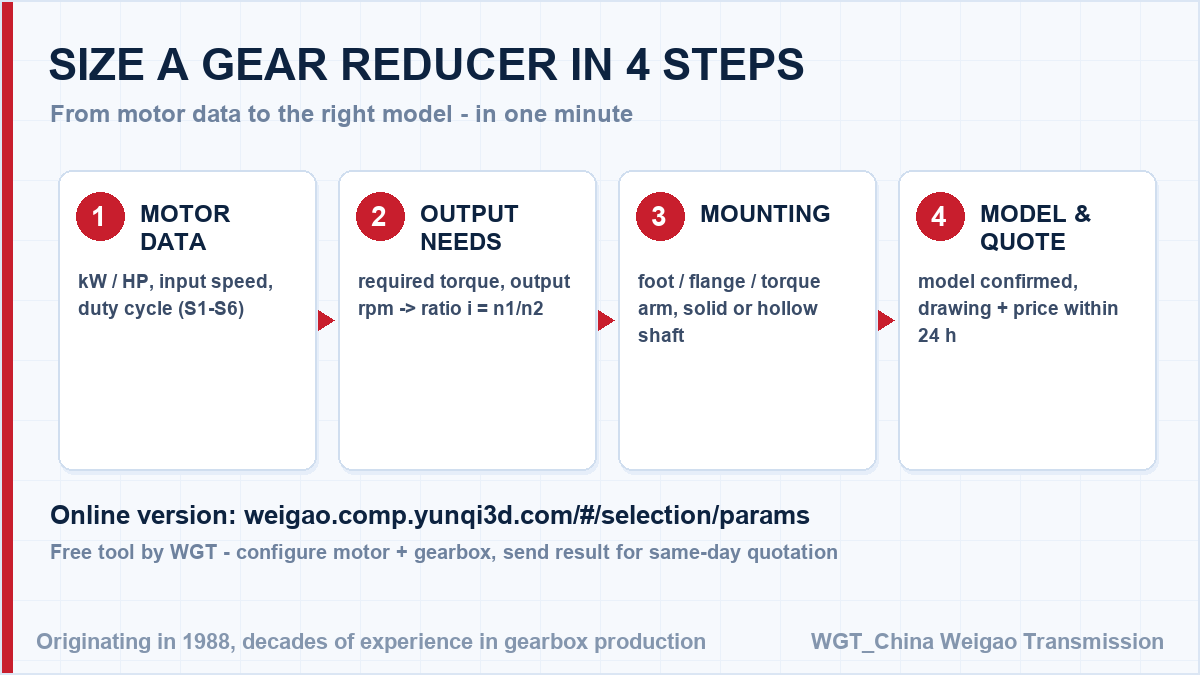
Take a 110 kW motor at 1490 rpm turning the head shaft at 22 rpm. The ratio follows directly: 1490 / 22 = 67.7, so a ratio near i=68 sits at the very top of the two-stage band, and the frame is confirmed through a documented selection reply and an acceptance test before shipment, since a project of this size buys the paperwork along with the iron. In this case frame nine arrives with its trail in order - load cases shown, test records signed, drawings filed at the drive - and the first thousand hours establish the baseline the plant will quote against for years. Note that the ratio comes from speeds alone, while the frame size depends on torque and service factor - never size a unit on ratio only.
![industrial helical gearbox selection chart]()
A quick visual of the selection sequence for a industrial helical unit.
![M3 series gear reducer installation examples]()
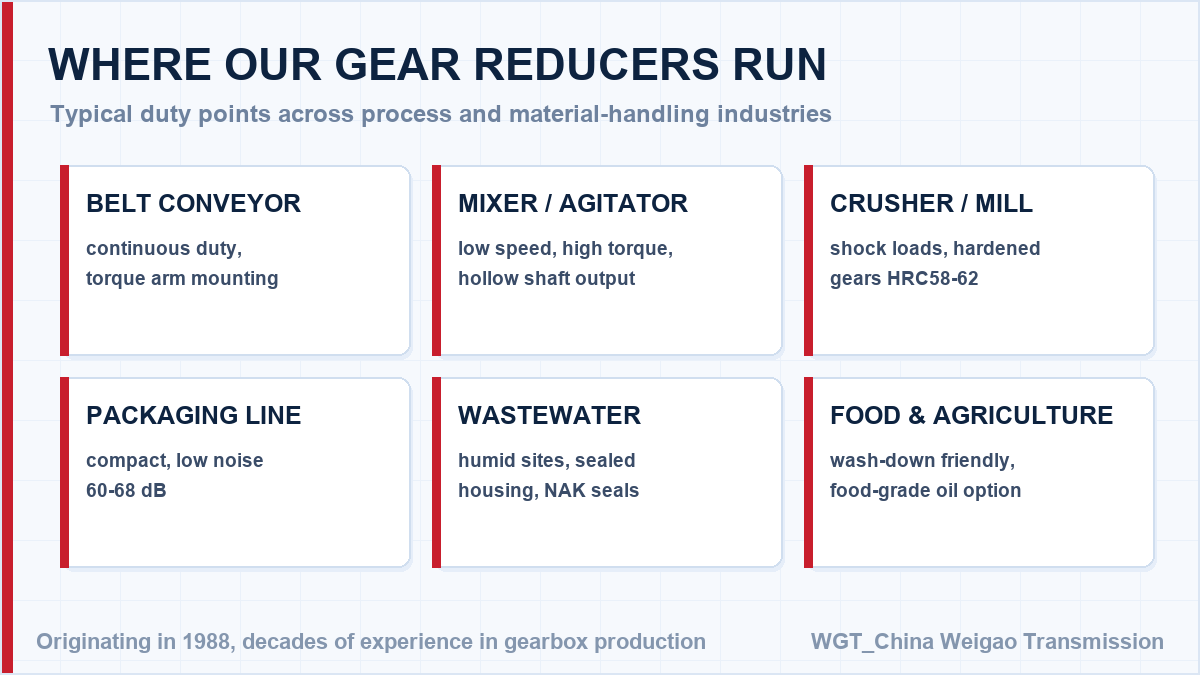
Application coverage of the the M3 series.
Custom Shafts and Ratios for OEM Builds
Non-standard interface? Prefer to check the figures yourself? The WGT Motor & Gearbox Online Selection System gives you the model, torque margin and ratio before you ask us.
Splined, extended or flanged output shafts and special ratios are quotable for OEM volumes. Tooling cost is amortised across the order, and the drawing approval cycle starts the day you ask. Looking for a gear reducer for food processing machine? Tell us the duty point and we will confirm the model in writing.