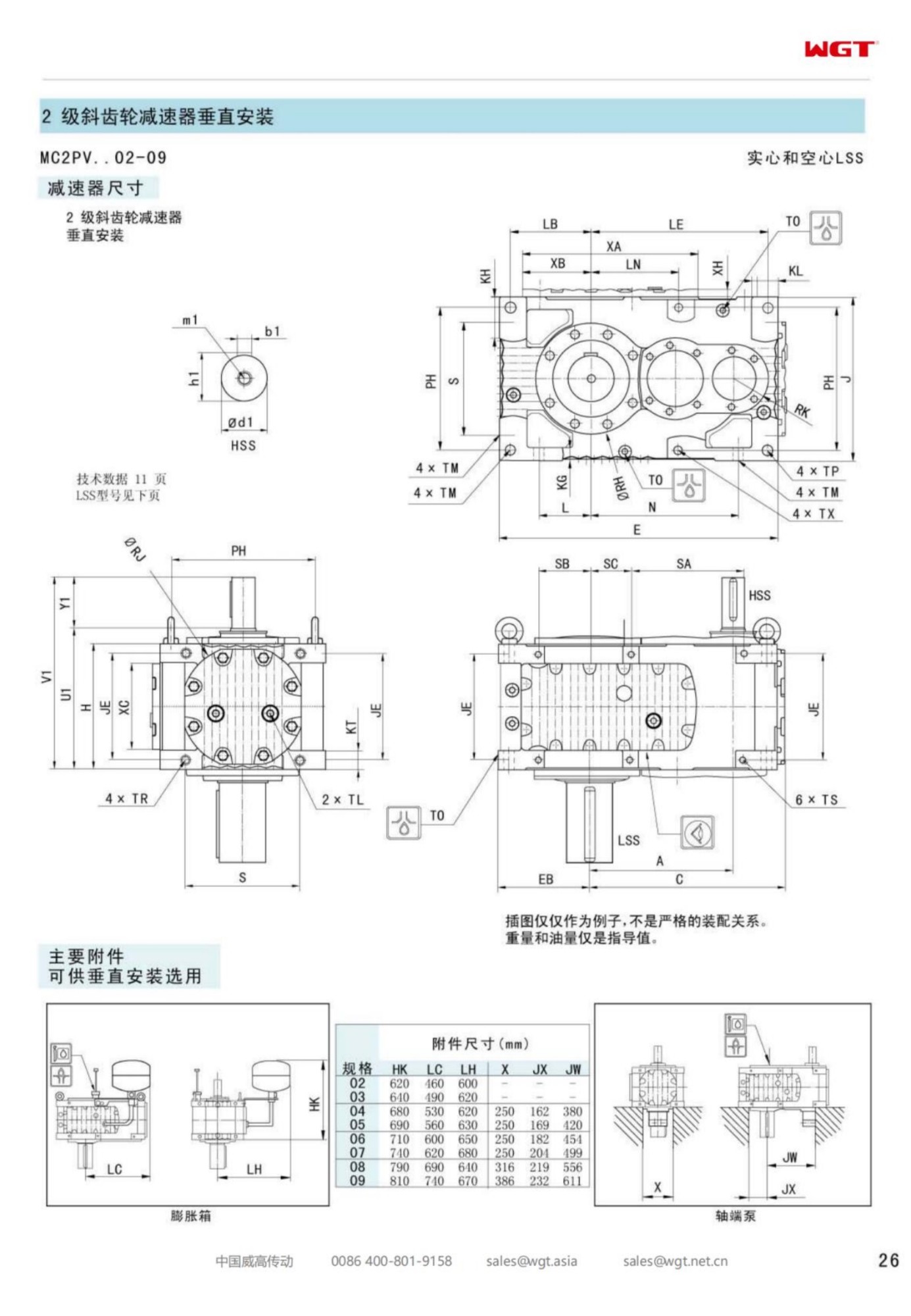
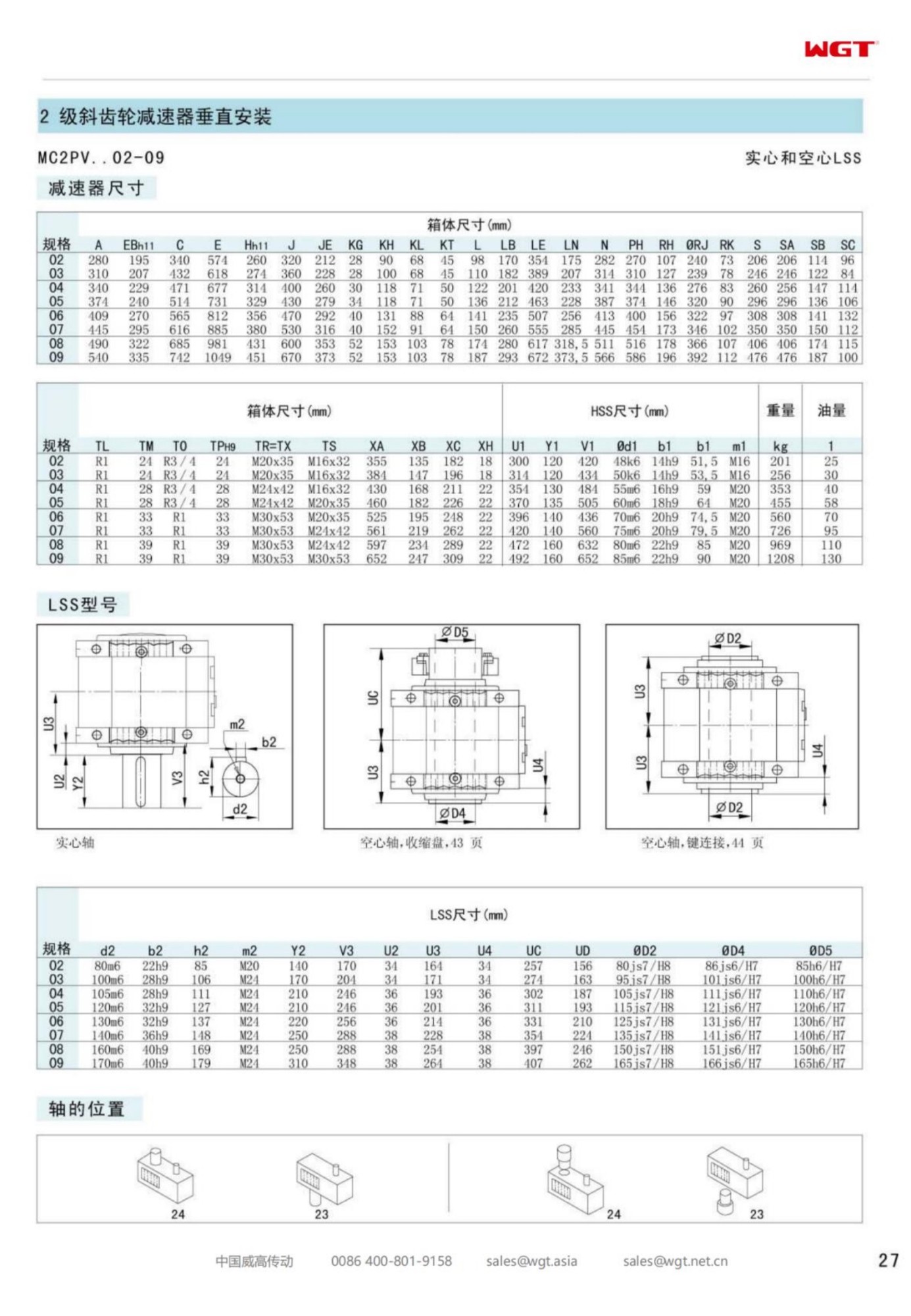
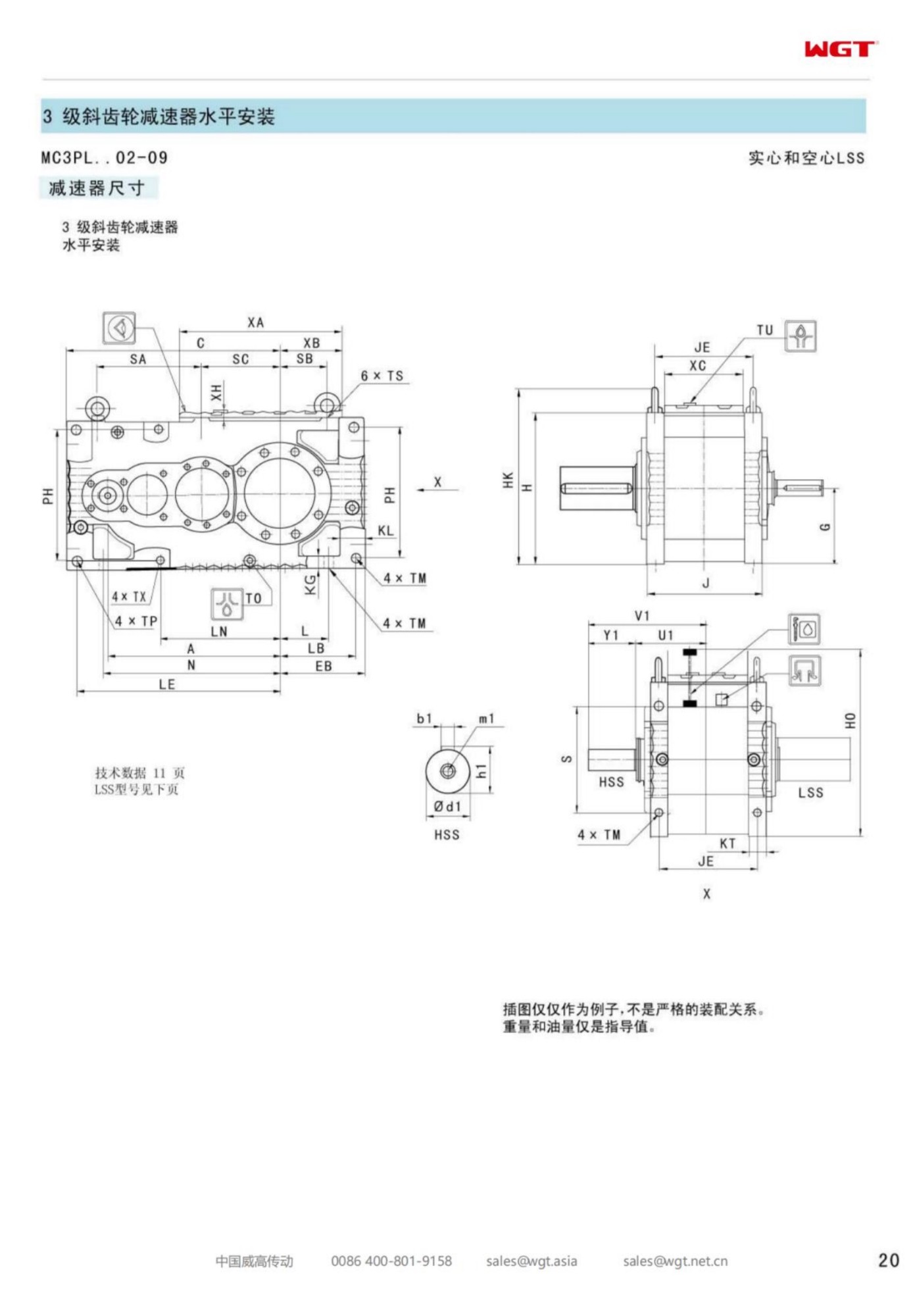
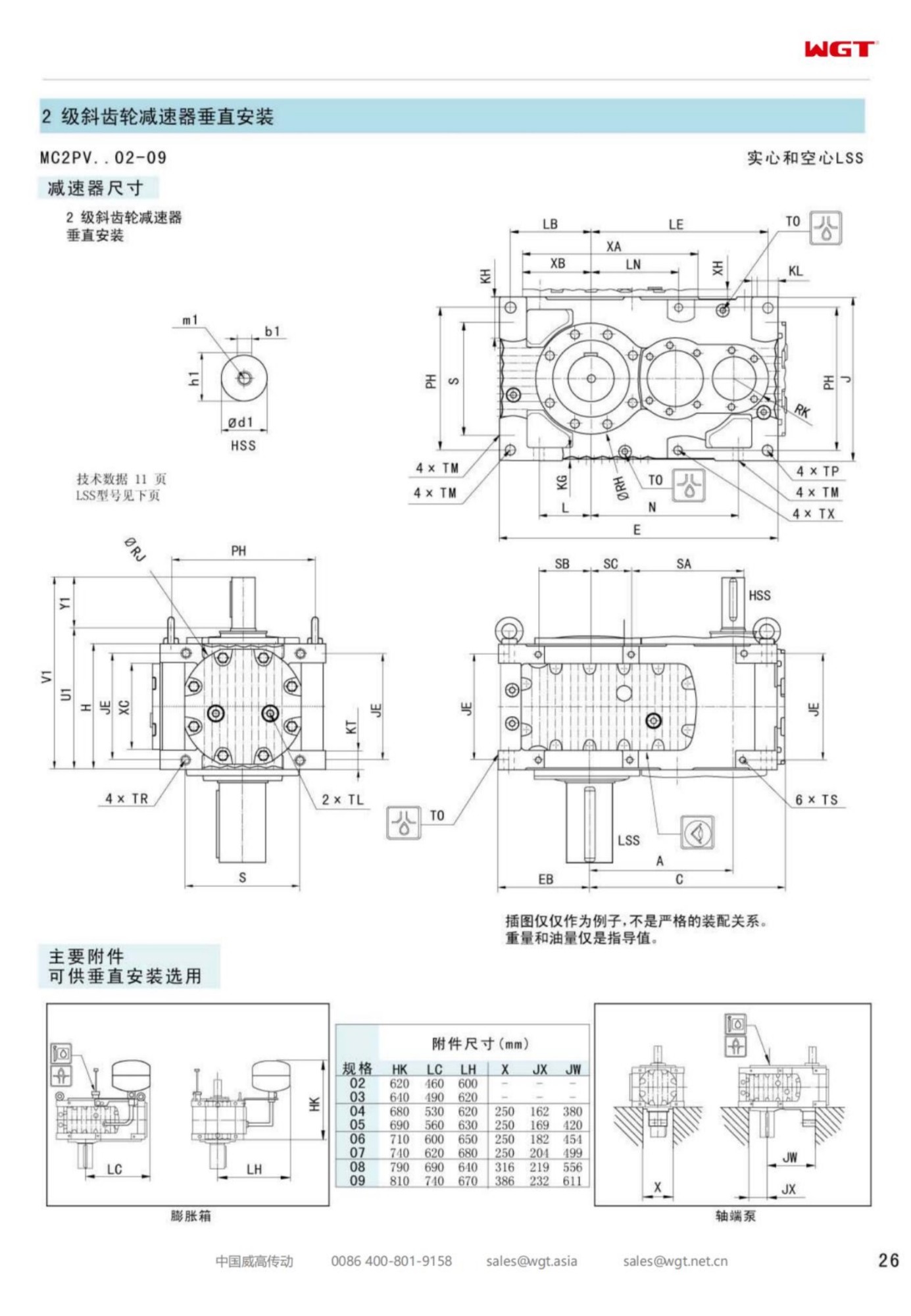
Every vessel hall has a tier of duties that outgrew the small frames: the fermenters that pay the plant's bills, the digesters that never stop feeding, the deep tanks whose shafts run true but whose torque runs deep. The MC2PVHF03 vertical hollow shaft gear unit is the frame that tier lands on - one step up the band, the same hanging construction, and a bore that still grips the process shaft without a coupling in sight.
Frame three buys its position honestly. It carries the largest impellers the mid-band sees, hangs from bridges that were drawn with real loads in mind, and runs in the halls where a stopped vessel stops a batch rather than a shift. This page covers what changes at the third frame - torque, weight, heat, reaction - and what the buyer should specify while the order is still cheap to change.
Frame Three and the Fermenter Hall
Fermentation and digestion halls are hard places for gearboxes to be ordinary. The atmosphere is warm and wet, vessels run for campaigns measured in months, and access is controlled by the process rather than by the maintenance calendar. A drive in this hall is chosen to be ignored for a year at a stretch, and frame three earns that trust with thermal margin, sealing depth and bearings sized for shafts that flex more than their drawings admit.
The hall also decides the failure modes worth insuring against. Condensation finds breathers, washdown finds seals, and campaign pressure postpones every inspection until the next scheduled emptying. The buyer's job at this frame is not to specify heroics but to match the build to the hall: the right breather, the right lip material, and a reaction interface the bridge can actually carry. Frame three rewards that match with years of being forgotten, which is the compliment this hall pays best.
Reading MC2PVHF03 as an Order
The designation carries the same grammar one frame up the band.
| MC | Industrial gear unit family built for continuous plant duty |
| 2 | Two helical reductions inside one upright case |
| P | Parallel-shaft layout, input and output on parallel axes |
| V | Vertical build, output axis pointing down into the vessel |
| H | Hollow output bore, the process shaft passes through it |
| F | Footed reaction pads, bolted to the vessel bridge or plate |
| 03 | Third frame, mid-band duties with real campaign torque |
As an order document the string settles the construction; the duty sheet settles the frame. The numbers that matter at this tier are the start torque a fouled vessel delivers, the hours a campaign accumulates, and the ambient the hall holds at the worst hour of the worst month. A frame chosen from running torque alone arrives correct on paper and warm in service, and warmth in a fermentation hall is a specification failure nobody enjoys explaining.
More Torque Through the Same Bore Logic
The hollow bore does not care about frame numbers; it cares about fit. At frame three the bore carries more torque through the same logic - contact, key and clamped reaction - which raises the stakes on every tolerance the first frame forgave. Keyway edges see harder starts; the fit length matters more; the shaft's surface finish in the bore region decides whether the contact frets. None of this is exotic, and all of it is checked with the same three tools: a micrometer, a straightedge and a note in the file.
The reward for that care is the same as at frame two, scaled up: no coupling alignment, no spacer inventory, no flexible element to order ahead of every service. The third frame multiplies the torque, not the maintenance model. Plants that understood the bore at frame two run frame three with the same routines and larger margins; plants that skipped the understanding meet the same lesson with heavier tools.
Bridges, Beams and the Weight Budget
Frame three hangs real tonnage over the vessel, and the bridge conversation deserves to happen before the order, not under the crane. The numbers the structural engineer needs are short: hanging mass, torque reaction at the pads, bolt pattern, and the lifting load during installation. With those, the bridge is approved on paper; without them, it is argued on site, where every day of delay costs more than the steel ever did.
Wise buyers also reserve the weight budget's future. Vessels get re-rated, impellers get wider, and a drive that consumes every kilogram the bridge can hold makes the next campaign decision expensive. Specifying the frame with the bridge's headroom written down keeps the plant's options open for the price of one line in the file - the cheapest flexibility this hall can buy.
Duties That Grow Into the Third Frame
The third vertical frame, where fermenters, digesters and deep-tank duties land:
- Production fermenter drive in a pharmaceutical fermentation hall
- Digester agitation at a municipal treatment works
- Deep-tank agitation in an industrial yeast plant
- Crystallizer drive on a fine-chemicals batch line
- Kettle drive in a glucose and starch sweetener plant
- Large vat agitation in a fermentation-based ingredients works
The common thread is consequence: batches worth more than the drive, campaigns that cannot pause, shafts long enough to need the steady bearing respected. Frame three exists for duties that grew past the small frames honestly - through torque and hours, not through specification inflation.
Vapour, Humidity and the Seal Plan
At frame three the seal plan stops being a line item and becomes a system. The output seal works in the process's exhalations; the input seal works in the hall's washdown; the breather decides what the case inhales on every thermal cycle. A fermented broth exhales differently than hot water, an outdoor digester breathes dust and rain, and a caustic cleaning cycle attacks lips that would outlast years of mere oil. The plan names all three interfaces and matches each to its atmosphere.
The economical form of the plan is chosen at order and verified at every lift-off. Seal sets for this frame are inexpensive; the shutdown they avoid is not. Buyers who write the atmosphere into the enquiry - medium, temperature, cleaning chemistry, outdoor exposure - receive a build that fits the hall instead of a build that fits the brochure, and the difference shows up as a decade of dry oil samples rather than as a seal budget.
Vertical Oil Habits at Frame Three
Oil in an upright three-frame case lives closer to its limits than oil in any horizontal cousin: hot zones near the upper bearings, a seal sitting in the sump, and a level mark that must be read with the case standing. The grade is chosen for the vertical film strengths, the fill is measured, and the first change comes early to remove the run-in particles before they find the upper bearings on their own.
After commissioning, the habit is sampling rather than guessing. Quarterly samples on a campaign-running drive turn the oil into a trend line: water content flags the breather or the seal, particle counts flag a bearing, additive health dates the next change. The frame three duty profile - long, loaded, warm - is exactly the profile where sampling pays for itself in one avoided intervention, and the discipline costs an hour a quarter.
Reaction Pads, Pins and the Mounting Interface
The torque reaction of a third-frame drive is a real number with real consequences, and it leaves the gearbox through the footed pads into whatever steel the bridge offers. The interface deserves the same drawing discipline the bore gets: pad seating machined or shimmed flat, bolts tightened to figure and re-checked after the first thermal cycles, and the bridge's welds inspected on the same calendar as the drive itself.
Sites occasionally meet the argument that the pads are 'just feet'. The argument is cheaper to settle at order time, with the reaction figure on the drawing, than at year four with an elongated bolt hole as the exhibit. A reaction path is a chain of inexpensive parts holding an expensive one in place - pads, bolts, shims, welds - and it is inspected as a chain or not at all.
Commissioning With the Vessel Already Full
Not every installation enjoys an empty vessel. Frame three is often fitted over a live process, which moves the whole commissioning plan onto the shaft: the unit must go on clean, dry and filled before the first rotation, and the first hours of running are the only baseline the plant will get until the next emptying. The sequence is short and unforgiving - bore fit recorded, pads seated and torqued, oil filled to the vertical mark, breather fitted, brief uncoupled-style check run at low load while the hall listens.
The baseline matters more here than at any lower frame. Temperatures, noise character and the first oil sample, taken while the campaign is young, become the reference every later reading is argued from. A drive commissioned with notes has a history; one commissioned between batches has only anecdotes, and anecdotes argue poorly at budget time.
Adapter Sleeves and a Fleet of Shafts
Plants that run several vessels rarely run one shaft diameter. Frame three's adapter sleeves let a single spare serve a fleet: bore reduction sleeves that fit the drive to an older shaft, sleeve kits that bridge a modest diameter difference, and the option to order the next unit pre-bored to match. The fleet argument is arithmetic - one spare gearbox plus two sleeves costs less than two spare gearboxes, and fails half as rarely.
The discipline that makes the fleet work is bookkeeping. Sleeve kits live in stores, shaft diameters live in files, and the two meet only if someone records them together. The plants that do this lift a frame three onto any vessel in the hall within a shift; the plants that do not rediscover, every few years, that the spare fits a vessel they no longer own.
Trending the Third Frame Across Campaigns
The third frame's service life is long enough that trends matter more than readings. Temperature, vibration, oil analysis and seal condition, plotted across campaigns, show the slow drifts that single readings hide: a bearing warming a degree a season, a seal weeping a gram a week, an oil trend bending as the breather ages. The plot is what turns 'the drive seems different' into a part number ordered ahead of the next emptying.
Trending also prices the honest question every plant eventually asks - run, overhaul, or order anew. With campaigns of comparable data the question is a calculation; without them it is a debate. The data costs minutes per month on a drive the operator already visits, and it is the only difference between a mid-band drive that ages gracefully and one that ages expensively.
Ordering the Second Unit on Purpose
Vessel halls duplicate. The fermenter hall that bought one frame three is usually drawing the extension that needs three more, and the first order is the rehearsal for the rest. The rehearsal is worth recording: what the enquiry missed, which bore dimension arrived wrong, how the bridge argument went, what the first lift-off taught. Written down, those notes become the template that makes the second order clerical and the third one fast.
The best frame three is the one the hall forgets: fitted in a shift, trended in a notebook, serviced between campaigns, and never once the subject of an emergency. None of that is luck. It is the bore taken seriously, the bridge given its numbers, and an order sheet that described the hall it was actually moving into.
Full Frame Range of the M3 Series
| Model | Centre distance | Output | Typical duty |
|---|
| M3PSF50 | size 50 | solid shaft, foot | conveyors, feeders |
| M3PSF60 | size 60 | solid shaft, foot | crushers, mixers |
| M3PSF70 | size 70 | solid shaft, foot | ball mills, shredders |
| M3PSF80 | size 80 | solid shaft, foot | kilns, heavy conveyors |
| M3PSF90 | size 90 | solid shaft, foot | mill and kiln drives |
| M3RSF50 | size 50 | solid shaft, foot, right-angle | inclined conveyors, elevators |
| M3RSF60 | size 60 | solid shaft, foot, right-angle | screw classifiers, feeders |
| M3RHF70 | size 70 | hollow shaft, foot, right-angle | agitators, drum drives |
| M3PHT80 | size 80 | hollow shaft, torque arm, parallel | shaft-mounted conveyors |
| M3RHT90 | size 90 | hollow shaft, torque arm, right-angle | heavy shaft-mounted drives |
Every frame in the table can be ordered with alternative shaft and mounting styles. If you are matching an existing installation, send the nameplate details and we confirm the equivalent frame in writing.
Installation Snapshots
Mining slurry pump drive
At a mineral processing site, hollow-shaft reducers drive slurry pump agitators. The hollow bore takes the pump shaft with no coupling, so a pump change-out no longer means re-aligning a separate drive.
Palm oil mill fruit elevator
A palm oil mill powers its fruit elevator with reducers. The humid, oily atmosphere is handled by FKM seals, and the compact frame fits between the steriliser and the threshing drum.
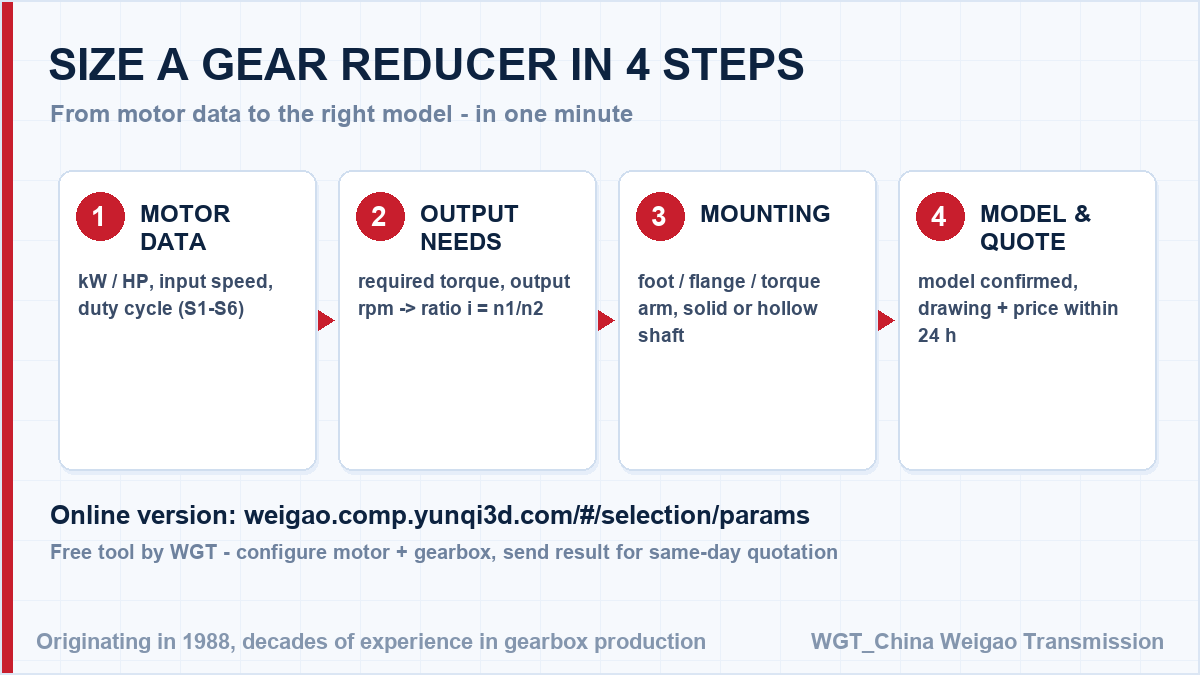
Selection Example: Digester agitation at a municipal treatment works
Take a 30 kW motor at 1470 rpm turning the digester impeller at 29 rpm. The ratio follows directly: 1470 / 29 = 50.7, so a ratio near i=51 is selected from the two-stage band, and the frame is confirmed against the fouled start torque a digester delivers after a long shutdown rather than against running torque alone. In this case frame three holds the campaign torque with margin, and the hanging drive keeps the vessel roof free for the gas and dosing equipment the process needs. Use the same method for any frame in the series, then confirm the service factor with us - it is the one number buyers most often get wrong.
![speed reducer selection process diagram]()
The selection path we follow when checking your enquiry.
Technical Q&A
What is the recommended oil change interval?
The housing is lubricated for life under normal duty and normal ambient. In hot, humid or continuous service, change the oil after the first 400 running hours and then every 4000 hours, or once a year, whichever comes first.
What paint finish and corrosion protection is applied?
Housings are shot-blasted and finished with a two-component industrial paint in RAL colours, giving good protection for indoor and sheltered outdoor duty. For aggressive or coastal sites, ask for the heavy-duty coating option.
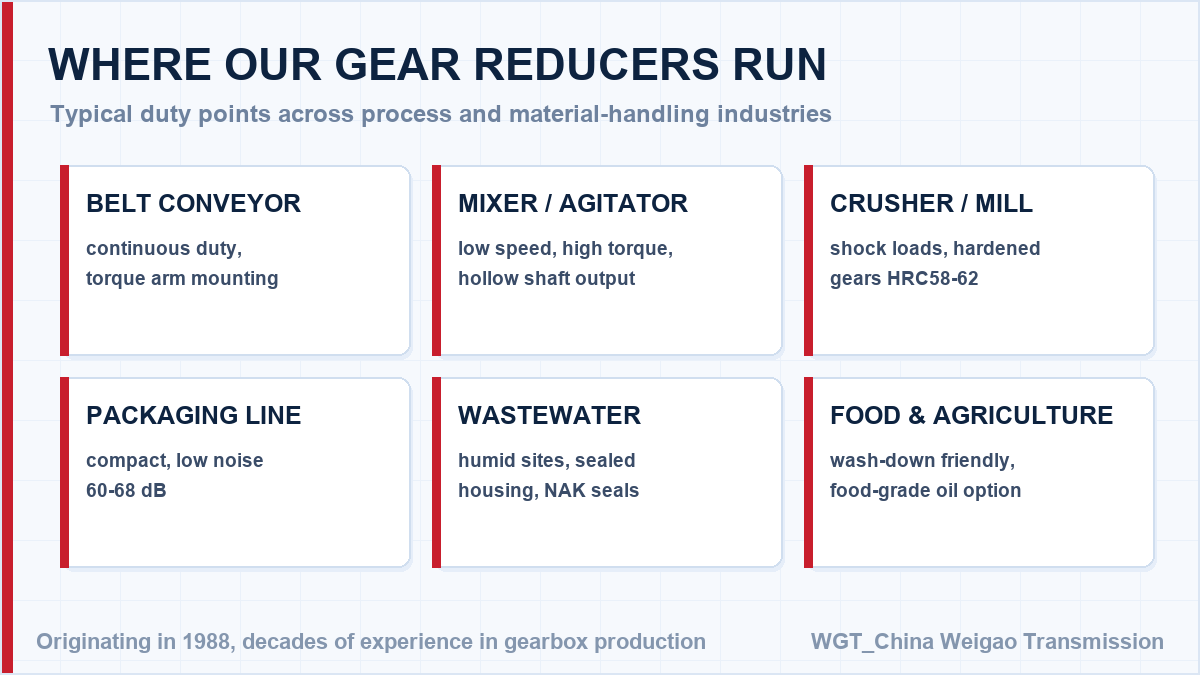
![speed reducer use cases across sectors]()
Typical installation environments for this gearbox family.
Torque Margin Checked Before Every Quotation
No catalogue guessing. One screen in the WGT Motor & Gearbox Online Selection System is usually enough to pin down the frame size; we confirm the service factor afterwards.
Every quotation includes the calculated service factor and the resulting torque margin, so the unit you buy covers the real duty - including starts, jams and reversals - not just the average load. Looking for a reducer for woodworking machine? Tell us the duty point and we will confirm the model in writing.