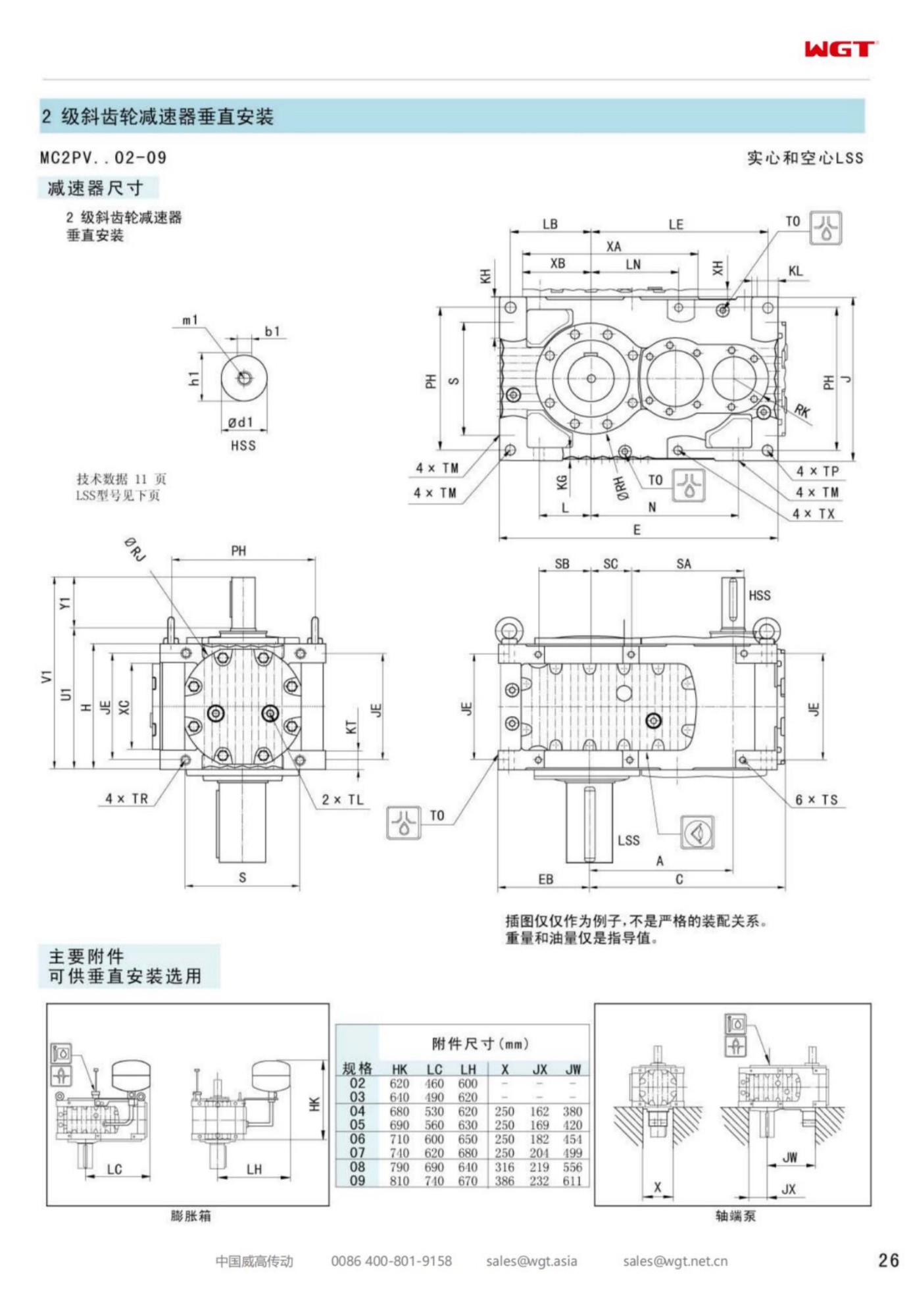
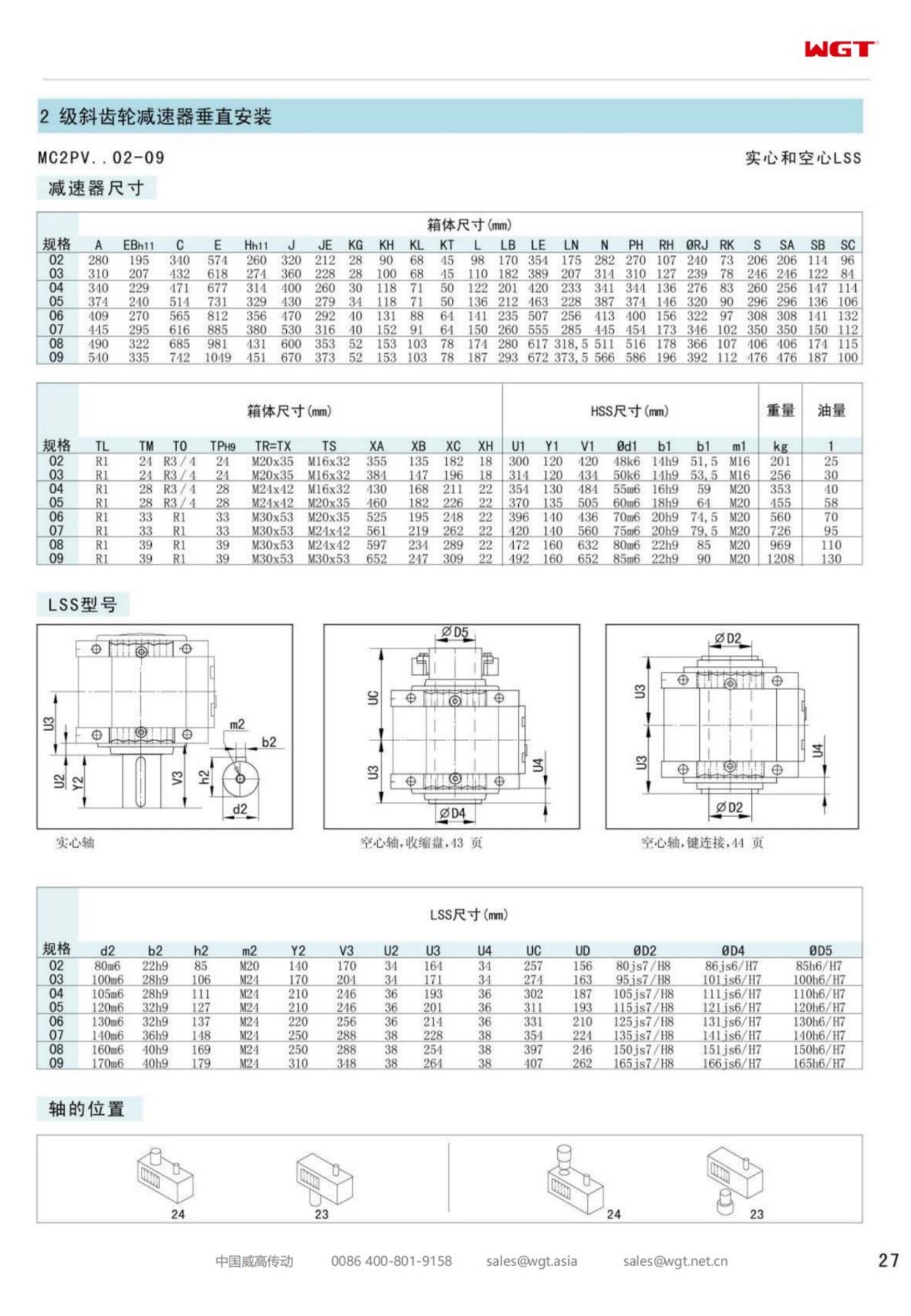
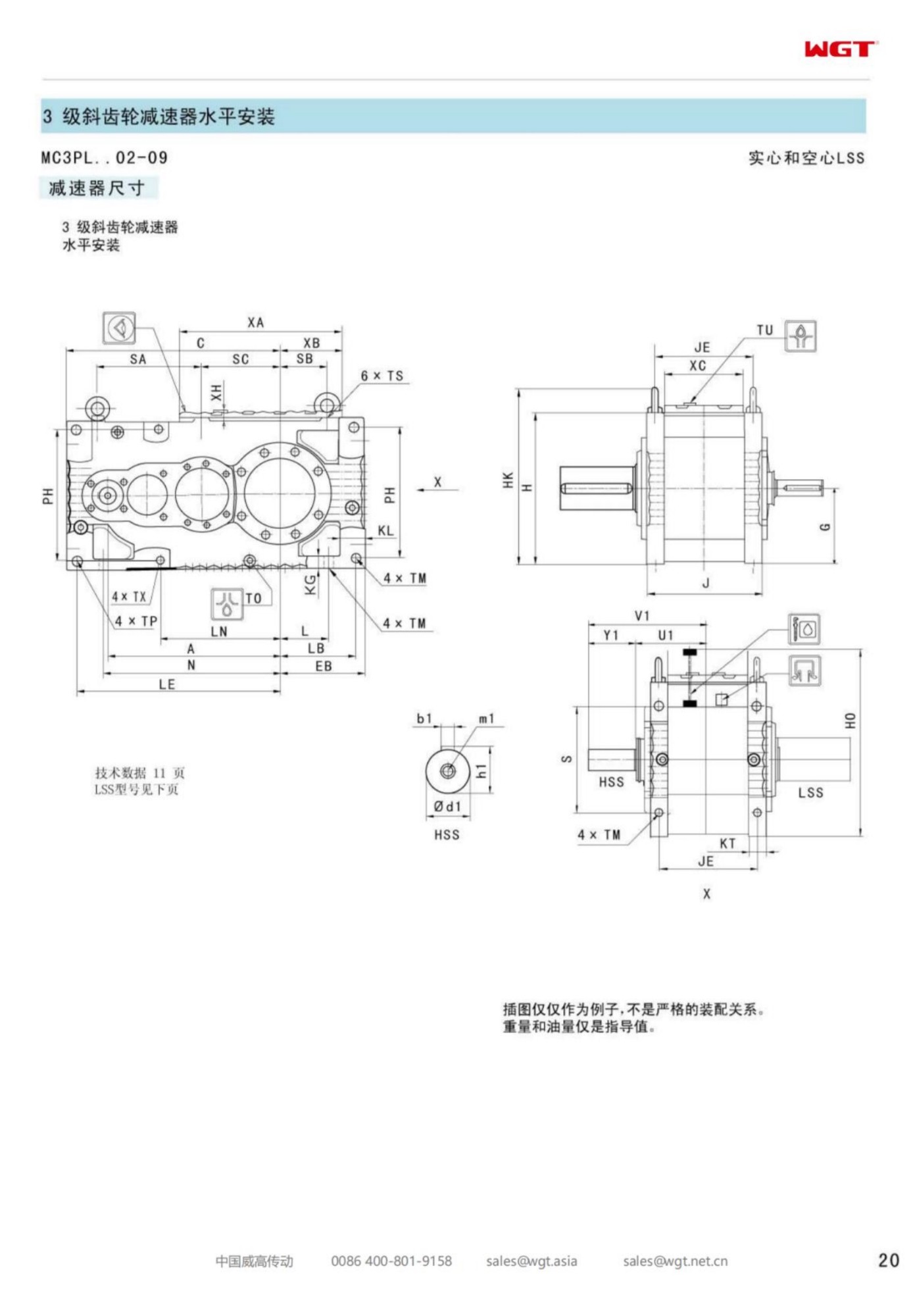
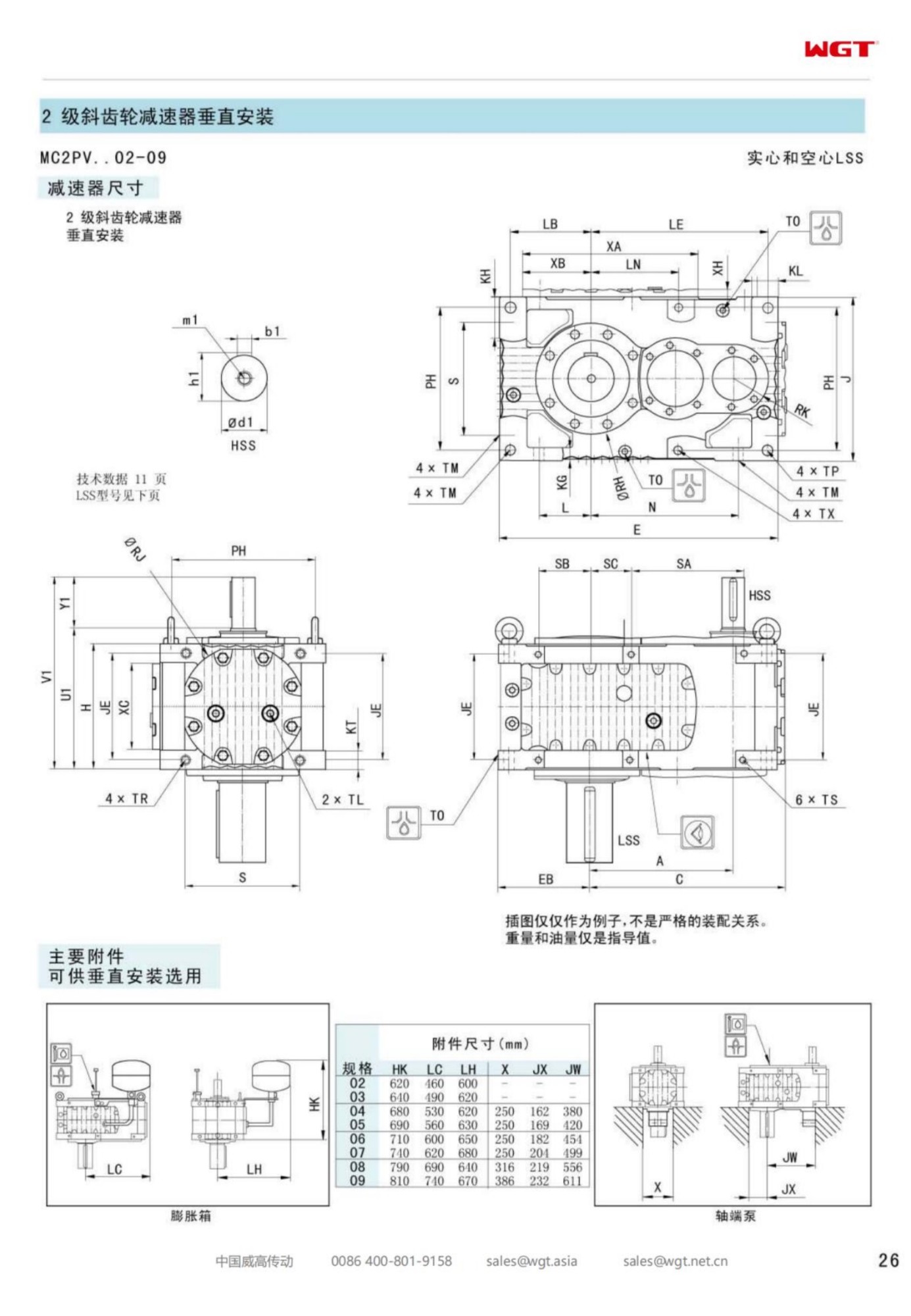
Below frame five, a vertical hollow-shaft drive is mostly a torque conversation. At frame five the vessel starts contributing geometry: shafts run longer, bridges span wider, and the bending behaviour of a several-metre shaft becomes as important as the torque it carries. The MC2PVHF05 vertical hollow shaft gear unit is where the band takes that step - the same hanging construction, now asked to hold still at the top of something tall.
This page is about the physics that arrives with height. A long shaft has natural modes of vibration that set the safe speed band; a steady bearing at the tank floor stops being an accessory and becomes part of the drive design; the output bearings inherit lateral loads nobody photographed; and the bridge itself flexes under the case it carries. None of it is difficult. All of it is invisible on an order sheet that only mentions a model number, which is why frame five orders deserve the extra page.
Frame Five and the Tall Vessel Question
The question that defines this frame is simple to ask and awkward to answer late: how long is the shaft, and what is holding it straight? A stubby agitator under frame three governs itself. A six-metre shaft on a crystallizer answers to every out-of-balance force along its length, and the gearbox - hanging at the top, gripping the shaft through a bore - is the component that feels the sum first.
Plants reach frame five from two directions. Some are scaling proven duty: the same product in a taller vessel, the same recipe at a bigger batch. Others are specifying new capacity and inheriting a vessel drawing they did not write. In both cases the order is decided less by the torque table than by the shaft, the bridge and the bearing at the bottom - and the buyers who send those three items choose their frames in an afternoon.
Decoding MC2PVHF05
The type string fixes the geometry; at this frame the geometry is the story.
| MC | Industrial gear unit family built for continuous plant duty |
| 2 | Two helical reductions inside one upright case |
| P | Parallel-shaft layout, input and output on parallel axes |
| V | Vertical build, output axis pointing down into the vessel |
| H | Hollow output bore, the process shaft passes through it |
| F | Footed reaction pads bolted to the vessel bridge or deck |
| 05 | Fifth frame, where shaft length starts to govern the order |
Read as an order document, the string tells the factory what to build and reminds the site of its own obligations: a bridge flat and stiff enough to hang the case without leaning it, a shaft whose straightness and runout were checked cold, and a floor bearing - if the shaft is long - that was specified by someone, not improvised. The remaining variable is the fit at the bore, and at frame five the fit works harder than at any size below it.
Long Shafts and Their First Bending Mode
Every shaft has a speed at which it prefers to bow: the first bending mode. Below it, the shaft spins about its own axis and the drive forgets it has a length. Near it, the shaft whips, the bore sees alternating load, and the vibration works outward from the tank floor into the bridge and the case. Agitator speeds sit far below the first mode of a healthy shaft - but fouling, added impellers and product build-up all shift the mode downward, and a shaft that was safe on commissioning can drift toward trouble over years.
The buyer does not need to compute the mode. The buyer needs to know it exists and to say the shaft length out loud. A gearbox order that mentions a six-metre shaft gets a conversation about the bottom bearing and the balance of the impellers; an order that mentions only a frame number assumes the shaft will behave, and ships the assumption anyway.
When the Steady Bearing Stops Being Optional
Short shafts hang straight under their own stiffness. Long ones need help, and the help is a steady bearing at the tank floor that carries the lateral load the shaft cannot. Below frame five, that bearing is often an economy choice. At frame five, with shafts several metres long and impellers heavy with product, it is part of the drive train - and the gearbox is quietly designed around the assumption that it exists.
The failure pattern when it is skipped is well rehearsed: vibration that rises with product level, seal wear at the case that no seal change fixes, and output bearings that age twice as fast as their rating promised. None of it announces itself as a bearing decision made two years earlier. Halls that keep the steady bearing on the same inspection calendar as the gearbox seals never meet the pattern.
Lateral Loads on the Output Bearings
The output bearings of a hanging case were sized for torque and the loads a straight shaft delivers. What they actually receive includes the horizontal component of every out-of-balance impeller, the pull of a shaft checked warm instead of cold, and - in unbaffled duty - the precession described on the frame four page. Individually small, these loads arrive several million times a month.
There is no accessory that fixes this at the gearbox; the fix lives in the declaration. An enquiry that states shaft length, impeller count and whether the tank is baffled lets the bearing spec and the bore fit be chosen for the real load path. An enquiry that omits them gets a unit sized for the average of all duties, and frame five is not the place to run averages - the shafts are too long and the visits to the tank floor too rare.
Bridge Stiffness and Hanging Geometry
At frame five the hanging case is heavy enough to become a structural item. A bridge that flexes under it turns the gearbox into a leaning tower: every degree of lean moves the bore off the shaft axis, loads the fit unevenly, and telegraphs the error down to the bottom bearing as side thrust. The unit does not fail; it simply spends its life correcting a geometry problem that belonged to the steelwork.
The practical checks are short. The mounting pads must land on structures that do not deflect measurably when the case is lowered onto them; the shimming happens once, with a level, and is then recorded. Where the bridge is shared with other equipment, the order for the drive is the moment to argue about the steel - after the unit is hung and vibrating, the argument belongs to everyone and the fix belongs to nobody.
Motor Growth and the Thermal Picture
Frame five carries bigger motors than the frames below, and the motor's heat joins the case's heat on the same upright surface. In a warm hall over a warm product, the sum can nudge oil temperatures past the comfortable band - not to failure, but to the slow oxidation that shortens oil life and seal life together. The larger the motor, the more the unit benefits from a clean case surface and an oil grade chosen for the ambient, not the catalogue default.
Halls running this frame in hot service settle on a rhythm: oil sampled at campaign ends, skin temperature logged with the same pen as the product temperature, breather and cooling fins on the washdown schedule. The pattern costs a few minutes a month and is the difference between a case that runs warm and one that runs hot.
Watching a Drive You Visit Weekly
Vertical drives on tall vessels are inspected less often than their importance deserves, because the visit takes stairs. The crews who keep frame five units healthy turn the climb into a fixed loop: temperature by hand or gauge, noise character by ear at two speeds, oil level against the mark, seal area wiped and looked at, breather clear. Five items, two minutes, once a week - written where the next crew can read it.
The value of the loop is the trend, not the reading. A degree a month, a seal that weeps after every third campaign, a noise that arrives only at full level - each is nothing on the day it is first seen and everything by the time it is undeniable. Frame five units on tall vessels rarely fail suddenly; they drift, and the log is what catches the drift.
Lift Planning Above a Working Hall
A frame five case is a load the hall's usual lifting gear may not want. Planning its arrival - or its eventual change-out - is part of the order, not an afterthought: access for the crane, headroom above the vessel, the weight the bridge sees while the unit swings, and the route down for the old case. Halls that sketch this before the delivery date change the drive in a shift; halls that improvise it rent equipment nobody quoted.
The same plan serves the first day. Lowering the case onto the shaft is the moment the bore fit is either respected or ruined; a controlled, guided descent with the key aligned takes twenty minutes and sets the drive's character for the next decade. Rushed, the same descent brinells the fit and leaves a vibration nobody can tune out later.
Where Frame Five Sits in the Band
The vertical hollow band does not end here, and frame five buyers are usually scaling toward the frames above or duplicating across a hall. That makes the fifth order a template by accident: its shaft drawing, bridge check, bearing calendar and lift plan get photocopied onto every vessel that follows. Worth doing deliberately - the sixth order written from the fifth's paperwork is clerical, and the hall that treats it that way scales without relearning anything.
It also makes frame five the last frame where some economies are still safe. Above it, the structural conversation dominates; at it, the buyer can still choose between a bottom bearing and a shorter shaft, between a standard seal set and a product-specific one, and see the consequence in weeks rather than quarters. The frame rewards decisions made here, at the order, more than any size below.
Documents to Send With a Tall-Vessel Enquiry
A frame five enquiry carries more paper than the frames below, and the paper is the price of a drive that fits: the shaft drawing with runout figures, the vessel drawing with baffle positions, the batch card with the worst viscosity, the motor's electrical data, and a line stating how often the drive starts and stops. Each document removes one assumption from somebody's desk.
The reply, when the documents arrive, is equally concrete: a frame and ratio with the torque margin shown, a bore fit quoted to the shaft actually drawn, seal and breather choices matched to the product and the washdown, and an oil and inspection interval that acknowledges the height of the vessel. That exchange, one email each way, is the whole craft of ordering this frame well.
What a Good Frame Five Year Looks Like
A year on a healthy frame five is quiet. The log fills with readings that barely move: skin temperature within a degree or two of last quarter, oil level at the mark, seals dry, the bottom bearing greased on its calendar, one oil change at the campaign boundary. The only events are scheduled ones. Nobody climbs the stairs with a problem; they climb with a checklist and come down with it unchanged.
That quiet is manufactured, not lucky - by the shaft drawing that was sent, the bridge that was checked level, the steady bearing that was included, and the fit that was lowered onto the shaft with care. Frame five asks for a little more of everything than the frames below it: more paper at the order, more minutes at the visit, more honesty about the vessel it hangs over. It returns the same in decades.
Tall vessels, long shafts and the steady-bearing conversation - frame five is where geometry governs:
- Tall crystallizer vessel agitation at a fine-chemicals plant
- Deep extraction column stirring in an oils-and-fats works
- Large blending duty on lubricant storage tanks
- Tall polymerization reactor drive in a resins complex
- Syrup and concentrate blending tank at a beverage plant
- Deep leaching tank agitation at a hydrometallurgical plant
The M3 Series at a Glance
| Model | Centre distance | Output | Typical duty |
|---|
| M3PSF50 | size 50 | solid shaft, foot | conveyors, feeders |
| M3PSF60 | size 60 | solid shaft, foot | crushers, mixers |
| M3PSF70 | size 70 | solid shaft, foot | ball mills, shredders |
| M3PSF80 | size 80 | solid shaft, foot | kilns, heavy conveyors |
| M3PSF90 | size 90 | solid shaft, foot | mill and kiln drives |
| M3RSF50 | size 50 | solid shaft, foot, right-angle | inclined conveyors, elevators |
| M3RSF60 | size 60 | solid shaft, foot, right-angle | screw classifiers, feeders |
| M3RHF70 | size 70 | hollow shaft, foot, right-angle | agitators, drum drives |
| M3PHT80 | size 80 | hollow shaft, torque arm, parallel | shaft-mounted conveyors |
| M3RHT90 | size 90 | hollow shaft, torque arm, right-angle | heavy shaft-mounted drives |
All frames in the table belong to one industrial family. P = helical parallel-shaft, R = bevel-helical right-angle; the low-speed shaft is solid (S) or hollow (H), mounted on feet (F) or a torque arm (T).
Selection Example: Crystallizer agitation in a tall vessel at a fine-chemicals plant
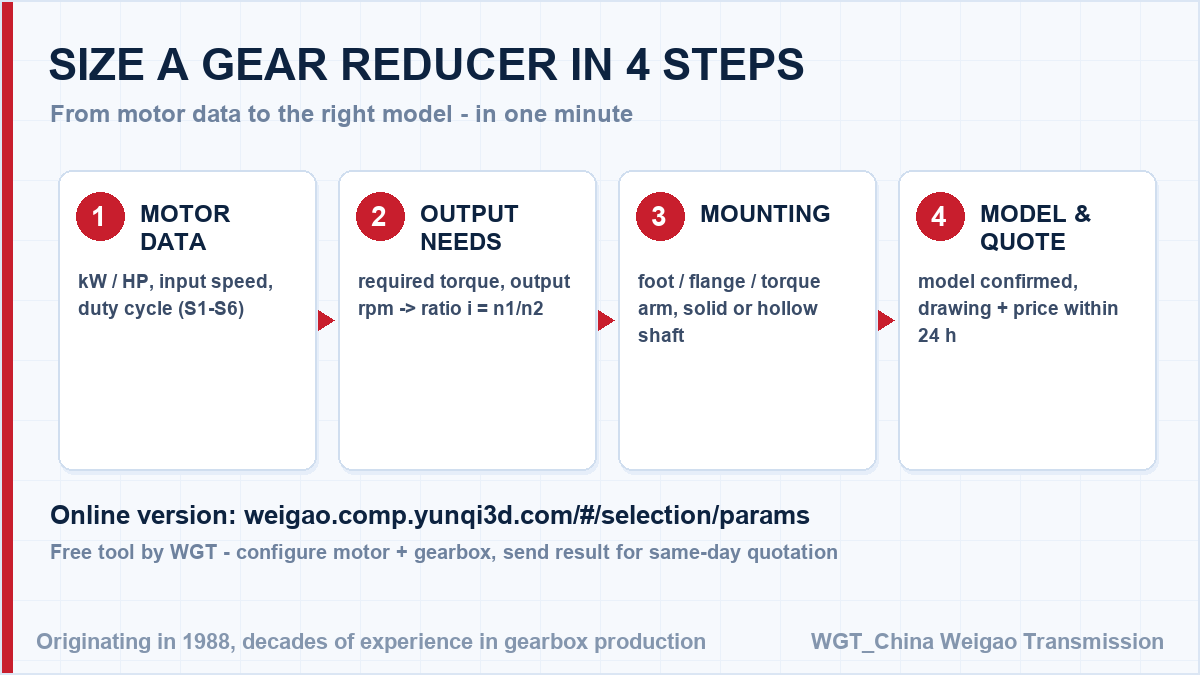
Take a 45 kW motor at 1480 rpm turning the crystallizer stirrer at 24 rpm. The ratio follows directly: 1480 / 24 = 61.7, so a ratio near i=62 comes from the two-stage band, and the frame is confirmed against the lateral loads a long shaft delivers, with the floor steady bearing written into the drive design rather than left as an option. In this case frame five holds the duty while the geometry is declared - shaft length, runout, baffle positions and bridge stiffness - so the hanging case spends its years quiet. That single division gives the catalogue ratio; the service factor for your duty class is then applied to the torque, and the frame size follows.
![how to size a industrial helical gearbox in four steps]()
Sizing flow: motor speed, target output speed, torque, service factor.
Where This Series Works in Practice
Pet-food extruder feeder
A pet-food plant chose reducers for the feeder screws ahead of its extruders. Steady torque at variable output speed keeps the kibble size consistent, and washdown sealing protects the unit during sanitation shifts.
Ceramic tile press feeder
A ceramic tile producer fitted reducers to press feeders. The dusty environment is handled by sealed housings, and the stable low-speed output stops the tile blanks shifting before pressing.
Technical Questions, Answered
Will the unit match my existing gearbox interface?
The series is manufactured to the standard centre distances, shaft dimensions and flange patterns of its frame family, so couplings, guards and foundations do not have to be redesigned. Send the nameplate details and we confirm the equivalent frame in writing.
What is the maximum overhung load on the output shaft?
The permissible overhung load depends on frame size, output speed and the distance from the shaft shoulder - all listed in the catalogue. If you drive a chain sprocket or V-belt pulley direct on the output shaft, send us the load and pitch diameter and we will confirm the limit.
![industrial helical gear reducer application fields]()
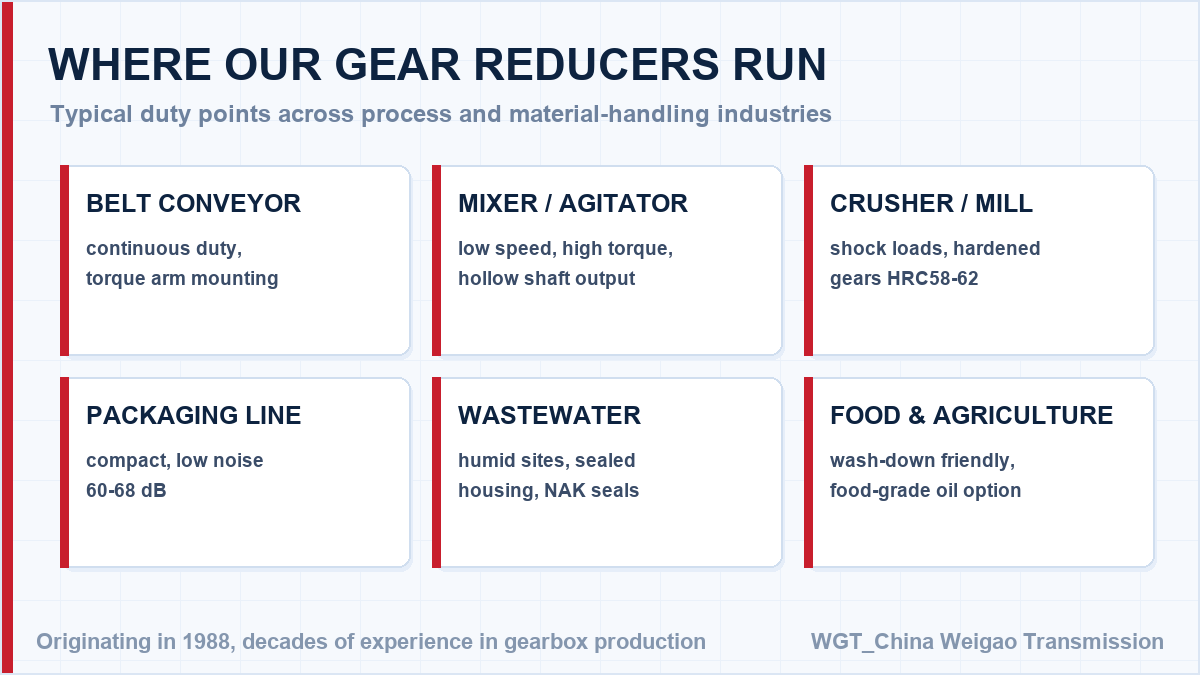
Common application areas for right-angle industrial helical drives.
Full Documentation for Project Tenders
Bidding a project? Skip the back-and-forth: configure your drive in the WGT Motor & Gearbox Online Selection System and send us the result for a same-day quotation.
We support tenders with complete technical files: dimension drawings, rating tables, material certificates and test record formats, in the format your client specifies. Looking for a gear motor for car wash system? Tell us the duty point and we will confirm the model in writing.