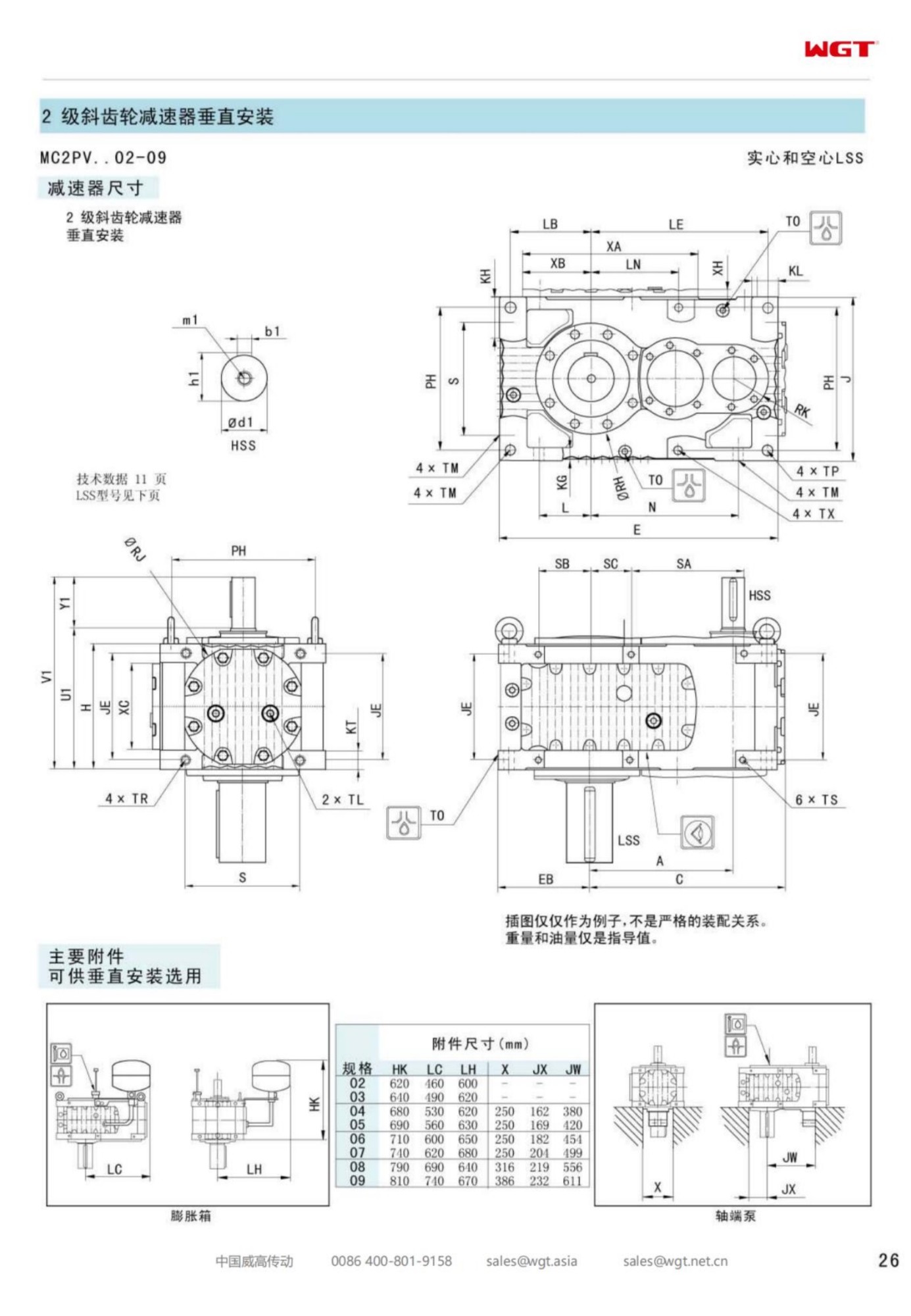
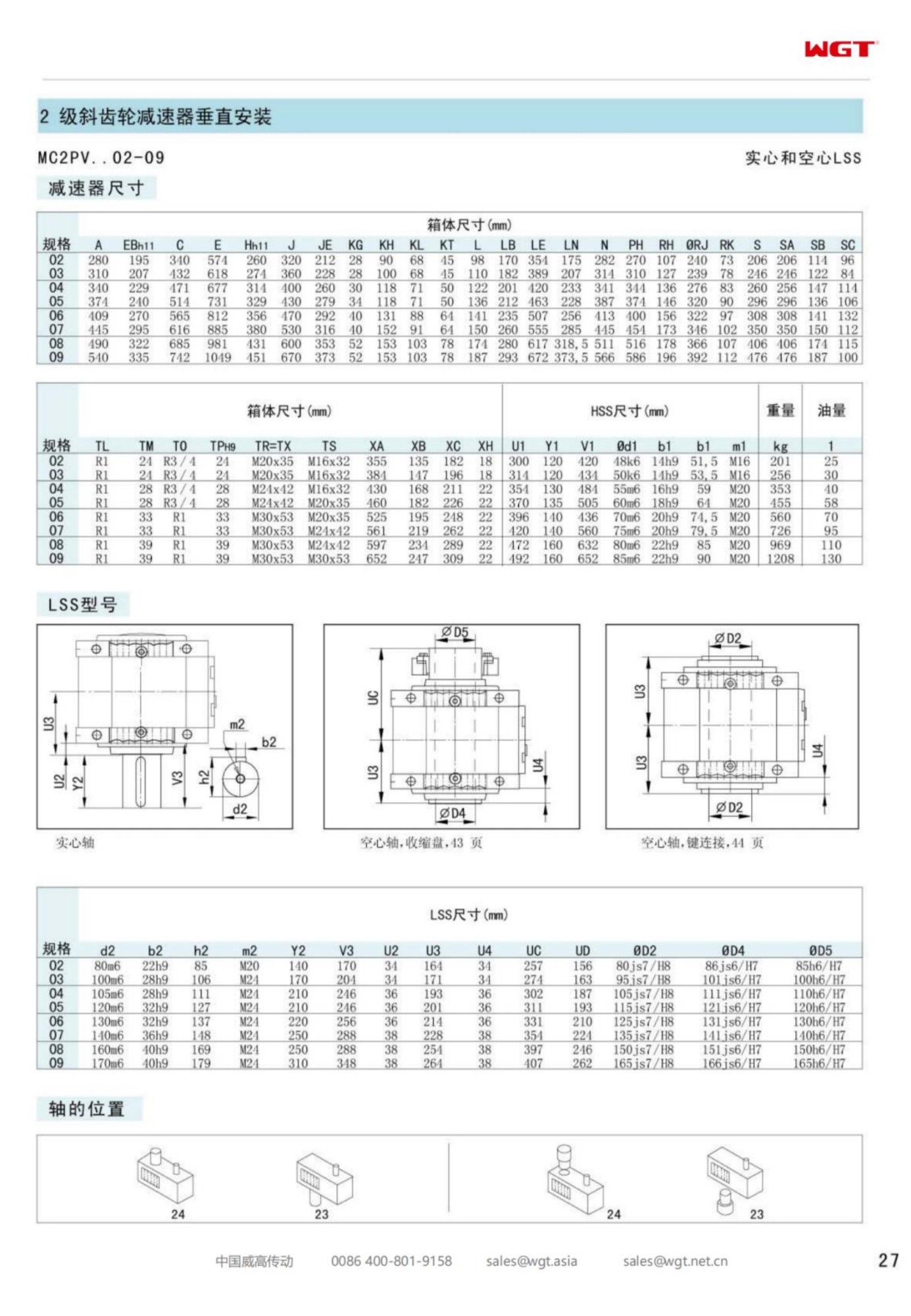
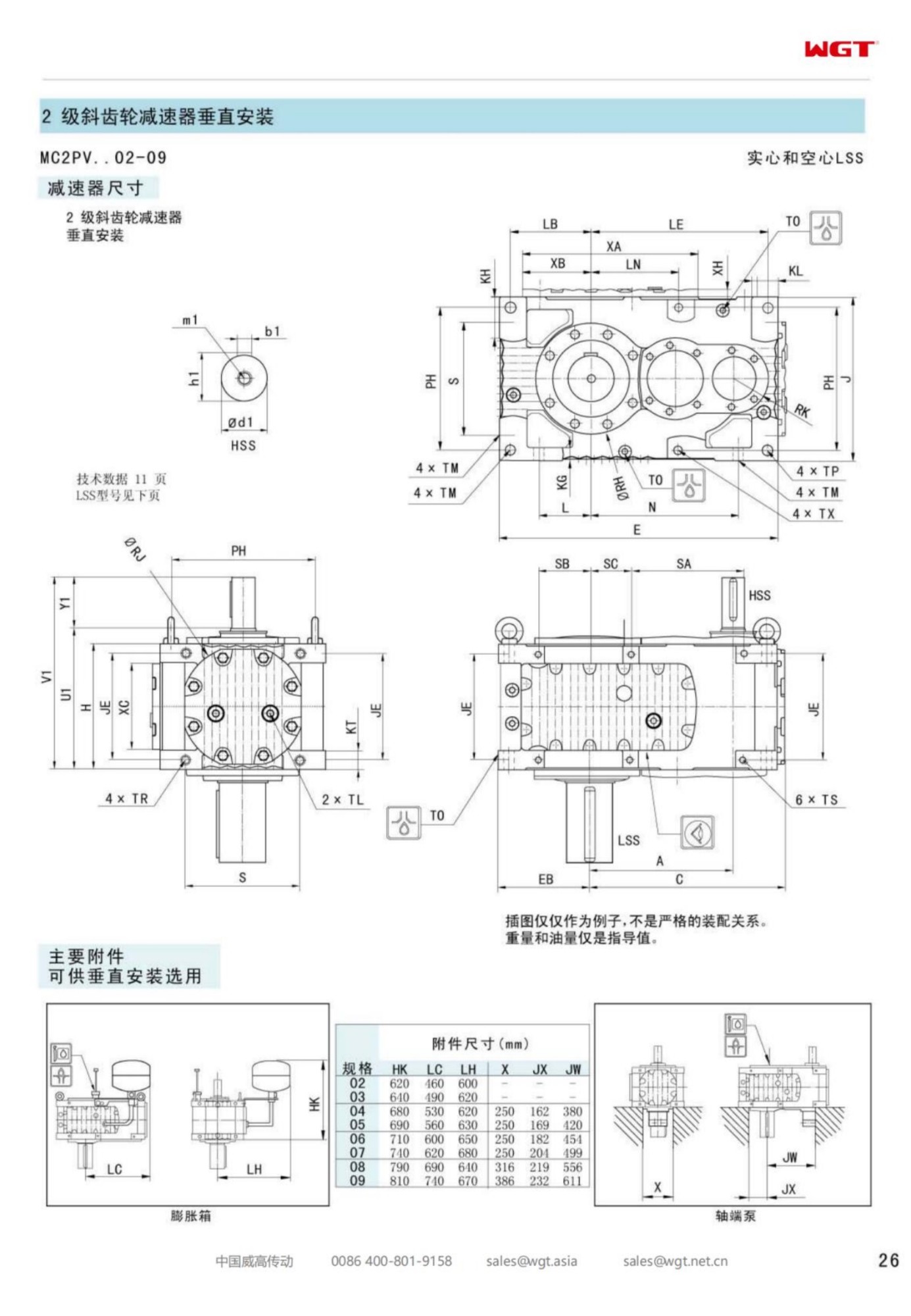
Every product line has a frame that closes it, and in this vertical family the ninth is the one. The MC2PVSF09 vertical gear unit stands at the ceiling of the band: two helical stages in one plane, the widest standard foot-mounted upright case, and a solid coupled shaft taking torque straight down into processes that would stall anything smaller. Above this frame the answer stops being a bigger gearbox and becomes a different kind of machine.
Buying at the top of a range has a particular rhythm. The commercial paperwork matters less than the engineering conversation, because at this size the drive, the structure and the process are designed around each other rather than one after the other. This page follows the questions that actually decide whether the installation runs for thirty years: how much torque the last step really buys, where the load lands, and how the machine will be inspected when the people who ordered it have moved on.
The Frame That Tops the Vertical Band
Position matters when reading any designation, and the ninth frame's position is the message. Everything the letters describe has been true since the second frame; what the final digit adds is scale, and with scale comes a change in who signs the drawings.
| MC | Industrial multi-stage gear unit family |
| C2 | Compact two-stage parallel-shaft series |
| P | Parallel stages - gear planes in one horizontal plane |
| V | Vertical build, output facing downward |
| S | Solid output shaft through a coupling |
| F | Foot mounting on a bridge or head plate |
| 09 | Ninth and final frame of the vertical band |
Commissioning crews read the same string backwards as a delivery check: the frame digit fixes the mounting drawing, the S promises a coupling register rather than a bore, the V says which way up, the P says what is inside. A mismatch in any of those is a machine that goes back, and the cause is almost always a specification taken verbally. At the top of the band, confirm the code in writing - twice.
Torque at the Top: What the Last Step Buys
The step from the eighth frame to the ninth is not a rounding of the series; it is the reserve the line holds for duties that outgrow everything below. In practice the extra capacity is spent three ways: slower output speeds for large rakes and thickeners, higher torque for heavy agitated duties, or a deliberately generous service factor where a stopped vessel costs more per hour than the entire drive.
The honest way to use the last frame is to buy it for a stated reason. A plant that specifies the ninth frame because the eighth 'looked marginal' has usually been given poor selection advice; a plant that specifies it because its rake must break out of consolidated underflow after a week of settling without attention has done the arithmetic. The frame rewards calculation and quietly punishes guesswork, exactly as every machine below it does.
Foundations Drawn Like Bridge Work
Above roughly the seventh frame, the plate under the feet is structural engineering, and at the ninth this is beyond argument. The clean division of labour: the gearbox supplier states reaction torque, mass, centre of gravity and bolt pattern; the fabricator designs the plate, stiffeners and bracing to those figures; both parties check the structure's natural frequency against the driven element's pass rate before steel is cut.
Two requests keep that division honest. Ask for the reaction figure at quotation, not at delivery, because fabricators order steel from the quotation drawing. And ask for the frequency check in writing even when the answer is one line. A bridge that finds the rake frequency will broadcast its complaint into the gearbox bearings, and the warranty meeting that follows will be about everything except the bridge.
Duties Reserved for the Largest Vertical
The top of the vertical band carries the duties no smaller frame can hold:
- Primary clarifier drives at a large municipal treatment works
- Stock chest agitators feeding a fine paper machine
- Red mud stirring tanks at an alumina plant
- Bitumen storage and blending tank drives at a road products terminal
- Crude slop tank mixers at a refinery terminal
- Cane juice clarification tank drives at a raw sugar mill
What these duties share is permanence. The tanks run continuously, their contents punish a stopped impeller, and the plants operate on shutdown calendars planned years ahead. A drive that keeps every wearing part above the liquid line, on a case that two fitters can inspect from a walkway, is not a styling choice at this scale - it is the layout that makes the maintenance plan possible at all.
Starting a Loaded Rake From Rest
The hardest moment in a large vertical drive's life is the start after a stop: product settled, torque at breakaway, the whole train asked to move a structure that has been sitting still. How the machine survives that moment is decided at specification time, not in the moment. Soft starters, variable frequency drives, part-wound motors and process interlocks that guarantee agitation before filling each produce a different torque trace, and the selection engineer needs to know which one the site will use.
Where speed control is fitted, the top frame gains a second talent: a settled start can be run slowly and brought up to duty speed as the contents begin to move, turning a shock into a ramp. Where the start is direct-on-line, the service factor must carry the whole shock, and the honest specification puts the worst observed start torque into the enquiry in words as well as numbers.
Oil, Heat and the Climate Above the Roofline
Drives of this size usually live indoors or under a roof, and roofs trap heat. The unit sits in the warm layer above the tank, where a summer afternoon can run several degrees above the weather station's report. Rating conversations therefore belong in temperatures measured at the drive's own elevation, across a working week, in the season when the plant runs hardest.
A thermometer hung on the bridge for one week in the hottest month settles arguments that would otherwise surface during the first heatwave. Where the trace comes back near the limit, the answers are ordinary ones - a fan guard cleared of dust, a louvre opened, a cooling coil ordered with the machine rather than improvised after it. What is not ordinary is discovering the ceiling from a product already drifting off specification.
Service Intervals Measured in Years
The top frame is built to be inspected, not to be opened casually, and its service plan reflects that. Between major interventions the routine is short: level at the glass on a fixed day, temperature at the marked patch, breather clear, seal area dry, vibration at the painted points, all logged. Oil analysis on a quarterly cadence does the listening inside the case - iron trending up, silicon after a breather fault, water after a steam hose parked too close.
Single samples judged alone mislead everyone; a number without a history is a conversation, not a diagnosis. Plants that keep four consecutive reports schedule bearing work months ahead at their own convenience. Plants that sample once a decade meet their bearings through noise, and by then the repair belongs to a shutdown nobody planned.
Planning the First Major Inspection
A machine at the top of a vertical train earns its keep for years before it needs more than oil, yet the first major inspection should be planned while the machine is still new. The questions to settle early: what scaffolding or crane access the position requires, which spares are held against that day, and whether the drive line includes a spacer so the seal and coupling can be reached without emptying the vessel.
Answering those questions at order time costs a paragraph in the specification. Answering them five years later costs an emergency scaffold contract and a week of lost production. The plants that run these machines longest are not the ones with the fewest problems; they are the ones whose first inspection was a calendar entry rather than an improvisation.
Records That Survive the Crew Who Started It
A drive this size will outlive the project team, the commissioning crew and probably the maintenance manager who accepted it. What carries knowledge across those changes is a short file: the general arrangement with plate and nozzle dimensions, the reaction torque figure, the bolt pattern and torque values, the oil grade and charge, the seal part numbers, and the commissioning readings taken on day one.
Keep the file where operators can reach it, not only in the capital project archive. When a vibration reading steps up in year six, the first question anyone asks is what the baseline was - and the answer is either in that file or nowhere. Sites that maintain the habit diagnose in an afternoon; sites that rely on memory re-learn the machine from scratch, one expensive hour at a time.
When the Process Outgrows the Ninth Frame
There is one honest conversation left at the top of a range, and mature buyers have it early: what happens if the process later needs more? The answers are real options - a second drive on a duty that can be divided, a process change that trims the load, or a different machine family entirely. What is not an option is the silent upgrade, in which a denser product or a wider impeller raises the load and never sends a memo to the gearbox.
One email to the supplier when the process changes is the cheapest reliability measure in industry. It usually results in nothing more dramatic than a revised service factor in the file - and occasionally it prevents a failure that would have stopped the largest vessel on the site.
The Enquiry That Gets a Firm Quotation
The complete enquiry for the final frame carries: vessel dimensions and driven element geometry with its mass; shaft length and the chosen thrust arrangement; motor power, speed and starting method; output speed with tolerance; duty hours and batch pattern; atmosphere above the liquid; and the plate drawing with bolt pattern, thickness and bracing description. In return comes a firm quotation, an outline the fabricator can build from, a drilling template and a delivery date that fits the shutdown calendar.
None of that is exotic. It is simply the difference between buying a machine and buying a conversation - and at the frame that closes the vertical band, the plants that buy the machine are the ones still running when the vessel comes due for its next internal inspection.
The M3 Series at a Glance
| Model | Centre distance | Output | Typical duty |
|---|
| M3PSF50 | size 50 | solid shaft, foot | conveyors, feeders |
| M3PSF60 | size 60 | solid shaft, foot | crushers, mixers |
| M3PSF70 | size 70 | solid shaft, foot | ball mills, shredders |
| M3PSF80 | size 80 | solid shaft, foot | kilns, heavy conveyors |
| M3PSF90 | size 90 | solid shaft, foot | mill and kiln drives |
| M3RSF50 | size 50 | solid shaft, foot, right-angle | inclined conveyors, elevators |
| M3RSF60 | size 60 | solid shaft, foot, right-angle | screw classifiers, feeders |
| M3RHF70 | size 70 | hollow shaft, foot, right-angle | agitators, drum drives |
| M3PHT80 | size 80 | hollow shaft, torque arm, parallel | shaft-mounted conveyors |
| M3RHT90 | size 90 | hollow shaft, torque arm, right-angle | heavy shaft-mounted drives |
All frames in the table belong to one industrial family. P = helical parallel-shaft, R = bevel-helical right-angle; the low-speed shaft is solid (S) or hollow (H), mounted on feet (F) or a torque arm (T).
Selection Example: Red mud stirring tank drive at an alumina plant
Take a 110 kW motor at 1485 rpm turning the stirrer at 15 rpm. The ratio follows directly: 1485 / 15 = 99, so a ratio near i=99 sits at the slow end of the two-stage band, and the frame is sized by the breakaway of a stirrer restarting in settled red mud rather than by the steady running load. In this case the final frame carries that breakaway with the reserve a plant cannot lose drive deserves, and the footed case stands on a plate whose design starts from the reaction torque figure issued with the quotation. That single division gives the catalogue ratio; the service factor for your duty class is then applied to the torque, and the frame size follows.
![how to size a industrial helical gearbox in four steps]()
Sizing flow: motor speed, target output speed, torque, service factor.
Where This Series Works in Practice
Stacker-reclaimer travel drive
A bulk terminal drives the travel gear of a stacker-reclaimer with units. Long-travel duty with frequent direction changes is smoothed by the ground gearing, and backlash stays within 20 arcmin over the full rail length.
Automatic parking system
A parking equipment manufacturer uses reducers on its puzzle-type car stackers. The hollow shaft takes the drive axle directly, and the quiet 60-68 dB operation suits installations inside residential buildings.
Technical Questions, Answered
Why does low backlash matter, and what is the limit?
Backlash is the small free rotation between input and output. We hold it within 20 arcmin - tight enough for indexing tables, positioning drives and reversing applications, without the cost of a precision servo gearbox.
Do you offer food-grade or washdown versions?
We can supply food-grade lubricant, FKM (Viton) oil seals and stainless fasteners for washdown areas. These units are common in bakeries, dairies and packaging halls where hygiene and moisture are daily concerns.
![industrial helical gear reducer application fields]()
Common application areas for right-angle industrial helical drives.
Size It, Quote It, Ship It
One minute, one model. Skip the back-and-forth: configure your drive in the WGT Motor & Gearbox Online Selection System and send us the result for a same-day quotation.
Give us the driven machine, the required output speed and the daily running hours, and we return a confirmed model number with torque margin and a firm price - no obligation, no charge for the selection work. Looking for a speed reducer for bucket elevator? Tell us the duty point and we will confirm the model in writing.