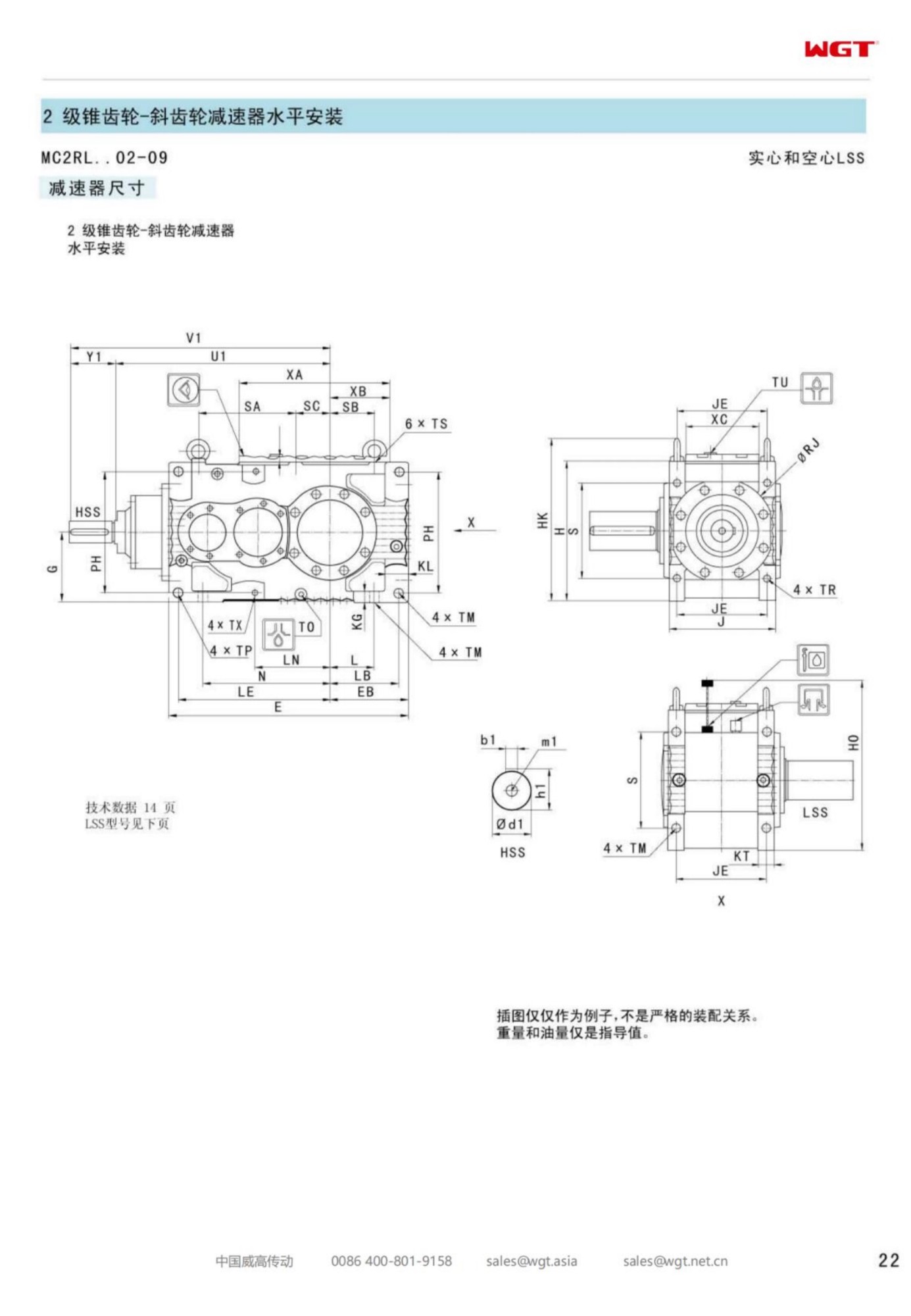
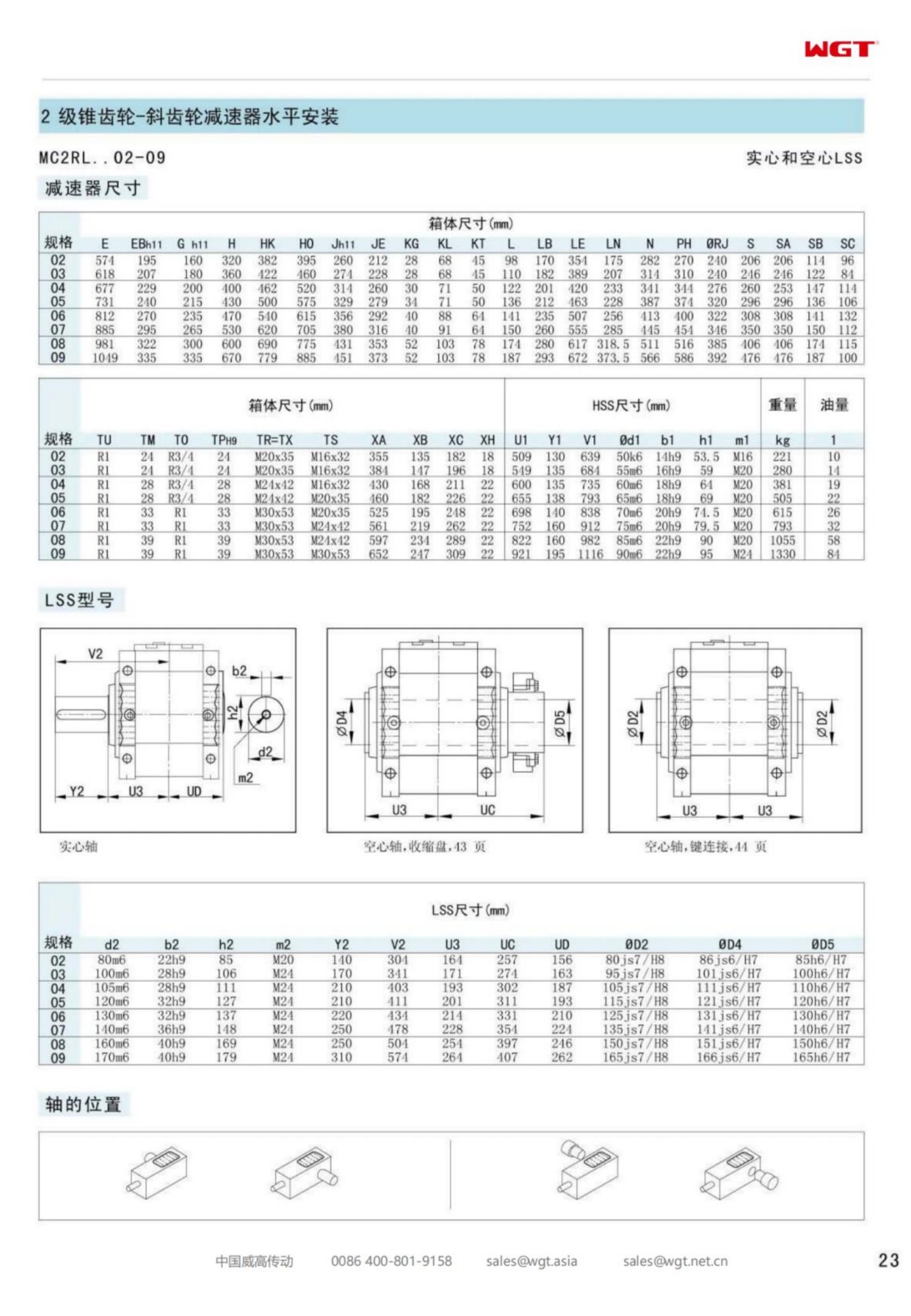
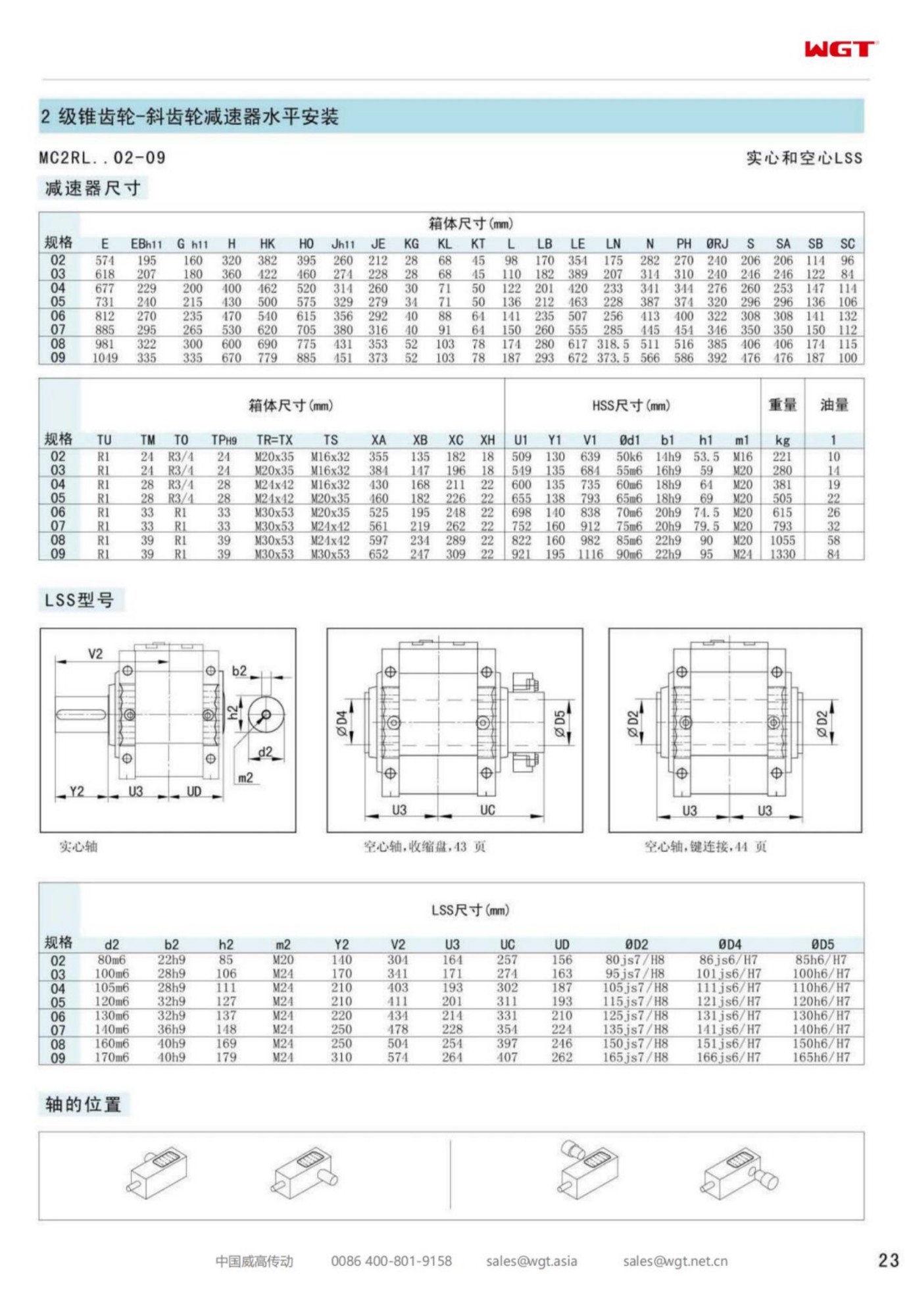
A packing hall is the last place a product is touched by a machine, and the machines there are small, fast and filthy. Screw conveyors feed the weigh hoppers, short belts carry filled bags to the palletiser, and every one of those drives lives under a layer of fine mineral powder that finds its way into anything with a gap. The MC2RLHF03 right-angle hollow shaft gear unit is the frame this family quotes into that duty: small enough for a screw conveyor end, turned ninety degrees so the motor clears the trough, and bored to sit directly on the auger shaft.
This page covers what a packing plant actually asks of a drive: how mineral dust differs from organic dust in what it destroys, why intermittent loading is harder on a small case than steady running, where wear shows first on a screw conveyor, and how to write an enquiry that a factory can answer without a site visit. Frame three adds a step of capacity over frame two and stays inside the same small-case discipline.
Frame Three in a Bagging Hall
Frame three is the rung where a packing plant stops buying the smallest unit that will do and starts buying the one it will standardise. Screw conveyors of three to six metres, bucket elevators feeding a weigh deck, and the short inclined belts that climb to a loading spout all sit in this band, often in the same building and often with the same spare parts shelf behind them.
What makes the hall demanding is not the torque. It is the combination of fine powder, vibration from the weighing equipment, and a crew whose attention is on the bag count. A drive that needs a weekly look will not get one. The frame that survives is the one whose requirements are few enough to be met by people doing something else.
Reading the MC2RLHF03 String
The type code carries the whole geometry, and each position has a consequence on site.
| MC | Industrial gear unit family built for continuous plant duty |
| 2 | Two gear stages, one helical pair and one bevel pair in a right-angle case |
| R | Right-angle layout, input shaft at ninety degrees to the output axis |
| L | Horizontal build, output axis parallel to the floor line |
| H | Hollow output bore, keyed onto the screw or head shaft |
| F | Footed housing with reaction pads for the torque bracket |
| 03 | Third frame, one step of capacity above the smallest gallery size |
What the string fixes is the shape and the mounting principle. What it leaves to the order is everything the plant knows and the catalogue cannot: the shaft it will sit on, the powder it will breathe, how often it starts, and how hot the hall gets in August. Those four answers turn a generic unit into a specified one, and they take ten minutes to write down.
Mineral Dust Is Not Organic Dust
Flour and grain dust settle and cake; cement, lime and fly ash settle and grind. The difference matters at every moving interface. A dust lip that keeps flour out of a bearing will pass a fine abrasive that then mixes with a trace of oil and becomes a lapping compound. Seals do not fail from the powder itself so much as from what the powder turns the lubricant into.
The answer is a package rather than a single part: a dust lip in front of the main seal, a breather that filters rather than merely vents, a case finish that sheds powder instead of holding it, and a wipe-down routine that treats the case top as part of the shift. Plants that buy the standard unit and then fight the dust for a decade spend more on seals than the package would have cost at order time.
Screw Conveyors and the Shaft They Turn
A screw conveyor is a simple machine with an unforgiving shaft. The auger is supported at the drive end by the gearbox bore and at the far end by a hanger bearing, and any misalignment between the two shows up as a wobble at the drive end. Because the unit hangs on the shaft rather than sitting on a bedplate, the bore's fit and the shaft's straightness become the alignment.
In practice this means three checks before the drive goes on: the shaft diameter at the seat measured rather than assumed, the keyway clean and long enough for the bore, and the trough end plate square to the shaft axis. A screw that has run for years with a worn hanger bearing will have a shaft that droops slightly, and no gearbox bore can correct that. Fixing the hanger first is cheaper than renewing the seal every quarter.
Bulk Loading Bays and Intermittent Starts
A loading bay does not run steadily. It runs in bursts timed by trucks, and each burst begins with a screw full of powder and a motor that has to break it loose. Those starts are where a small case earns its reputation, because the thermal and mechanical peaks arrive far more often than the running hours suggest. A drive sized on running torque alone will be asked for starting torque several hundred times a week.
The remedies are ordinary: a service margin chosen for the start profile rather than the average load, a soft-start or inverter ramp where the electrical supply allows, and a discharge routine that empties the trough before a long stop. Where the powder is hygroscopic, an empty trough also removes the burden of a screw that set solid overnight. Small habits, measured in minutes, and they decide whether the frame runs cool for a decade.
Abrasion, Wear and the Slow Decline
Nothing in a gearbox wears as visibly as a conveyor screw, but everything in it wears. The bevel mesh on a right-angle frame works with a sliding component, and sliding wears faster when the oil is contaminated. Fine powder that passes a tired seal does not stay in one place; it circulates, and the first place it shows is the oil colour on the dipstick.
The countermeasure is to treat the oil as an instrument. Sampling at fixed intervals, watching for the grey haze that means powder, and checking the drain plug magnet for the paste that means the mesh is polishing itself away. A drive whose oil stays clean for years is telling you the seals are doing their job; a drive whose oil turns grey in a season is telling you where next month's maintenance will go.
Cooling a Small Case in a Hot Hall
Bagging halls are hot in summer and dusty all year, a combination that works against every cooling assumption. A small case has a large surface-to-volume ratio, which helps, but only if the surface is clean. A millimetre of cement dust on a case wall is a millimetre of insulation, and on a hot day that is the difference between a comfortable sump and one that runs at the edge of its grade.
So the cleaning routine is a thermal measure as much as a cosmetic one. Where the hall is genuinely hot and the duty is continuous, the specification can go further - a higher oil grade for the ambient band, a fan-cooled motor rather than a totally enclosed one running hot, and a position for the drive that catches air movement instead of a corner behind a hopper. Each is a line on the enquiry, not a discovery to make in July.
Bolted Interfaces in a Working Hall
Packing equipment shakes. Weigh hoppers, bag placerarms and the structure that carries them all transmit vibration into anything bolted to that steel, and a gearbox bracket is no exception. Fasteners that were tight at commissioning work loose over months, and a loose reaction pad turns into a hammering load that no cast iron enjoys.
The fix is a habit rather than a product: torque marks painted on the fasteners at installation, a check on the same walk as the oil level, and washers or thread compound chosen for vibration rather than convenience. A bracket that stays tight keeps the reaction arm doing its job; a bracket that loosens quietly converts a designed load path into an impact, and impact is what cracks feet.
The Motor and the Starter Cabinet
In a dusty hall the electrical side deserves the same attention as the mechanical. A motor that ingests powder through its cooling fan blocks its own airflow within a season; a starter cabinet with a filter that nobody changes runs hotter every month; and a cable gland that was hand-tight at installation becomes the route for dust into a terminal box.
The specification that avoids all three is short: enclosure class matched to the hall's dust loading, filters on a change calendar rather than on failure, glands sized to the cable and tightened with a wrench, and terminal boxes oriented away from the discharge point. None of it is expensive. All of it is invisible until the day the drive stops for a reason that turns out to be electrical.
Condition Checks a Loader Crew Can Do
Sophisticated monitoring is available and often unnecessary on a frame this size. What works in a packing hall is a two-minute check the crew can own: listen at the case for a change in tone, put a hand on the bearing housing to feel for a step in temperature, look at the floor under the drive for fresh oil, and glance at the case top for powder build-up that has started to cake.
Four observations, recorded as a tick and a note rather than a report, catch most of what goes wrong before it becomes a breakdown. The value is not in the data but in the habit of looking: a crew that checks learns what normal sounds like, and normal is the reference every fault is measured against. Vibration analysis becomes useful the day the crew says the drive sounds different.
Writing the Enquiry for a Packing Plant
An enquiry for this frame should carry six facts and one drawing: screw or head shaft diameter, keyway and seat length; the ratio or output speed required; running power and the start profile; hours per day and starts per shift; ambient temperature and dust loading; and the reaction point available on the structure. The drawing is the shaft, dimensioned at the seat.
The reply should confirm the bore against that drawing, state the ratio and the output speed, name the oil grade for the ambient, describe the reaction arm and its bracket, and list the accessories chosen for the dust: lip seals, filtered breather, case finish. When both sides work from the same page, the unit arrives fitting the machine it was bought for, which is the only kind of arrival that stays cheap.
Ten Years of Loading Shifts
Ask a plant what it thinks of a small gearbox after a decade and the answer is never about torque. It is about whether anybody had to take it off. The units that reach ten years in a packing hall were fitted to a true shaft, bolted to steel that did not shake them loose, fed clean oil on a sensible interval, and kept under a layer of dust thin enough to see the paint.
Frame three provides the capacity for that decade without asking for attention it will not get. The rest is scheduling, and scheduling is free. In a hall where the product is leaving on a truck and every minute of the bag count is money, a drive nobody thinks about is the highest compliment a gearbox can be paid.
Fine powder, burst loading and a hall that never cools - frame three is the rung packing plants standardise:
- Screw conveyor drive under a cement weigh hopper
- Bucket elevator feed at a lime slaking and packing plant
- Fly ash transfer auger at a concrete products works
- Bag take-away belt at a dry mortar mixing line
- Reclaim screw under a gypsum storage silo
- Loading spout feed conveyor at a bulk powder terminal
How Customers Use This Unit
Steel mill transfer car
A rolling mill drives its slab transfer cars with industrial gear units mounted on torque arms. Reversing duty every few minutes is handled without complaint, and the hollow-shaft connection keeps the wheel axles free of couplings.
Rotary dryer drive
A minerals processor powers a rotary dryer with a large foot-mounted gear unit. Slow rotation with high torque is the natural duty band, and the housing stays within its temperature limits without auxiliary cooling.
What Engineers Ask Us
Can the unit be rebuilt instead of replaced?
Yes. Bearings, seals and gear sets are available as spare internals, and the horizontally split housing allows inspection and reassembly on site. Many operators overhaul units during annual shutdowns instead of buying new.
What ambient and altitude limits apply?
The standard build suits -10 to +40 degrees C at altitudes below 1,000 m with the supplied oil grade. Colder sites get synthetic oil and heaters; high altitudes or hot climates may call for the next frame size or forced cooling.
Model Table: Frames, Shafts and Duty
| Model | Centre distance | Output | Typical duty |
|---|
| M3PSF50 | size 50 | solid shaft, foot | conveyors, feeders |
| M3PSF60 | size 60 | solid shaft, foot | crushers, mixers |
| M3PSF70 | size 70 | solid shaft, foot | ball mills, shredders |
| M3PSF80 | size 80 | solid shaft, foot | kilns, heavy conveyors |
| M3PSF90 | size 90 | solid shaft, foot | mill and kiln drives |
| M3RSF50 | size 50 | solid shaft, foot, right-angle | inclined conveyors, elevators |
| M3RSF60 | size 60 | solid shaft, foot, right-angle | screw classifiers, feeders |
| M3RHF70 | size 70 | hollow shaft, foot, right-angle | agitators, drum drives |
| M3PHT80 | size 80 | hollow shaft, torque arm, parallel | shaft-mounted conveyors |
| M3RHT90 | size 90 | hollow shaft, torque arm, right-angle | heavy shaft-mounted drives |
Larger size numbers mean higher torque capacity and larger shafts. Because interfaces follow the common industrial dimensions, a size-for-size change is the normal upgrade route for these industrial units.
Selection Example: Screw conveyor drive under a cement weigh hopper
Take a 22 kW motor at 1480 rpm turning the auger shaft at 47 rpm. The ratio follows directly: 1480 / 47 = 31.5, so a ratio near i=31 is selected from the two-stage right-angle band, and the frame is confirmed against the burst-start profile of a loading bay rather than the running torque alone, with the dust package written into the order beside the ratio. In this case frame three holds the intermittent loading duty on a filtered breather, a dust lip ahead of the output seal, and an oil sampling interval set by the powder loading rather than the calendar. Note that the ratio comes from speeds alone, while the frame size depends on torque and service factor - never size a unit on ratio only.
![industrial helical gearbox selection chart]()
A quick visual of the selection sequence for a industrial helical unit.
![M3 series gear reducer installation examples]()
Application coverage of the the M3 series.
From Duty Point to Delivery in One Working Day
Stop guessing the ratio. Prefer to check the figures yourself? The WGT Motor & Gearbox Online Selection System gives you the model, torque margin and ratio before you ask us.
Tell us what the machine does and how hard it works; we calculate the ratio, apply the service factor and send back the drawing and quotation within one working day, including sea-freight and air-freight options. Looking for a gear reducer for screw conveyor? Tell us the duty point and we will confirm the model in writing.