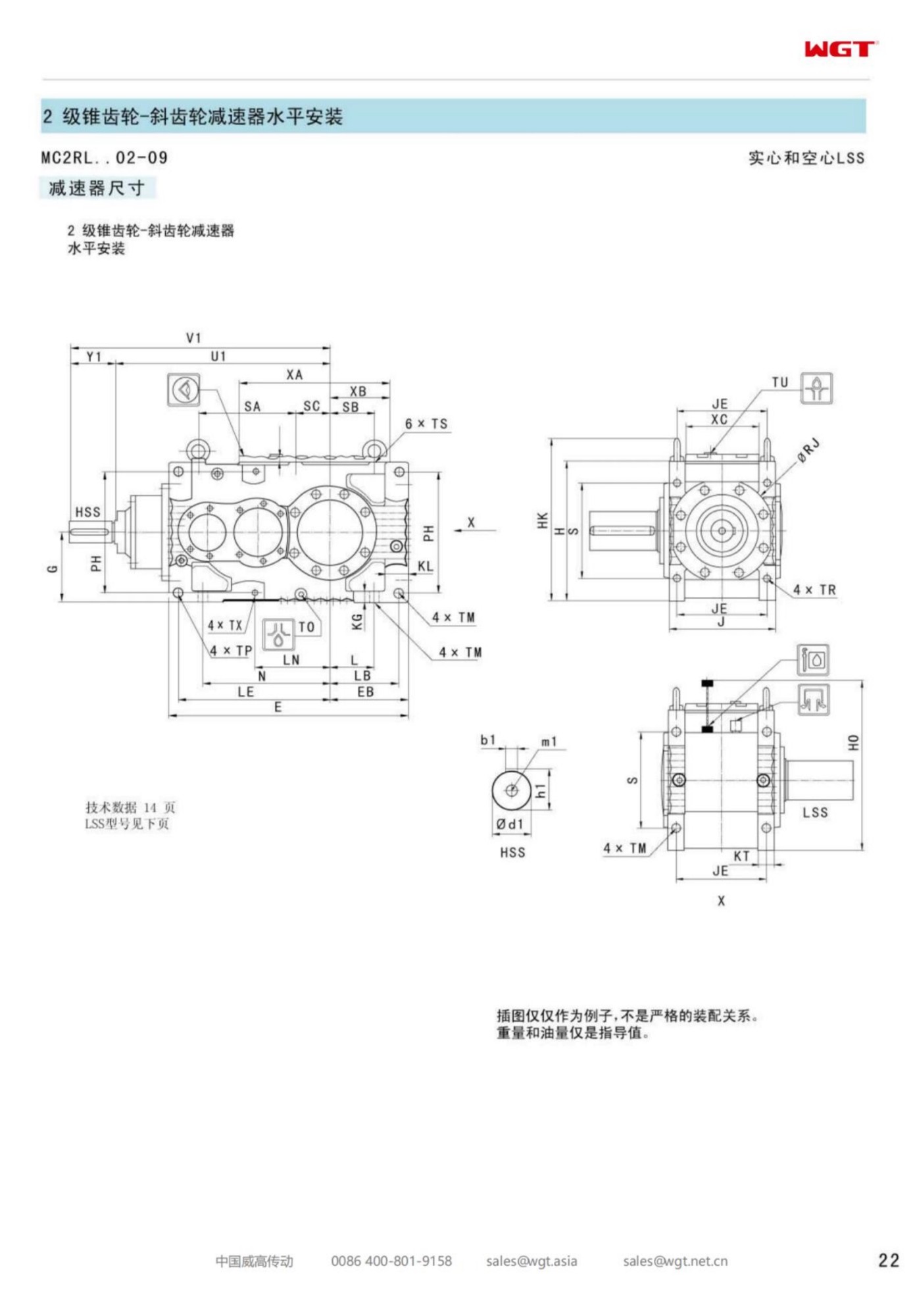
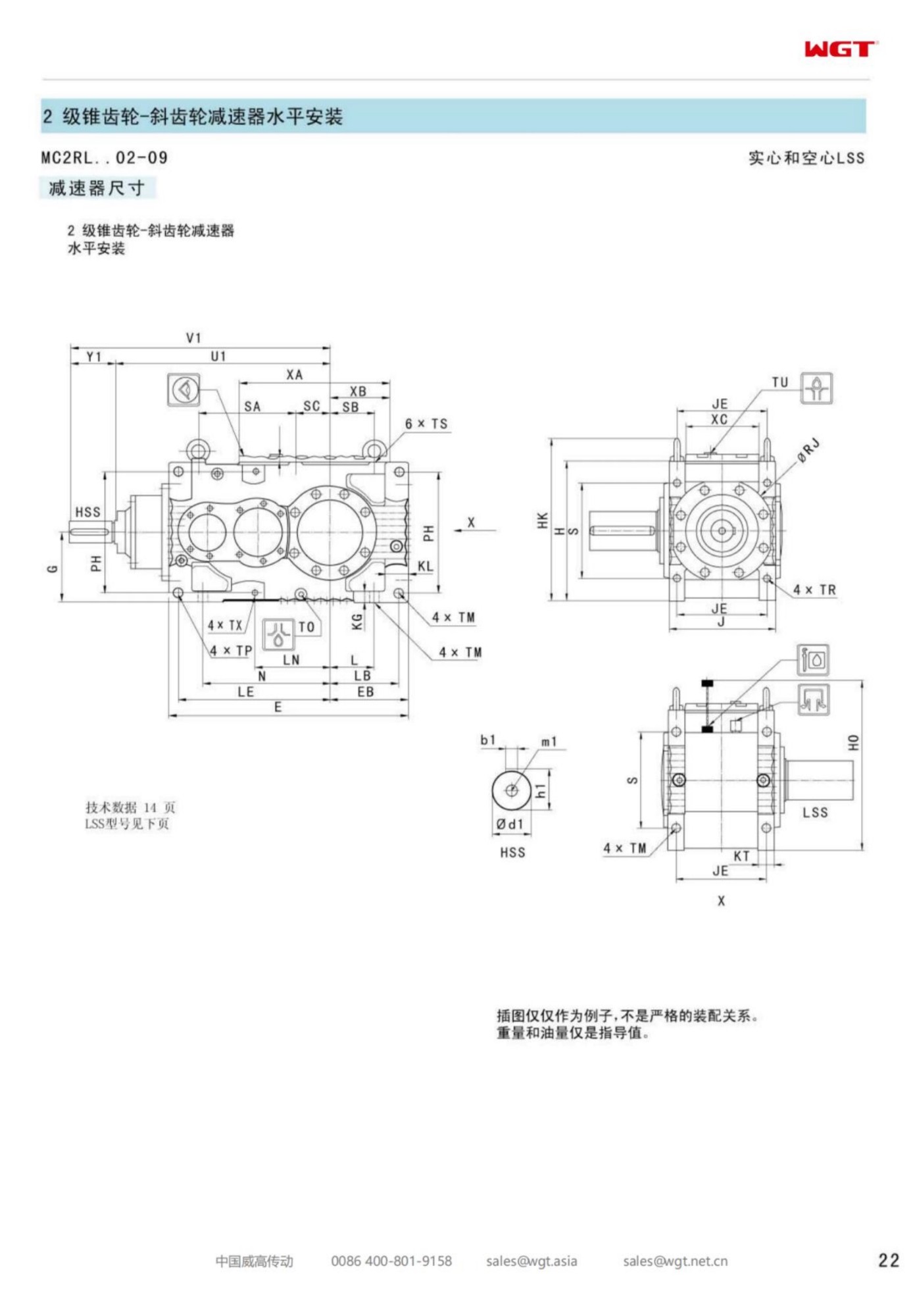
A primary crusher does not receive material, it receives whatever the blast left behind. Lumps arrive at awkward angles, the feed rate swings with the haul cycle, and the drive that carries the discharge has to survive both. The MC2RLHT09 right-angle hollow shaft gear unit is the top frame of its band, quoted for primary discharge conveyors, ore transfer runs and the stockpile belts behind them.
What follows is written for mine and quarry engineers: how shock load gets written into a service factor, why a remote site changes the spares decision, what a plugged belt does to a drive on restart, and which details on the enquiry decide whether the frame lasts a mine plan or a season.
Rock Arrives Without Manners
Designing for average tonnage is the classic mistake on a primary line. The average is a statistic produced by a month of data; the drive experiences individual lumps, individual stalls and individual restarts, each of which loads the mesh far beyond the mean.
The frame has to be chosen on the worst credible event: the largest lump the crusher can pass, the belt plug that forms at the transfer, the restart that follows. That is not pessimism, it is the only basis on which a service factor means anything.
Reading the MC2RLHT09 String
The code tells you what the unit is before the drawing does.
| MC | Industrial gear unit family for continuous plant duty |
| 2 | Two stages in the case - a helical set working into a bevel set |
| R | Right-angle build, the motor set along the conveyor frame |
| L | Level output axis, standard for head-shaft mounting |
| H | Hollow output bore keyed onto the driven shaft |
| T | Torque-arm bracket, reaction taken into the skid or structure |
| 09 | Ninth frame, the top of the bore ladder |
The letters settle geometry; the enquiry settles survival. Ore character, lump size, feed variation, restart practice, altitude, ambient range and the spares strategy all belong in the same document as the shaft dimensions.
Frame Nine at the Primary Station
Frame nine is the ceiling of the band and it is chosen where the argument for a bigger unit has run out: the discharge belt under a jaw or gyratory, the transfer that lifts ore to the stockpile, the reclaim run that feeds the mill.
At this size the case has real mass, the bevel set is substantial, and the bearings are sized to carry years of pulsing load rather than a demonstration campaign. It is not a frame bought on price; it is bought because the alternative is a stopped plant and a hired crane.
Shock Load and the Service Factor
Shock does not need to be dramatic to matter. A lump landing on a belt that is already carrying load produces a torque spike that lasts a fraction of a second and leaves a mark on the mesh, the key and the bore. Repeat it a thousand times a shift and the wear becomes a trend.
The service factor is where that reality is either captured or ignored. Argue it on the lump case and the stall case, not on the running load, and write the reasoning onto the enquiry so the next person who opens the file can see why the frame is the size it is.
Remote Sites and the Spares Shelf
A mine two hundred kilometres from the nearest supplier has a different economics from a plant in an industrial park. Every failure costs travel, every travel costs production, and the spare that was not bought becomes the most expensive part on site.
Two habits help: standardise the drives across the line so one spare covers several positions, and keep the wear items - seals, breather elements, arm pins, oil - on the shelf rather than on order. The frame that arrives with a documented parts list is worth more at a remote site than a cheaper unit with no paperwork.
Belt Plugging and the Restart Argument
A plugged transfer stops the belt with the drive still trying. The protection should trip before the drive becomes the fuse, and the restart procedure should be a written step rather than a hopeful press of the button.
Restarting against a full belt is the single most damaging event in the life of a primary drive. Where the plant cannot guarantee a cleared belt, the frame and the service factor have to carry the difference - and the control philosophy should be reviewed as part of the drive specification, not left to the electrical contractor.
Torque Arm on a Modular Skid
Primary stations are often built as skids that can be relocated when the ore body moves. That makes the torque arm a structural question again: the reaction has to go into a member that was designed for transport as well as for running.
Pick a main beam rather than a brace, keep the stay square to the reaction, and check the bracket welds after every relocation. A skid that has been lifted, trucked and set down is not the same structure it was at the works, and the arm bracket is where that shows first.
Dust, Grit and the Seal Path
Ore dust is abrasive in a way that agricultural dust is not. It works into the seal path, polishes the shaft under the lip, and turns a sealing problem into a shaft repair.
A dust lip ahead of the main seal, a sealed bore, and a breather routed to a clean point are the three measures that matter. Where the shaft is already worn, a wear sleeve is a cheap intermediate step that buys time until the next planned outage rather than forcing an unscheduled one.
Heat, Altitude and the Cooling Margin
High sites cool better and breathe worse. Air density falls with altitude, fan performance falls with it, and a drive that was thermally comfortable at sea level can be marginal at fifteen hundred metres, particularly in a closed transfer house.
Declare the altitude and the enclosure on the enquiry. Where the margin is tight, an oil grade with a wider working band and a clean case surface do more than an oversized fan, and both are decisions that cost nothing if they are made at the order stage.
Oil Analysis as a Maintenance Tool
On a primary drive, oil analysis is the cheapest instrument on site. Wear metals tell you the mesh is behaving, water tells you the breather is working, and viscosity tells you whether the oil is still the oil that was specified.
Sample on a fixed interval, keep the history, and act on trends rather than single readings. A plant that has twelve samples can see a bearing starting to go; a plant that has one knows only that the oil was changed.
Writing the Enquiry for a Primary Drive
The enquiry that gets this frame right names the ore, the lump size, the feed variation, the belt speed and centres, the shaft condition, the structure available for the stay, the restart practice, the altitude, the ambient range and the spares policy.
The reply should answer as a system: bore and key against the drawing, ratio and belt speed, service factor argued on the lump and stall cases, seals and breather for abrasive dust, oil chosen for the site, arm geometry drawn against the skid, and a parts list with wear items named. One document, and the drive stops being a gamble.
A Frame Nine Through the Mine Plan
Mine plans run in years, and drives are judged against them. The units still working at the end are the ones whose oil was sampled, whose bores stayed tight, whose brackets were checked after each move, and whose spares were on the shelf before they were needed.
Frame nine carries the load side of that bargain with mass, margin and a mesh that does not care about the average. The site carries the rest. Between the two, a primary line can run to the plan instead of to the next breakdown.
Lumps, stalls and restarts that set the service factor - frame nine holds the primary line:
- Primary crusher discharge belt at an open-pit mine
- Ore transfer conveyor lifting to the coarse stockpile
- Apron feeder take-away belt behind a jaw crusher
- Reclaim belt feeding the primary mill circuit
- Overland conveyor head drive at a satellite ore body
- Waste rock transfer belt on a modular crushing skid
The M3 Series at a Glance
| Model | Centre distance | Output | Typical duty |
|---|
| M3PSF50 | size 50 | solid shaft, foot | conveyors, feeders |
| M3PSF60 | size 60 | solid shaft, foot | crushers, mixers |
| M3PSF70 | size 70 | solid shaft, foot | ball mills, shredders |
| M3PSF80 | size 80 | solid shaft, foot | kilns, heavy conveyors |
| M3PSF90 | size 90 | solid shaft, foot | mill and kiln drives |
| M3RSF50 | size 50 | solid shaft, foot, right-angle | inclined conveyors, elevators |
| M3RSF60 | size 60 | solid shaft, foot, right-angle | screw classifiers, feeders |
| M3RHF70 | size 70 | hollow shaft, foot, right-angle | agitators, drum drives |
| M3PHT80 | size 80 | hollow shaft, torque arm, parallel | shaft-mounted conveyors |
| M3RHT90 | size 90 | hollow shaft, torque arm, right-angle | heavy shaft-mounted drives |
All frames in the table belong to one industrial family. P = helical parallel-shaft, R = bevel-helical right-angle; the low-speed shaft is solid (S) or hollow (H), mounted on feet (F) or a torque arm (T).
Selection Example: Primary crusher discharge belt at an open-pit mine
Take a 55 kW motor at 1485 rpm turning the belt at 30 rpm. The ratio follows directly: 1485 / 30 = 49.5, so a ratio near i=50 is taken from the two-stage right-angle band, and the service factor is set on the largest lump the crusher can pass and on the restart after a plugged transfer, which is the event that actually decides the frame. In this case frame nine is the top of the band: a stiff case for shock duty, a sealed bore onto a shaft that may already be dressed, and a wear-parts list that suits a site far from the nearest supplier. That single division gives the catalogue ratio; the service factor for your duty class is then applied to the torque, and the frame size follows.
![how to size a industrial helical gearbox in four steps]()
Sizing flow: motor speed, target output speed, torque, service factor.
Where This Series Works in Practice
Glass batch charger
A float-glass line drives its batch charger with units. Abrasive raw material demands a robust drive, and the case-hardened gears show minimal wear after years of continuous operation.
Battery slurry mixer
A battery materials plant uses reducers on slurry mixers. High shear loads are absorbed by the 42CrMo shafts, and the 94-96% efficiency keeps motor sizing and running cost down.
Technical Questions, Answered
Can the gear unit hold a load on an inclined conveyor?
For inclined belts a backstop prevents the loaded belt from driving the unit backwards when power is cut. Specify the incline angle when ordering so the backstop and the oil level are matched to the actual mounting position.
What is the difference between foot and torque-arm mounting?
Foot mounting bolts the housing to a foundation and suits most fixed installations. A torque-arm lets the housing swing on the driven shaft, so no base frame is needed - common on shaft-mounted conveyors where the reaction rod absorbs the torque.
![industrial helical gear reducer application fields]()
Common application areas for right-angle industrial helical drives.
From RFQ to Dispatch - One Account Manager
Tired of chasing suppliers? Skip the back-and-forth: configure your drive in the WGT Motor & Gearbox Online Selection System and send us the result for a same-day quotation.
One account manager follows your enquiry from selection to dispatch, with lead times and test dates confirmed in writing. Urgent unit needs and project volumes are handled on the same route. Looking for a gear reducer for screw conveyor? Tell us the duty point and we will confirm the model in writing.