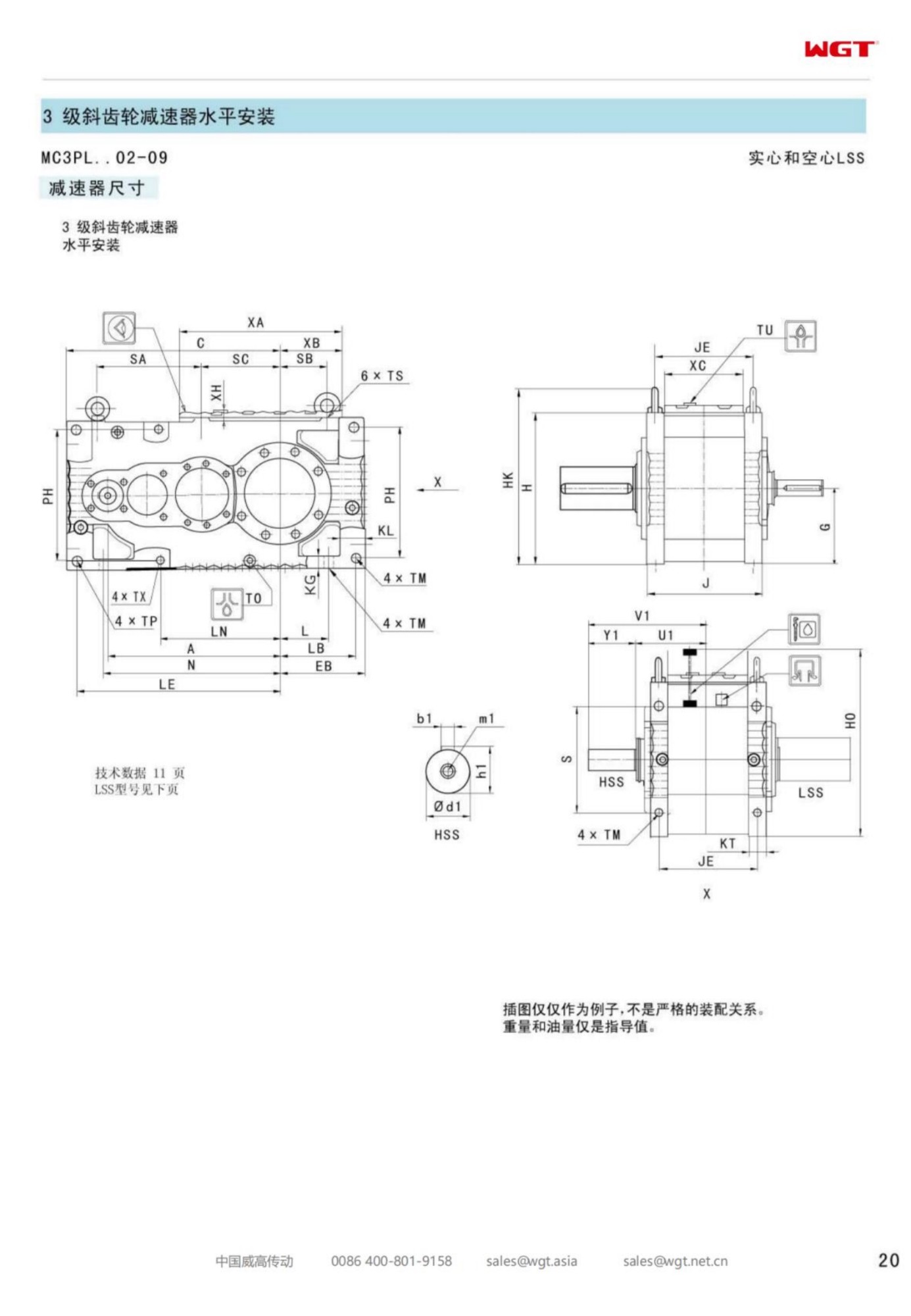
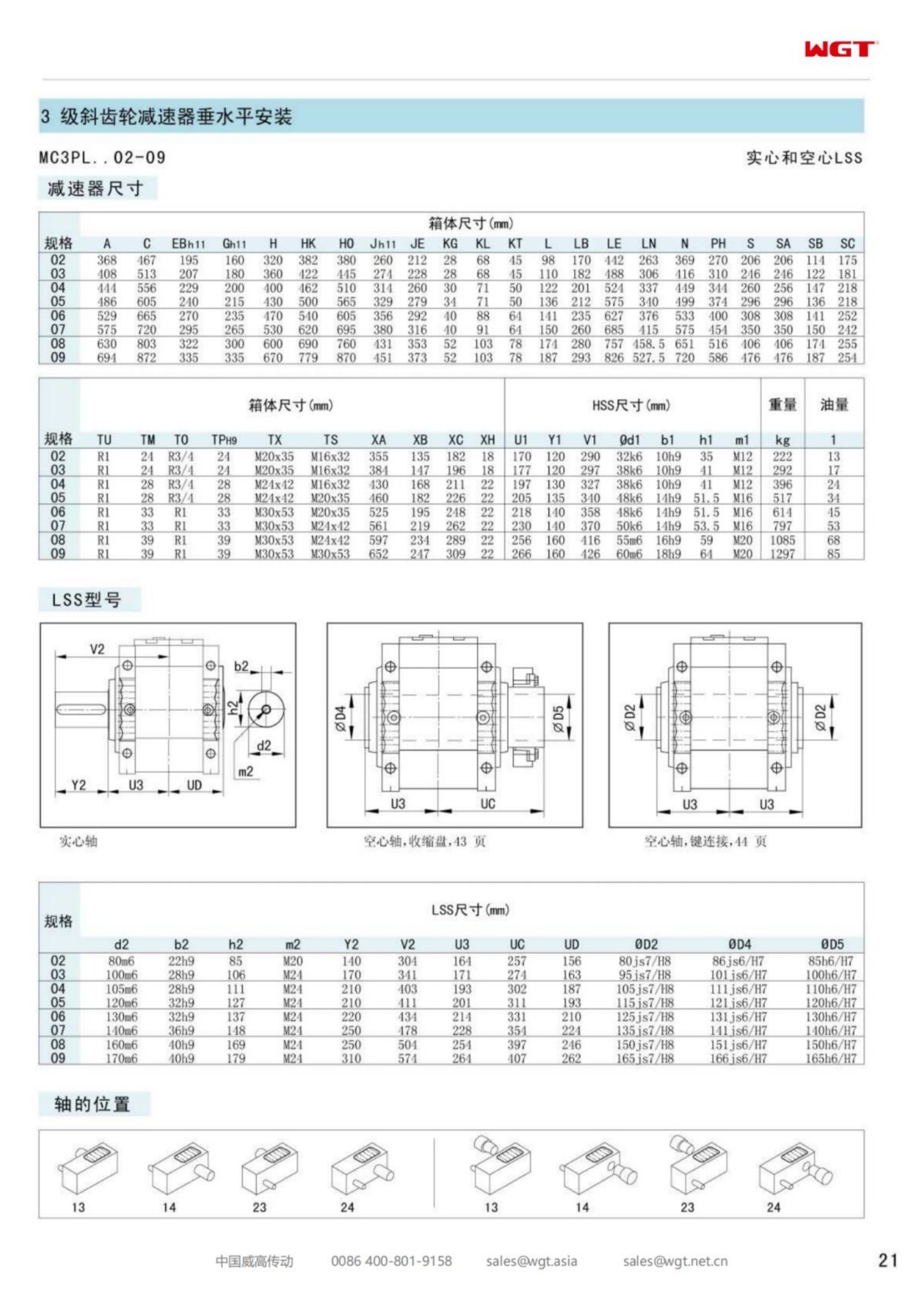
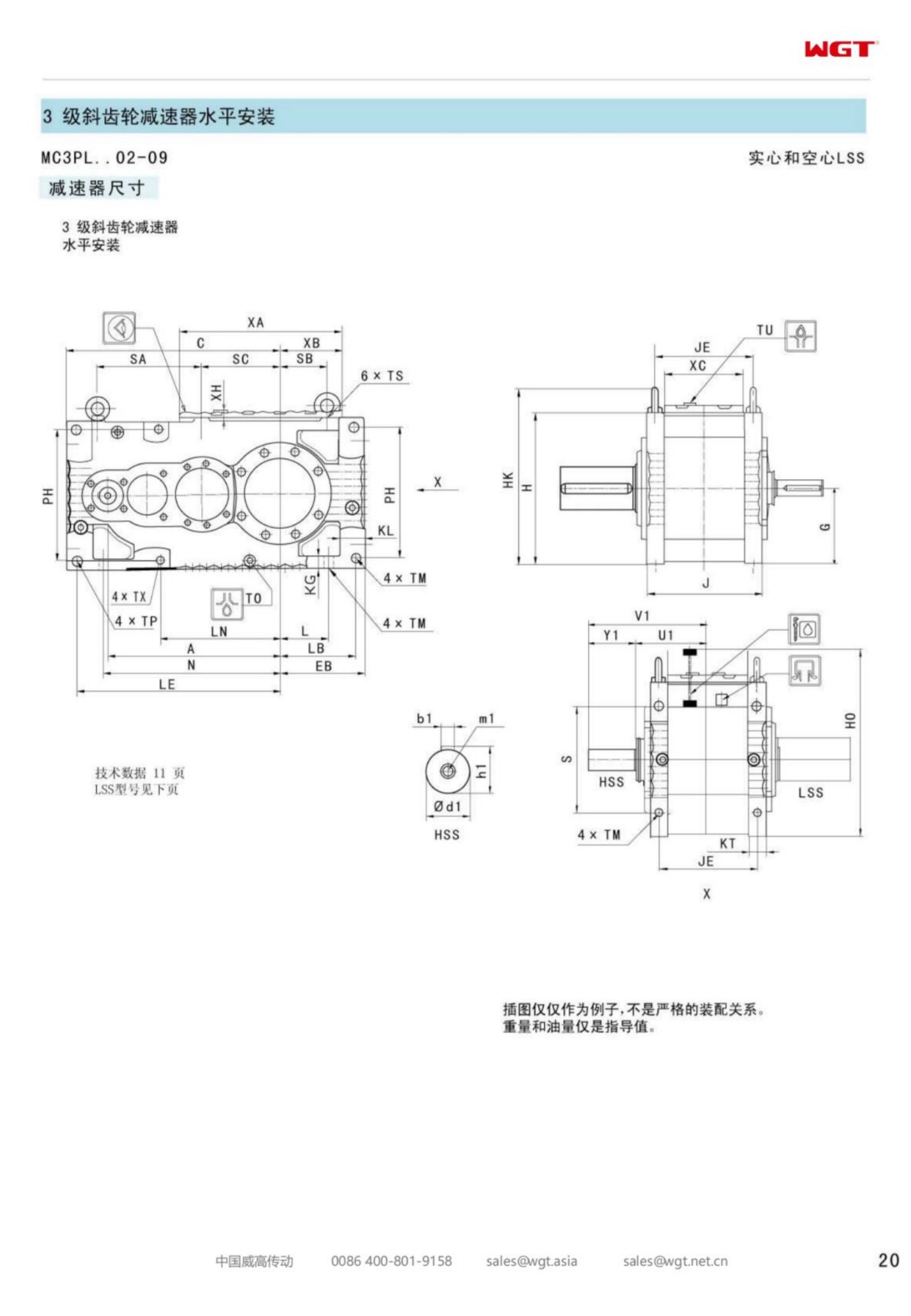
Quicklime does not forgive a lazy mixer. Feed it water and it rewards whoever stirs it with steam, caustic slurry and a paddle shaft that would seize solid if the agitation ever stopped. Water treatment plants and reagent rooms therefore run their slaking mixers continuously at slow speed, on shafts that pass through the tank end wall. The MC3PLHF03 three-stage parallel shaft gearbox was drawn for exactly that seat: a foot-mounted case with a hollow output bore that carries the paddle shaft directly, and three helical stages turning motor speed down to mixer pace.
The sections below set out what the designation fixes, how the hollow bore and the foot mounting share the work, and what a reagent-room buyer states on the enquiry so the quotation needs no second round.
Slaking Is a Rough Business
A slaking mixer looks gentle and is not. Lime lumps break up under the paddles, steam comes off the batch, and the shaft load swings with every feed variation. The drive sees that variation as slow, heavy torque with sharp little peaks - a profile that suits a helical three-stage train far better than any belt or chain arrangement would.
The MC3PLHF03 Name, Letter by Letter
Each position of the code is a layout decision already made.
| MC | Industrial gear unit family for continuous plant duty |
| 3 | Three stages of reduction in one housing |
| P | Parallel-shaft helical gearing, input and output in line |
| L | Level output axis into the paddle shaft |
| H | Hollow output bore over the mixer shaft |
| F | Foot mounting on the mixer bridge or plinth |
| 03 | Second frame of the three-stage band |
Put simply: the case bolts down beside the tank, the paddle shaft slides through the bore, and the mixer is driven without a coupling, a guard or a pedestal bearing on the wet side.
Hollow Bore on a Paddle Shaft
The bore carries the shaft straight through, so the shaft keeps one line from the drive to the paddles and the outboard bearing does the rest. Removal for paddle service becomes a clamp-and-lift job rather than a coupling alignment project - a difference the maintenance crew notices every single shutdown.
Why Three Stages Fit a Mixer Duty
Mixer speeds sit low, and the ratio to get there from a four-pole motor is deep. Spread over three meshes, each stage works near its best geometry, the case stays short enough for a reagent room, and the train turns with the calm a steam-wetted shaft deserves.
Wet Lime, Steam and the Paint System
Slaking air eats standard finishes. The case paint, the breather position and every fastener near the tank should be specified for a humid, alkaline atmosphere, and the breather should sit where condensate cannot run back into the sump. None of this is exotic; all of it is settled at order time.
Foot Mounting on the Mixer Bridge
Foot mounting puts the reaction into the bridge deck, which usually has metal to spare - but the deck must be flat and the shims honest, because a twisted case loads the output seal off-centre and shortens its life for no mechanical reason. A half-day of alignment care at installation buys years of seal service.
Breakaway Torque in a Settled Bed
After a stoppage, lime settles into something closer to masonry than slurry. The first restart therefore asks for several times running torque, and the frame is selected against that figure with the service factor the site applies. Plants that purge the mixer before stopping rarely need the extra margin, but the enquiry should say which habit the plant keeps.
Seal Choices Around Slaked Lime
The output seal works in steam and alkaline dust. Standard lip seals serve when the environment around the seal collar is kept clean and greased; a plant that washes the deck down daily should say so, because the specification then changes toward protected or labyrinth arrangements rather than a bare seal in the spray path.
Running Slow Without Overheating
A continuously turning mixer never cools, and reagent rooms are warm. The thermal check belongs at the true room ambient with the true continuous torque, not at catalogue values - a five-minute confirmation that the second-frame case sinks its own heat, or an honest decision to step a frame up.
Sizing the Frame to the Batch Profile
Batch and continuous slakers ask different things: a batch duty lives on breakaway, a continuous duty on steady thermal load. Stating which one the plant runs - and the paddle shaft speed it needs - lets the frame be confirmed against the right limit instead of the generic one.
The Enquiry for a Slaking Drive
A complete first message carries the paddle shaft diameter and keyway, the required shaft speed, the motor frame, the true ambient, the wash-down habit and the restart assumptions. A photograph of the bridge seat and shaft entry finishes it. That enquiry returns a complete quotation, and the installation starts without correspondence.
HF03 Through the Maintenance Cycle
Service on this unit is deliberately dull: oil checks from the walkway, seal inspections with the paddle lifted clear, and a breather that stays clean. A reagent drive that never makes the maintenance meeting is the one doing its job, which is precisely what the hollow-bore, foot-mounted three-stage build is for.
Lime, steam and a paddle shaft that binds on start - three stages hold it:
- Paddle mixer shaft on a quicklime slaking plant
- Reagent preparation mixer at a water treatment works
- Slurry holding tank agitator in a reagent room
- Lime milk tank stirrer on a dosing line
- Small batch slaker drive in a paper chemical plant
- Grit chamber paddle mechanism on a treatment train
Full Frame Range of the M3 Series
| Model | Centre distance | Output | Typical duty |
|---|
| M3PSF50 | size 50 | solid shaft, foot | conveyors, feeders |
| M3PSF60 | size 60 | solid shaft, foot | crushers, mixers |
| M3PSF70 | size 70 | solid shaft, foot | ball mills, shredders |
| M3PSF80 | size 80 | solid shaft, foot | kilns, heavy conveyors |
| M3PSF90 | size 90 | solid shaft, foot | mill and kiln drives |
| M3RSF50 | size 50 | solid shaft, foot, right-angle | inclined conveyors, elevators |
| M3RSF60 | size 60 | solid shaft, foot, right-angle | screw classifiers, feeders |
| M3RHF70 | size 70 | hollow shaft, foot, right-angle | agitators, drum drives |
| M3PHT80 | size 80 | hollow shaft, torque arm, parallel | shaft-mounted conveyors |
| M3RHT90 | size 90 | hollow shaft, torque arm, right-angle | heavy shaft-mounted drives |
Every frame in the table can be ordered with alternative shaft and mounting styles. If you are matching an existing installation, send the nameplate details and we confirm the equivalent frame in writing.
Installation Snapshots
Pet-food extruder feeder
A pet-food plant chose reducers for the feeder screws ahead of its extruders. Steady torque at variable output speed keeps the kibble size consistent, and washdown sealing protects the unit during sanitation shifts.
Ceramic tile press feeder
A ceramic tile producer fitted reducers to press feeders. The dusty environment is handled by sealed housings, and the stable low-speed output stops the tile blanks shifting before pressing.
Selection Example: Paddle mixer on a quicklime slaking plant
Take a 7.5 kW motor at 1450 rpm turning the paddle shaft at 21 rpm. The ratio follows directly: 1450 / 21 = 69, so a ratio near i=70 is selected from the three-stage parallel band, and the frame is confirmed against the breakaway of a settled lime bed rather than against the running mixing torque. In this case frame three stirs the batch from a case bolted to the mixer bridge, carries the paddle shaft through a hollow bore, and runs its seal plan for steam and alkaline dust. Use the same method for any frame in the series, then confirm the service factor with us - it is the one number buyers most often get wrong.
![speed reducer selection process diagram]()
The selection path we follow when checking your enquiry.
Technical Q&A
Which lubrication system does the unit use?
Small and medium frames run on splash lubrication with mineral or synthetic oil. Larger frames or high ambient temperatures can be ordered with forced-feed circulation and cooling coils; the lubricant grade is stated on the nameplate and in the manual.
How often should the oil be changed in heavy duty?
With mineral oil, plan an initial change after the running-in period and then roughly every 5,000 hours. Synthetic oil stretches the interval to around 10,000 hours. Hot environments, dust or frequent starts shorten the interval - we advise the schedule with the quotation.
![speed reducer use cases across sectors]()
Typical installation environments for this gearbox family.
Sample Units Available for Performance Testing
Validating before you commit? One screen in the WGT Motor & Gearbox Online Selection System is usually enough to pin down the frame size; we confirm the service factor afterwards.
Sample units can be supplied for bench or field testing so your team can confirm noise, temperature rise and backlash before a production order. Tell us the test conditions and we will prepare the documentation. Looking for a gear reducer for food processing machine? Tell us the duty point and we will confirm the model in writing.