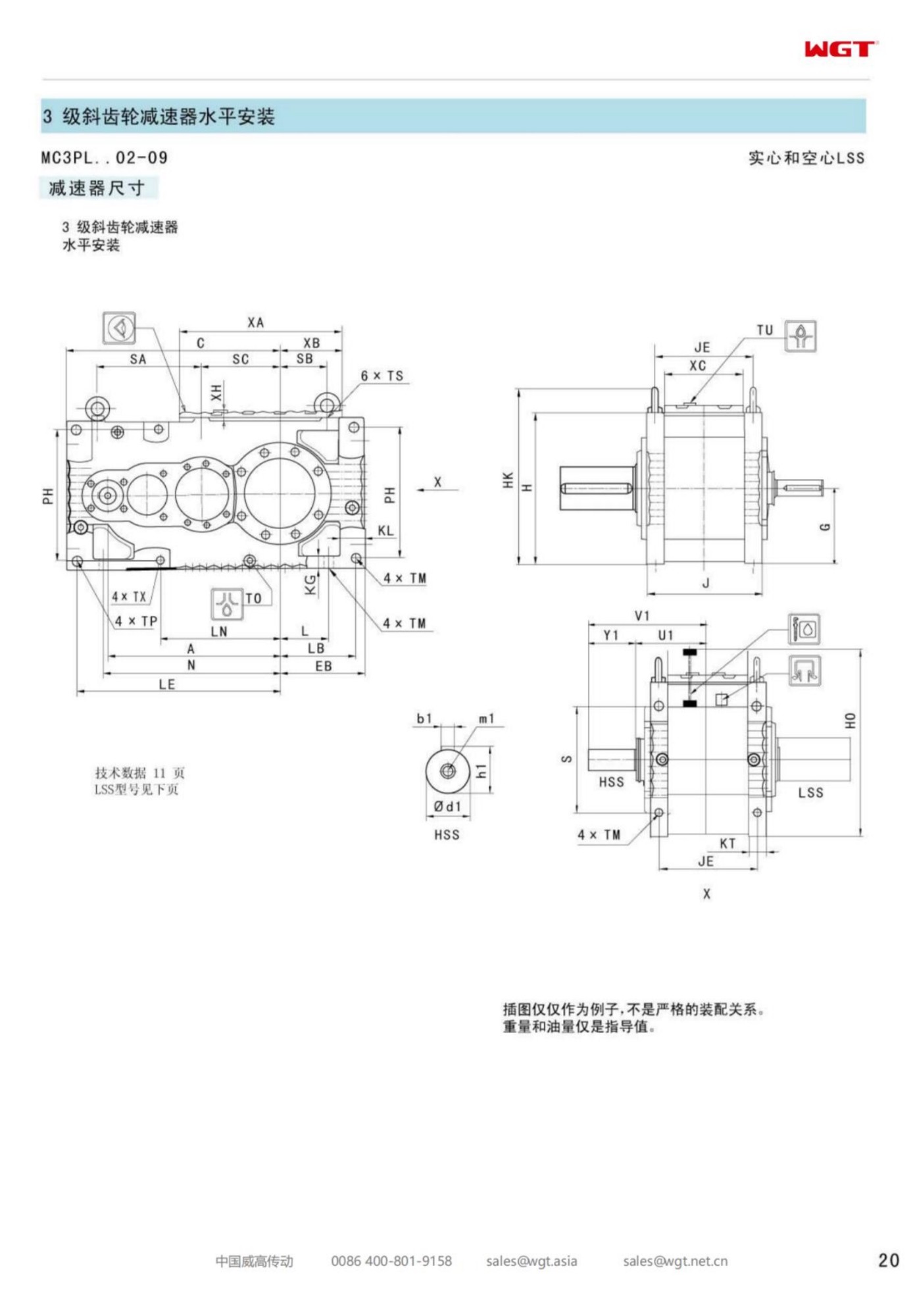
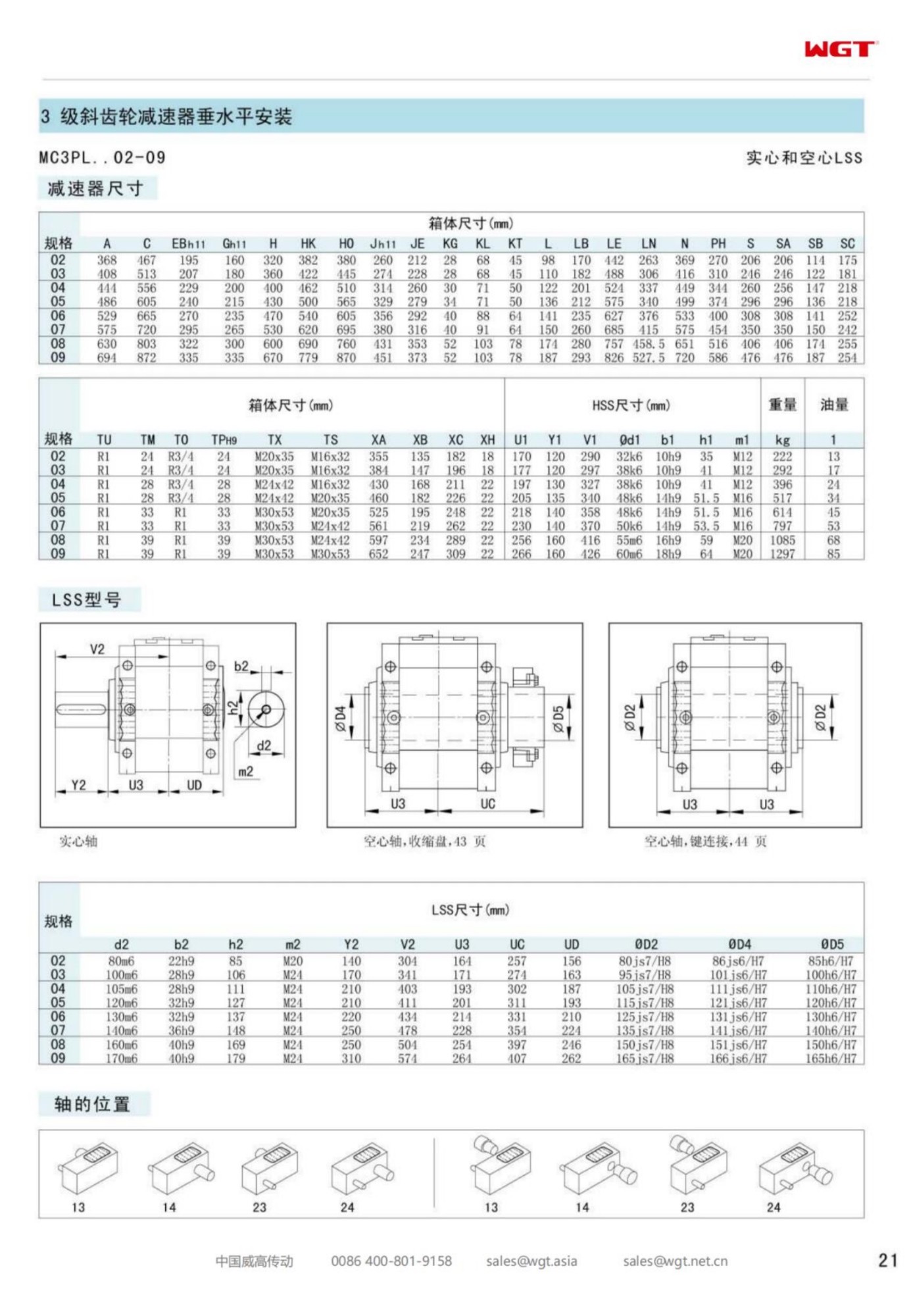
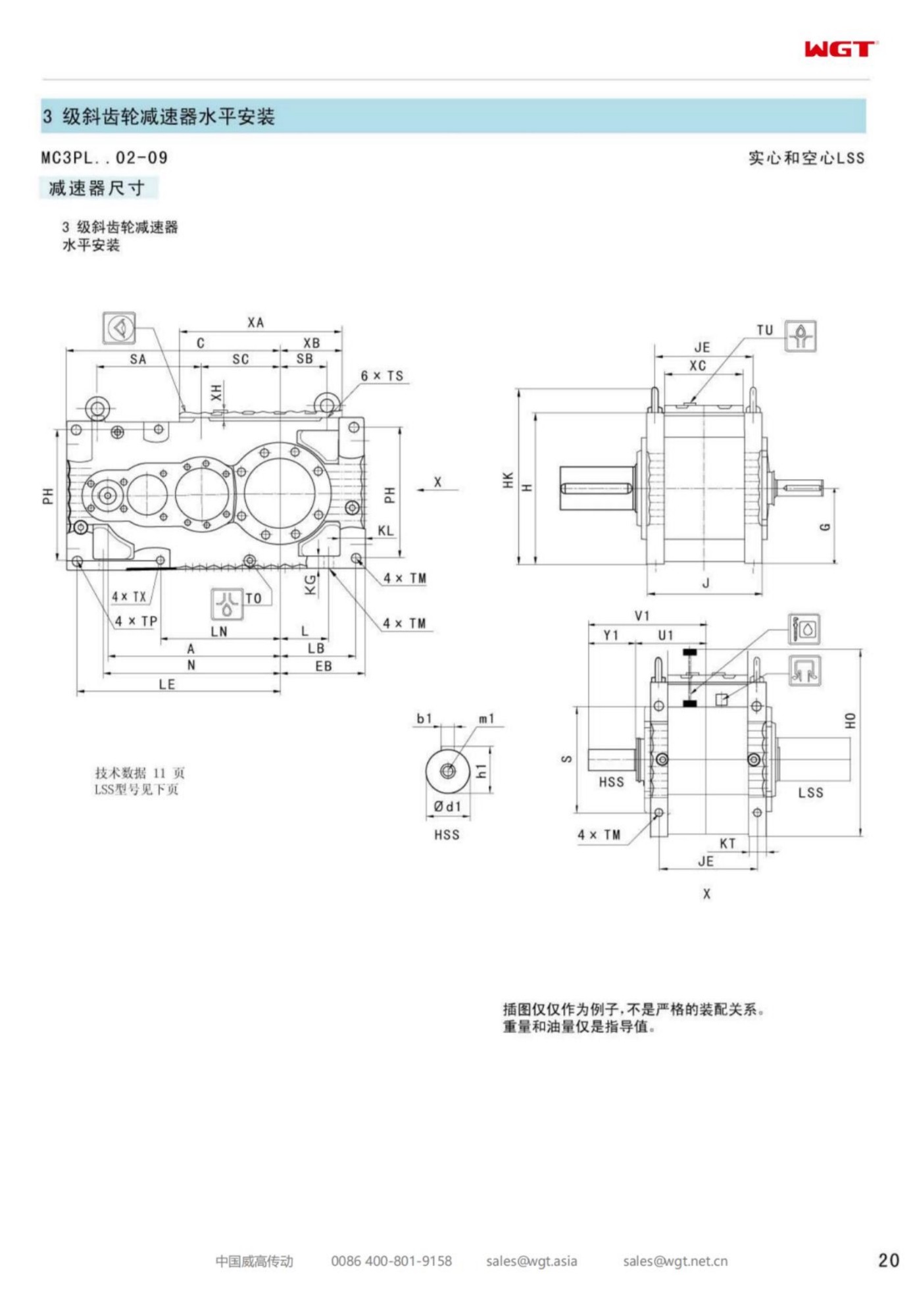
The MC3PLSF03 parallel shaft gear unit is the frame most three-stage enquiries actually land on. It is one step above the smallest casting in the line, and that single step is usually enough to cover the duty with a service factor that leaves the unit comfortable rather than merely adequate. Screw conveyors, bucket elevators, small drum dryers and reactor agitators form the bulk of its working life.
The architecture is the same as every other frame here: three helical meshes laid out in one plane, a footed cast case, a solid keyed output shaft and a motor mounted alongside on a common bedplate. What changes from the 02 is material in the case walls, face width on the gears and the size of the output bearing set. Those are the differences that decide whether a drive survives a jam, a restart or a season of slightly heavier material than the specification assumed.
Where the 03 Sits in the Three-Stage Family
Frame steps are small on a drawing and noticeable on a plant floor. Moving from the 02 to the 03 buys a wider centre distance and a heavier output shaft, which together move the thermal ceiling up and make the unit far less sensitive to an ambient that turns out hotter than the site survey suggested. It also buys margin against starting torque, and that margin is what most buyers are actually purchasing when they choose the larger frame.
There is a practical argument on top of the technical one: fasteners, seals and oil grade are shared across the range, so a store room built around this line does not need a separate shelf for each frame. Maintenance crews learn the routine once and apply it to every unit in the plant, which is worth more over ten years than the price difference between two neighbouring frames.
Reading Each Field of the Type Code
The code carries the specification, provided it is read in sequence rather than treated as a part number.
| MC | Compact industrial gear unit, multi-stage helical design |
| 3 | Three stages, selected when the ratio sits beyond a practical two-stage band |
| P | Parallel shaft geometry, keeping the drive low and long instead of tall |
| L | Heavy section case with cast feet and a generous inspection opening |
| S | Solid keyed output shaft sized for a slow, high-torque machine |
| F | Foot mounted for a horizontal bedplate |
| 03 | Second frame in the three-stage range, with wider gear faces than the 02 |
Ratio and mounting position sit outside the string and both change the drawing. Where the unit has to land on an existing bedplate, add the drawing number of the old unit and the shaft dimensions actually measured on site; a measurement taken with a caliper beats a dimension copied from a forty-year-old manual.
Torque, Service Factor and the Cost of Being Too Thin
Three numbers decide the frame: motor speed, required output speed and absorbed torque. Divide the first by the second for the ratio, multiply the third by the service factor the duty class demands, and compare the result with the rating table. The comparison is where discipline matters, because the service factor is the one figure buyers most often understate.
A conveyor that is always emptied before starting can live with a modest factor. The same conveyor with a loaded belt, a history of jam clears, or a shift pattern where a stoppage costs more than a gearbox, needs a larger one. The 03 is usually the frame that absorbs the higher factor without pushing the unit to its thermal limit, and that is precisely why so many enquiries settle here instead of one step lower.
Ambient belongs in the same arithmetic. A unit standing in still, warm air inside a closed gallery loses cooling capacity compared with the same unit on an open frame outdoors. State the site conditions plainly and let the factory apply the correction on paper, rather than discovering the shortfall in service.
Installations That Favour This Frame
Through-shaft positions this vertical build is specified into:
- Trough screw conveyors moving damp sand and foundry moulding material
- Bucket elevators on fertiliser blending and bagging towers
- Rotary drum dryers in mineral processing pilot plants
- Agitator drives on paint, resin and adhesive reactors
- Belt feeders under small hoppers at quarry screening stations
- Chain conveyors handling wood chips at panel board mills
These are duties where the drive is expected to run for years with routine attention and no heroic intervention. That expectation is exactly what a frame of this size is built to meet, and it is the honest reason to choose it over a smaller casting that would also, on paper, carry the running load.
Coupling Choice and Shaft Loading
The output shaft is designed for torque and for the bending that a coupling imposes, not for the bending that a tight chain or an over-tensioned belt imposes. Where the driven machine connects through a chain sprocket mounted well out on the shaft, the overhung load has to be calculated and compared with the permitted value at that distance. Ignoring it is the most common way a correctly sized gearbox still loses a bearing early.
A flexible coupling absorbs the small misalignments that remain after installation and keeps them out of the output bearing. A rigid coupling does not, and should only be used where the two machines are on a common machined bedplate and alignment has been recorded. Where a shrink disc or a keyless fit is preferred, the shaft tolerance and the clamping range belong on the enquiry, because those details decide whether the hub can be fitted at all.
Noise, Temperature and What Normal Looks Like
A helical unit at this size should run with a steady, low hum and a sump temperature that settles rather than climbs. Establish the baseline in the first week: sump temperature, bearing housing temperatures at the same three points, and a note of load at the time of reading. Without a baseline, every later reading is a guess.
What deserves attention is change, not absolute numbers. A temperature that rises twenty degrees with an unchanged load points at oil condition, cooling surface or breather. One warm bearing points at alignment or preload. A whine that appears only in a narrow load band points at mesh contact and is worth recording with the load at which it starts. None of these require the unit to be opened to identify, and all of them are cheaper to act on before a shutdown is forced.
Assembling a Complete Technical Enquiry
An enquiry that arrives complete is quoted once. Send the motor rating, speed and starting method; the required output speed and the tolerance band; the absorbed torque or power at the driven machine; the duty pattern including starts per hour and whether the machine can be emptied before starting; the mounting position and available height; the coupling type and any overhung load; shaft and bore dimensions where existing hardware is reused; ambient temperature, altitude, dust and washdown conditions; and the paint, nameplate and documentation requirements.
With that in hand the frame, ratio and option set can be fixed in one exchange. The quotation then becomes something a project can order from, rather than something that has to be negotiated a second time after the technical review.
Model Range and Centre Distances
| Model | Centre distance | Output | Typical duty |
|---|
| M3PSF50 | size 50 | solid shaft, foot | conveyors, feeders |
| M3PSF60 | size 60 | solid shaft, foot | crushers, mixers |
| M3PSF70 | size 70 | solid shaft, foot | ball mills, shredders |
| M3PSF80 | size 80 | solid shaft, foot | kilns, heavy conveyors |
| M3PSF90 | size 90 | solid shaft, foot | mill and kiln drives |
| M3RSF50 | size 50 | solid shaft, foot, right-angle | inclined conveyors, elevators |
| M3RSF60 | size 60 | solid shaft, foot, right-angle | screw classifiers, feeders |
| M3RHF70 | size 70 | hollow shaft, foot, right-angle | agitators, drum drives |
| M3PHT80 | size 80 | hollow shaft, torque arm, parallel | shaft-mounted conveyors |
| M3RHT90 | size 90 | hollow shaft, torque arm, right-angle | heavy shaft-mounted drives |
Frame sizes in this series follow a widely used industrial dimension ladder: foundations, couplings and guards of the existing installation are reused as they are.
Proven Installations
Stacker-reclaimer travel drive
A bulk terminal drives the travel gear of a stacker-reclaimer with units. Long-travel duty with frequent direction changes is smoothed by the ground gearing, and backlash stays within 20 arcmin over the full rail length.
Automatic parking system
A parking equipment manufacturer uses reducers on its puzzle-type car stackers. The hollow shaft takes the drive axle directly, and the quiet 60-68 dB operation suits installations inside residential buildings.
![gearbox applications in quarry food and water plants]()
Conveyor, mixer, crusher and wastewater duties share the same gear family.
Selection Example: Trough screw conveyor moving damp foundry sand
Take a 15 kW motor at 1475 rpm turning the screw shaft at 17 rpm. The ratio follows directly: 1475 / 17 = 86.8, so a ratio near i=87 is drawn from the three-stage band and the absorbed power is compared with the 03 rating at the service factor the foundry duty demands. In this case the wider gear faces of the 03 absorb the surge that a flooded screw produces on restart, so the unit is not living at its thermal limit every time the trough comes up full. Motor speed over target speed gives the ratio; the driven machine decides the service factor, and the two together decide the model.
![industrial gear unit sizing procedure diagram]()
The four inputs the online selector asks for.
Engineering Support Before You Buy
Unsure about the frame size? Work out the ratio, torque and frame size yourself with the WGT Motor & Gearbox Online Selection System, then send the result - we confirm it in writing.
Our selection engineers check every enquiry against the rating tables, including shock class and daily running hours. You get the calculation, not just a part number - at no charge and with no obligation. Looking for a reducer for woodworking machine? Tell us the duty point and we will confirm the model in writing.
FAQ: Selection, Mounting and Maintenance
What inspection access does the housing provide?
The horizontally split housing opens along the shaft centreline, so gearing and bearings can be examined without removing the unit from its foundation. Covers give access to the oil galleries and bearing seats during service.
Can you supply vertical-shaft versions?
Yes. Vertical builds of the same industrial family cover the smaller size band and are common on vertical mixers, agitators and clarifier drives. State the orientation when ordering so oil levels and breathers are set correctly.