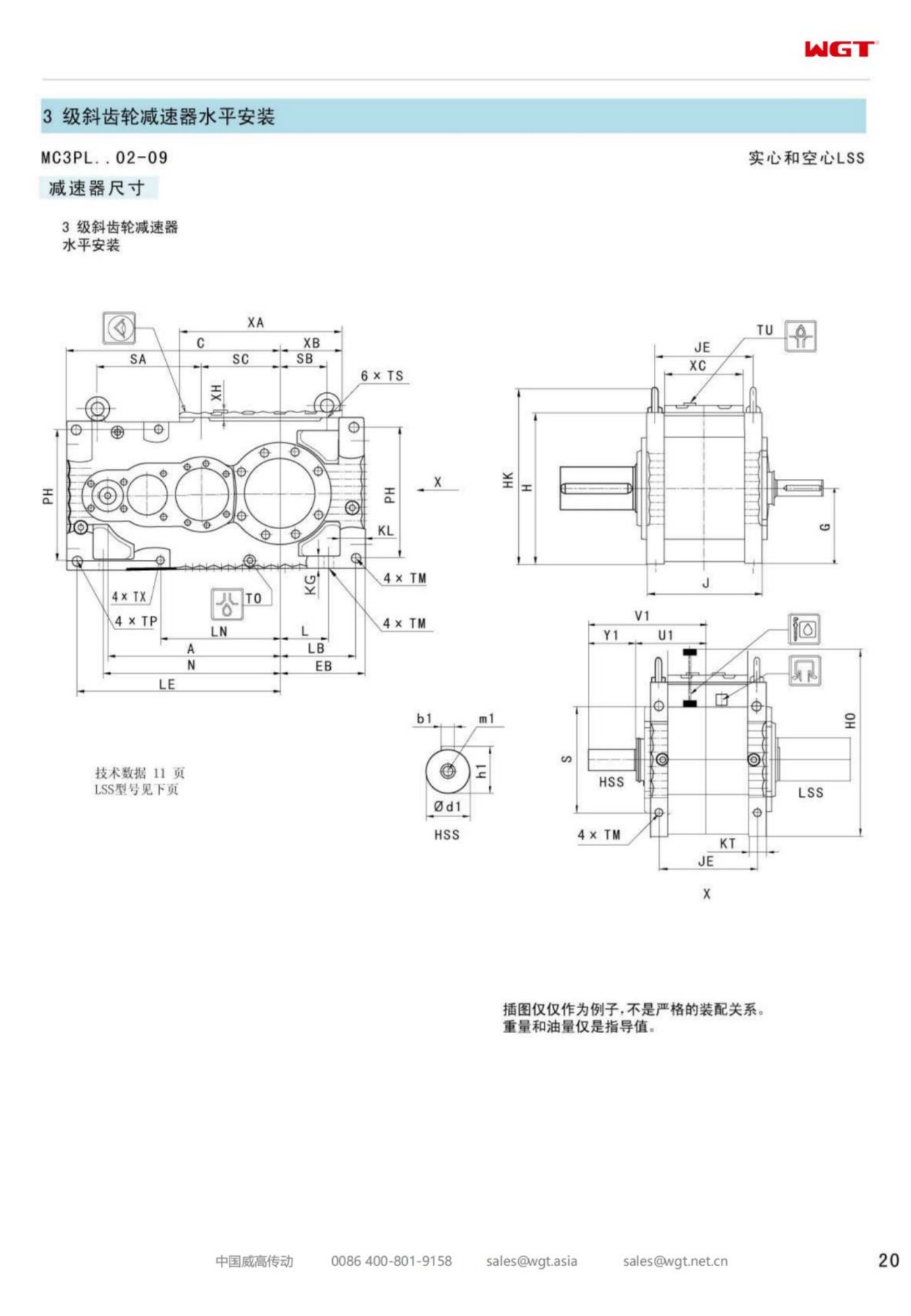
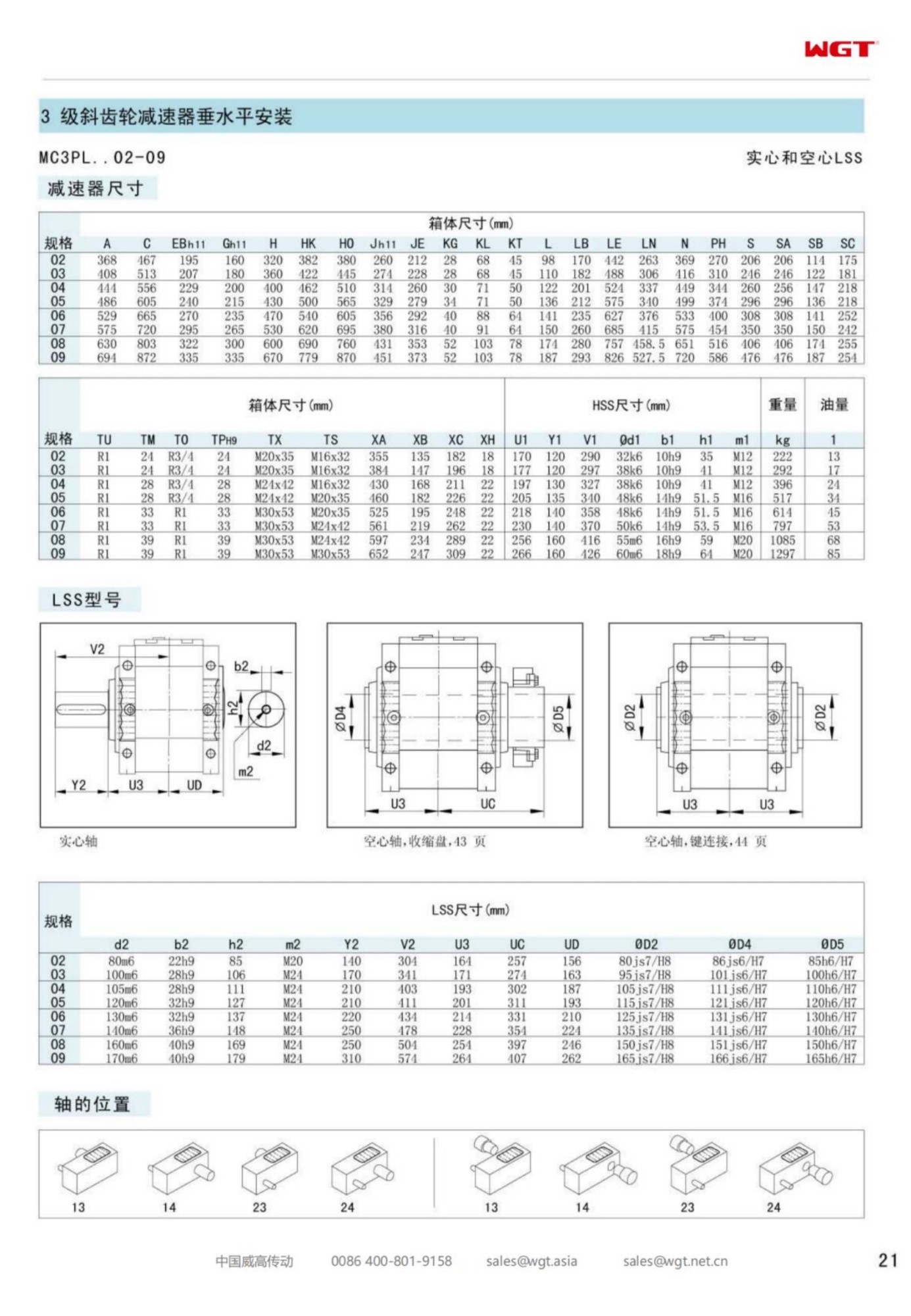
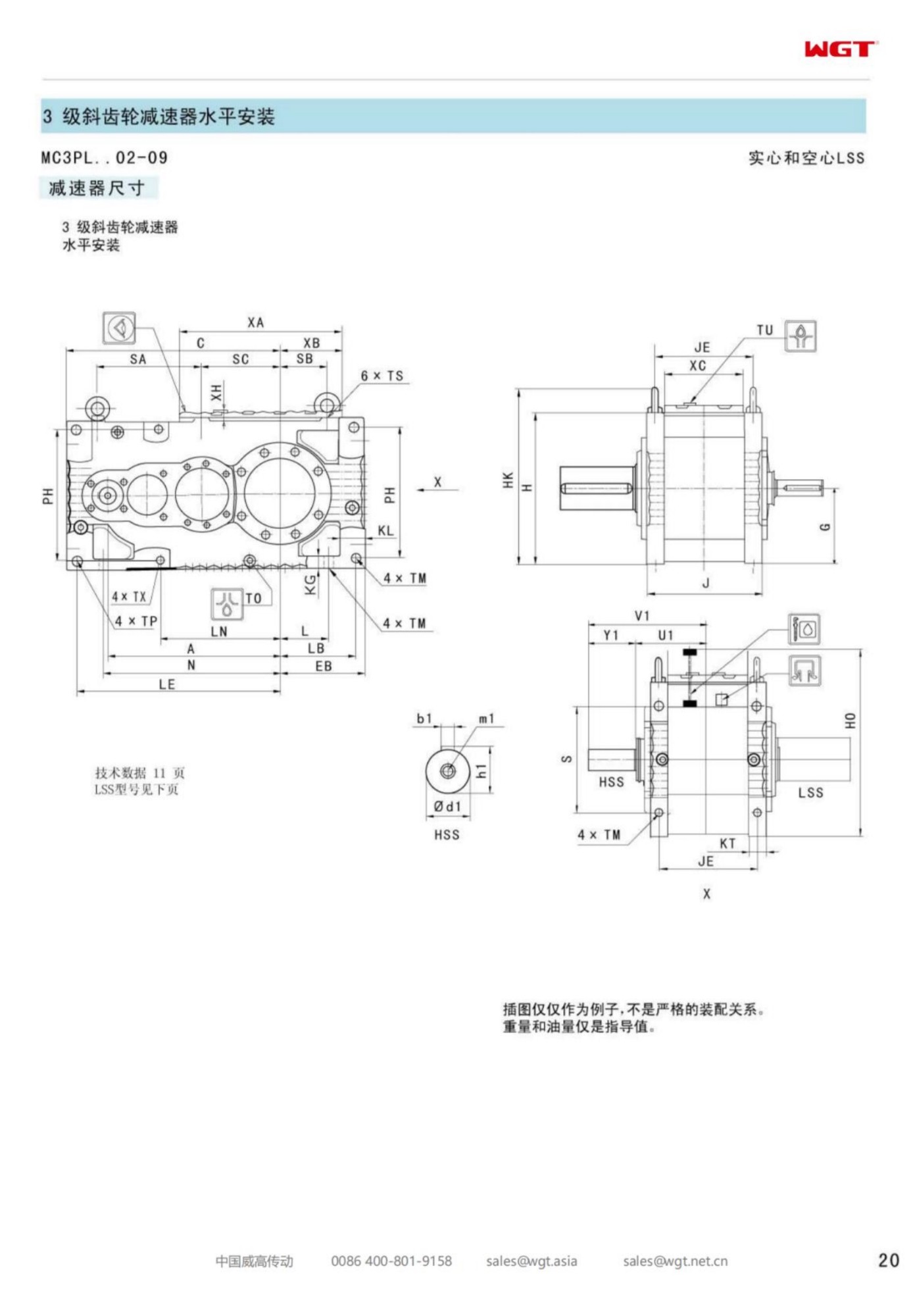
The MC3PLSF05 parallel shaft gear unit sits at the middle of the three-stage range, and middle frames are where a product line earns its reputation. Small frames get the glory of fitting impossible corners and large frames get the respect, but the frame in the middle is the one plants buy again and again - big enough to carry real torque with margin, small enough to keep the price and the spare parts list sensible.
The design brief is the same as every frame in the family: three helical reductions in one plane, a footed cast case, a solid keyed output shaft and a motor mounted alongside. What the 05 adds is headroom - in gear face width, in bearing capacity and in the thermal reserve that keeps a hard-working drive from living at its cooling limit.
The Middle Frame That Carries the Range
There is a reason the 05 turns up on so many plants that run mixed machinery. Its torque band covers the bulk of conveyor, mixer and feeder duties that need deep reduction, and its dimensions stay compatible with the bedplates and guarding that plants already build around this class of drive. Maintenance crews stock one seal kit, one oil grade and one coupling range, and those cover the whole line.
Standardisation is the quiet argument for this frame. When a plant settles on one family and one mid-range frame, the spare shelf shrinks, the fitting crew learns one assembly sequence, and a failed drive is met with a known unit rather than an emergency purchase. Over a decade that consistency is worth more than the last few percent of rating efficiency any alternative might offer.
From Type Code to Drawing: the Fields That Decide
The designation compresses the mechanical decisions; decode it before the order, not after delivery.
| MC | Compact industrial gear unit, multi-stage helical construction |
| 3 | Three reduction stages - chosen when two stages cannot reach the ratio at a workable size |
| P | Parallel shafts, input and output in one horizontal plane |
| L | Long-section case with cast feet and a generous inspection opening |
| S | Solid keyed output shaft for a slow, torque-heavy machine |
| F | Foot mounted for a horizontal bedplate |
| 05 | Mid-range frame, above the 04 in rating and thermal reserve |
The ratio and the mounting position sit outside the code and both alter the drawing. Where the unit lands on an existing bedplate, send the measured shaft dimensions and the old drawing number with the enquiry - a caliper reading taken on site settles an argument that a scanned manual page cannot.
Starting Torque, Jams and the Factor That Covers Them
Every duty has a running load, and most have a worst moment: the start with the conveyor loaded, the elevator restarted after a plugged chute, the mixer turned over after a settle. The service factor exists to cover exactly that moment, and understating it is the most expensive shortcut in gearbox selection - the unit runs fine until the one afternoon the plant expects it to be tough.
Be candid about the worst case in the enquiry. A machine emptied before starting earns a modest factor; the same machine started buried needs the bigger one, and the 05 is usually the frame that absorbs the larger factor without climbing to the next housing. Say what the plant considers a normal jam, and the selection can be made against reality rather than against the brochure.
Where Plants Standardise on the 05
Deep-shaft and through-bore duties this build serves:
- Belt conveyors carrying crushed ore from secondary crushers
- Bucket elevators on grain terminal and flour mill intake towers
- Dewatering press and cake conveyors at municipal treatment plants
- Paddle and plough mixers in plaster and mortar production
- Apron feeders under clinker hoppers at cement depots
- Cooler and kiln auxiliary drives at small lime works
These duties share deep reduction, long running hours and material that does not always behave. The mid-frame carries them with margin to spare, and the margin is why the drive is still there when neighbouring machines have been rebuilt twice.
Overhung Loads and the Honest Way to Count Them
A solid output shaft is built for torque and for the moderate bending a coupling imposes - not for a tight chain sprocket hung well outboard, and not for a belt pulling sideways at full tension. Both are overhung loads, and both must be calculated at their actual distance from the bearing and compared with the permitted value at that distance. A gearbox sized correctly on torque can still lose a bearing in a year because nobody counted the pull.
If the load is real, say so on the enquiry and the factory can confirm or propose a stronger bearing set, a shorter lever or a different connection. A flexible coupling on an accurately aligned drive keeps residual misalignment out of the bearing; a rigid coupling transfers every bit of it. Choose with the numbers, not with habit.
Trend Lines Worth Keeping in the Log Book
One reading is an anecdote; ten readings are a trend. Log sump temperature, bearing temperatures at fixed points and load at the time of reading, and the log begins to speak. A temperature that creeps up shift by shift points at oil, cooling or breather. A bearing that warms only under peak load points at mesh or alignment. A vibration note that changes after a foundation repair says the steelwork moved, not the gearbox.
The log also protects the plant's judgment in disputes and overhauls: with a clean record, the overhaul scope is decided from evidence, bearings are changed because the trend said so rather than because the calendar did, and the second gearbox on the same application is specified with the first one's history in hand.
A Checklist That Makes the Quotation One-Shot
Tick these before sending the enquiry: motor rating, speed and starting method; output speed and tolerance band; absorbed torque or power, with the starting and stall cases; duty cycle and starts per hour; mounting position, available height and bedplate drawing; shaft and bore dimensions where hardware is kept; overhung load and its distance if a pulley or sprocket is fitted; ambient temperature, dust, moisture and washdown; paint, nameplate and documentation requirements.
A complete list comes back as a fixed, orderable quotation in one exchange. A partial list comes back padded with assumptions - and the day those assumptions meet the plant floor is the day the project pays for the shortcut.
Selection Example: Bucket elevator on a grain intake tower
Take a 22 kW motor at 1480 rpm turning the elevator head shaft at 24 rpm. The ratio follows directly: 1480 / 24 = 61.7, so a ratio near i=62 is selected and the service factor is raised to cover a restart with the buckets loaded after a plugged chute. In this case the mid-range frame carries the head shaft torque with room to spare, which is why plants that standardise on this line keep the 05 as the default for tall intake duty. Work through the same three steps - speed, output speed, torque - and the model number falls out; we verify it against the duty class before quoting.
![gear reducer ratio calculation steps]()
From duty point to model number - the same four steps every time.
Applications in Industry
Glass batch charger
A float-glass line drives its batch charger with units. Abrasive raw material demands a robust drive, and the case-hardened gears show minimal wear after years of continuous operation.
Battery slurry mixer
A battery materials plant uses reducers on slurry mixers. High shear loads are absorbed by the 42CrMo shafts, and the 94-96% efficiency keeps motor sizing and running cost down.
![gear reducer industries served - WGT]()
Industry map: the sectors where the M3 series is most common.
Buyer Questions and Answers
What happens if my duty changes after installation?
Send us the new duty point. A revised torque and service-factor calculation is free of charge, and the answer is usually one of three: the unit is fine, add an oil change interval, or plan a frame change at the next shutdown.
Can this unit mount on my existing installation without redesign?
Yes - the series is manufactured to the same centre distances, shafts and flange dimensions of the common industry frames, so couplings, guards and foundations stay untouched.
M3 Series Model Overview
| Model | Centre distance | Output | Typical duty |
|---|
| M3PSF50 | size 50 | solid shaft, foot | conveyors, feeders |
| M3PSF60 | size 60 | solid shaft, foot | crushers, mixers |
| M3PSF70 | size 70 | solid shaft, foot | ball mills, shredders |
| M3PSF80 | size 80 | solid shaft, foot | kilns, heavy conveyors |
| M3PSF90 | size 90 | solid shaft, foot | mill and kiln drives |
| M3RSF50 | size 50 | solid shaft, foot, right-angle | inclined conveyors, elevators |
| M3RSF60 | size 60 | solid shaft, foot, right-angle | screw classifiers, feeders |
| M3RHF70 | size 70 | hollow shaft, foot, right-angle | agitators, drum drives |
| M3PHT80 | size 80 | hollow shaft, torque arm, parallel | shaft-mounted conveyors |
| M3RHT90 | size 90 | hollow shaft, torque arm, right-angle | heavy shaft-mounted drives |
The series is sized for continuous heavy duty rather than by motor power alone: the required torque with the service factor decides the frame, and the stage count (2 to 5) decides the ratio band.
Drawings, Ratings and Test Records on Request
Need the paperwork first? Run your duty point through the WGT Motor & Gearbox Online Selection System first: it saves a round of emails and gets you to a firm price faster.
We issue dimension drawings, rating tables and sample test records in English for your approval package, before the order is placed. Engineering and purchasing sign-off without delays. Looking for a gear motor for car wash system? Tell us the duty point and we will confirm the model in writing.