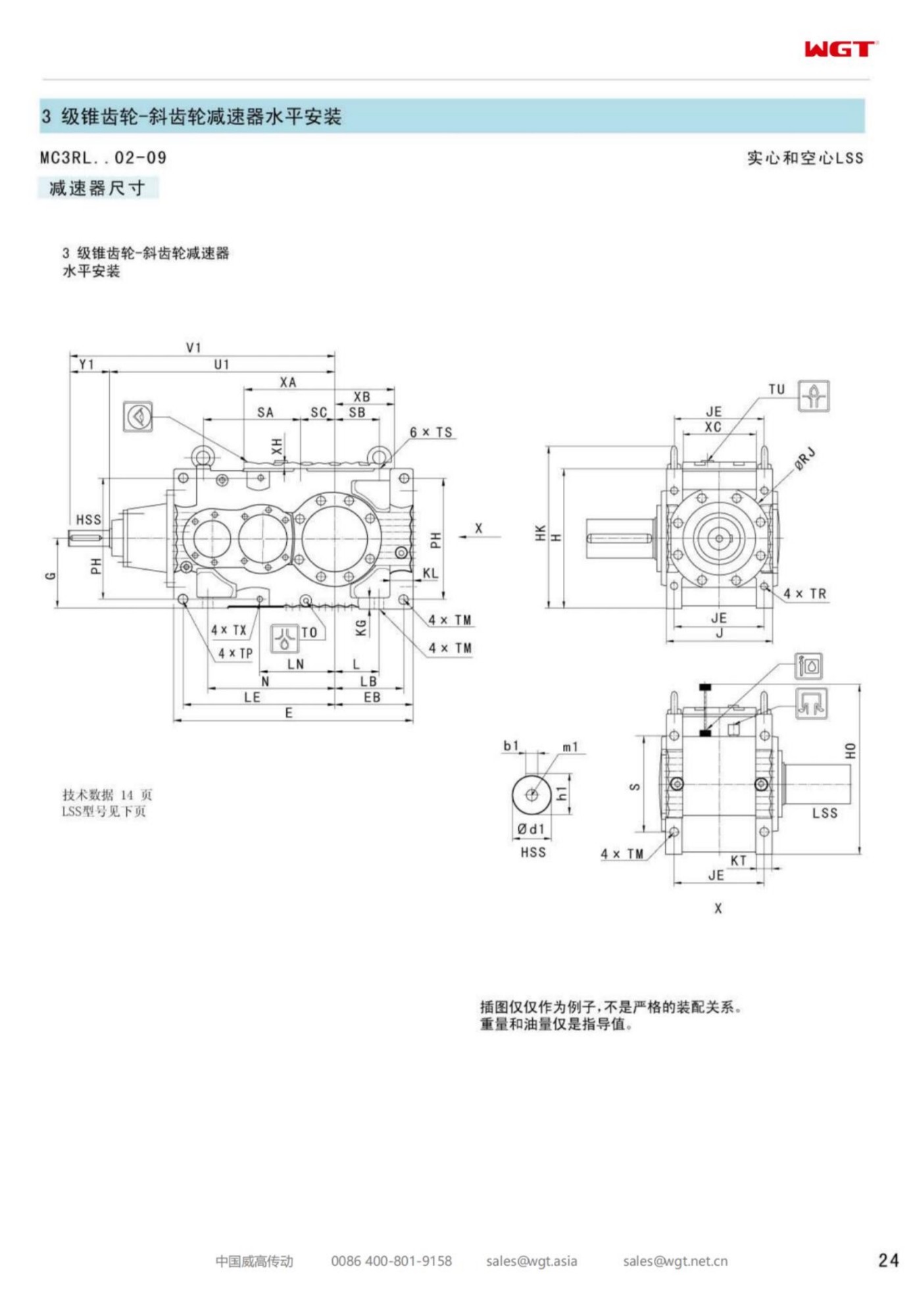
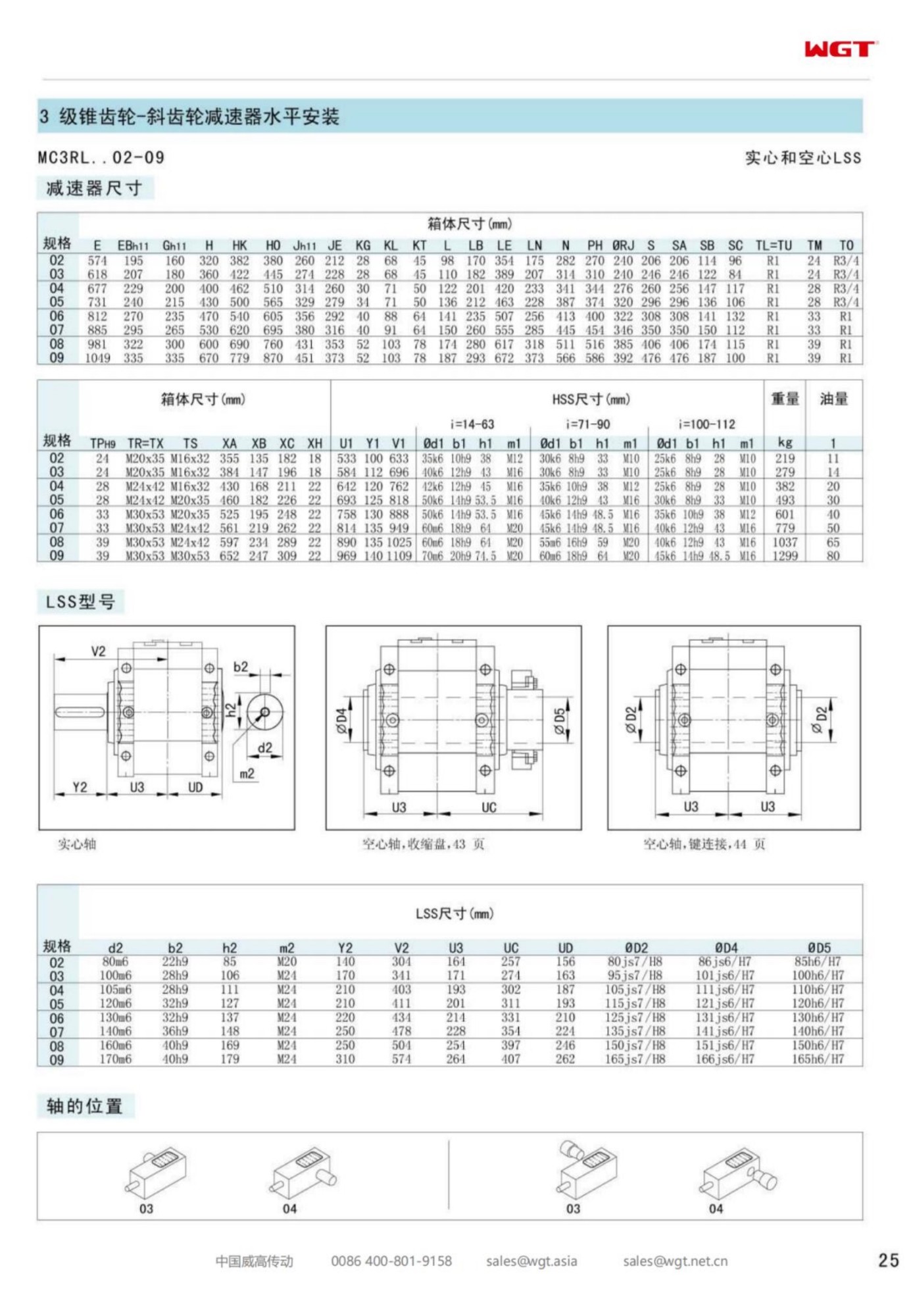
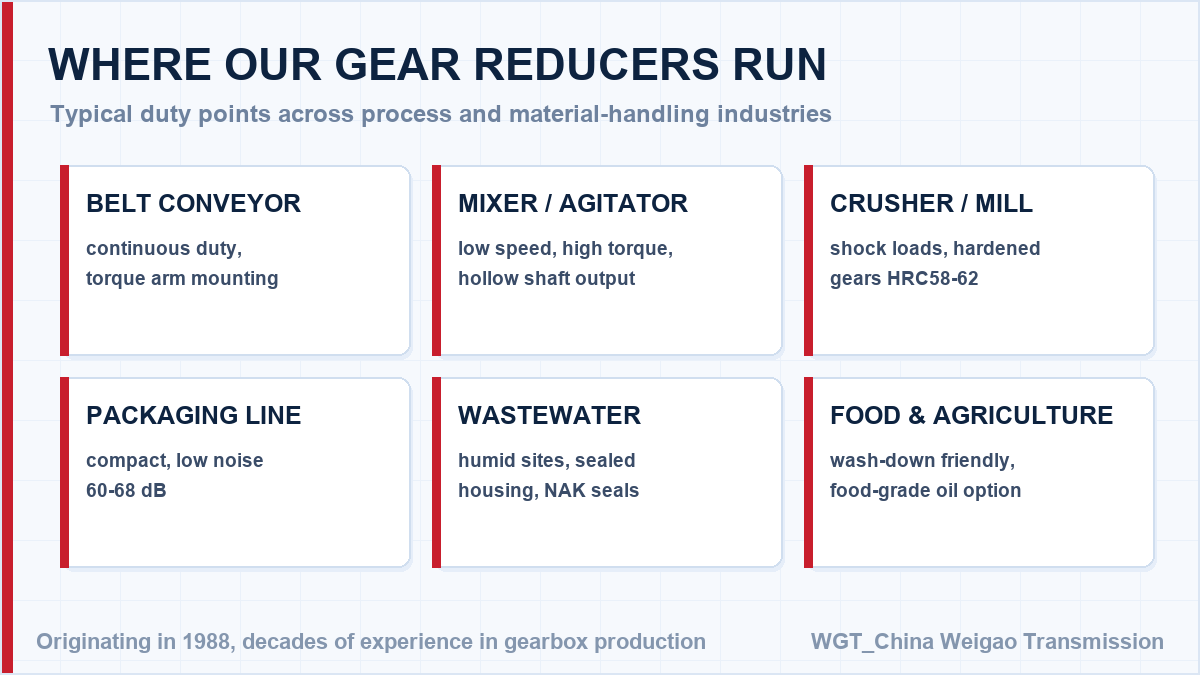
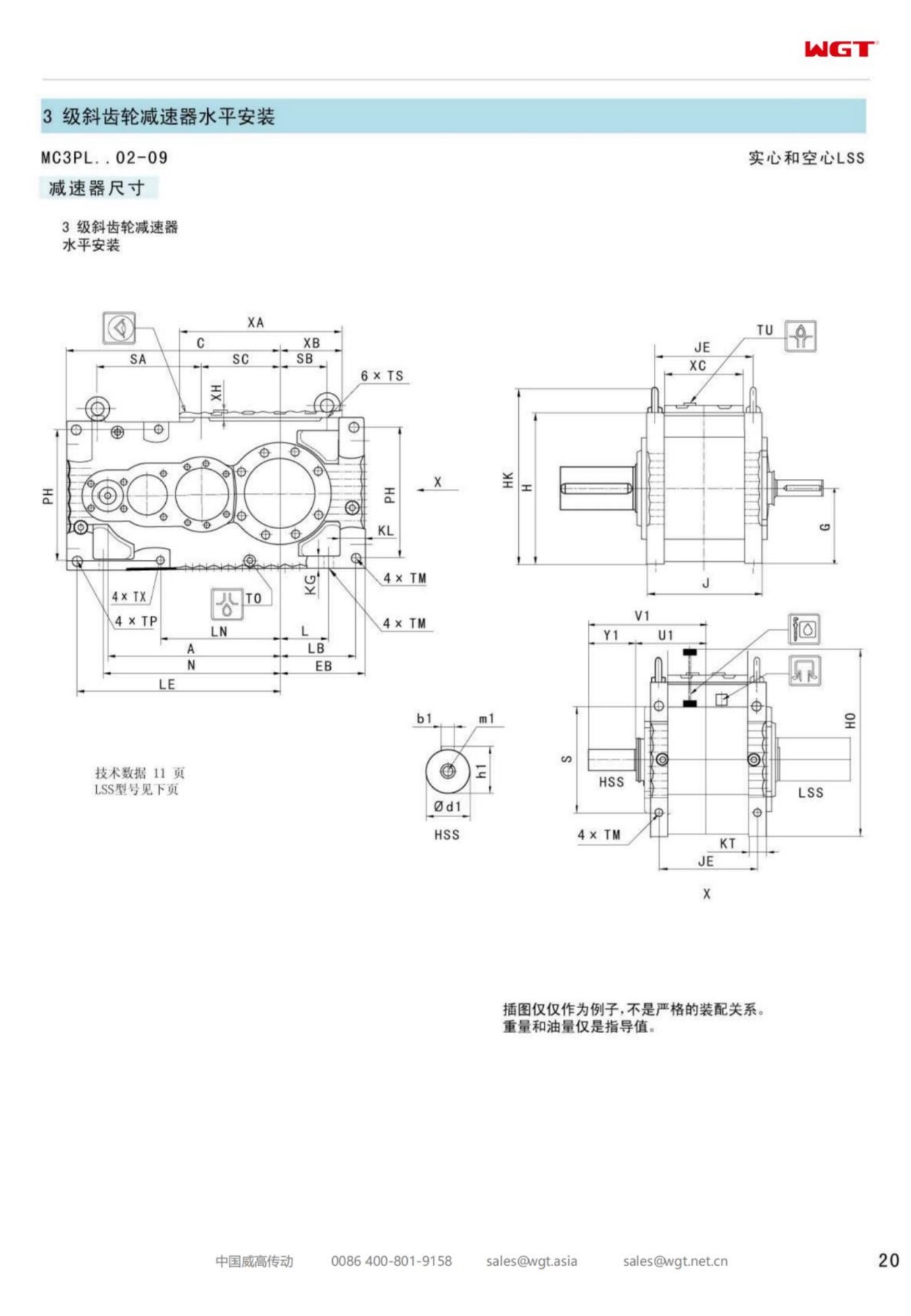
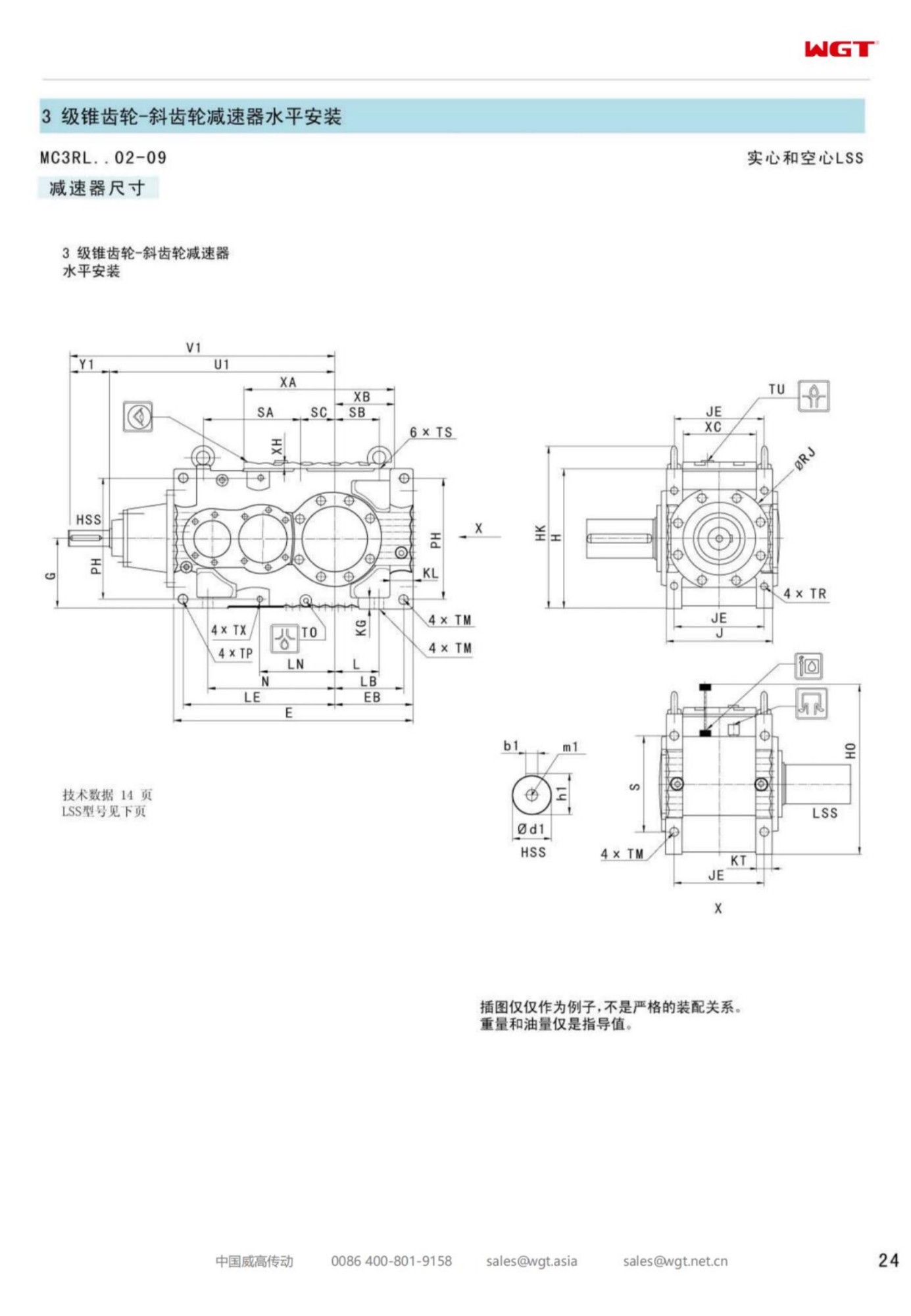
The bottom of a size band is where most gear units actually live. Not the mill circuits and not the overland conveyors, but the hundreds of unglamorous positions - agitators, feeders, small conveyors, rakes - where the torque is modest and the hours are not. The MC3RLHF02 bevel-helical gearbox belongs to that world, and this page describes it as it is really used rather than as a line in a rating table.
The train is the family standard: a bevel pair turns the motor's rotation through a right angle, and two helical stages take the speed down to where the machine wants it. What separates this build from its solid-shaft siblings is the letter in the middle of the type string. The output is a hollow bore, and that single feature changes how the whole installation goes together.
The Smallest Frame and the Longest Hours
A frame two rarely impresses anyone at first sight. It bolts to a bedplate a hand's width above the floor, it hides behind pipework, and a visitor will walk past it without a glance. Yet the duties it takes are often the least forgiving in the plant, because nobody watches them. An agitator that runs 8,400 hours a year in a corner of the works accumulates more running time in a decade than a mill drive does, and it does it without a scheduled outage or a stand-by unit.
That is why the design questions at this end of the band are about endurance rather than peak capacity. Seal life against washdown hoses. Bearing protection against a shaft that is checked once a month, if that. A breather that survives steam and splashing liquor. None of these appear in a torque calculation, and all of them decide whether the unit is still quiet five years on.
How the Hollow Bore Changes the Installation
With a solid-shaft unit, the driven shaft arrives at a coupling and alignment is a two-machine affair. With a hollow-shaft build, the gear case climbs over the driven shaft instead. The bore receives the shaft end, a key drives the torque, and the case hangs its own weight and reaction on the shaft through the mounting arrangement. There is no flexible coupling to buy, no coupling guard to fabricate, and no laser alignment session to schedule.
The trade is precision rather than parts. The bore and the shaft must agree on diameter, key and fit, and the end play and the clearance at the torque arm must follow the drawing, because the case locates itself on the machine instead of beside it. Done properly the result is the tidiest drive in the plant - no overhang, no coupling spacer, nothing to drift out of line. Done carelessly the same feature becomes a standing source of fretting at the bore, which is why the fitting instructions deserve a quiet half-hour with a micrometer before the unit goes up.
Reading the Letters Before the Two
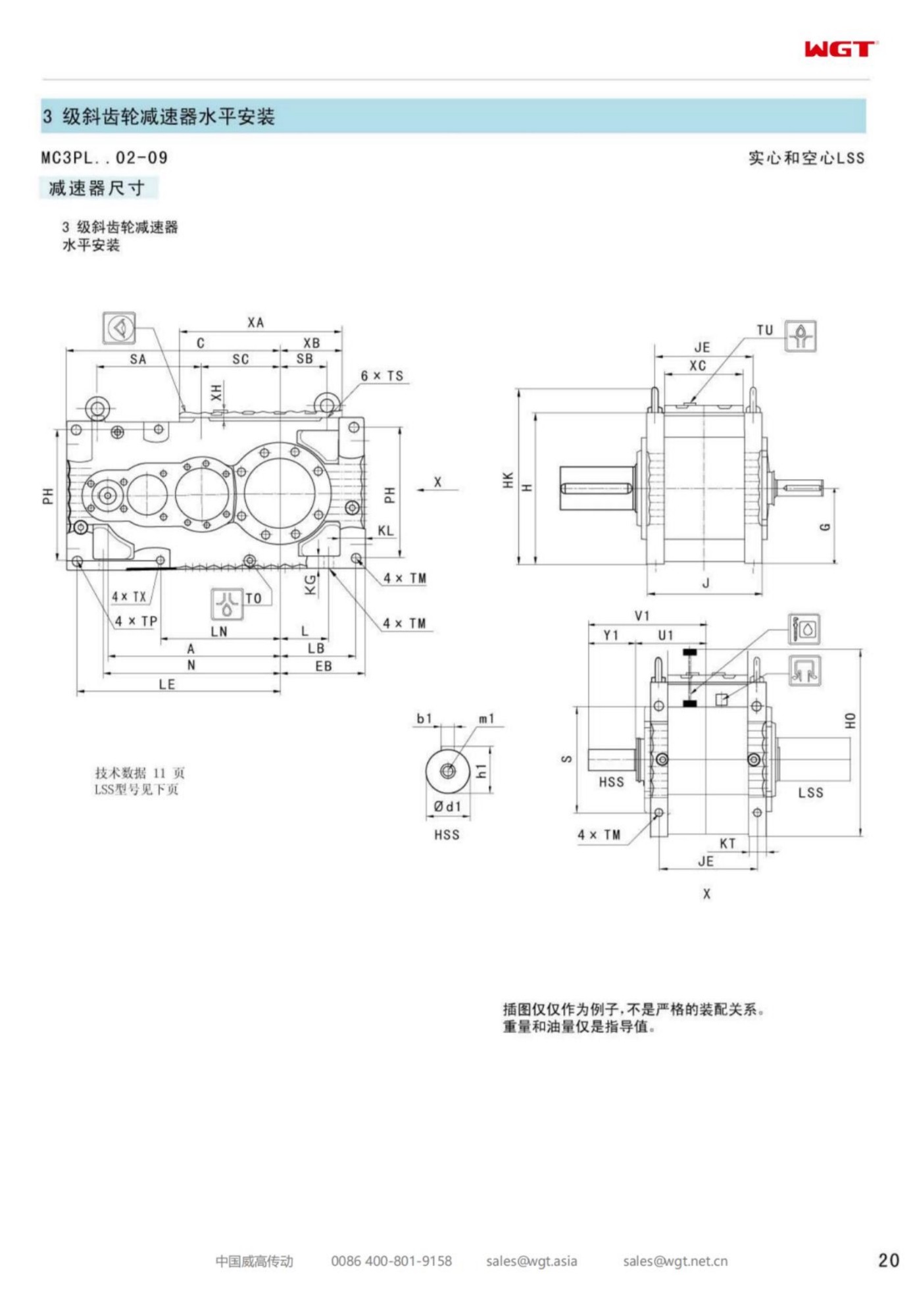
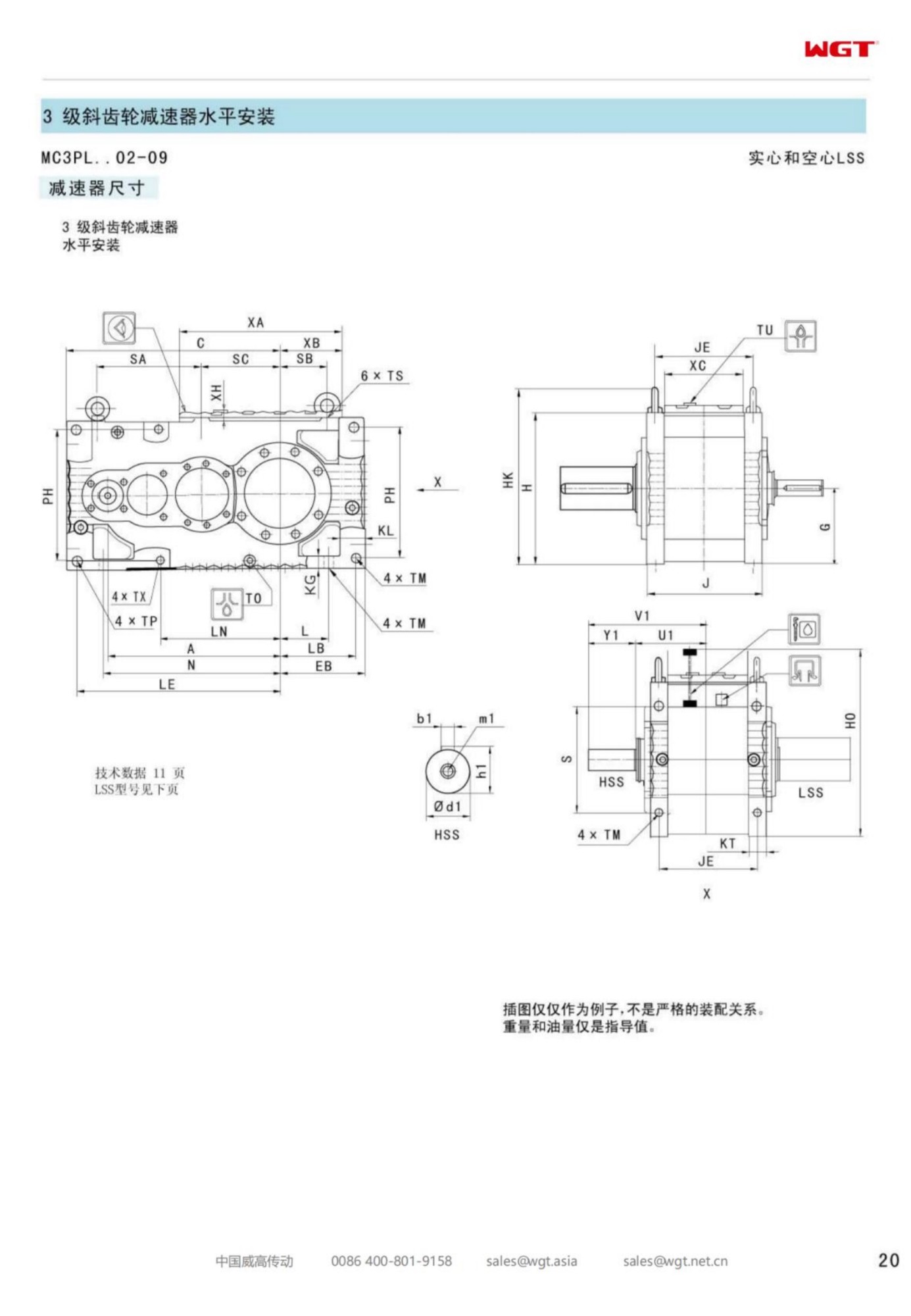
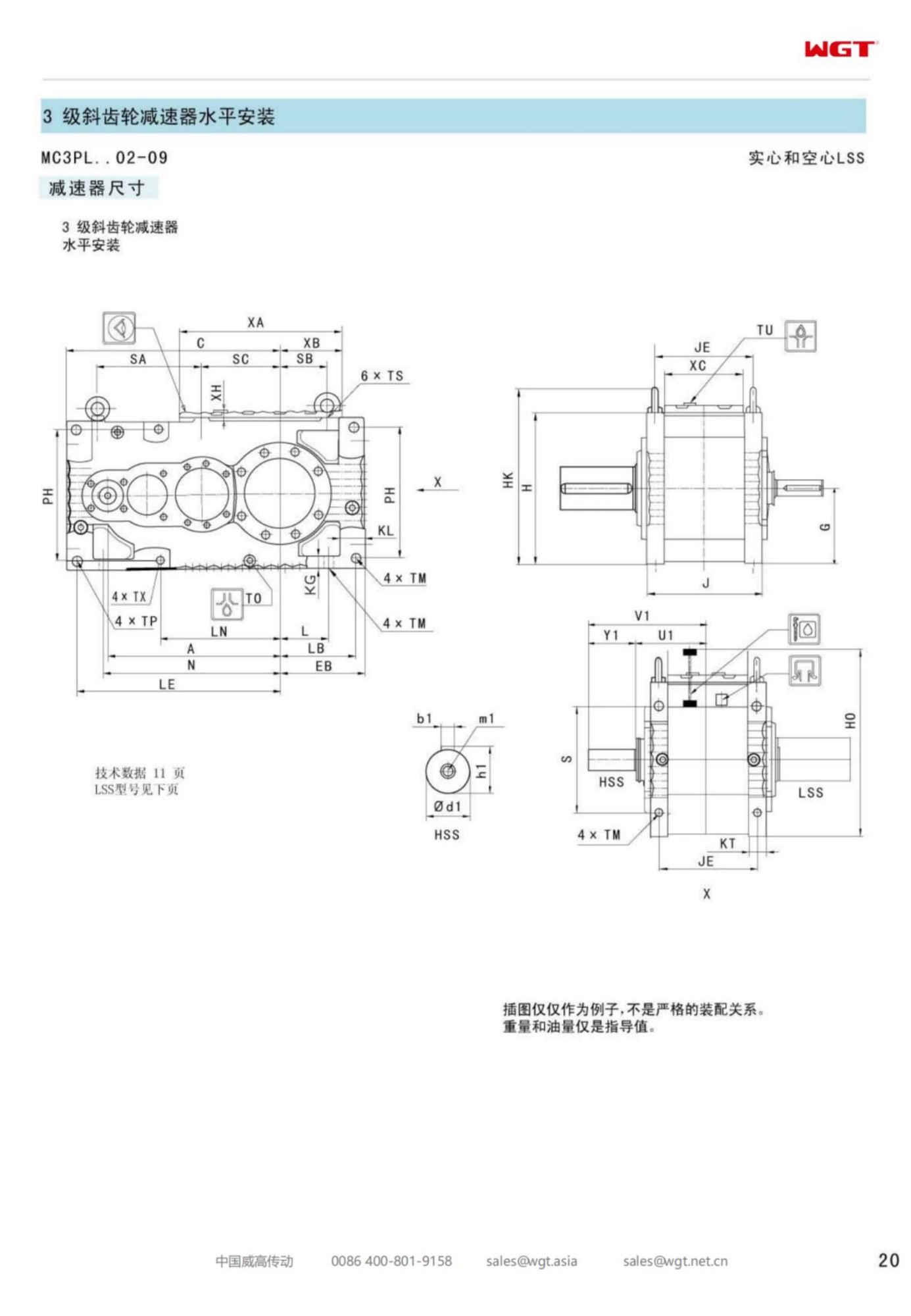
Every character in the designation is a decision someone already made on the buyer's behalf, and reading it once against the outline drawing prevents most later correspondence.
| MC | Industrial gear unit family for continuous plant service |
| 3 | Three reductions in train: bevel pair plus two helical stages |
| R | Right-angle bevel-helical layout with the motor set across the output |
| L | Horizontal build with both shafts level on a common case |
| H | Hollow output bore that mounts directly over the driven shaft |
| F | Foot mounting onto a bedplate, plinth or fabricated steel base |
| 02 | Second frame of the 02-09 band: the light continuous duties that run the longest hours |
Away from the string, three order-time choices shape daily life with the unit. Motor orientation decides which side the breather and filler face. Rotation direction decides which bevel flank does the working. And the position of the hollow bore relative to the foot pads decides whether the drain plug ends up above a drum or above a cable tray. All three are free on paper and expensive afterwards.
What a Frame Two Is Asked to Do
Shafts and bores matched once and forgotten for a decade:
- Agitator drives on chemical make-up tanks where a coupling would hang over live liquor
- Rotary valve feeders under dust-collection hoppers running around the clock
- Screw conveyors in a coating plant where floor space will not give up another metre
- Paddle dryers turning a slowly stiffening cake through a long batch
- Clarifier rake drives at smaller water works with no crane above the drive
- Small bucket elevators on a grain intake pit during harvest weeks
The common thread through that list is not torque but consequence-free hours. These are machines where a stoppage does not stop the plant, only a process step, which is exactly why they get neglected - and why a unit chosen with a real service factor, not a hopeful one, quietly outlives everything around it.
Mounting Over the Driven Shaft Without Drama
The fitting sequence for a hollow-bore foot-mounted unit is short and worth following exactly. Verify the driven shaft diameter, runout and key against the drawing. Support the unit so its weight never hangs on the bore edges before the foot bolts take it. Slide it home, fit the key and the shaft retaining hardware, then level the feet before final tightening so the case is not pre-twisted onto the shaft. Last of all, connect the torque arm or reaction bracket at its designed position, with its bushings free to take up as intended.
The failure mode to avoid is bracing the case against the machine through the mounting hardware. A foot bolt torqued against an unleveled pad, or a torque arm used as a second foundation, imposes a load path the bearings were never given credit for. It shows up later as a bore that has fretted orange and a seal that leaves a weal on the shaft - symptoms that look like manufacturing faults and almost never are.
Seals, Breathers and the Wet Corner Problem
Small units spend their lives in the corners where the wet and the washdown arrive. The oil seal on a hollow bore works hardest when the shaft turns slowly and splash is intermittent, so the condition of the lip matters more than its age in years. A quarterly look for a damp ring under the bore, and a fresh lip fitted as soon as one appears, is the cheapest gearbox insurance in the plant.
Breathers deserve the same respect. In a steamy corner, a plain breather becomes a condensation pump that moves water into the sump one thermal cycle at a time. A suitable breather, positioned away from direct hose spray, and an oil change at the first sign of milking costs an hour; a rusted bearing set costs a unit. Neither item is in the sales literature, and both decide the ownership experience.
The First Service and Why It Comes Early
Run-in oil exists to be thrown away. The first lube change on a new unit, at a few hundred hours rather than a few thousand, carries out the wear particles that running-in always produces and gives the fitter a reason to open the plugs while the delivery notes are still on file. Plants that skip it almost always regret it in the second year, when a bearing that ran bright from the first month finally complains.
The early service is also the moment to record the baseline. Oil level against the plug, case temperature after four loaded hours, the sound of the bevel mesh from a metre away. A unit whose later history is compared against those three numbers can be diagnosed over the phone; one without a baseline generates opinions instead.
Ordering a Frame Two With Everything on the Drawing
A small frame rewards a complete enquiry exactly as much as a large one. Motor power, speed and starting method. The driven machine and how it loads the shaft, including any seizing risk at rest. Output speed and the tolerance the process accepts. Hours per day and starts per hour, honestly counted. Ambient, including washdown and steam. Driven shaft diameter, keyway and length available to the bore. Mounting position, motor orientation and rotation direction. Paint and documentation needs.
Sent complete, that enquiry comes back as a firm quotation and an outline drawing that bolts onto the first revision of the layout without a query round. Sent as a power figure and a shaft diameter, it comes back as questions, and the questions cost a week each. The frame is small; the time saved by writing the enquiry properly is not.
Selection Example: Agitator drive on a chemical make-up tank
Take a 4 kW motor at 1440 rpm turning the agitator shaft at 29 rpm. The ratio follows directly: 1440 / 29 = 49.7, so a ratio near i=50 is drawn from the three-stage bevel-helical band, and the frame is checked against the stall that follows a batch left to set overnight. In this case the hollow bore slips straight over the agitator shaft, so no coupling has to be aligned above a tank that cannot easily be drained for the job. That is the whole calculation. If your duty involves heavy starting, frequent reversing or many stops per hour, tell us and we raise the service factor.
Which Frame Size Do You Need?
| Model | Centre distance | Output | Typical duty |
|---|
| M3PSF50 | size 50 | solid shaft, foot | conveyors, feeders |
| M3PSF60 | size 60 | solid shaft, foot | crushers, mixers |
| M3PSF70 | size 70 | solid shaft, foot | ball mills, shredders |
| M3PSF80 | size 80 | solid shaft, foot | kilns, heavy conveyors |
| M3PSF90 | size 90 | solid shaft, foot | mill and kiln drives |
| M3RSF50 | size 50 | solid shaft, foot, right-angle | inclined conveyors, elevators |
| M3RSF60 | size 60 | solid shaft, foot, right-angle | screw classifiers, feeders |
| M3RHF70 | size 70 | hollow shaft, foot, right-angle | agitators, drum drives |
| M3PHT80 | size 80 | hollow shaft, torque arm, parallel | shaft-mounted conveyors |
| M3RHT90 | size 90 | hollow shaft, torque arm, right-angle | heavy shaft-mounted drives |
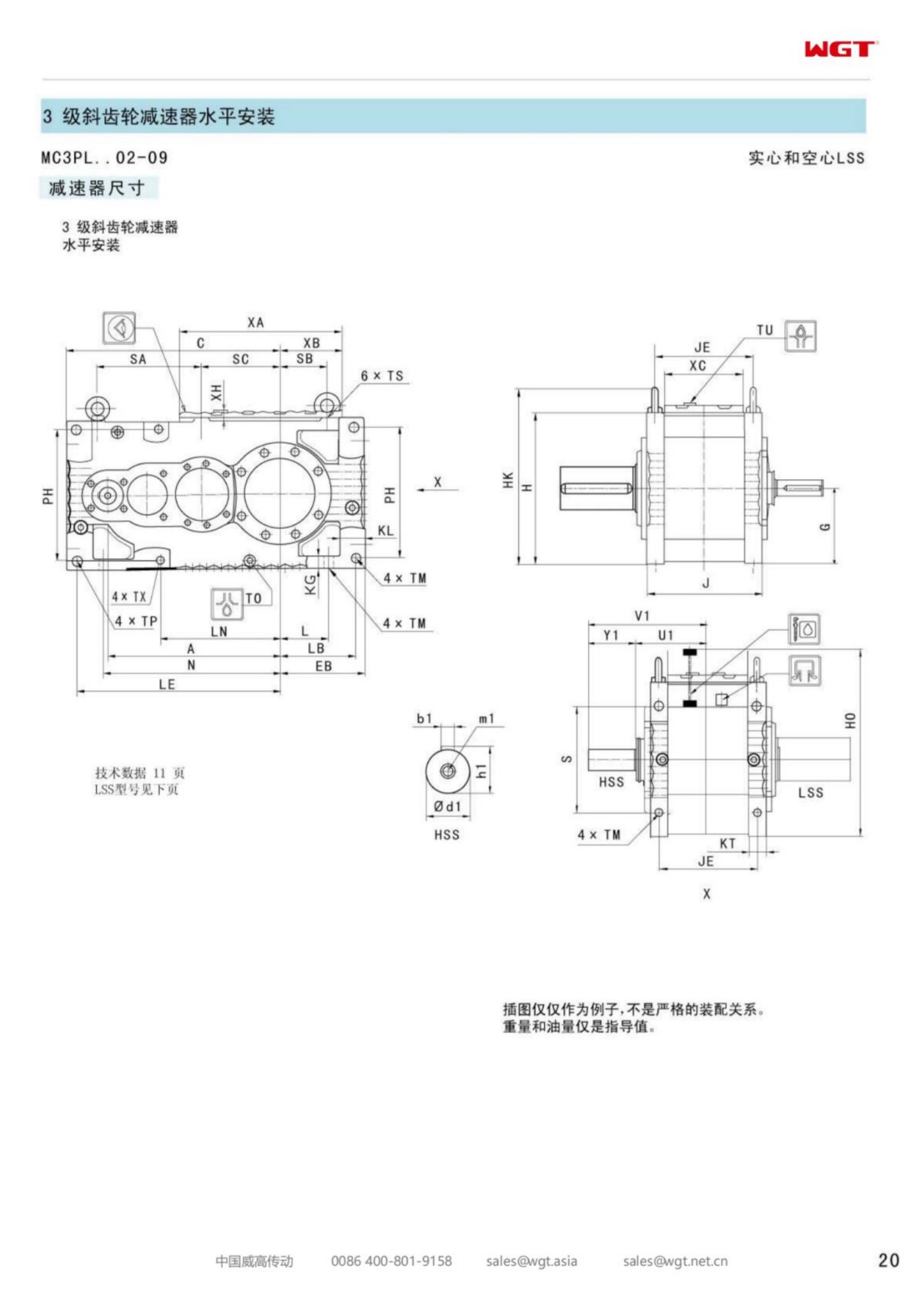
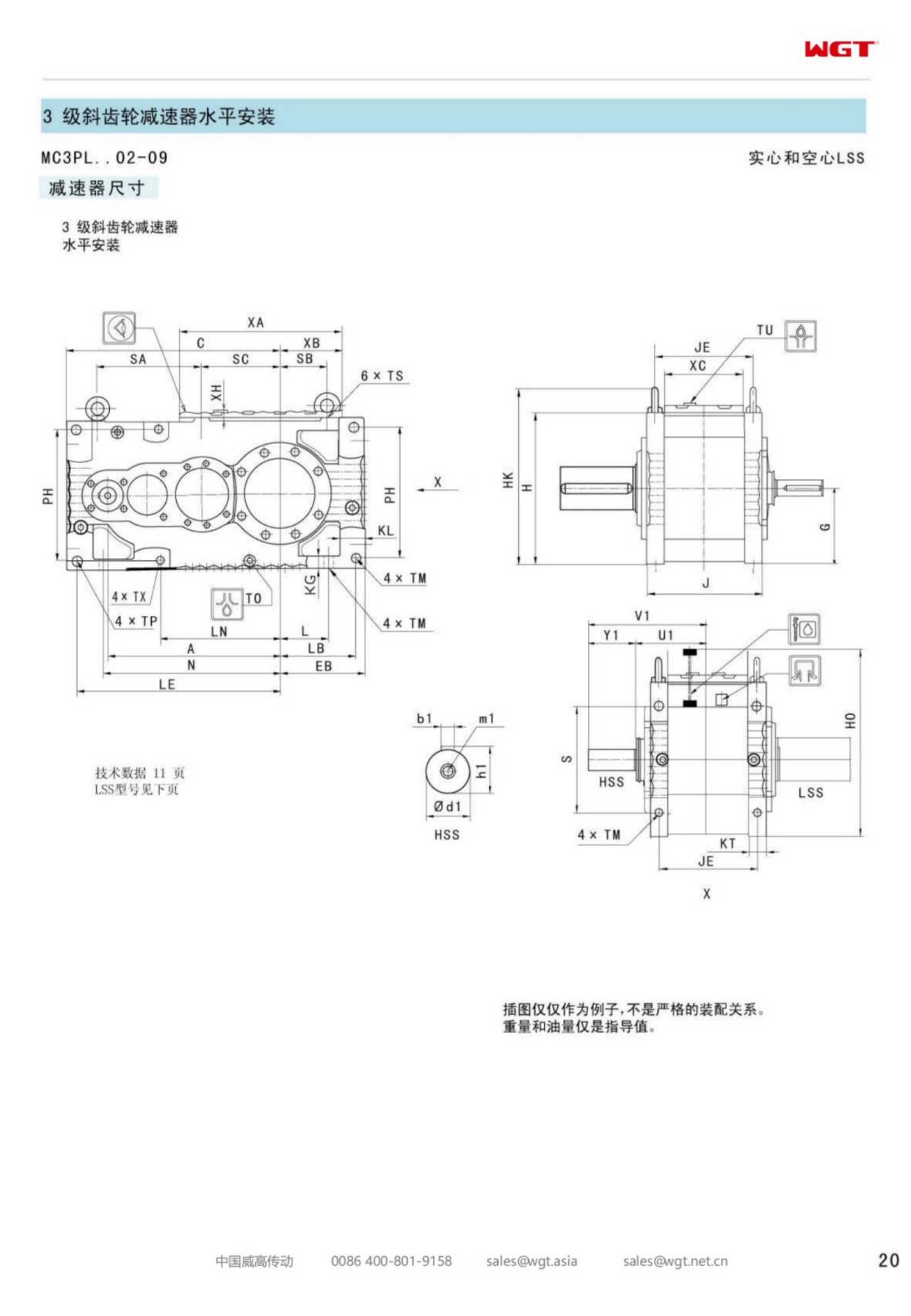
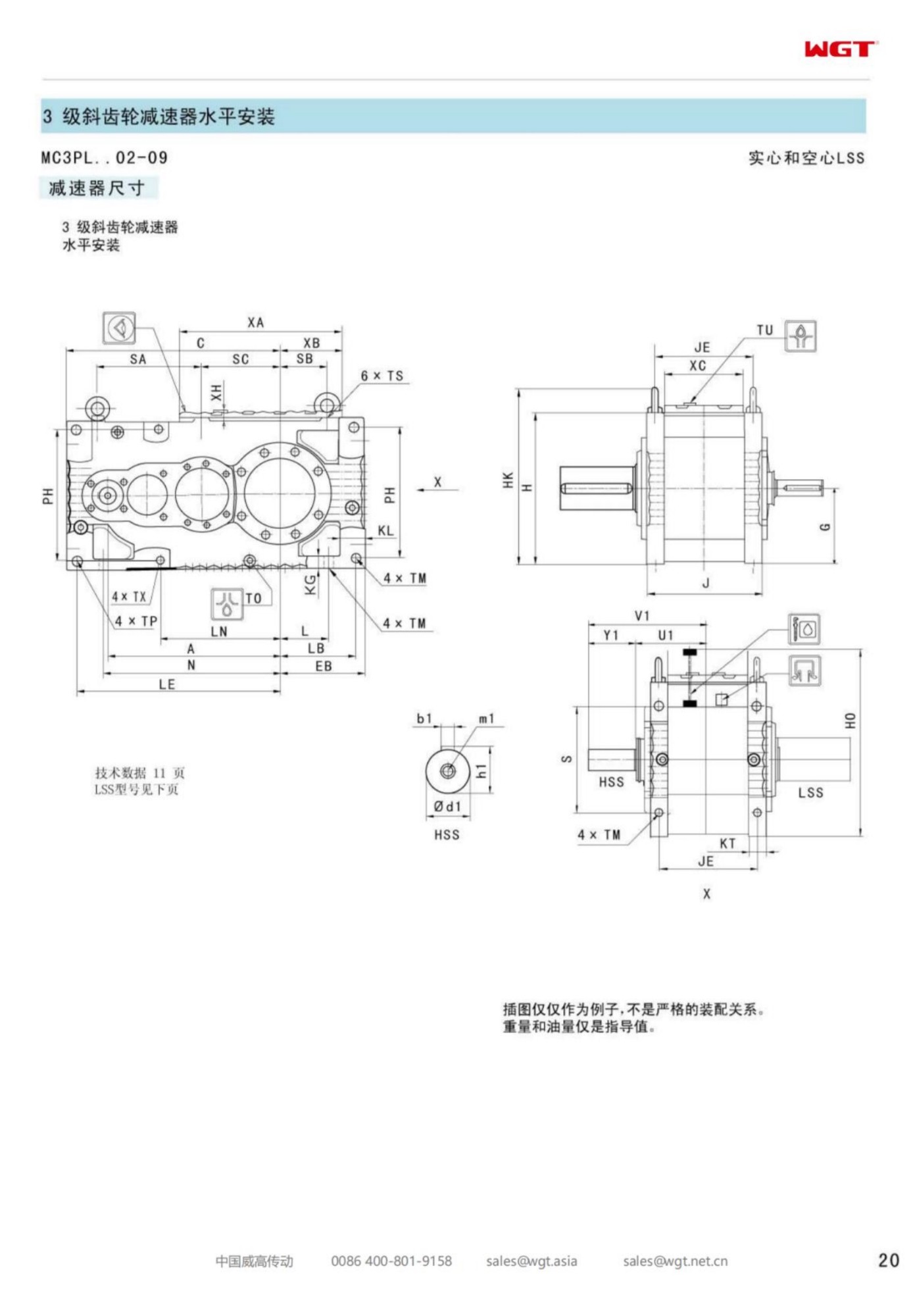
Foot-mounted frames are listed below; torque-arm (T), hollow-shaft (H) and vertical (V) variants are available across the size range. Ask for the outline drawing to check the interface before ordering.
Answers to Common Questions
Can the unit be rebuilt instead of replaced?
Yes. Bearings, seals and gear sets are available as spare internals, and the horizontally split housing allows inspection and reassembly on site. Many operators overhaul units during annual shutdowns instead of buying new.
What ambient and altitude limits apply?
The standard build suits -10 to +40 degrees C at altitudes below 1,000 m with the supplied oil grade. Colder sites get synthetic oil and heaters; high altitudes or hot climates may call for the next frame size or forced cooling.
Do you supply the unit with an electric motor fitted?
We deliver the bare gear unit with an input suitable for your motor, or as a complete motor-gearbox assembly aligned and tested at the works. For upgrade projects many customers keep the existing motor and order the unit alone.
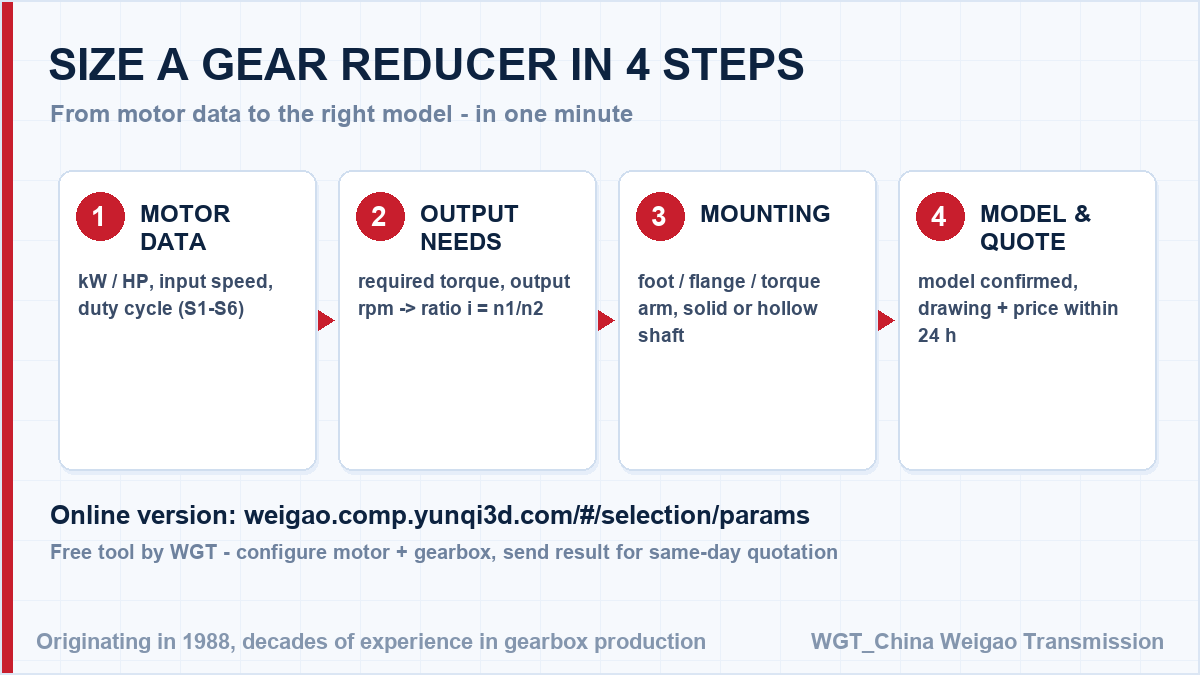
![gearbox sizing steps for engineers]()
Four steps from your application data to a firm model number.
Case Notes from the Field
Grain terminal elevators
A grain terminal powers its bucket elevators with gear reducers. The anti-run-back option holds the loaded buckets during power cuts, and standard interface dimensions meant the old foundations were reused as they were.
Pallet lift in a warehouse
A logistics integrator selected units for pallet lifts. The hollow output bore carries the lift screw directly, and one year of three-shift operation has passed without a single seal replacement.
![industrial gear unit application overview]()
A cross-section of the installations we supply every month.
Tell Us the Torque, We Confirm the Model
Not sure where to start? Try the WGT Motor & Gearbox Online Selection System, then send the result sheet - we return a complete datasheet, drawing and price the same day.
A photo of the nameplate, the motor power and the output speed you need are enough to start. We confirm the frame size, ratio and mounting style and return a written quotation the same day. Looking for a gearbox for packaging machine? Tell us the duty point and we will confirm the model in writing.