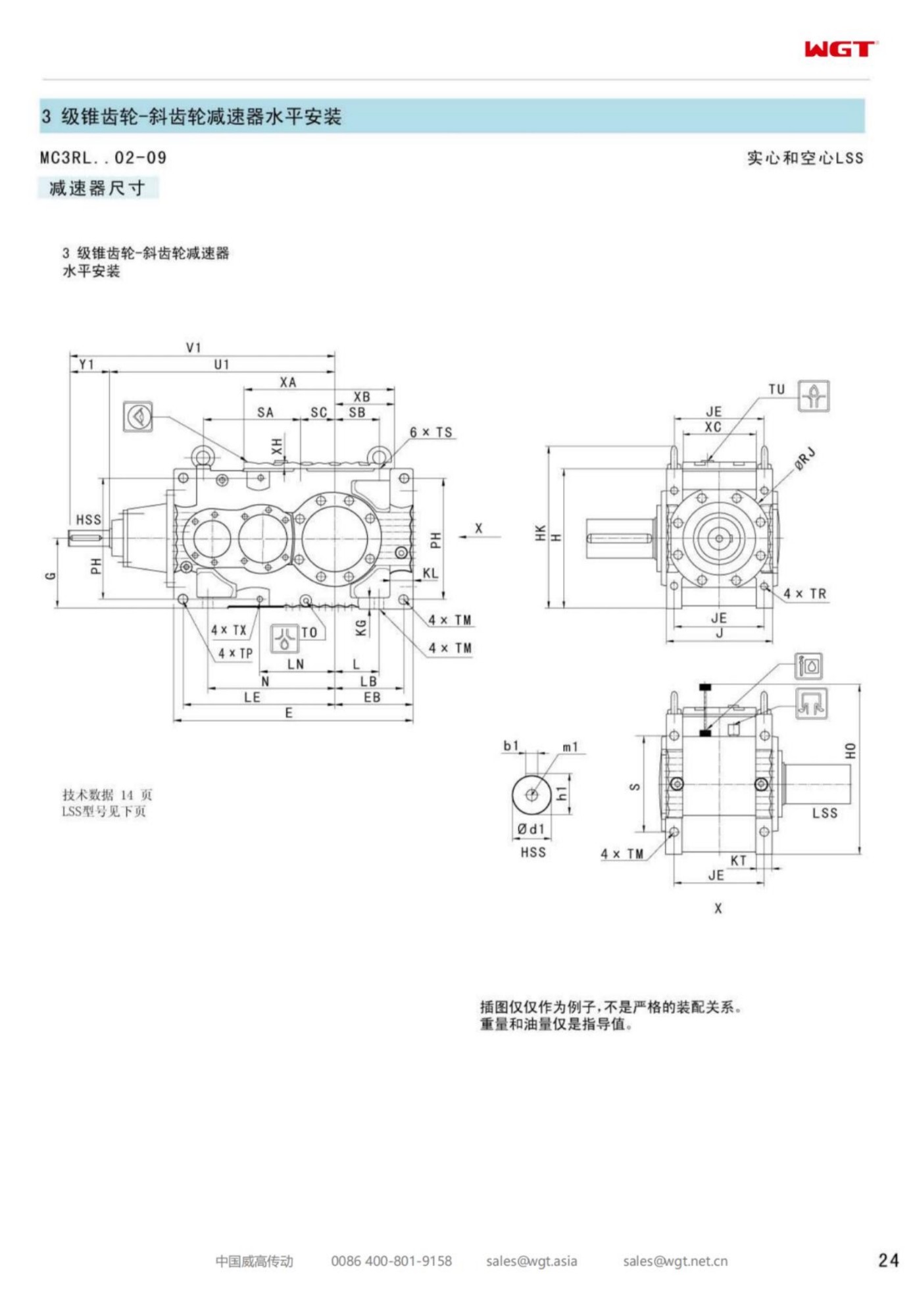
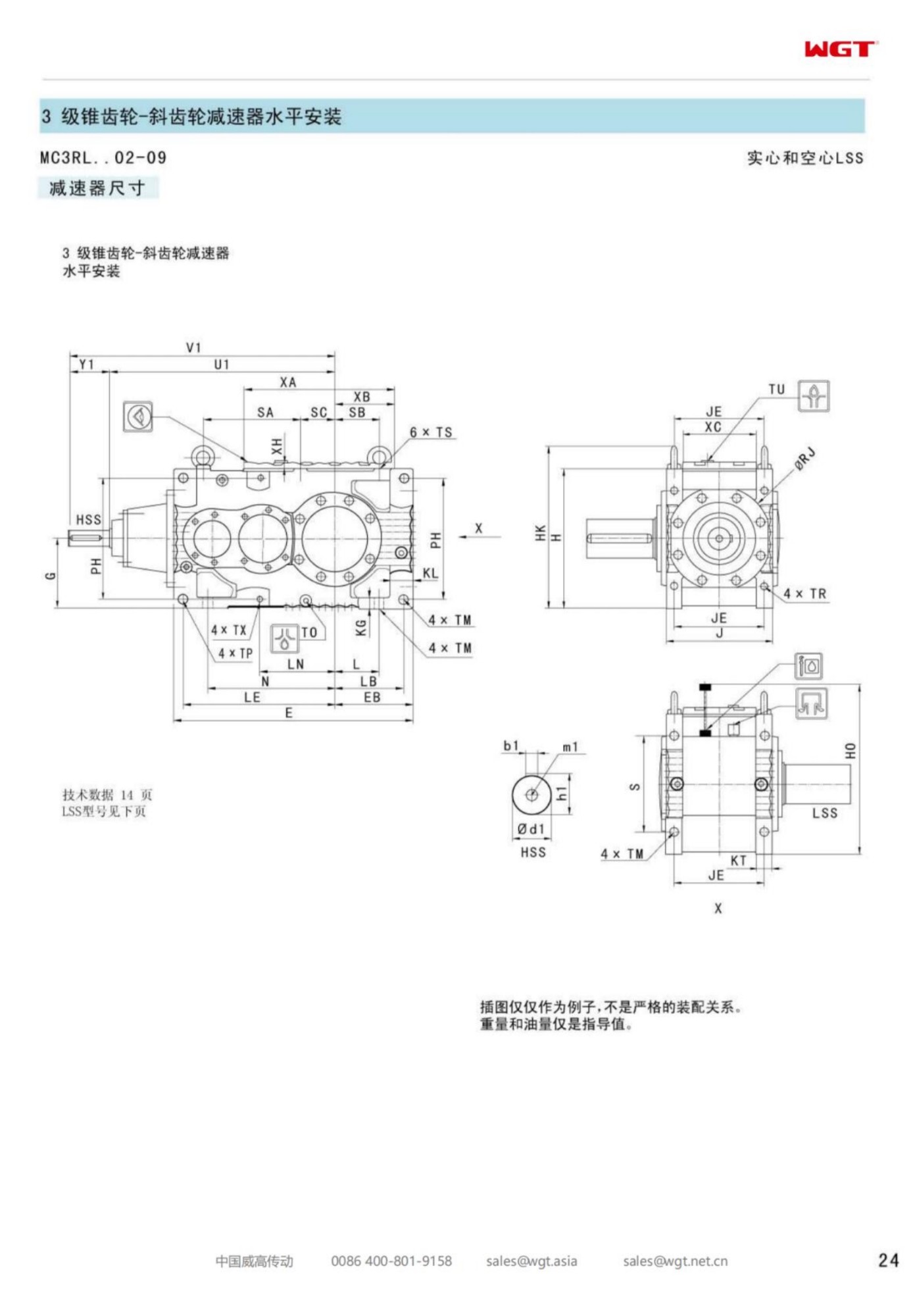
Every product band has a frame that becomes a house default - not because a catalogue prints it in bold, but because enough engineers have sized enough duties and landed on the same answer. In the hollow-bore, foot-mounted bevel-helical line, that answer is frequently the MC3RLHF06 bevel-helical gear unit: large enough to carry genuine process machinery, small enough that a crew of two can still handle it, and priced where a plant can hold one on the shelf without a committee. This page describes the frame six as it is actually bought, fitted and lived with.
The mechanical train is the family's own: a bevel pair turns the motor input through a right angle, two helical stages take the speed down, and the output is a hollow bore that climbs directly over the driven shaft from a case that sits on feet. Nothing about the arrangement is exotic. What the sixth frame adds is margin in the right places - wider bearing sections, a larger oil sump, a bore sized for shafts that carry real machinery - and it is those margins that decide how a drive behaves in its third year, not its third week.
The Frame at the Heart of the Mid Band
Ratios in a bevel-helical family overlap between adjacent frames, which means most duties can be met by either of two sizes. The choice between them is rarely about the ratio. It is about what the drive must survive: the thermal load of a dusty summer, the stall of a choked feeder, the hundredth loaded restart of a season. A frame five meets the average duty; a frame six absorbs the year. Plants that buy on that logic end up with fewer frame sizes in service, one oil grade, one seal kit, and a maintenance crew that knows the strip-down sequence by heart.
Standardisation has a second, quieter benefit. When the same frame appears on the clarifier, the lime conveyor and the screen building, the spares shelf shrinks to a drawer and the breakdown procedure becomes a routine rather than an investigation. The frame six earns its place as the band's centre of gravity precisely because it covers the widest span of duties with a single order code.
Where a Frame Six Is Found
Slow, heavy duties this frame turns without ceremony:
- Clarifier bridge drives turning slowly over settlement tanks all week
- Lime slurry screw conveyors feeding a neutralisation plant
- Apron feeders under a crusher house taking lump ore all shift
- Filter press plate shifters that cycle on the hour, every hour
- Paddle dryers on a sludge line where torque is steady and dirt is not
- Bar and rake screens at a water works head house
The common thread through that list is slow rotation with real torque and no tolerance for surprise stops. A clarifier bridge does not move quickly, but if it stops moving, the settlement process behind it stops with it. A lime screw that seizes mid-transfer backs material into a chute nobody wants to dig out at the end of a shift. The frame six is sized for machines like these - where the running figure is modest and the consequences are not.
The Same Letters, Read From the Stores
Most pages decode the type string for the design engineer. It is worth reading the same seven characters from the other end of the plant, where a crate arrives and somebody has to check it against the order before signing for it.
| MC | The industrial gear-unit family the order belongs to - a receiving check, not a performance claim |
| 3 | Three reductions inside: a bevel input pair and two helical stages |
| R | Right-angle layout: the motor sits across the driven shaft, so the crate's longest dimension is not the shaft line |
| L | Horizontal build: both shafts level in one case, feet flat on a bedplate |
| H | Hollow output bore: the unit mounts over the driven shaft, so the shaft itself ships loose and is stored separately |
| F | Foot mounting: the base plate and holding-down hardware follow the frame drawing, not improvisation |
| 06 | Sixth frame of the band: crate mass and lifting points grow accordingly - check the lifting plan before the crane is booked |
Three of those lines change the receiving procedure directly. The hollow bore means the driven shaft arrives as loose goods and must be protected until fitting day. The foot mounting means the holding-down hardware follows a frame-specific drawing. And the right-angle layout means the crate's orientation on the shelf decides which face the fitter finds the breather on - worth a chalk mark before the crate is stacked.
Torque Events and How the Case Takes Them
The running torque of the machines a frame six usually drives is settled within an hour of the plant opening. What varies is everything around it: the surge when a feeder chokes, the restart against a belt settled overnight, the shock when a screen blinds and then clears. These events are why the service factor exists, and why a duty description that lists them in writing produces a better-sized unit than one that states only the motor power.
A bevel-helical train absorbs these episodes well, but it keeps score. Each shock above the calculation leaves its trace in the bevel contact pattern, and an annual look at that pattern - a dab of marking compound, a turn of the input by hand - tells a maintenance crew years in advance whether the margins were honest. Units specified against their real events keep their pattern; units specified against the average meet it early.
The Bore Seat, Done Once
On a hollow-bore build the driven shaft and the bore make the joint, so the quality of the fit is the quality of the coupling. Before fitting day, three measurements settle everything: the shaft diameter at the seat against the drawing, the runout at the same position, and the keyway width and depth. All three take minutes; all three are expensive to discover as fretting corrosion a season later.
Fitting itself rewards patience over force. The case is supported so its weight never rides on the bore edges, bore and shaft are oiled rather than greased, and the unit is eased on square instead of driven on fast. The retaining hardware then holds the case against axial creep without clamping it hard against the machine - a distinction that sounds fine until an unleveled pad is found and a case is found fighting its own foundation. Done once and done square, the seat outlives every seal in the unit.
Oil Stories Told Once a Year
The sump on a frame six holds enough oil to be worth listening to. The first change comes early, within a few hundred running hours, to clear the debris of running-in. After that, an annual sample does the talking: water in the sample names a tired breather; steel and bronze wear metal name a bevel mesh losing its geometry; a rising dust mineral count names an ingress path that should not exist. A milky sample from a washdown corner is a breather wearing the costume of a bearing fault, and catching it at sampling stage is the entire point of taking one.
The level check belongs to the monthly round - cold, on the level, breather wiped first. It is a two-minute job that prevents the most common slow failure in the band: an oil level a litre low, running hot, spending a seal lip a year earlier than it should. No instrument predicts that failure better than a rag and a level plug.
Dust, Washdown and the Case Surface
Frame sixes live where plants are honest about their housekeeping - beside screens, under conveyors, in the spray path of washdown hoses. Dust on a warm case bakes into a felt blanket that holds heat in exactly where the unit can least afford it, so a wipe-down in the monthly round is maintenance, not tidiness. Where the position is hosed, the breather and plug seals are checked for tightness after the season's first wash, because a cooling case draws moisture in through any path it is offered.
The paint and the cast surface do more work than they are credited for. A case kept clean sheds radiant heat; a case furred with dust and oil film runs measurably warmer at the same load. The difference is a few degrees that never appear on any calculation - and a few degrees is precisely the margin a summer peak asks for.
Installation Day, Hour by Hour
A frame six fitting day rewards a written sequence. The driven shaft is checked and the spare space around it cleared before the unit leaves the stores. The lifting gear is sized to the crate mass on the drawing, not guessed at the crane. The case is brought to the shaft, supported clear of the bore edges, oiled and eased home. The key and retainer go in, the feet are levelled in the diagonal order, and only then are the holding-down bolts pulled to torque. The motor is set and aligned last, because every earlier step can move it.
Two habits separate a fitting day that ends at lunchtime from one that ends at night. The first is measuring before lifting - the three shaft checks above, done while the unit is still on the floor. The second is leaving the breather for last: fill the oil through it, fit it after, and the first hour of running does not breathe dusty workshop air straight into a fresh sump.
Noise and Vibration, Read Early
A bevel-helical unit that is right speaks with one voice: a smooth, geared murmur that settles after the first hour and never changes. What precedes trouble is change - a note that rises with temperature, a tick that appears at one position of a slow shaft, a shudder on restart that was not there at commissioning. None of these announce a failure; they announce a question worth asking a month before the failure would have asked it.
The commissioning recording is what makes that possible. Ten minutes of audio and a vibration reading at the bearing housings, taken when the unit was new, give every later reading something to be compared against. Plants that keep that baseline renew bearings on evidence; plants without one renew them on calendar, and the calendar is wrong in both directions.
An Enquiry That Returns a Quotation, Not Questions
The enquiry that gets quoted in one pass answers the fitter's questions before they are asked. Motor power, speed and starting method. The driven machine, described as it behaves rather than as it is named. Output speed and the tolerance the process accepts. Hours per day, counted over a real week. The ambient at the position, with dust and washdown stated plainly. The driven shaft diameter, keyway and usable length. Mounting position, motor orientation, rotation direction. Paint, nameplate, documentation.
Sent whole, that list returns a firm quotation and an outline drawing the layout can absorb without a query round. Sent as a power figure and a shaft diameter, it returns questions, and every round of questions is a week the project plan had already spent. The frame six is not expensive machinery; the delay from a thin enquiry usually is.
Field Applications
Stacker-reclaimer travel drive
A bulk terminal drives the travel gear of a stacker-reclaimer with units. Long-travel duty with frequent direction changes is smoothed by the ground gearing, and backlash stays within 20 arcmin over the full rail length.
Automatic parking system
A parking equipment manufacturer uses reducers on its puzzle-type car stackers. The hollow shaft takes the drive axle directly, and the quiet 60-68 dB operation suits installations inside residential buildings.
![where gear reducers are used in industry]()
Where these units are installed across industry.
Selection Example: Clarifier bridge drive at a municipal treatment works
Take a 7.5 kW motor at 1450 rpm turning the bridge at 25 rpm. The ratio follows directly: 1450 / 25 = 58, so a ratio near i=58 is drawn from the three-stage band, and the frame is checked against the surge when the scraper meets a wind-blown raft of solids after a storm. In this case the sixth frame turns the bridge with the bearing margin a long span deserves, and the hollow bore drops over the centre shaft without a coupling to align above live water. Once the ratio is fixed, check the required output torque against the rating table with the service factor applied - that is what decides the frame, not the ratio alone.
![gearbox selection guide: speed, torque, service factor]()
How a ratio and a frame size are determined, step by step.
Frame Sizes and Typical Duties
| Model | Centre distance | Output | Typical duty |
|---|
| M3PSF50 | size 50 | solid shaft, foot | conveyors, feeders |
| M3PSF60 | size 60 | solid shaft, foot | crushers, mixers |
| M3PSF70 | size 70 | solid shaft, foot | ball mills, shredders |
| M3PSF80 | size 80 | solid shaft, foot | kilns, heavy conveyors |
| M3PSF90 | size 90 | solid shaft, foot | mill and kiln drives |
| M3RSF50 | size 50 | solid shaft, foot, right-angle | inclined conveyors, elevators |
| M3RSF60 | size 60 | solid shaft, foot, right-angle | screw classifiers, feeders |
| M3RHF70 | size 70 | hollow shaft, foot, right-angle | agitators, drum drives |
| M3PHT80 | size 80 | hollow shaft, torque arm, parallel | shaft-mounted conveyors |
| M3RHT90 | size 90 | hollow shaft, torque arm, right-angle | heavy shaft-mounted drives |
The size number is the key dimension that steps up torque capacity through the range: 50 to 90 in horizontal builds, 10 to 90 in vertical builds. Gearing philosophy is shared across the family.
Gearbox Selection Support from the Factory Floor
Talk to the people who build it. Engineers can size the unit themselves in the WGT Motor & Gearbox Online Selection System - input speed, torque and duty, get the model instantly.
Our technical team sits beside the assembly line, not in a call centre. Describe the application in your own words - we will tell you honestly whether this series is right, or point you to a better frame or a different series. Looking for a gearbox for agricultural machine? Tell us the duty point and we will confirm the model in writing.
Common Questions from Buyers
Which lubricating oil should be used?
GB L-CKC220~460 or Shell Omala 220~460 as supplied. Under normal duty the housing is lubricated for life; in hot or continuous-duty environments an oil change after the first 400 hours and then every 4000 hours is recommended.
What warranty and documentation come with the gearbox?
A one-year warranty covers material and workmanship. Each unit ships with a test record (noise, temperature rise, backlash), a dimension drawing and an installation manual.
How do I calculate the ratio I need?
Divide motor speed by the target output speed (i = n1/n2), then check the required torque against the rating table with your service factor. The online selector below does this automatically.