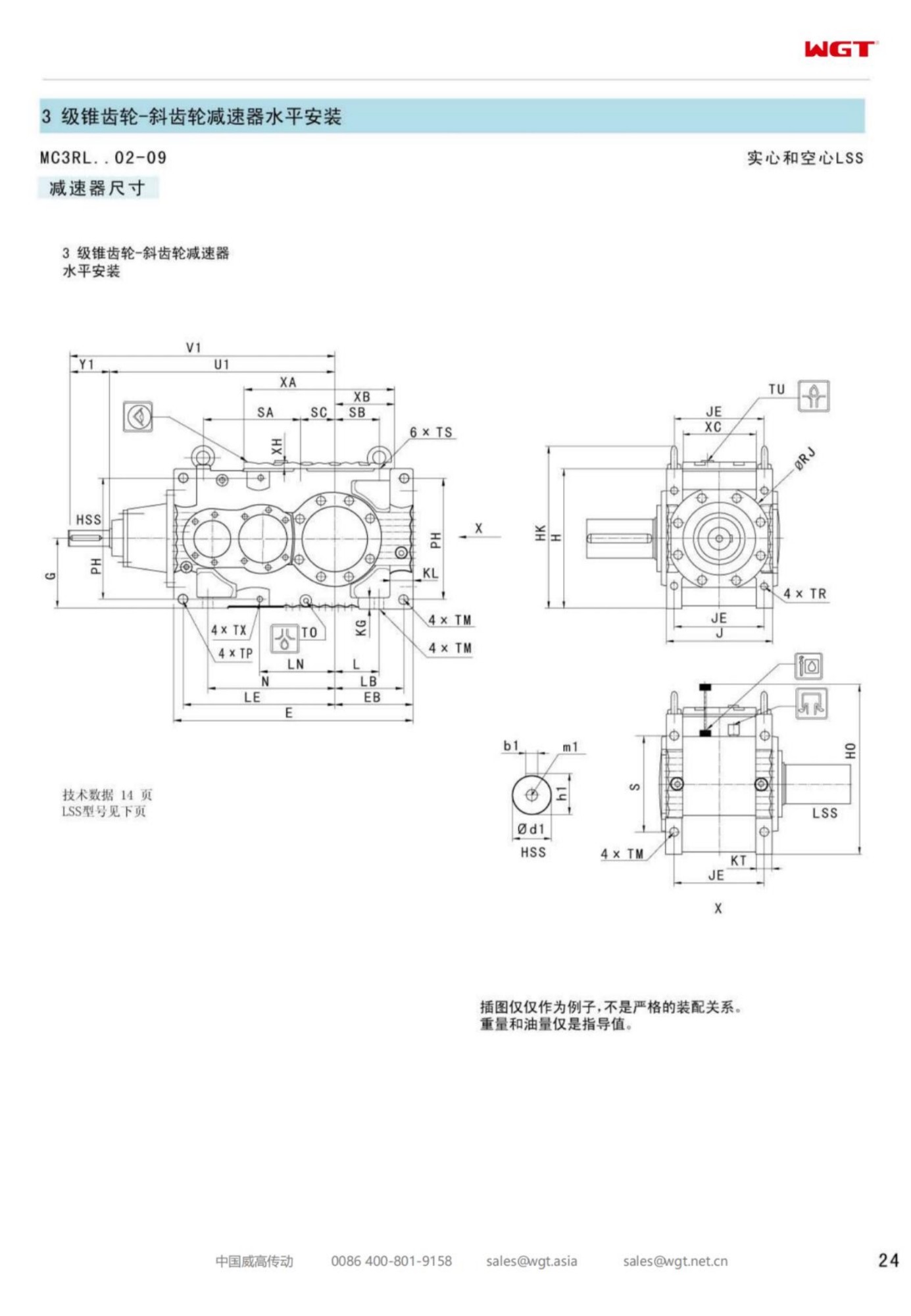
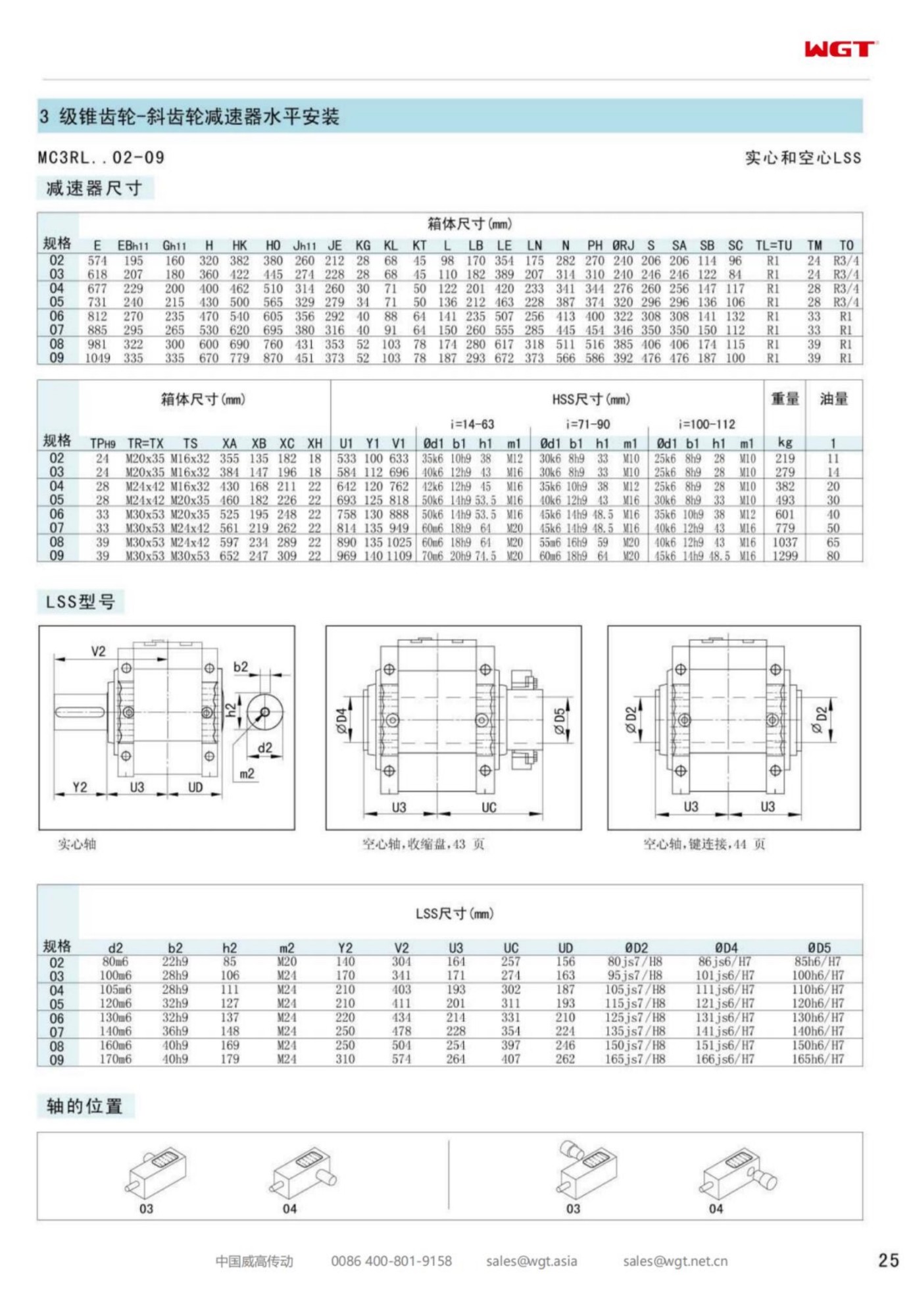
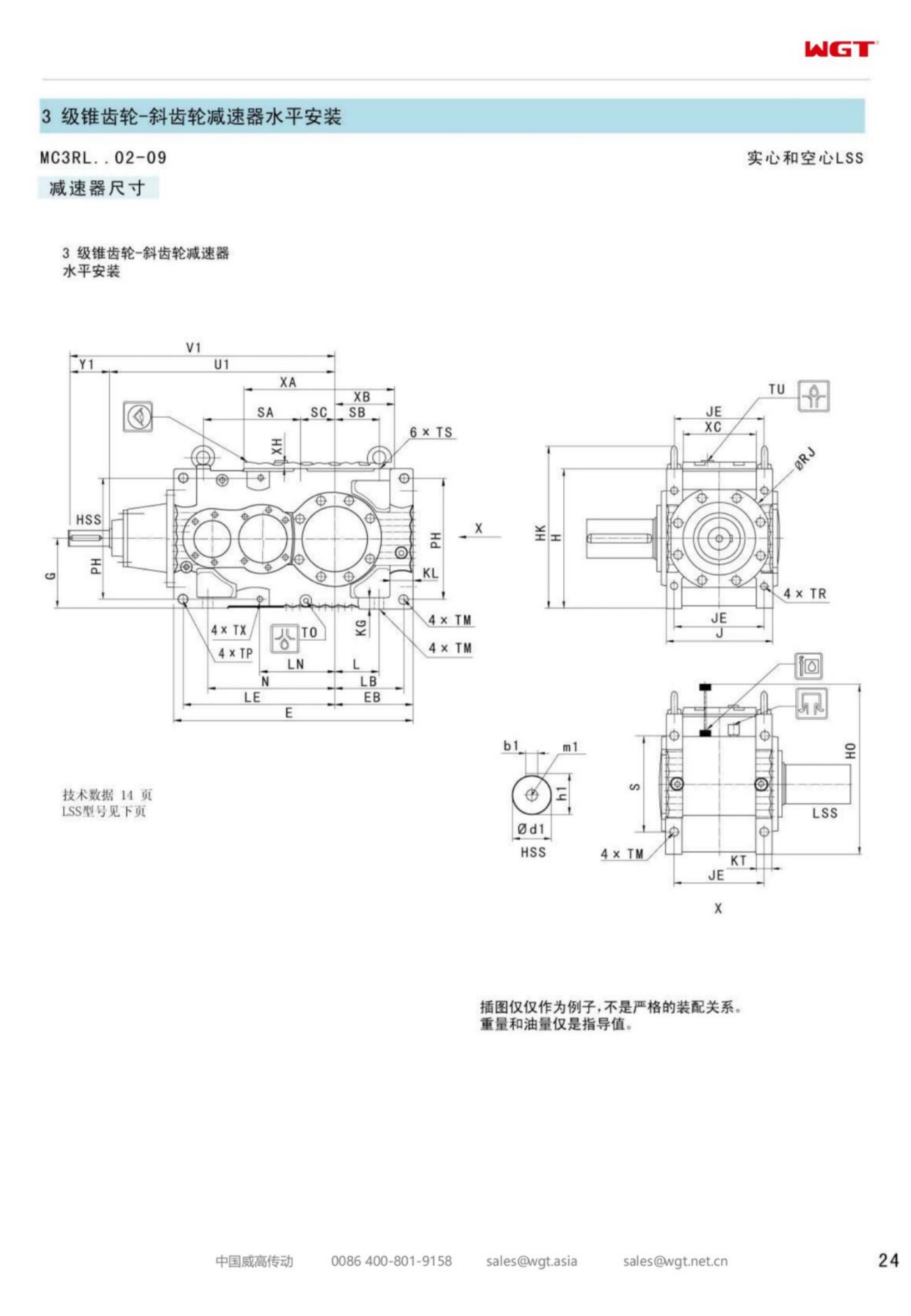
Plants divide their drives into two honest categories: the ones that attract attention and the ones that quietly earn their keep. The MC3RLHF08 bevel-helical gear unit belongs to the second group. It is specified for lines that start in January and stop for Christmas - belt presses that never really cool, conveyors that feed boilers through an entire crushing season, screens that shake from dawn to dark. This page describes what the eighth frame of the hollow-bore, foot-mounted band offers such duties, and what it asks in return.
The mechanical train is the family's own: a bevel pair turns the motor input through a right angle, two helical stages bring the speed down to where slow, heavy machines want it, and the output is a hollow bore that climbs over the driven shaft from a case resting on feet. What the eighth frame contributes is stamina - bearing sections rated for years of uninterrupted rotation, a sump sized to hold its temperature through a summer afternoon, and internal margins that absorb the small insults a continuous line collects by the hundred.
A Rating Written for the Clock, Not the Peak
Catalogue figures are often quoted at a duty cycle the buyer never actually runs. On a continuous line the governing question is not what the unit survives in the worst starting moment but where its temperature settles in the sixth hour of a warm shift. A gearbox in true continuous service reaches thermal equilibrium, and that equilibrium - not the peak torque - decides whether the oil, the seals and the bearings live out their intended years. The frame eight is chosen when the running point sits high enough that the smaller frames would live permanently warm, trading their margin away a degree at a time.
The arithmetic is worth doing before the order rather than after. Take the absorbed power of the driven machine at its honest worst, not its nameplate best, and read the frame's thermal rating at the real ambient of the position. Where the two curves cross comfortably, the eighth frame is the answer; where they nearly touch, the next size up earns its price within a single unplanned shutdown.
Plant That Runs This Frame Around the Clock
Round-the-clock machines this frame was sized for:
- Belt press dewatering lines running all week at a sludge works
- Bagasse conveyors feeding boilers through the sugar crushing season
- Broke conveyors returning trim to the pulper at a board mill
- Ship-loader belt drives working to a river berth's schedule
- Compost windrow turners crossing a facility floor twice a day
- Screen feed belts at a demolition and recycling depot
The pattern through that list is heat, moisture and no convenient stopping time. A belt press that halts dries out its cloth; a bagasse conveyor that halts idles a boiler line; a ship loader follows the berthing schedule, not the maintenance plan. Drives in that company are judged by a single figure above all - availability - and the eighth frame exists to protect it.
Efficiency, Counted in Kilowatt-Hours
On a drive that runs eight thousand hours a year, efficiency stops being a catalogue footnote. A percentage point of gear-mesh efficiency compounds into a five-figure energy line over the unit's working life, which is why the all-helical stages of this family matter on continuous duty in a way they never would on an occasional hoist. The helical meshes run cool and quiet, and the power they do not waste is power the motor never has to draw.
The companion to good gearing is honest right-sizing. An oversized unit carries its own windage and churning losses every hour it turns, so the cheapest kilowatt-hour is the one the frame never processes. Sizing the duty carefully and taking the frame that covers it with margin - rather than the frame above it out of caution - pays a quiet dividend on every shift.
Keeping Water on the Outside
Continuous lines are rarely kind environments. Washdown hoses, humid process air and the daily breathing of a cooling case all conspire to move water towards the oil. The defence is unglamorous and effective: lip seals in good condition, a breather sited out of the spray path and sized to the case's thermal breathing, and flange paint kept unbroken so rust never gets a start under a gasket edge. A case that breathes dry air stays dry inside; a case that inhales through a rain-filled breather will eventually show a milky sample no matter how sound the gearing.
Condensation deserves particular respect in humid seasons. As the unit cools overnight, the air inside contracts and draws moisture in through any path offered - which is why the breather is a maintenance item rather than a fitting accessory. A desiccant breather on a washdown position, or simply a monthly wipe-and-inspect on a dry one, costs minutes and prevents the slow water ingress that no oil change fully undoes.
Reading the Designation on the Crate
By the eighth frame the crate has real mass, and the receiving dock becomes part of the engineering. The type string on the nameplate compresses the whole arrangement into a few characters; read against the order, it answers most of the questions a stores clerk will ask before signing.
| MC | The industrial gear-unit family - the first thing the stores check against the order |
| 3 | Three reductions inside: one bevel pair and two helical stages |
| R | Right-angle build: the motor sits across the driven shaft, so the crate is deeper than it is long |
| L | Horizontal arrangement with both shafts level in one case |
| H | Hollow output bore: the unit mounts over the driven shaft, which ships as loose goods |
| F | Feet and holding-down hardware to the frame drawing |
| 08 | Eighth frame: the mass on the drawing governs the lifting-gear booking |
Two of those lines change the day's plan directly. The hollow bore means a driven shaft arrives as loose goods that must be stored clean and protected until fitting. And the frame number means the crane or hoist is booked against the drawing's mass, not against the impression the crate gives from the doorway.
Months in the Crate Before the First Turn
Not every unit goes straight from delivery to the plinth. Spares held on the shelf, project machinery delivered early, seasonal lines that start in a different quarter - all of these leave a frame eight standing for months, and standing is a condition that deserves its own routine. The transport plug stays in until the unit is mounted; the shaft is turned by hand a revolution or two every month so the bearings re-circulate their film and never rest on one spot; and the crate stays indoors, off a wet floor, away from a wall that sweats.
Before a stored unit is energised, three checks take minutes and prevent the classic first-start failures: oil condition and level if it was shipped filled, free rotation by hand without scraping or dead spots, and breather refitted after the transport plug comes out. A unit that passes those three starts its working life as if it had never waited at all.
When the Load Pushes Back Downhill
Inclined conveyors bring a question the flat ones never ask: what happens when the drive stops and the load wants to keep going. On a belt rising out of a pit or a screen feed climbing a gantry, the reversed torque finds its way back through the train, and an unprotected drive can turn backwards with the motor dead. The family answers it with a backstop option - an internal overrunning element that holds the load the moment the output tries to reverse.
The sizing point that matters is the held torque, which belongs on the enquiry in writing: gradient, loaded mass and whether holdback is wanted on the gearbox shaft or somewhere else in the line. Stated early, the backstop arrives built in and tested; discovered late, it becomes a retrofit conversation nobody enjoys having over a unit already bolted to a gantry.
Lubrication Made Boring on Purpose
The most reliable oil programme is the one nobody has to think about. Plants that run this band as a family settle on a single grade across every frame, which turns the oil store into one drum, the top-up procedure into one habit and the training of new fitters into an afternoon. The frame eight's sump takes its share from the same drum, and the sight glass reads the same way as its smaller siblings.
Discipline then reduces to a calendar: level checked cold on the monthly round, first change early in the unit's life to clear running-in debris, and an annual sample after that. The sample is where the programme earns its keep - water names a breather, bronze names a bevel mesh, and a rising dust count names a path in that should have stayed out. Logged year on year, the samples turn the unit's internal story into a line any planner can read.
Watching a Drive With No Control Room
Plenty of the positions this frame serves have no PLC watching them, and the drive's condition still announces itself to anyone equipped to listen. An infrared thermometer on the bearing housings at the same point each visit costs less than one bearing. A length of dowel pressed to the case and an ear pressed to the other end tells more about mesh condition than a month of guesswork. An hour meter reading copied into a logbook converts vague impressions into a rate of change.
The habit that ties those readings together is the baseline. Ten minutes spent at commissioning - temperatures noted, sound recorded, vibration felt and described in words - gives every later visit something to compare against. Plants that keep that first record renew parts on evidence; plants without one renew them on calendar, and the calendar is wrong in both directions.
The Order That Needs No Follow-Up
A continuous-duty enquiry is quoted fastest when it answers the thermal and electrical questions up front. Absorbed power of the driven machine at its honest worst, motor power and speed with the starting method named, output speed and the tolerance the line accepts, hours per day counted across a real week, ambient conditions with moisture and washdown stated plainly, driven shaft diameter, keyway and usable length, mounting position and breather orientation, backstop requirement if the duty rises, and the documentation the plant's file will want.
Sent whole, that list returns a firm quotation and an outline drawing the layout absorbs without a query round. Sent as a power figure and a shaft diameter, it returns questions - and on a line that runs continuously, every round of questions is downtime waiting for its moment. The frame eight is not complicated machinery; a thin enquiry is the only thing that makes it complicated.
Questions We Hear Most Often
What are the delivery lead times and shipping terms?
Standard lead time is 5-10 weeks ex-works, with popular ratios often available sooner. We quote EXW, FOB NINGBO / SHANGHAI or CIF, and urgent units can be air-freighted within 72 hours of payment.
What materials are used for the gears and shafts?
Gears are 20CrMnTi alloy steel, case-carburised to HRC58-62 over a tough HRC33-40 core. Input and output shafts are 42CrMo, quenched and tempered to HRC25-30. The housing is cast iron at HBS190-240.
Why does low backlash matter, and what is the limit?
Backlash is the small free rotation between input and output. We hold it within 20 arcmin - tight enough for indexing tables, positioning drives and reversing applications, without the cost of a precision servo gearbox.
Choosing the Right Frame Size
| Model | Centre distance | Output | Typical duty |
|---|
| M3PSF50 | size 50 | solid shaft, foot | conveyors, feeders |
| M3PSF60 | size 60 | solid shaft, foot | crushers, mixers |
| M3PSF70 | size 70 | solid shaft, foot | ball mills, shredders |
| M3PSF80 | size 80 | solid shaft, foot | kilns, heavy conveyors |
| M3PSF90 | size 90 | solid shaft, foot | mill and kiln drives |
| M3RSF50 | size 50 | solid shaft, foot, right-angle | inclined conveyors, elevators |
| M3RSF60 | size 60 | solid shaft, foot, right-angle | screw classifiers, feeders |
| M3RHF70 | size 70 | hollow shaft, foot, right-angle | agitators, drum drives |
| M3PHT80 | size 80 | hollow shaft, torque arm, parallel | shaft-mounted conveyors |
| M3RHT90 | size 90 | hollow shaft, torque arm, right-angle | heavy shaft-mounted drives |
One family, two layouts. Choose P for a coaxial-in / parallel-out drive train, R when the motor must turn 90 degrees; then pick the shaft type and mounting style that the machine interface needs.
Selection Example: Bagasse conveyor feeding the boiler line at a sugar mill
Take a 30 kW motor at 1470 rpm driving the head pulley at 26 rpm. The ratio follows directly: 1470 / 26 = 56.5, so a ratio near i=57 is drawn from the three-stage band, and the thermal check is run at the season-peak ambient because the conveyor never stops through the crushing campaign. In this case the eighth frame holds that duty in continuous service with sump volume to spare on a hot afternoon, and the hollow bore drops over the head shaft without a coupling to align above a live line. It always comes down to those three figures. Send them over and we confirm the frame, ratio and service factor in writing.
![online gearbox selection system workflow]()
Selection workflow used by our engineers for every quotation.
Real-World Duty Points
Glass batch charger
A float-glass line drives its batch charger with units. Abrasive raw material demands a robust drive, and the case-hardened gears show minimal wear after years of continuous operation.
Battery slurry mixer
A battery materials plant uses reducers on slurry mixers. High shear loads are absorbed by the 42CrMo shafts, and the 94-96% efficiency keeps motor sizing and running cost down.
![right angle gearbox duty points overview]()
An overview of the duty points this series is built for.
Sample Units Available for Performance Testing
Validating before you commit? Use the WGT Motor & Gearbox Online Selection System to turn your motor data into a model number, and we will quote that exact unit within the day.
Sample units can be supplied for bench or field testing so your team can confirm noise, temperature rise and backlash before a production order. Tell us the test conditions and we will prepare the documentation. Looking for a gearbox for belt conveyor? Tell us the duty point and we will confirm the model in writing.