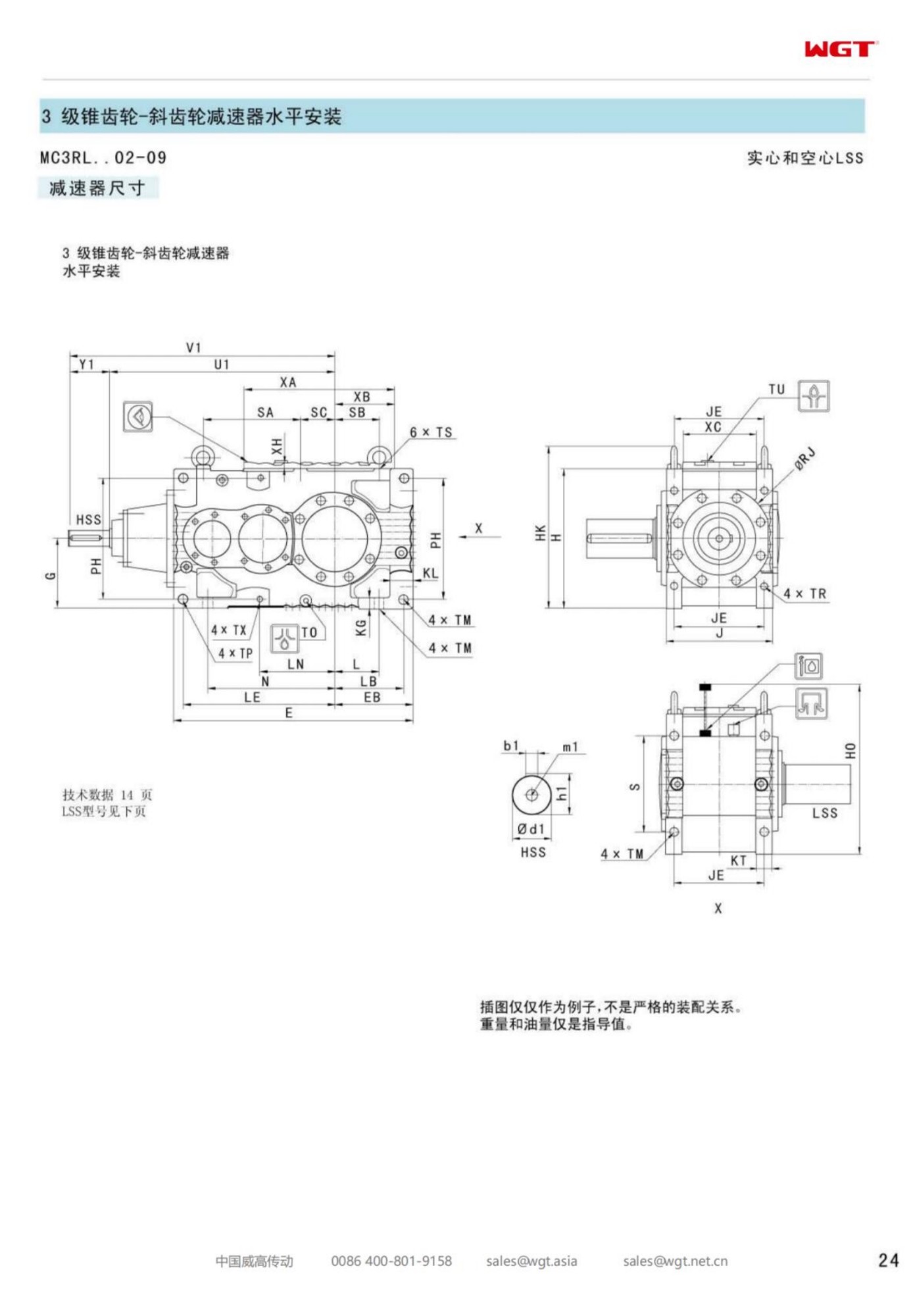
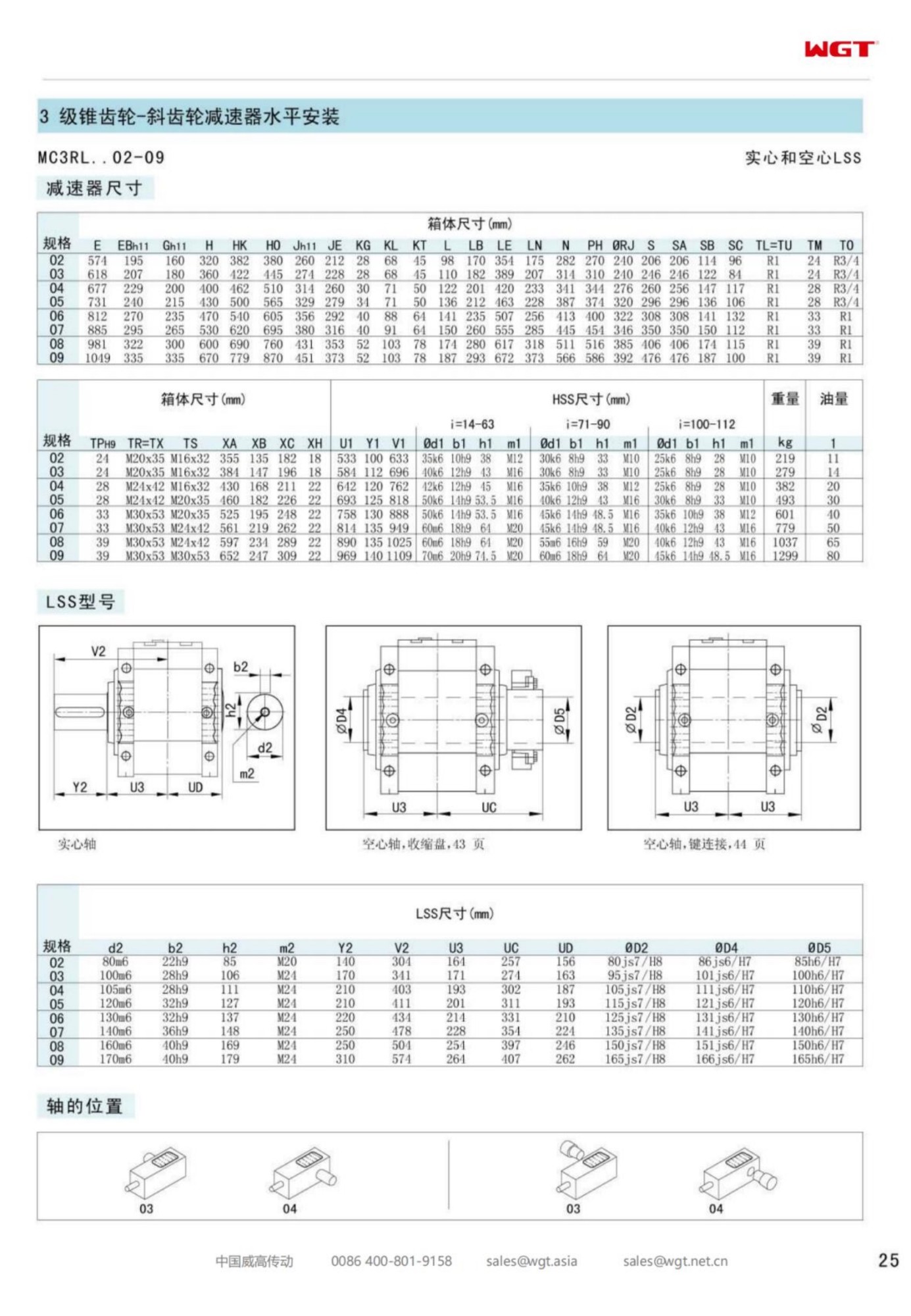
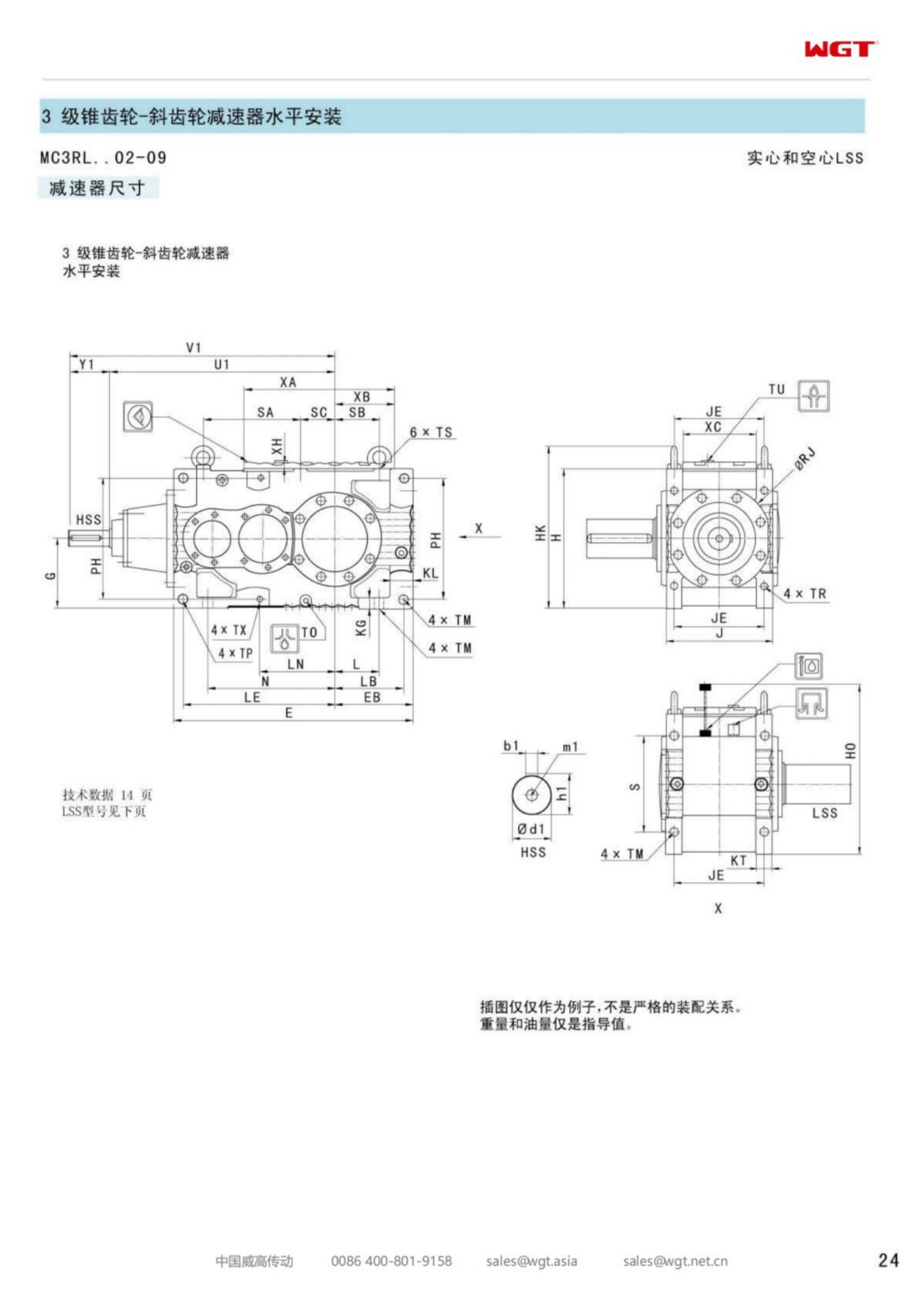
Sludge is not a fluid that behaves. It thickens as it settles, it turns thixotropic under agitation, and it arrives at a drive with a torque demand that can double between one shift and the next. When the output speed has to be very low and the torque very high, two stages run out of ratio and the answer is a third. The MC3RLHT02 right-angle hollow shaft gearbox is the small end of that three-stage band, quoted for thickener underflow, dewatering feed screws and the transfer pumps that move the result.
These notes are for the engineers who keep a treatment works running: why slow shafts change the specification, what hydrogen sulphide does to a case that lives in a wet room, how a torque arm anchors to a concrete wall instead of a foundation, and what belongs on the enquiry.
Slow Shafts in a Wet Room
A wet room is a hostile place for reasons that have nothing to do with splashing. Humidity stays near saturation, the air carries a sulphur load, and the temperature swings between a warm day and a cold night across every surface. Steel that is merely damp most of the time corrodes faster than steel that is regularly soaked.
That combination decides more of the specification than the torque figure does: paint system, fastener grade, breather position, and whether the case should be arranged so water runs off instead of standing on a cover.
Reading the MC3RLHT02 String
The code is short, but every position in it answers a question asked at the works.
| MC | Industrial gear unit family for continuous plant duty |
| 3 | Three stages in the case - two helical reductions into a bevel set |
| R | Right-angle build, the motor set back from the wet side |
| L | Level output axis, along the wall or the channel |
| H | Hollow output bore keyed onto the driven shaft |
| T | Torque-arm bracket, reaction into the wall or the frame |
| 02 | Second frame, the smallest bore in the three-stage band |
Three stages are there for ratio, not for capacity. They let a four-pole motor turn a shaft at a few revolutions per minute in one unit, which is why this band appears wherever a process needs slow rotation and full torque from the first turn.
Three Stages Where Torque Is the Question
Adding a stage multiplies ratio and adds a mesh to share the load. The practical consequence is that a small frame can deliver a large output torque at a very low speed, which is exactly the shape of a sludge duty: a shaft turning at single-digit revolutions per minute with a scraper or a screw hanging on it.
It also means the frame is chosen on torque and on the structure that carries the reaction, not on the motor that happens to be in the stores. Get those two right and the third stage earns its place; get them wrong and the extra mesh simply shares the failure.
Sludge Consistency and the Load That Changes
The same works can produce sludges with very different behaviour across a week. Digested sludge is comparatively well-behaved; a polymer-dosed sludge can gel; a raw primary sludge can settle into something closer to a solid between shifts, and the drive meets it on the restart.
That variability is the reason a service factor argued on the running load is not enough here. Describe the worst consistency the works can produce, how long it can stand before the drive starts again, and whether the control philosophy permits a jog or a slow breakaway. Those three answers decide the frame more reliably than any average torque figure.
Hydrogen Sulphide and the Case
Sulphide attack is quiet. It does not produce the flakes that water does; it produces a dull surface, then a thinning one, and it goes for the fasteners and the seal housings first because they are where the exposed edges are.
Specify for the atmosphere rather than for the splash: a paint system with a proper primer, fasteners in a corrosion-resistant grade, and seal materials that tolerate the chemistry. A stainless breather is a small line item that removes one reliable failure point from the walk-round.
Torque Arm on a Concrete Wall
Treatment works are built in concrete, and the drive usually lands on a wall bracket rather than on a plinth. That is an advantage if the bracket is designed, and a slow crack if it is improvised from angle iron and a hammer drill.
Put the stay square to the reaction where the wall allows, spread the load with a plate rather than four bolts, and allow for the reaction reversing when the shaft is turned back during maintenance. Check the anchors at the annual inspection: they are the part of the installation nobody looks at until something moves.
Screw Feed and the Rag Problem
Screens catch most of the rags, and the rest find the screw. A rag wrapped around a screw flight does not stop it immediately; it builds a load that the drive carries quietly until the torque climbs into the trip or the shaft gives.
A drive with margin and a torque monitoring relay that trips on trend rather than on absolute value is the practical answer. So is a maintenance routine that clears the screw on a schedule rather than on a symptom, because by the time the symptom is a trip the flight is usually bent.
Wash-Water and the Seal Flush
Wash-water is good for the process and hard on seals. A lip running dry against a shaft that alternates between wet and dry will wear a groove; a lip running with grit in the water will wear faster.
Where wash-down is routine, a dust lip ahead of the main seal and a shaft surface that is smooth where the lip runs are worth more than any claim on an ingress rating. Where the wash is pressurised, a simple deflector keeps the direct jet off the seal housing altogether.
Starts, Stops and the Control Philosophy
Treatment works run to flow, and flow varies through the day. That means the drive starts and stops more often than a process engineer's torque calculation usually assumes, and the worst start is the one after a long settle.
Two measures are cheap at the design stage: a control sequence that starts the drive before the sludge is admitted, and a variable-speed arrangement where the process can benefit from it. Neither can be added later without a panel change, so both belong in the same conversation as the frame size.
Polymer Dosing Changes Everything
Dosing turns a thin sludge into a structured one that releases water quickly and then resists movement. For the dewatering feed, that is exactly the intended effect; for the drive, it is a change of load character that arrives with a chemical rather than with a drawing.
Ask what the works doses, at what rate, and whether the dose changes seasonally. A drive specified before the polymer programme was introduced is a drive specified for a different material, and that is a conversation worth having before the frame is ordered rather than after the first trip.
Writing the Enquiry for a Sludge Drive
The enquiry that gets this frame right describes the material and the place: solids content range, worst consistency, standing time before restart, dosing practice, wash-down routine, shaft dimensions and condition, wall or frame available for the stay, and the atmosphere in the room.
The reply should answer as a system: bore and key against the drawing, ratio and output speed, service factor argued on the settled start, seals and breather for a wet sulphide atmosphere, paint and fasteners for the room, and arm geometry drawn against the concrete. Then the unit arrives as part of the plant.
A Frame Two Through the Wet Season
Treatment works are judged in the wet season, when flow doubles and nothing gets the maintenance hours it was promised. Drives that come through are the ones whose arm anchors were checked, whose breathers stayed clear, and whose bores were tight because the shaft was clean at assembly.
Frame two carries its half with three stages that deliver slow torque from a small case, a hollow bore that needs no coupling in a wet room, and margin held for the settled start. The works carries the rest with a walk-round and a dosing sheet that tell the truth.
Settled sludge, sulphide air and a restart that decides the frame - the three-stage band holds it:
- Thickener underflow screw feed at a municipal treatment works
- Dewatering centrifuge feed conveyor on a sludge line
- Sludge transfer screw between holding and digestion tanks
- Grit classifier screw at the inlet works
- Cake conveyor after a belt press
- Chemical dosing and mixing shaft drive in a wet room
Field Applications
Asphalt plant aggregate feeder
An asphalt plant powers its aggregate feeders with reducers in outdoor, dusty conditions. The cast-iron housing and standard paint finish have come through several winters without refurbishment.
Fertiliser granulator drum
A fertiliser producer drives granulator drums with gear units. The slow, high-torque rotation needed to tumble the granules is a natural fit, and the torque-arm option avoids a heavy base frame.
![where gear reducers are used in industry]()
Where these units are installed across industry.
Selection Example: Thickener underflow screw feed at a treatment works
Take a 5.5 kW motor at 1440 rpm turning the screw at 6.5 rpm. The ratio follows directly: 1440 / 6.5 = 221, so a ratio near i=220 comes out of the three-stage right-angle band, and the frame is confirmed against the settled sludge the screw meets on the first start of the morning rather than the running torque. In this case frame two of the three-stage band delivers that output from a small case, hangs on the shaft through a hollow bore, and reacts into a wall bracket above the wet floor. Once the ratio is fixed, check the required output torque against the rating table with the service factor applied - that is what decides the frame, not the ratio alone.
![gearbox selection guide: speed, torque, service factor]()
How a ratio and a frame size are determined, step by step.
Frame Sizes and Typical Duties
| Model | Centre distance | Output | Typical duty |
|---|
| M3PSF50 | size 50 | solid shaft, foot | conveyors, feeders |
| M3PSF60 | size 60 | solid shaft, foot | crushers, mixers |
| M3PSF70 | size 70 | solid shaft, foot | ball mills, shredders |
| M3PSF80 | size 80 | solid shaft, foot | kilns, heavy conveyors |
| M3PSF90 | size 90 | solid shaft, foot | mill and kiln drives |
| M3RSF50 | size 50 | solid shaft, foot, right-angle | inclined conveyors, elevators |
| M3RSF60 | size 60 | solid shaft, foot, right-angle | screw classifiers, feeders |
| M3RHF70 | size 70 | hollow shaft, foot, right-angle | agitators, drum drives |
| M3PHT80 | size 80 | hollow shaft, torque arm, parallel | shaft-mounted conveyors |
| M3RHT90 | size 90 | hollow shaft, torque arm, right-angle | heavy shaft-mounted drives |
The size number is the key dimension that steps up torque capacity through the range: 50 to 90 in horizontal builds, 10 to 90 in vertical builds. Gearing philosophy is shared across the family.
Custom Shafts and Ratios for OEM Builds
Non-standard interface? Engineers can size the unit themselves in the WGT Motor & Gearbox Online Selection System - input speed, torque and duty, get the model instantly.
Splined, extended or flanged output shafts and special ratios are quotable for OEM volumes. Tooling cost is amortised across the order, and the drawing approval cycle starts the day you ask. Looking for a gearbox for mixer and agitator? Tell us the duty point and we will confirm the model in writing.
Common Questions from Buyers
How do I match the gear unit to my existing foundation?
Send the nameplate or the outline drawing of the unit being replaced. Frame dimensions follow the common industry dimension ladder, so foot holes, shaft heights and flange bolt circles normally match without redrilling foundations.
What ratio range does an industrial gear unit cover?
The range spans from low single-digit reductions to very high ratios by combining stage counts: two-stage builds for the lower band and up to five-stage builds for the highest reductions, with intermediate ratios available between catalogue steps on request.
Which lubrication system does the unit use?
Small and medium frames run on splash lubrication with mineral or synthetic oil. Larger frames or high ambient temperatures can be ordered with forced-feed circulation and cooling coils; the lubricant grade is stated on the nameplate and in the manual.