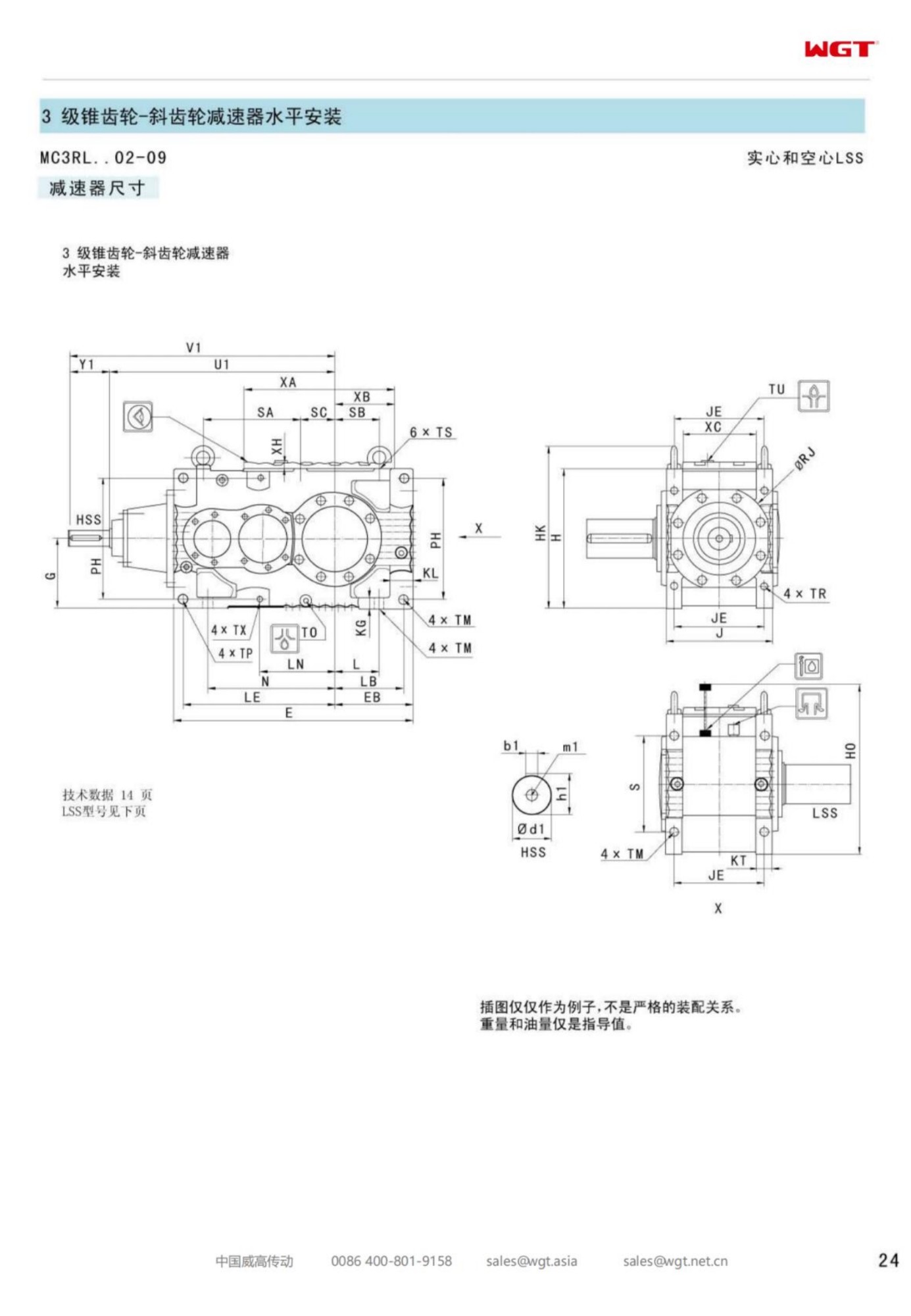
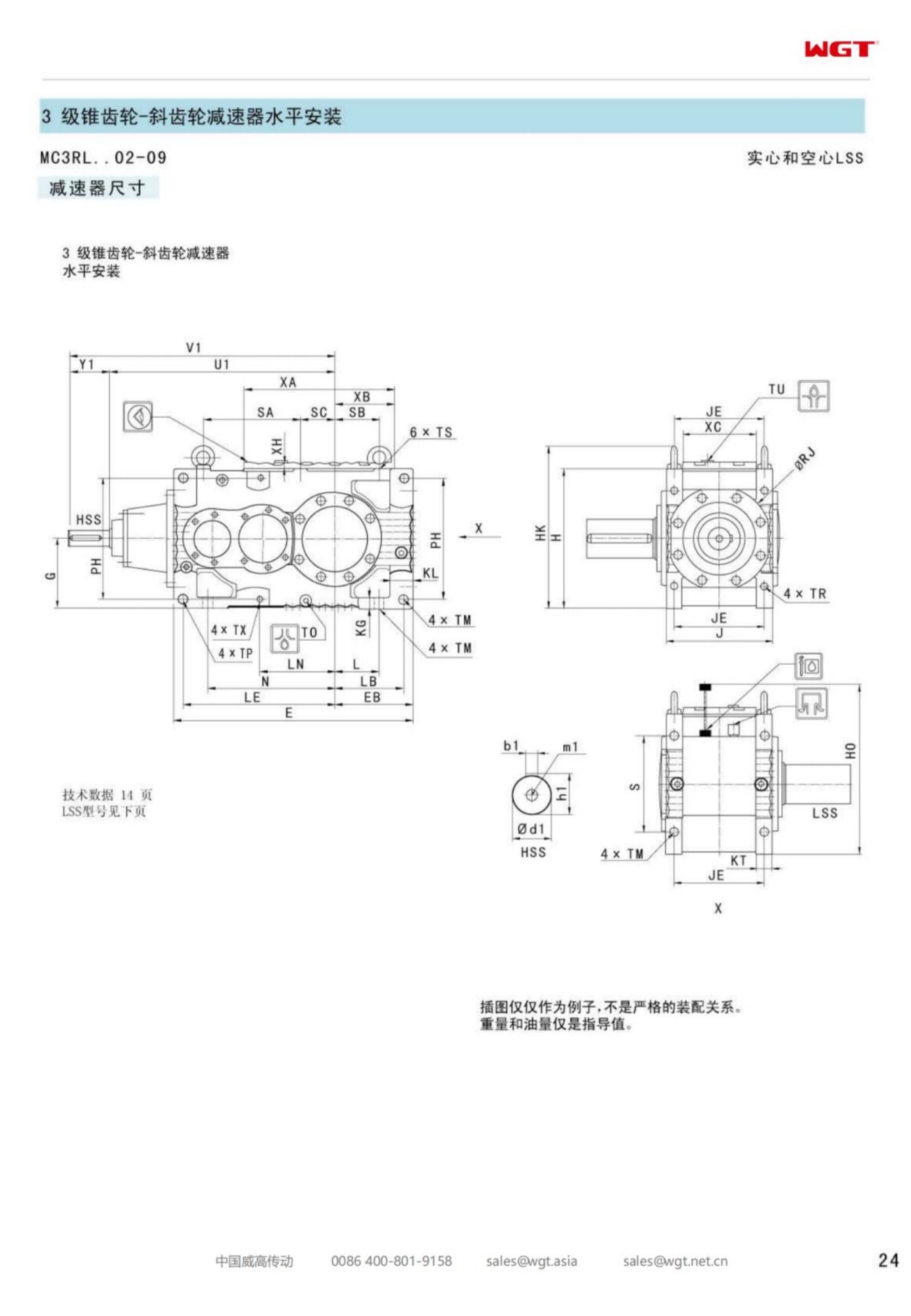
There is a moment in every right-angle drive selection when the duty stops being polite. A yard conveyor that once carried screened stone starts taking run-of-crusher feed; a reclaimer that worked one shift now works two; a kiln feed screw that ran dry in commissioning now runs buried in powder. That moment is where a small corner unit runs out of manners and the MC3RLSF04 bevel-helical gear unit begins to make sense. It is the fourth frame of the right-angle branch - a bevel input stage turning the drive ninety degrees, then two helical stages cutting speed at a rate a single pair could not reach in a case that would fit the same plinth.
The 04 is not simply a bigger 03. Wider faces, a deeper sump and a stouter output assembly change what the unit tolerates: sustained overhung load, the occasional buried start, ambient heat that never drops below thirty degrees. What follows is written for the engineer or the maintenance planner who has to make that argument in writing, once, and then live with it for two decades.
A Corner That Carries Tonnage
Aggregate and mineral plants are laid out around material flow, not around gearbox convenience. A transfer point sits where the ground allows, a stockpile sits where the drainage allows, and the drive ends up between them at whatever angle the two lines happen to meet. A parallel-shaft unit forces the motor out along the conveyor axis into the walkway; a right-angle case turns the motor sideways and keeps the gangway clear.
At frame four that argument carries real tonnage behind it. The bevel pair is sized to take full motor speed with a contact pattern wide enough to survive grit that gets past a tired breather, and the helical stages below it are cut with face widths that keep tooth loading civil even when the belt is choked. The result is a drive that fits a cramped transfer tower and still has something in reserve for the afternoon the crusher produces a lump nobody expected.
Reading the Type String at Frame Four
Six characters plus a size number describe the entire mechanical agreement between plant and factory. Read them against the general-arrangement drawing once, and the rest of the project can quote the type without explanation.
| MC | Multi-stage industrial gear unit built for continuous plant service |
| 3 | Three reductions in series: one bevel stage at the input, two helical stages at the output |
| R | Bevel-helical layout with the motor shaft at ninety degrees to the driven shaft |
| L | Horizontal mounting: shafts level, case seated on its foot plane |
| S | Solid output shaft with parallel key for a keyed coupling or sprocket |
| F | Foot mounting on a prepared horizontal bedplate or steel frame |
| 04 | Fourth frame of the band (02-09): the size where aggregate and mineral duties become routine |
What the string leaves out matters as much as what it carries. The exact ratio, the motor position relative to the case, and the direction of rotation are all decided on the enquiry, not in the catalogue. On a right-angle unit the motor can hang left, right, high or low, and each arrangement moves the breather, the oil level plug and the drain. A drawing that fixes all three before the order leaves saves a site modification later.
The Bevel Mesh and the Two Helical Stages Below It
Speed handling in a three-stage right-angle case is a relay. The bevel pair takes the baton at full motor speed, turns the course and hands over a slower, calmer rotation; the first helical stage cuts again; the second delivers the final shaft speed with torque multiplied twice over. The relay explains the maintenance priority: the fastest mesh sees the most cycles per hour and the least tolerance for poor lubrication, so it sets the tone for everything downstream.
In practice that means the oil grade and the breather deserve more attention than they usually get. A bevel mesh running in clean oil at the right level will outlast the plant's memory of who installed it; the same mesh running in emulsified oil will announce itself as a rising whine long before any temperature gauge moves. Photograph the contact pattern at commissioning, keep the picture in the machine file, and every later inspection has a baseline rather than an opinion.
Duties That Fill an 04 Shift
Vertical right-angle duties where the frame step-up is usually justified:
- Head drives on aggregate yard belt conveyors running two shifts
- Screw reclaimers pulling clinker from open stockpiles
- Rotary kiln feed screws on lime and dolomite lines
- Mixer shafts in dry mortar and plaster blending plants
- Travelling stacker booms on small bulk terminals
- Flight conveyors moving wood chips into a boiler day bin
These are duties with a shared signature: the load is steady in the good hours, brutal in the bad ones, and the machine is expected to restart into whatever it was buried in. That restart, not the running torque, is what separates frame four from frame three. Where a plant knows its worst start - a choked transfer chute, a stockpile that has drained onto the belt overnight - that number belongs in the enquiry in plain words.
Setting a Foot-Mounted Right-Angle Drive on Site
Installation of a right-angle unit adds one chapter to the usual routine, and it is the chapter crews skip. Because the input sits across the corner, a motor coupling misalignment shows up as axial rocking of the bevel mesh rather than the obvious radial wobble of a parallel drive. The symptom is quieter and the repair is more expensive, so the alignment is worth doing twice: once cold to the gauge figures, once warm after the first loaded hour.
The rest is the familiar discipline. Grout or shim until every foot sits flat with no bolt pulling a pad down; torque in the sequence the drawing gives, diagonally and in stages; check the output coupling to the driven shaft with the feet finally tight, not before. Record what the gauges read and file it with the contact-pattern photograph. Two pages of paper at commissioning are worth more than any number of service visits afterwards.
The Weekly Five-Minute Walkround
A drive of this size does not fail without warning; it fails after the warnings have been ignored for a season. Five minutes a week covers everything that matters. Listen at the input bearing, the bevel housing and the output bearing in turn - a change in tone at one station is information, a change everywhere is usually the foundation. Look at the sump sight glass or dipstick for level and colour. Put a hand on the case, not to measure but to notice the day it feels different from last week. Wipe the breather; a blocked breather pushes oil past the seals and starts a chain of events that ends in a rebuild.
Write the readings down, even when they are unremarkable. A trend line needs a flat beginning to be useful, and the flat beginning is exactly what a healthy 04 gives you for its first years.
What the First Email Should Contain
A complete enquiry reads like a short technical brief: motor rating, speed and starting method; required output speed with the tolerance the process accepts; running and breakaway torque, described separately; hours per day and starts per hour; the honest worst-case ambient with radiant heat noted; mounting position with the motor side named; shaft and key dimensions if an existing coupling stays; overhung load and its distance from the shaft shoulder if a pulley or sprocket is involved; paint, nameplate and documentation requirements.
Send that in one message and the quotation comes back firm and orderable. Leave half of it out, and the quotation comes back with assumptions printed in the notes - which is a polite way of saying the risk has moved to the buyer. The 04 is a workhorse frame; it deserves a specification written by someone who expects it to still be working in 2045.
Field Applications
Coal handling conveyor
A power station coal-handling plant standardized on one industrial gear family for thirty drives. A single spare-part pool now covers the whole conveyor network, from transfer points to the bunker feed.
Dredger pump drive
A dredging contractor powers its slurry pump skid with an industrial gear unit built for shock loads. The dense abrasive mixture demands a rigid drive train, and ground gearing has kept backlash unchanged over multiple seasons.
![where gear reducers are used in industry]()
Where these units are installed across industry.
Selection Example: Head drive of an aggregate yard belt conveyor
Take a 30 kW motor at 1475 rpm turning the head pulley at 21 rpm. The ratio follows directly: 1475 / 21 = 70.2, so a ratio near i=70 is drawn from the three-stage bevel-helical band, and the frame is checked against the buried start that follows a chute choked overnight rather than against the steady running load. In this case the wide bevel faces and the deep sump of the 04 absorb both the lump feed and the summer ambient of an open yard, which is what a conveyor working two shifts actually asks for. Once the ratio is fixed, check the required output torque against the rating table with the service factor applied - that is what decides the frame, not the ratio alone.
![gearbox selection guide: speed, torque, service factor]()
How a ratio and a frame size are determined, step by step.
Frame Sizes and Typical Duties
| Model | Centre distance | Output | Typical duty |
|---|
| M3PSF50 | size 50 | solid shaft, foot | conveyors, feeders |
| M3PSF60 | size 60 | solid shaft, foot | crushers, mixers |
| M3PSF70 | size 70 | solid shaft, foot | ball mills, shredders |
| M3PSF80 | size 80 | solid shaft, foot | kilns, heavy conveyors |
| M3PSF90 | size 90 | solid shaft, foot | mill and kiln drives |
| M3RSF50 | size 50 | solid shaft, foot, right-angle | inclined conveyors, elevators |
| M3RSF60 | size 60 | solid shaft, foot, right-angle | screw classifiers, feeders |
| M3RHF70 | size 70 | hollow shaft, foot, right-angle | agitators, drum drives |
| M3PHT80 | size 80 | hollow shaft, torque arm, parallel | shaft-mounted conveyors |
| M3RHT90 | size 90 | hollow shaft, torque arm, right-angle | heavy shaft-mounted drives |
The size number is the key dimension that steps up torque capacity through the range: 50 to 90 in horizontal builds, 10 to 90 in vertical builds. Gearing philosophy is shared across the family.
Talk to the Factory, Not a Catalogue
Questions before ordering? Engineers can size the unit themselves in the WGT Motor & Gearbox Online Selection System - input speed, torque and duty, get the model instantly.
Our technical team works beside the assembly line. Describe the application in your own words and you get a straight answer - including when a different frame or series would serve you better. Looking for a gearbox for mixer and agitator? Tell us the duty point and we will confirm the model in writing.
Common Questions from Buyers
Will the unit match my existing gearbox interface?
The series is manufactured to the standard centre distances, shaft dimensions and flange patterns of its frame family, so couplings, guards and foundations do not have to be redesigned. Send the nameplate details and we confirm the equivalent frame in writing.
What is the maximum overhung load on the output shaft?
The permissible overhung load depends on frame size, output speed and the distance from the shaft shoulder - all listed in the catalogue. If you drive a chain sprocket or V-belt pulley direct on the output shaft, send us the load and pitch diameter and we will confirm the limit.
Do you offer a version with an integrated gear motor?
We can supply the unit as a complete gear motor with an IEC motor bolted on and tested as one assembly. That saves you the alignment and coupling work, and the whole assembly carries the same one-year warranty.