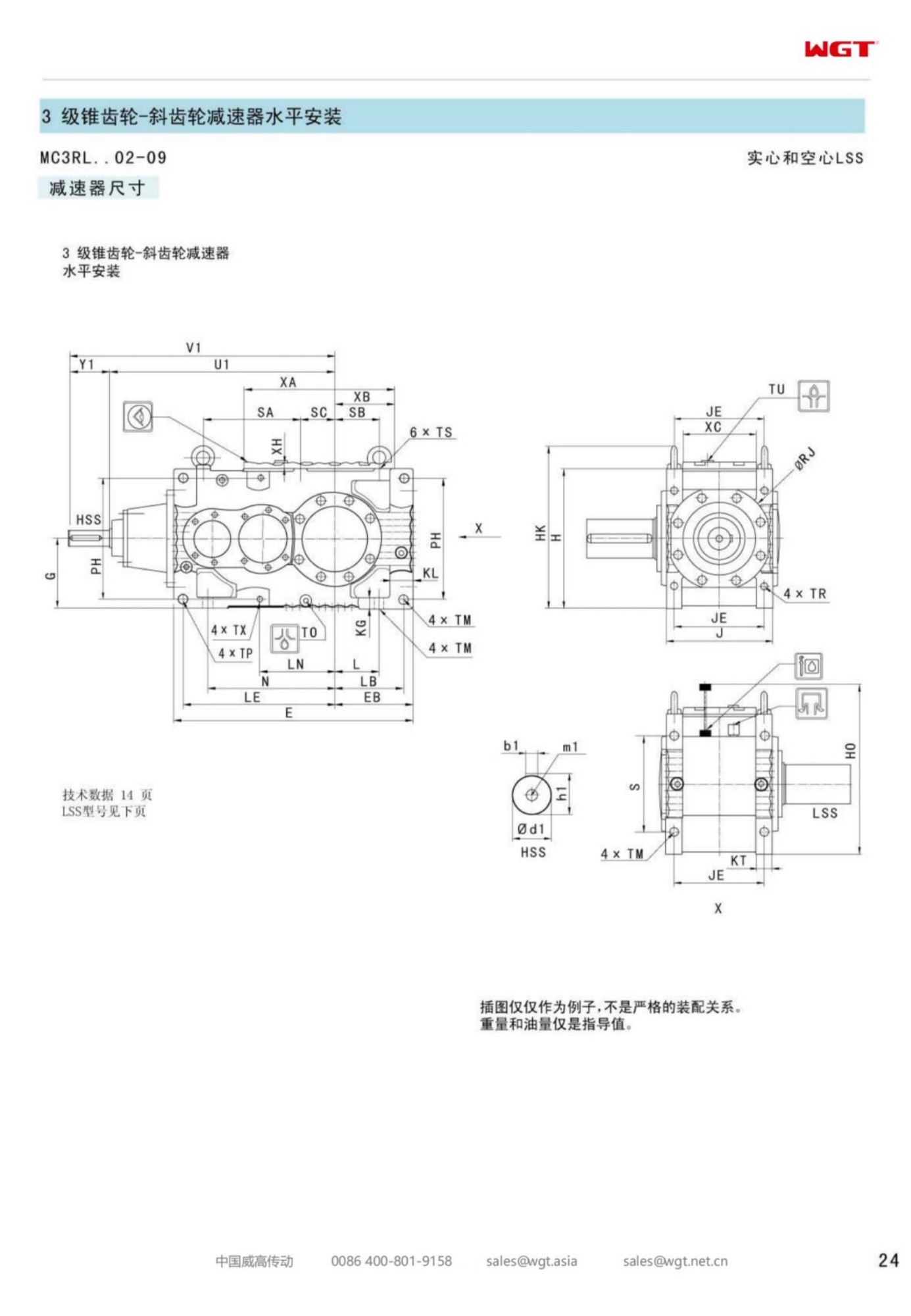
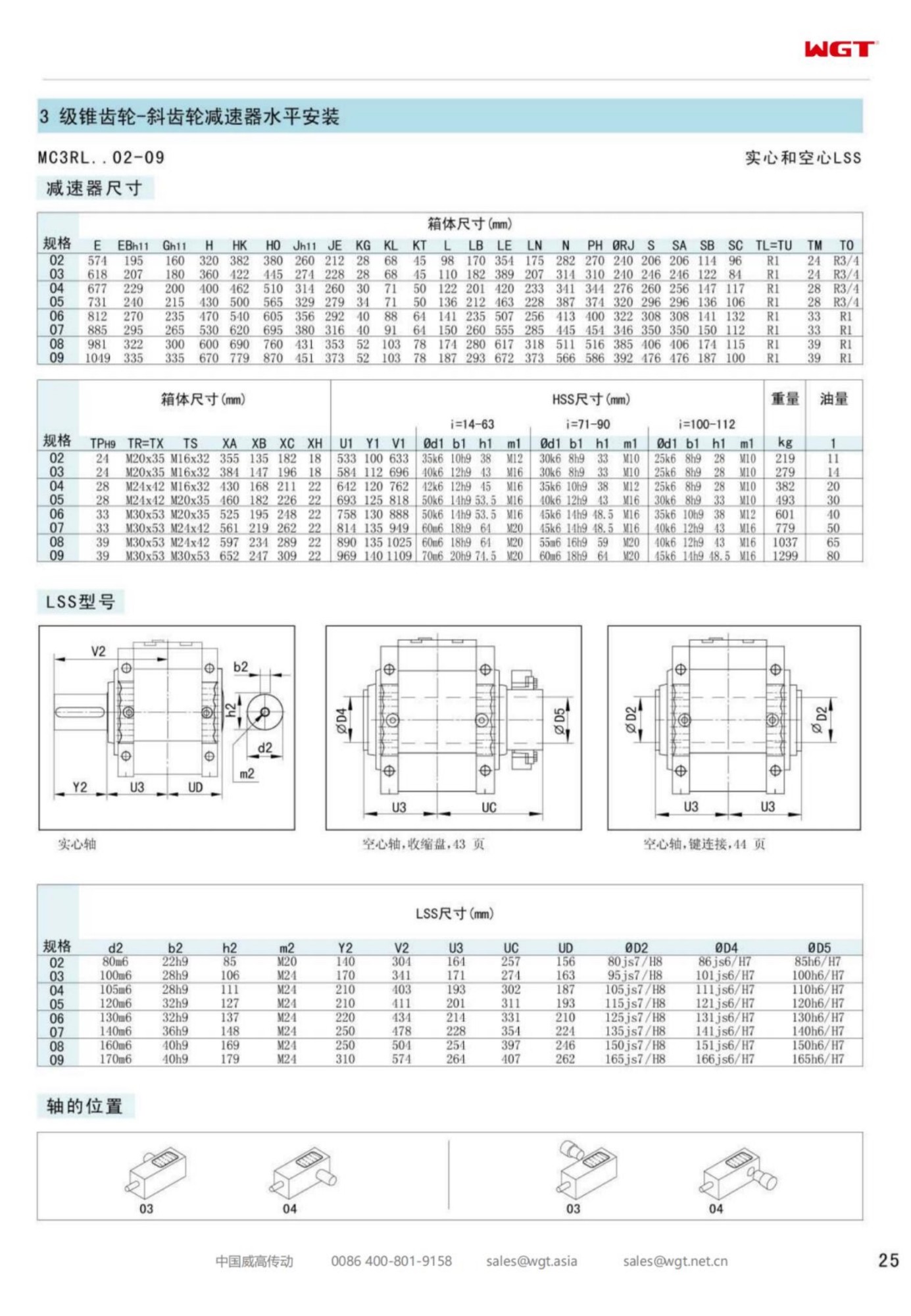
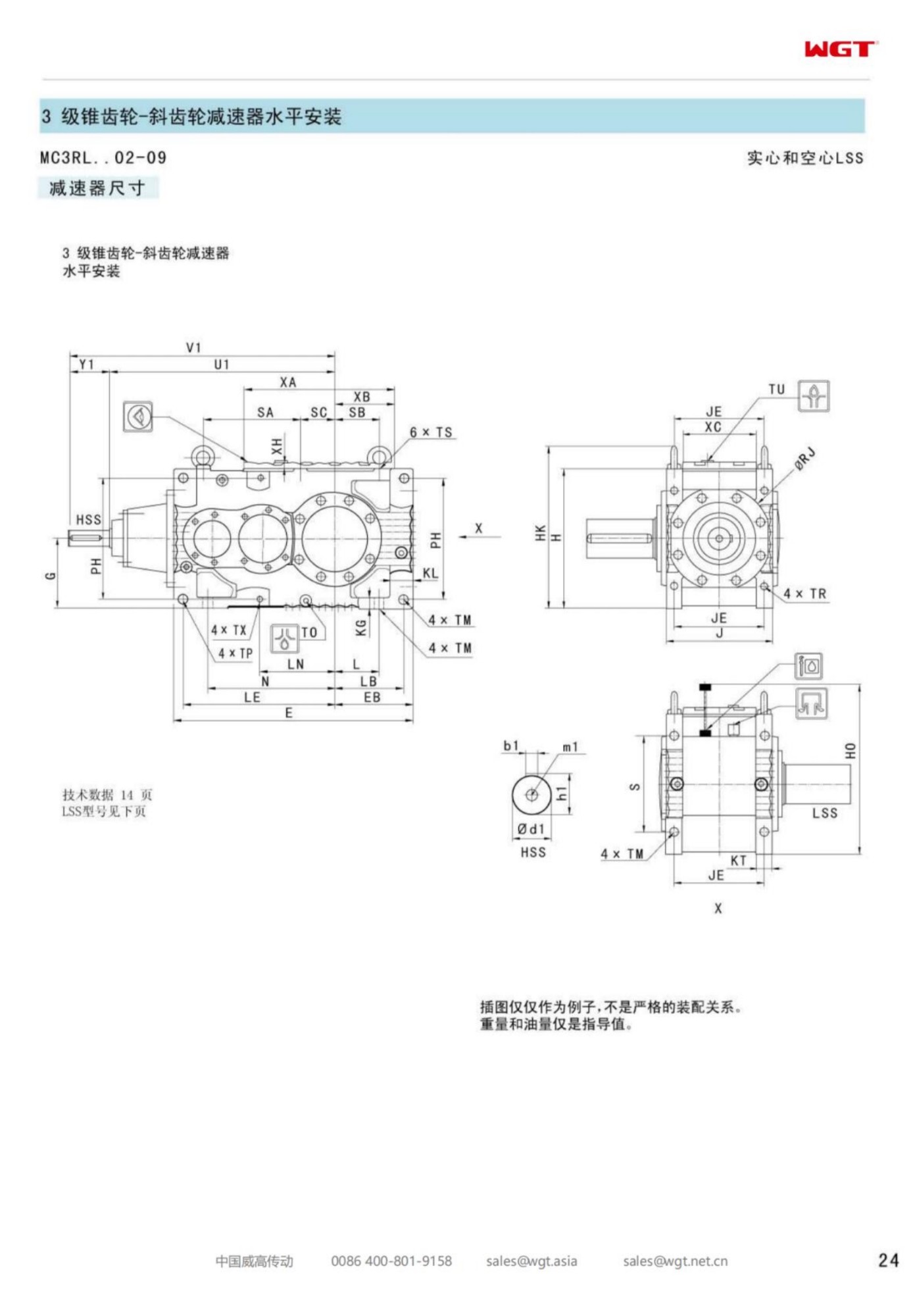
Ask a plant engineer which drive size they keep on the shelf and the answer is rarely the smallest or the largest. It is the middle one that covers most of the plant, the frame that gets ordered again whenever a machine is added because everyone already knows its oil volume, its foot pattern and which spanner fits its guard bolts. In the right-angle branch of the MC industrial family that frame is the MC3RLSF05 bevel-helical gearbox, foot mounted: three stages, a bevel input turned through ninety degrees, and enough metal in the case to carry duties that would make a smaller unit work for a living.
Its value is not a single impressive number. It is the combination - thermal headroom, shaft stiffness, bearing capacity, ratio range - landing in the middle of the bell curve of real plant requirements. This page is about what that combination means in service, and about the handful of decisions that determine whether the unit earns its twenty years.
Halfway Up the Bevel-Helical Band
The band runs from 02 to 09. Below the 05 the duties are conveying, dosing and mixing at modest torque; above it come the mill drives, the heavy reclaimers and the kiln auxiliaries. The 05 sits at the crossover, which is why it appears in so many different industries: it is the smallest frame that behaves like a heavy unit, and the largest that still fits through a normal doorway on a standard pallet.
That position has a practical consequence for spares policy. A plant with several 05s on site can hold one set of seals, one spare coupling half and a single drum of the correct oil, and cover a whole production line. Standardisation is not an aesthetic preference; it is the difference between a two-hour repair and a two-day one.
The 05 Stamp, Character by Character
The type designation is a compressed drawing. Each character commits the factory to a physical feature, so it pays to read it once with the outline sheet in hand instead of trusting memory across a project.
| MC | Industrial gear unit family for continuous duty in process and bulk plants |
| 3 | Three stages: bevel input pair followed by two helical reductions |
| R | Right-angle bevel-helical design, motor input at ninety degrees to the output |
| L | Horizontal shaft arrangement with the case on its foot plane |
| S | Solid keyed output shaft, single shaft end, for a standard machine coupling |
| F | Foot-mounted, bolted down through the case feet onto a rigid bedplate |
| 05 | Fifth frame of the band: the middle size that covers most plant duties |
Three things the string cannot express have to be written out in the enquiry: the ratio, the motor orientation, and whether the driven machine needs a shaft end at the opposite side. On a right-angle case the orientation question is the one buyers most often leave open, and it is the one that decides where the oil level plug ends up - which decides whether anyone will ever check the level properly.
Thermal Reserve, Measured Rather Than Claimed
Thermal rating is the quiet specification. Nobody asks about it at the quotation stage and everybody cares about it in August. A gear unit's continuous capacity is limited as much by how fast it sheds heat as by how much torque its teeth can carry, and the two limits cross at different points depending on ambient temperature, air movement and how much of the case is buried behind a guard.
The honest way to specify it is to state the worst ambient the plant actually sees, not the annual average, and to say whether the drive sits in still air inside a tower or on an open frame with a breeze through it. Where the margin looks thin on paper, the answer is usually a bigger frame rather than a fan - a fan adds a motor, a cable and a maintenance item to save a step in case size, and the arithmetic rarely favours it over fifteen years. The 05 carries enough thermal mass that most duties at this level close without auxiliary cooling once the ambient is stated truthfully.
Installations That Live on an 05
Bored-output right-angle drives serving tanks, sumps and thickeners:
- Bucket elevators lifting cement to the top of a packing house
- Dewatering screw presses at sand and gravel washing plants
- Agitators in thickener tanks on mineral tailings duty
- Belt feeders under coarse ore stockpile draw points
- Pugmill shafts in soil stabilisation and cold recycling
- Chain conveyors returning grit from a grit chamber
What unites them is continuity: each is a link in a chain where a stop propagates upstream within minutes. That is the real reason plants standardise on this frame. It is not that the 05 is the cheapest answer to any single duty; it is that it is the answer that keeps the same spare parts, the same oil and the same procedure across a whole site.
Couplings, Overhung Loads and the Shaft That Takes Them
The output shaft is the part of the unit that inherits every mistake made downstream. A sprocket mounted too far out on the shaft multiplies its own weight by the distance to the bearing and hands the result to the gearbox as bending stress. A coupling aligned to the eye rather than to a gauge does the same thing dynamically, every revolution, for years. Both failures are attributed to the gearbox because that is where the noise comes from.
The remedy is unglamorous: state the overhung load and its lever arm in the enquiry so the shaft and bearings are checked against reality; mount the sprocket or pulley as close to the shoulder as the machine allows; use a coupling that tolerates the misalignment the plant will actually deliver rather than the one the drawing promises. Where a chain drive is involved, remember that chain tension adds to the radial load continuously, not only at start.
Oil Analysis Kept as a Calendar
An oil sample taken on the same week each quarter turns the sump into a medical record. Iron and copper figures that creep upward over three samples tell a story that a single test cannot; water content rising slowly points at a breather or a seal before either fails visibly; viscosity drifting outside the grade band means top-ups with the wrong oil have been happening somewhere on site.
Set the interval from duty rather than from habit: continuous three-shift operation at high ambient deserves quarterly sampling, single-shift clean duty can stretch to twice a year. Keep the reports in the machine file next to the commissioning photographs, and the first rebuild - whenever it comes - will be planned from evidence instead of from a sudden noise one Tuesday morning.
An RFQ the Factory Can Answer in One Pass
Everything the factory needs fits on one page: motor power, speed and starting arrangement; target output speed and its tolerance; steady torque plus the breakaway figure; duty hours and starts per hour; the true worst ambient; mounting position and motor orientation; shaft, key and centre-height constraints if an existing machine is being re-driven; overhung load with its distance; and the documentation, painting and nameplate requirements the project specifies.
Sent complete, that page comes back as a firm quotation with a drawing number and a delivery week. Sent as a screenshot of a nameplate with no duty data, it comes back as questions - and the questions cost more time than the answers would have. The 05 is the frame most plants end up buying again; it is worth specifying the first one properly.
Model Range and Centre Distances
| Model | Centre distance | Output | Typical duty |
|---|
| M3PSF50 | size 50 | solid shaft, foot | conveyors, feeders |
| M3PSF60 | size 60 | solid shaft, foot | crushers, mixers |
| M3PSF70 | size 70 | solid shaft, foot | ball mills, shredders |
| M3PSF80 | size 80 | solid shaft, foot | kilns, heavy conveyors |
| M3PSF90 | size 90 | solid shaft, foot | mill and kiln drives |
| M3RSF50 | size 50 | solid shaft, foot, right-angle | inclined conveyors, elevators |
| M3RSF60 | size 60 | solid shaft, foot, right-angle | screw classifiers, feeders |
| M3RHF70 | size 70 | hollow shaft, foot, right-angle | agitators, drum drives |
| M3PHT80 | size 80 | hollow shaft, torque arm, parallel | shaft-mounted conveyors |
| M3RHT90 | size 90 | hollow shaft, torque arm, right-angle | heavy shaft-mounted drives |
Frame sizes in this series follow a widely used industrial dimension ladder: foundations, couplings and guards of the existing installation are reused as they are.
Proven Installations
Wood chipper line
A board mill drives its drum chipper with a heavy-duty gear unit. Knife engagement shocks arrive several times a second, and the case-hardened gearing with generous bearing spans has shown no measurable wear.
Fertiliser plant drag chain
A fertiliser complex runs drag-chain conveyors on industrial gear units in a corrosive atmosphere. The heavy-duty epoxy coating and FKM seals have kept the units presentable and leak-free through several campaign cycles.
![gearbox applications in quarry food and water plants]()
Conveyor, mixer, crusher and wastewater duties share the same gear family.
Selection Example: Bucket elevator lifting cement into a packing house
Take a 45 kW motor at 1480 rpm turning the elevator head shaft at 47 rpm. The ratio follows directly: 1480 / 47 = 31.5, so a ratio near i=31 is drawn, and the service factor is set by the load of buckets that come back full after a stop with the chain still loaded. In this case the middle frame of the band carries that restart with thermal reserve left over, and the stiff output shaft takes the sprocket overhang without asking the bearings to bend. Motor speed over target speed gives the ratio; the driven machine decides the service factor, and the two together decide the model.
![industrial gear unit sizing procedure diagram]()
The four inputs the online selector asks for.
Framework Stock for Critical Spares
Can your plant afford downtime? Work out the ratio, torque and frame size yourself with the WGT Motor & Gearbox Online Selection System, then send the result - we confirm it in writing.
For critical drives we can hold finished units or long-lead internals against a framework agreement, ready to dispatch when your shutdown starts. Ask for the spares-coverage proposal. Looking for a speed reducer for bucket elevator? Tell us the duty point and we will confirm the model in writing.
FAQ: Selection, Mounting and Maintenance
How do I know when the unit needs maintenance?
Beyond routine oil checks, watch for oil weeping at the seals, unusual noise or vibration, and any rise in housing temperature. A seal kit is inexpensive; catching a weeping seal early avoids damage to the bearings and gears.
Which mounting positions can be used?
The unit can be installed in M1 to M6 positions - floor, wall or ceiling. The oil level plug is repositioned for the position you order, so state it up front and the unit is filled and labelled correctly at the works.