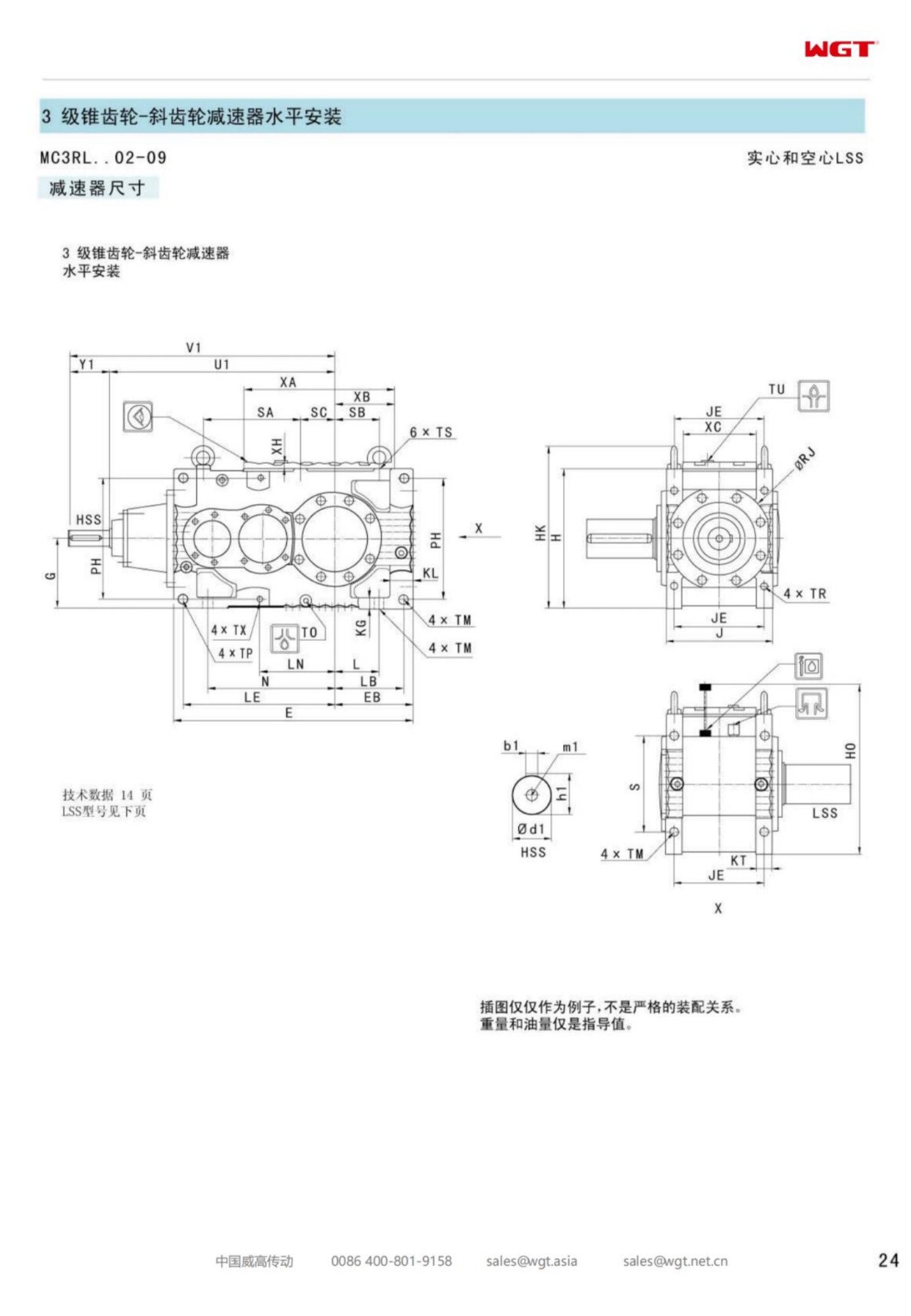
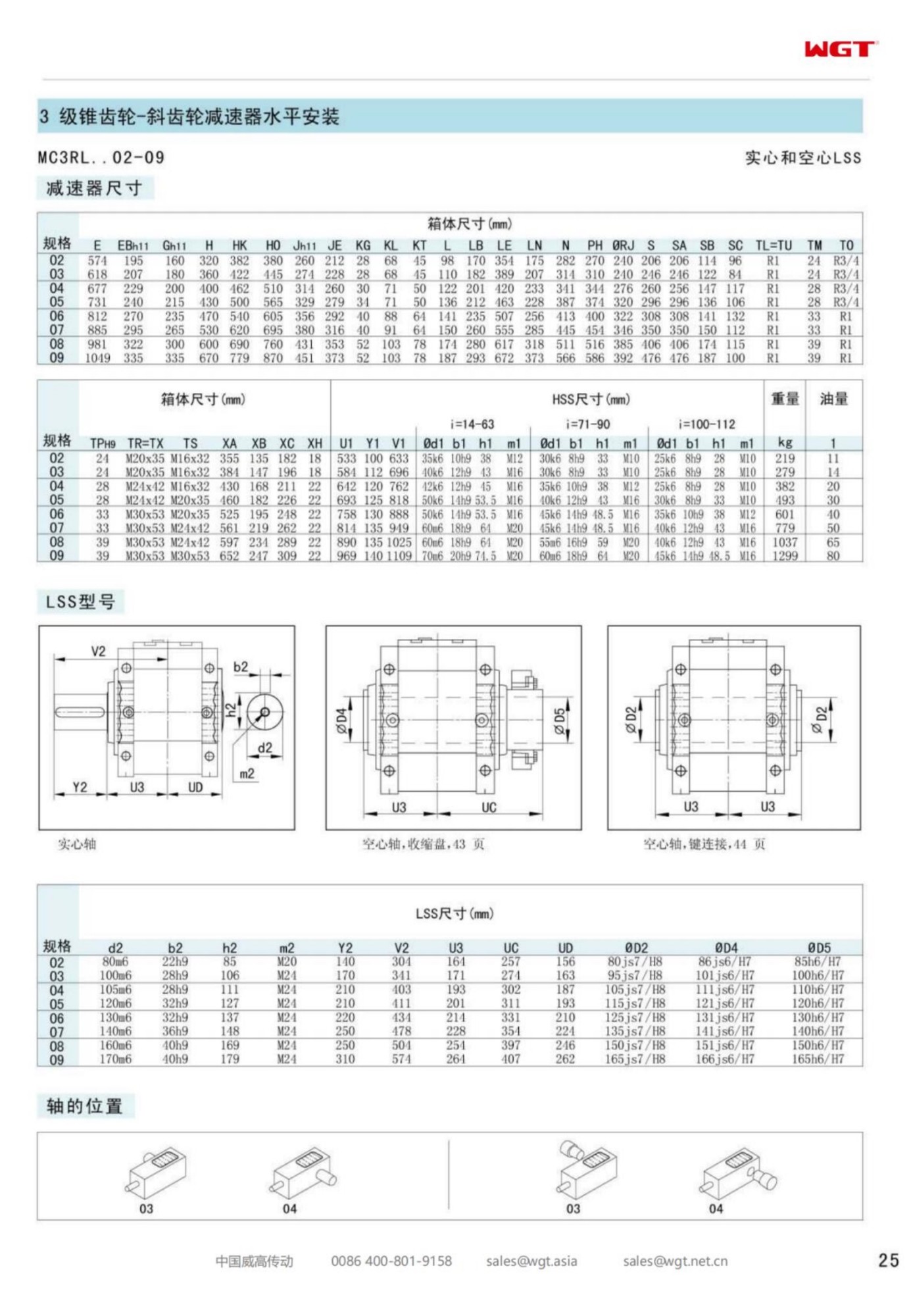
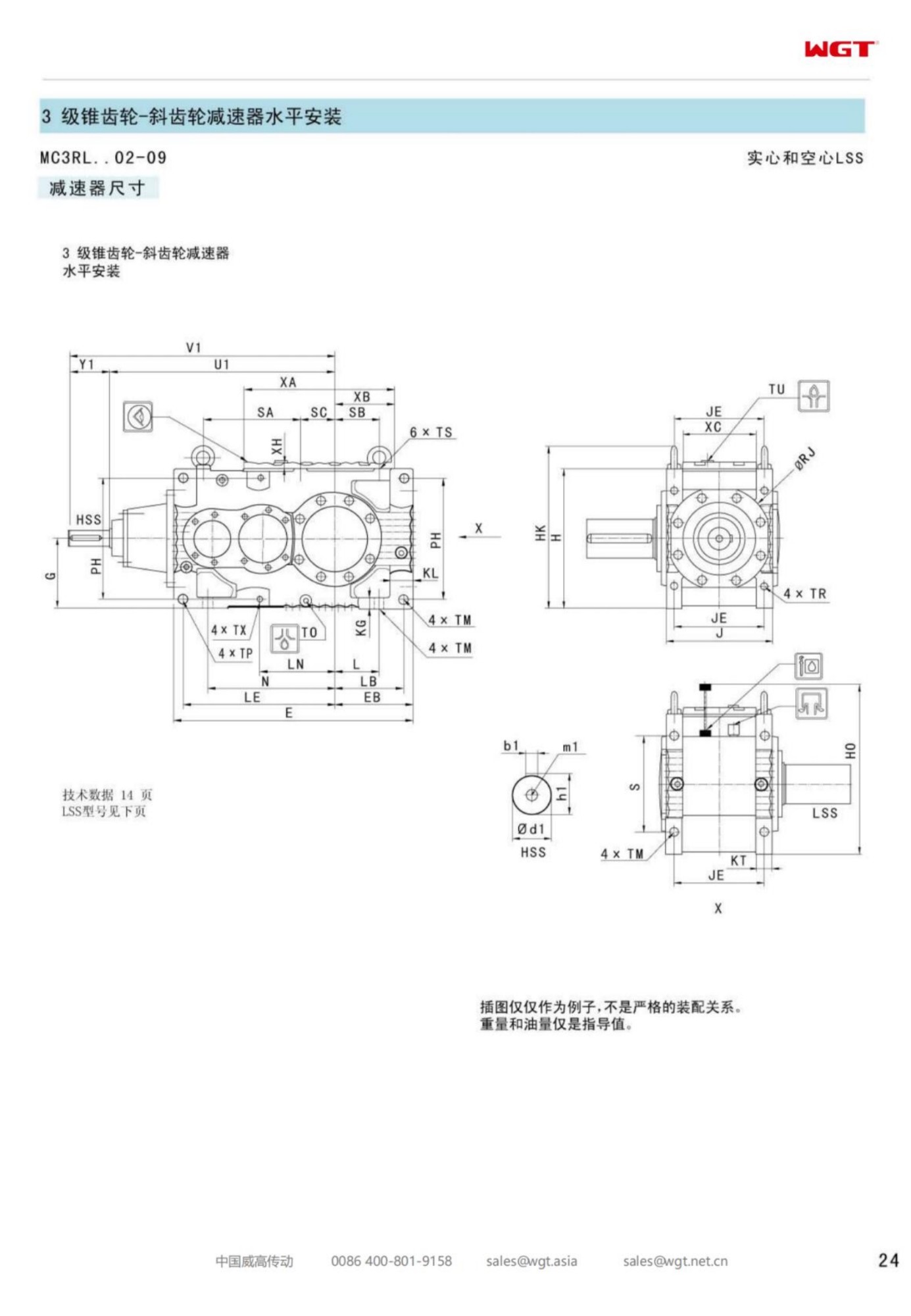
Every size band has a frame that quietly does the work of two. In the right-angle industrial range that is the eighth: large enough to anchor a mill circuit, compact enough to fit a transfer tower that was drawn before anyone knew the duty would grow. The MC3RLSF08 bevel-helical gear unit is that frame, and this page is about what it is genuinely for - not the catalogue headline, but the round of duties plant engineers actually put on it year after year.
The mechanical idea is the same as everywhere else in the family: a bevel pair turns the drive through a right angle at motor speed, and two helical stages take the speed down to the driven machine. By frame eight, though, the design effort has shifted. Tooth geometry is largely settled; what separates a good unit from an expensive disappointment is stiffness, bearing arrangement, oil capacity and the honesty of the foundation underneath it. Those four things decide how the frame ages.
What the Eighth Frame Is Actually For
A frame eight appears wherever three conditions meet. The torque is beyond what a seventh frame wants to carry continuously. The duty is not a peak that lasts a minute but a load that lasts a season. And the machine at the far end is expensive enough to stop that nobody enjoys restarting it. Grinding circuits, long inclined conveyors, thickeners and scrubbers all fit that description, which is why mining and mineral plants hold most of the installed base.
The frame also earns its keep in a less obvious role: as the drive a plant standardises on. When every heavy position on a site uses the same frame size, the spares shelf shrinks to one set of seals and one oil grade, the maintenance crew learns one disassembly sequence, and a breakdown on the thickener can borrow the shutdown window planned for the conveyor. Standardisation is rarely written into a selection calculation, but it is often the reason a frame eight is chosen over two smaller, individually cheaper units.
Reading the Type String on a Frame Eight
The designation compresses the whole arrangement into a few characters, and every one of them commits money and machining time. Read it once against the outline drawing and most later correspondence disappears.
| MC | Industrial gear unit family for continuous plant service |
| 3 | Three reductions in train: bevel pair plus two helical stages |
| R | Right-angle bevel-helical layout, input across the output shaft |
| L | Horizontal build, shafts level, case resting on its foot plane |
| S | Solid output shaft with parallel key, one shaft end |
| F | Foot mounting onto a bedplate, frame or grouted steel base |
| 08 | Eighth frame of the 02-09 band: heavy circuit duties where stiffness and oil volume govern |
Outside the string sit the choices that decide whether the unit is pleasant to live with. Motor orientation moves the breather, the filler and the level plug; a mirror-image case can turn an awkward monthly check into a two-minute one. Rotation direction decides which bevel flank carries load in the normal sense of travel. Both belong on the order drawing, agreed before the casting is poured, because neither can be negotiated afterwards.
The Bevel Stage Does More Work Here
In small right-angle units the bevel pair mostly changes direction and the helical stages do the reduction. At frame eight the proportions shift. The bevel mesh passes the full motor torque at the very first contact, and at this size its faces are wide, its bearings are heavily loaded, and its contact pattern is a genuine design document rather than an inspection afterthought.
Two practical conclusions follow. First, the pattern should be photographed during commissioning and kept with the machine file; a pattern that walks across the tooth between inspections is the earliest honest evidence of a foundation or alignment problem. Second, the input bearing arrangement deserves respect during maintenance - pulling the input assembly with a slide hammer instead of the designated withdrawal threads has ended more bevel stages than any genuine fatigue failure.
Where a Frame Eight Is the Right Call
Large vertical frames of this band are routinely specified into:
- Mill drives on a grinding line where start torque decides the selection
- Thickener rakes turning through a bed that thickens by the hour
- Long inclined belt conveyors climbing out of an open pit
- Rotary scrubbers in a wash plant running on raw river water
- Pulp lines on a paper machine where every stop is measured in tonnes
- Cane milling trains feeding a boiler house through a long season
The common thread is inertia. Every machine in that list stores energy in its rotating parts, and a unit chosen exactly to the running figure will spend its life being restarted into that inertia. A frame eight absorbs those starts without drama, and the drama it avoids is precisely the kind that ends a shift early.
Foundations, Bolts and the Boring Half of the Job
Nothing about a frame eight forgives a casual installation. The case transmits its reaction torque into four foot pads, and if those pads do not share the load, one bolt becomes a pivot and the whole transmission geometry wanders. The correct sequence is old and unglamorous. Level the bedplate before the unit arrives. Check pad contact with a feeler gauge and shim until it is even. Tighten in the diagonal sequence, in three passes, to the figures on the drawing. Align the couplings last, then again warm after the first loaded hours.
Grout matters as much as bolting. A bedplate bridged by unmortared shims acts like a spring, and the bevel mesh reads that spring as a moving target. Epoxy grout poured properly turns the foundation into part of the gearcase, which is the cheapest stiffness the plant will ever buy. It is also the step most often rushed on a weekend shutdown - which is why the same few units reappear on the alignment report year after year.
Oil Care on a Unit This Heavy
A sump of this size is a laboratory if anyone looks at it. The volume buffers contamination, so trends move slowly and a quarterly sample tells a story: iron pointing at gear or bearing wear, water pointing at a seal or a breather, viscosity drift pointing at heat or the wrong grade. Acting on those signals costs a filter cart or a seal; ignoring them costs a rebuild.
The level deserves equal attention. A large case runs with a wide oil surface, and every degree of tilt from a settling foundation moves that surface relative to the bearings. A level plug readable from the walkway gets checked; one that needs a permit and a ladder does not. When the position is being chosen, someone should stand where the fitter will stand and ask whether the daily check will actually happen.
Planning the First Shutdown Before Delivery
The first planned stop is when a heavy unit gives back the money spent on documentation. If the drawings, the torque values, the special tools and the seal part numbers are in the machine file, the shutdown is a timed exercise: drain and sample, open the inspection covers, photograph the meshes, check the bearing temperatures logged since start-up against the baseline, close and refill. Half a shift, once a year.
If none of that was kept, the same stop becomes an archaeology project. Nobody knows which shim pack was fitted, which seal variant is inside, or what the contact pattern looked like when the unit was new. The difference between those two shutdowns is not luck; it is whether someone filed the commissioning photographs instead of leaving them on a phone that has since been upgraded away.
An Enquiry That Gets a Drawing Back
A frame-eight enquiry should carry everything a selection engineer needs to close the calculation in one pass. Motor power, speed and starting method. Driven machine type and its torque characteristic, with breakaway stated separately from running torque. Output speed and the tolerance the process accepts. Hours per day and starts per hour, with the worst hour described. True enclosure ambient, with radiant sources named. Mounting position, motor orientation and rotation direction. Overhung load and its distance from the shaft shoulder where a pulley or coupling hangs. Paint system and documentation package.
Send that and the reply is a firm quotation with a general arrangement number. Send a photograph of an old nameplate and a request for the same thing, and the reply is a question sheet - fair enough, because the factory is being asked to guarantee a machine against a duty nobody has described. A unit at this size will outlast most of the equipment around it; the hour spent writing the enquiry properly is the cheapest line item in the whole project.
Available Frames and Their Typical Duty
| Model | Centre distance | Output | Typical duty |
|---|
| M3PSF50 | size 50 | solid shaft, foot | conveyors, feeders |
| M3PSF60 | size 60 | solid shaft, foot | crushers, mixers |
| M3PSF70 | size 70 | solid shaft, foot | ball mills, shredders |
| M3PSF80 | size 80 | solid shaft, foot | kilns, heavy conveyors |
| M3PSF90 | size 90 | solid shaft, foot | mill and kiln drives |
| M3RSF50 | size 50 | solid shaft, foot, right-angle | inclined conveyors, elevators |
| M3RSF60 | size 60 | solid shaft, foot, right-angle | screw classifiers, feeders |
| M3RHF70 | size 70 | hollow shaft, foot, right-angle | agitators, drum drives |
| M3PHT80 | size 80 | hollow shaft, torque arm, parallel | shaft-mounted conveyors |
| M3RHT90 | size 90 | hollow shaft, torque arm, right-angle | heavy shaft-mounted drives |
Note that PSF and RSF frames of the same size share the mounting footprint; the R build simply inserts a bevel stage, so switching layout rarely forces a foundation change.
Questions and Answers
What is the difference between foot and torque-arm mounting?
Foot mounting bolts the housing to a foundation and suits most fixed installations. A torque-arm lets the housing swing on the driven shaft, so no base frame is needed - common on shaft-mounted conveyors where the reaction rod absorbs the torque.
Should I choose a solid or hollow output shaft?
A solid shaft with a keyed coupling is the flexible, conventional choice. A hollow shaft takes the driven shaft directly with a key or shrink disc, removing one coupling and one alignment step; it is preferred where space or alignment access is limited.
How do I match the gear unit to my existing foundation?
Send the nameplate or the outline drawing of the unit being replaced. Frame dimensions follow the common industry dimension ladder, so foot holes, shaft heights and flange bolt circles normally match without redrilling foundations.
Installation Examples
Stone quarry conveyor
A stone quarry runs reducers on its primary conveyor. Shock loads from oversized rock are absorbed by the case-hardened gears (surface HRC58-62), and after two years of continuous duty the units still run within their original 68 dB noise spec.
Flour mill screw conveyors
A flour mill standardised on gear reducers for its screw conveyor network. One spare-part pool now covers fifteen drives, and the smooth helical input stage keeps noise low in the packing hall.
![gear box application map for industry]()
From quarries to food plants - one right-angle drive concept.
Selection Example: Belt conveyor climbing a long incline out of an open pit
Take a 132 kW motor at 1485 rpm turning the head pulley at 16 rpm. The ratio follows directly: 1485 / 16 = 92.8, so a ratio near i=93 is drawn from the three-stage band, and the frame is checked against a fully loaded restart after an emergency stop on the grade. In this case an eighth frame keeps the bevel contact pattern stable through that restart, and the mass of the case does the damping a lighter unit would need a soft-start routine to achieve. The ratio is the easy part. The service factor for the shock level is what makes the selection safe, and we check that for you at no charge.
![how to choose a speed reducer model]()
Ratio first, then torque, then frame size: the standard selection route.
Size It, Quote It, Ship It
One minute, one model. The WGT Motor & Gearbox Online Selection System covers motor power, ratio and mounting on one screen - enter your numbers and see the model immediately.
Give us the driven machine, the required output speed and the daily running hours, and we return a confirmed model number with torque margin and a firm price - no obligation, no charge for the selection work. Looking for a gearbox for crusher? Tell us the duty point and we will confirm the model in writing.